Read First
Stop at the Doorway
Joy and I have been married thirty-six years, and we’ve got our rhythm down. Even in a bathroom that’s too small for two, I can sense where she’s going and get out of the way. I might be old, but I’m spry.
But one week I ran into her three times. At first I thought I was getting clumsy. Then I paid attention. On Sunday morning I was following on her heels into the bedroom and plowed into her just inside the door. That’s when I figured it out: when Joy walks into a room, she stops right at the threshold. Every time. (A couple of my friends said their wives do the exact same thing.)

Maybe she’s just wise enough to look around first. That’s a good word for us, too. Don’t rush in. Step over the threshold, take a beat, breathe, and let the Scripture sink in. We’re not in a hurry. We’re on a journey together.
Does God Still Speak?
Since our Daniel series, I’ve kept four prayer alarms on my phone. At 9:00 a.m. I pray for my kids, daughters-in-law, and grandkids. At noon I pray for my church family. At 6:00 I pray for Joy. And at 3:00 p.m. I pray for God’s will for my own life: What do you want from me, Lord? Is there anything I’m missing?
During one of those 3:00 prayers, it hit me: what am I actually expecting? A hand writing on the wall, like in Daniel? A burning bush, like Moses? A whisper after the wind, the earthquake, and the fire, like Elijah? And how would I know it’s really God?
That question matters. In the Old Testament, if you said “God told me” and you were wrong, you could be stoned to death. It was that serious. You didn’t dare say “God said” unless you knew for sure.
Today, preachers and teachers tend to land in one of two camps.
Camp one: God stopped speaking when the last word of Scripture was written. Everything you need is in the Bible. Period.
Camp two: God has a specific word for you every moment of every day. Which parking spot, which lunch, which route home. Miss it, and you’ve missed his will.
I once had a friend who prayed for the best parking spot at the mall. If she got a close one, she figured she was right in the center of God’s will. If she had to park way out with everybody else, something must be off. Even as a young man, I thought, that doesn’t sound like Jesus. If anything, Jesus might say to park far away and leave the close spot for someone who needs it.
Both extremes can be dangerous. Truth, as it often does, lives in the balance.
The risk with camp two is that you make yourself the main character and turn God into a supporting actor. So how do we find the balance? God himself tells us how he speaks, right here in Hebrews 1.
“In the Past, God Spoke”
Two phrases jump out at me. First, “in the past.” That’s a period with a beginning and an end, running from Genesis 1 until Jesus ascended into heaven and sat down at God’s right hand.
Second, “God spoke.” Isn’t that good news? Try being in a relationship with someone who won’t communicate. (When I said that on Sunday, I saw a few elbows land in a few ribs.) I don’t wake up trying to make my wife miserable. Just tell me what you want, and because I love you, I’ll do my best! Other so-called gods stay silent. You’re left guessing, trying to appease them and tip the scales. But our God, all-powerful, all-knowing, and everywhere at once, wants you to know him. So he speaks.
He spoke “at many times and in various ways,” mostly through prophets. God spoke to them, they spoke for God, and they often wrote it down. That’s where much of the Old Testament comes from. All of it is true and inspired, but most of it was written to specific people in specific situations. Daniel was Daniel, and Babylon was Babylon. So we look for the timeless principles. In Daniel, the big one is that God is in control. He raises up leaders and takes them down, and his plan keeps moving.
“Let Me Tell You About My Son”
Now, about “these last days.” Some folks love to whisper “we’re in the last days” like they’ve got secret knowledge. Here’s the reality: yes, we’re closer to Jesus’ return today than we were yesterday. But that’s like me waking Joy up to announce, “I have a word for you! Today I’m one day closer to dying than I was yesterday.” Well, of course! The “last days” are simply the time between Jesus’ ascension and his return. We’re living in a giant ellipsis (dot, dot, dot), and nobody knows how long it lasts.
And in these days, God speaks to us by his Son.
Think of it this way. If we’d just met and you said, “Tell me about yourself, Rick,” it would be weird if I said, “Well, let me tell you about my oldest son.” You’d say, “That’s great, but tell me about you.” “Okay, let me tell you about my other son.” Yet that’s exactly how God introduces himself! If you want to know me, get to know my Son. Learn how Jesus thought, how he worked, what mattered to him, how he treated people. When you know Jesus, you know God.
If you want to know me, let me tell you about my Son.
Here’s a simple way to picture the entire Bible:
- The Old Testament is a big, flashing red arrow pointing forward to Jesus. Along the way we learn God’s character, but the arrow keeps pointing.
- The Gospels (Matthew, Mark, Luke, and John) tell the story of Jesus himself, from birth to ascension.
- Acts through Revelation point back to Jesus. They’re letters inspired by God, written to real churches and people, applying the life and teaching of Jesus to real situations.
So when we pray, “God, give me a word! Tell me what to do!” we can end up saying, in effect, “I already know everything there is to know about Jesus, and it isn’t enough.” I believe God sometimes reveals himself to us in specific, personal ways. But most of the time, we learn how to live by learning Jesus.
How the Trinity Works
Okay, lean in for a second. If you’ve been in church a long time, this is a reminder. If you haven’t, don’t worry. Nobody has explained it to you yet, and that’s all.
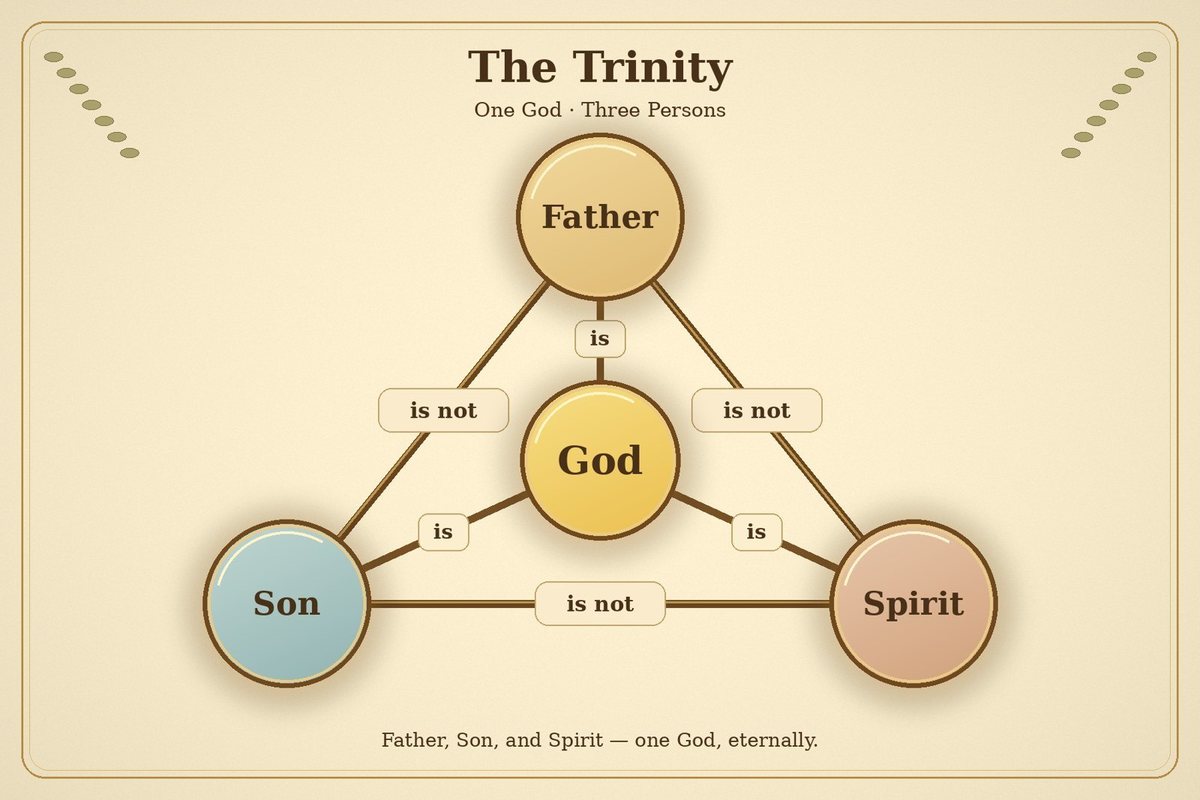
The Bible talks about the Father, the Son, and the Spirit. A smart reader could easily conclude there are three separate gods. But there is one God in three persons: not three gods, and not one God wearing three masks, but three persons who are each fully God, with different roles.
God is Jesus and Jesus is God. God is the Holy Spirit and the Spirit is God. The Father is God and God is the Father. But the Spirit is not Jesus, Jesus is not the Father, and the Father is not the Spirit. Different roles, one God. (I saw a few heads tilt like a puppy hearing a funny noise. That’s okay!)
Each one is God. But they aren’t each other.
Jesus didn’t just exist for 33 years. He was there at creation. He walked with Adam and Eve in the garden. When he did miracles, the Father willed it, the Spirit powered it, and Jesus did it. They’re never separate, because they’re one.
And when you become a believer, the Holy Spirit comes to live inside you, and he never leaves. He points you toward truth, almost always the truth of Scripture, and never against it. He also makes you restless when you’re wrong or when you’re running.
Jesus Searches Until He Finds
So if knowing God means knowing Jesus, let’s look at Jesus. I could have picked dozens of stories. This is the one that stuck with me that week.
Religious leaders were criticizing Jesus for hanging out with “sinners.” (You and I would call them “us.”) They thought he should keep his distance and preach at them. Jesus said no. This is the heart of God: not above, not aloof, but among. Then he told three stories. Here are the first two:
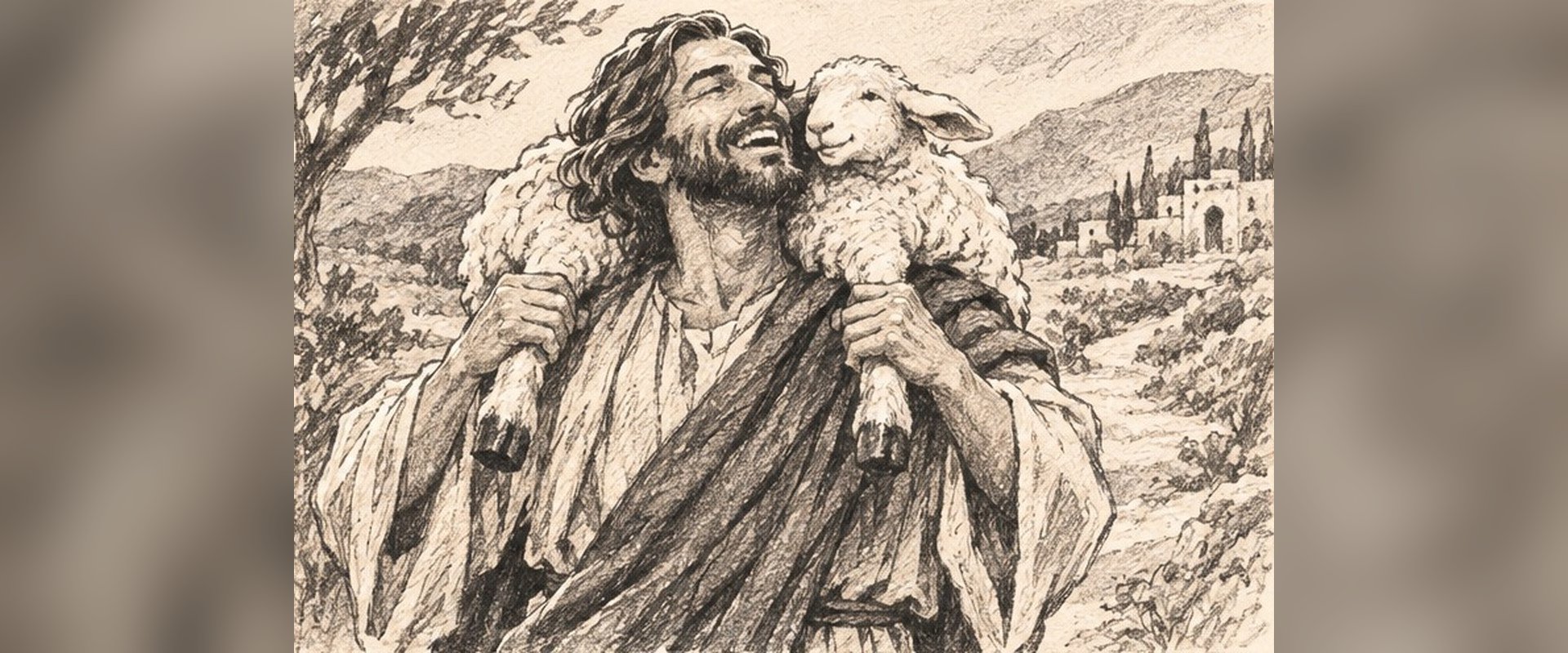
“Suppose one of you has a hundred sheep and loses one of them. Doesn’t he leave the ninety-nine in the open country and go after the lost sheep until he finds it? And when he finds it, he joyfully puts it on his shoulders and goes home. Then he calls his friends and neighbors together and says, ‘Rejoice with me; I have found my lost sheep.’ I tell you that in the same way there will be more rejoicing in heaven over one sinner who repents than over ninety-nine righteous persons who do not need to repent. Or suppose a woman has ten silver coins and loses one. Doesn’t she light a lamp, sweep the house and search carefully until she finds it? And when she finds it, she calls her friends and neighbors together and says, ‘Rejoice with me; I have found my lost coin.’ In the same way, I tell you, there is rejoicing in the presence of the angels of God over one sinner who repents.” (Luke 15:4–10)
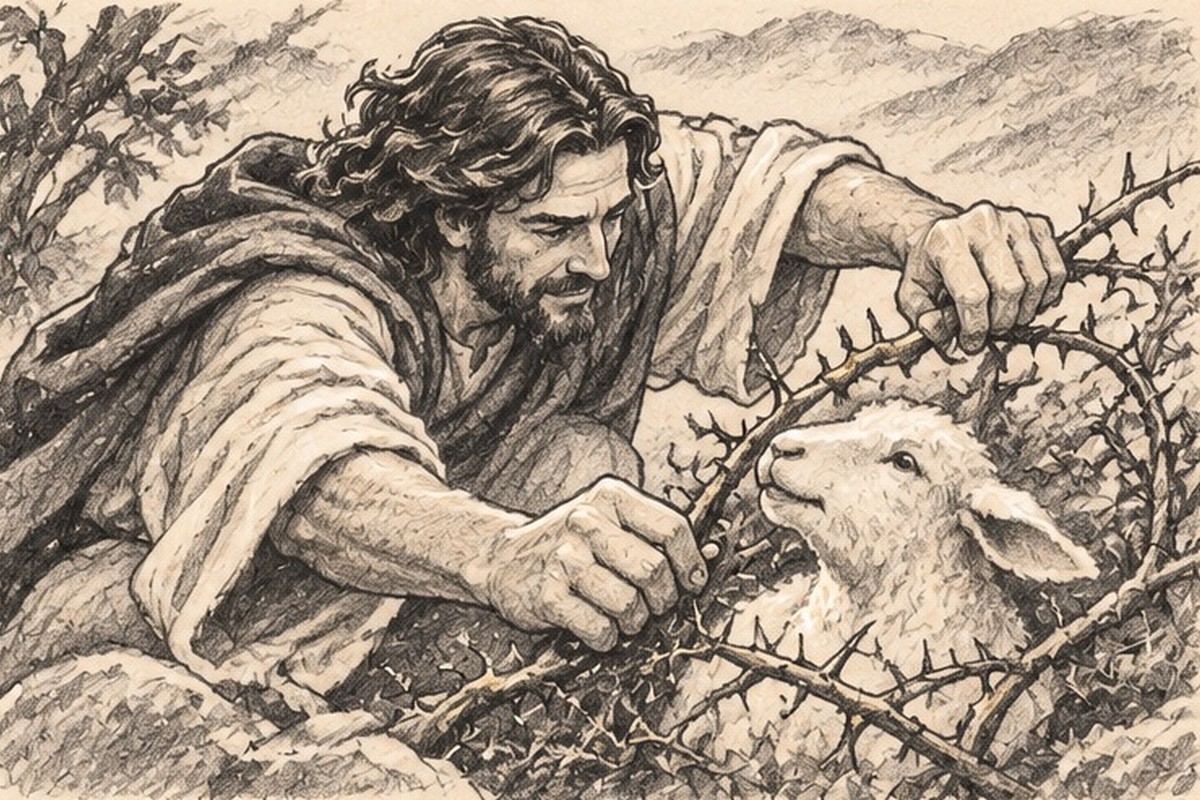
If you’ve got a paper Bible, circle “until he finds it” and “until she finds it.” When something is repeated, it’s important. (The coin was likely part of a bride’s wedding jewelry, something with real sentimental value. Jesus told one story the men would connect with and one the women would. He made sure everybody could understand.)
He doesn’t quit, and when he finds you, he carries you home rejoicing.
The third story, the prodigal son, shows this isn’t only for people who’ve never met him. It’s also for those who’ve wandered off. Some slip. Some drift. Some run.
Two things have been on my heart. First, maybe you’re praying for someone who seems far from God, and you’re losing hope. Jesus describes himself as a Savior who keeps searching. Second, maybe you’re the one who’s wandered. If so, I hope you’re restless. I hope there’s no peace in your soul until you stop and let him catch up with you.
When Moses killed an Egyptian, he ran and ran and ran. Then he sat down because he was tired of running, and that’s where God’s will found him. Maybe today’s the day you sit down.
Talk It Over
- Which “camp” do you naturally lean toward: God speaks only through Scripture, or God directs every little detail? What’s the danger in your direction?
- When you pray for direction, what are you secretly hoping for: a burning bush, a whisper, a sign?
- How would studying the life of Jesus change the way you look for God’s will?
- Who in your life feels “lost” right now? How does “until he finds it” encourage you to keep praying?
 Next in the seriesDid You Plug It In? Why Jesus Keeps Every PromiseLouder and Clearer · Part 2Read it →
 The entire series · Free bookGod Speaks: JesusAn entire month on Hebrews 1:1–3Read it free →
 Capitol City Store · Everything is freeBooks, Bible studies, kids’ comics and short readsDozens of short reads like this one, plus free books, City Group studies, sermon notes, and kids’ comics and games. Read on your phone, print or share with a friend.Explore the store →
© 2026 Rick Melick. All rights reserved. Free to read and share for personal use. Not for resale.
Scripture quotations taken from The Holy Bible, New International Version®, NIV®. Copyright © 1973, 1978, 1984, 2011 by Biblica, Inc.™ Used by permission. All rights reserved worldwide.