Read First
I moved a lot growing up. I was born in Fort Worth, Texas. From there we went to South Carolina, then South Florida, where we lived in Miami, then Hollywood, then West Palm Beach. In eighth grade we moved to Germantown, Tennessee, right outside Memphis, and that’s where I finished high school. My dad was a professor, so this isn’t a sad story. We weren’t sleeping in the car. We just moved. A lot.
But there was one place that never moved.
My dad’s parents lived in Atlanta, in the same house, my entire growing-up life. Every summer we went there on vacation, and every summer it was exactly the same. I loved that.
Grandma and Grandpa
My grandpa was one of my heroes. He was a World War II guy. So was my grandma, by the way. She enlisted and served as a radio operator, which not many women did back then. Grandpa was old school. When you got close to him, he smelled like Marlboro Reds and Brut cologne. Brut was practical. If you ran out, you could buy more at the 7-Eleven.
Grandpa was a Christian, but he was the kind of Christian you’d have to know before you’d know he was a Christian. He was a little rough around the edges. Grandma was not. Grandma’s faith was real, but every once in a while it got a little out of control, and Grandpa and I would slip down to the basement and hide out until it passed.
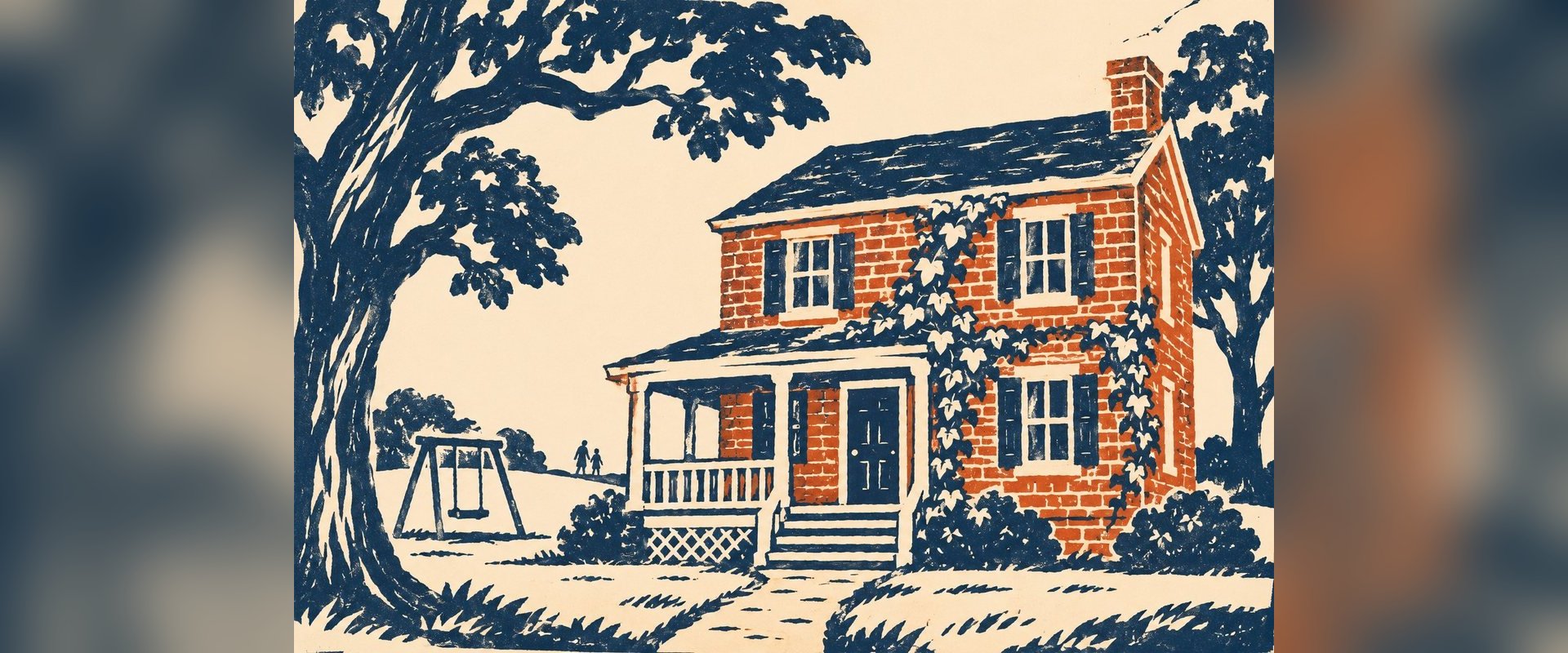
They lived near Chastain Park, an old neighborhood with big houses and lots of trees. When you pulled into the driveway, the first thing you noticed was the ivy growing all the way up the brick. You’re not supposed to do that. It’s bad for the house. But Grandpa liked the way it looked, so the ivy stayed.
The first time we arrived each summer, we went up the outside stairs and in the front door. To your left was the formal living room. Grandma had cream carpet in there, and a white couch covered in clear plastic, like seat covers for your car, only for a couch. That room was for guests and for Christmas. At Christmas the tree stood by the front window and we were allowed in. The rest of the year, that room wasn’t really for us.
Straight ahead was Grandpa’s den. He had a TV and a big recliner, and Grandma sat on the couch next to him. Sometimes Grandpa was allowed to smoke his pipe in the house, and the whole room smelled like vanilla tobacco. I loved sitting in Grandpa’s chair and looking out at the swing set in the backyard. It was awesome when I was little. By the time I was older it was rusting out, but I wouldn’t let him move it. It wasn’t safe anymore, but it was still there, and it was the same.
And we watched the same things. Grandpa loved Loretta Lynn. I think he thought she was pretty, and I think he liked her music too. We watched Hee Haw together, and we watched Lawrence Welk. You would never catch me listening to Lawrence Welk anywhere else on earth. But at Grandpa’s house, by golly, it was Lawrence Welk, and I sat in his lap, and that’s the way it was.
Every year we went. Every year it was the same. I counted on it.
The Year It Changed
Then one summer, when I was in high school, we turned down the street and pulled up to the house, and the ivy was gone.
I was a teenage boy. I didn’t care about ivy then and I don’t care about ivy now. But I was furious. We went inside, and the formal living room had been completely redone. The white couch with the plastic cover was gone. New curtains. And the swing set in the back? Gone.
I found my grandpa and said, “Listen, we need to have a talk. What in the world is going on with your house?”
And he said, “Ricky,” because he was allowed to call me that, “it’s my house. It was time to update. Grandma wanted it done, so we did it.”
I was mad at him. I wanted things to be the way they were. That house reminded me of simpler times. When I was four and five, life was simple. By fifteen and sixteen it was getting complicated, and Grandma’s house was the one place where nothing had changed. I could leave and come back, and it would be waiting for me exactly the way I left it.
Some things deserve our nostalgia. But in a church, nostalgia is deadly.
Grandpa was right, of course. It was his house, not mine. I’d been treating it like a museum, and he was living in it.
The Road to Irrelevance
Some things deserve our nostalgia. A grandparents’ house like that is a gift, and if you have one, you’re fortunate. There is absolutely nothing wrong with wanting Grandma’s house to stay the same.
But there’s everything wrong with it if that’s how we think about church.
Nostalgia wants to keep things the way they were. In a church, that quietly turns into a need to control and a fight against change. It’s the road to irrelevance, and the people on that road are usually the last ones to notice.
My wife and I were married in the church she grew up in. Not long ago I saw a photo of a wedding in that same sanctuary, decades later, and not one thing had changed. Not the stage. Not the decorations. Not even where the sound equipment was set up. For years, the sign out front, carved in brick and stone, listed the worship time and the Sunday school time, because at some point somebody decided that was how it was going to be, forever. I love that church and the people in it, and they’ve moved past some of that since. But for a long time the goal was to protect and preserve the past at all costs.
If we do that, we create Grandma’s house. We don’t create church.
Church is supposed to be alive. It should be dynamic and changing. If you miss a week, you should miss something. When you come back, you should feel a little disoriented, because while you were gone the people around you grew. They obeyed. They took another step. We live in an ever-changing culture with a never-changing Word, and the church’s job is to stand right where the two meet.
The First Time Jesus Said “Church”
Firsts matter. So let’s look at the very first time the word church shows up in the Bible.
Jesus and his disciples were walking near a city called Caesarea Philippi. They had just passed a mountain with a cave at the bottom, where one of the springs of the Jordan River comes up out of the rock. The pagans who lived there called that cave the gates of Hades. They believed that if you went down into it, you went down into the place of the dead.
Right there, in the shadow of that cave, Jesus turned to his disciples and asked, “Who do people say the Son of Man is?” (Matthew 16:13).
In other words: What’s the word on the street about me?
I’m careful about asking that question myself. I don’t always want to know. But Jesus asked, and the disciples answered. “Some say John the Baptist; others say Elijah; and still others, Jeremiah or one of the prophets” (Matthew 16:14). That’s quite a compliment. It just wasn’t who he was.
So Jesus made it personal. “But what about you? Who do you say I am?”
Simon Peter spoke up. “You are the Messiah, the Son of the living God” (Matthew 16:16).
Jesus said Peter didn’t figure that out on his own. God revealed it to him. And then Jesus said this:
“And I tell you that you are Peter, and on this rock I will build my church, and the gates of Hades will not overcome it.” (Matthew 16:18)
There’s a play on words there. Peter means “rock” or “stone.” But the foundation Jesus is talking about isn’t Peter the man. It’s what Peter just said: that Jesus is the Messiah, the Son of the living God. The One who would die on a cross and rise again, defeating sin, Satan and death once and for all. That’s the rock. On that truth, Jesus said, I will build my church. And standing right there by the so-called gates of Hades, he promised that those gates would never win.
A Gathering, Not a House
Now here’s where it gets important.
The Greek word Jesus used that we translate church is ekklesia. It means a gathering. An assembly. A group of people called together for a purpose. That’s it. It never meant a building.
Our English word church actually comes from a different Greek word, one that means “belonging to the Lord,” as in the Lord’s house. It seems like a small thing. It’s not.
When William Tyndale first translated the New Testament into English in the 1500s, he translated ekklesia as “congregation.” The people. But when the King James Version was produced a few decades later, the translators were instructed to keep the old church word, church. And over time, the word that meant “the people God calls together” came to mean “the building with the steeple.”
Why does that matter? Because if you think the church is God’s house, you will protect it like Grandma’s house. You will fight over the carpet. You’ll fight over the music, whether we’re going to watch Lawrence Welk or Loretta Lynn. And you’ll make sure nobody sits on the white couch.
::: myth
Myth: The church is a building, God’s house, and our job is to protect it and keep it the way it’s always been.
Truth: The church is people. Jesus said ekklesia, a gathering. The building is just where the family meets.
:::
You Are God’s House
My grandpa, the same one who smelled a little like Marlboro Reds, used to tell me to dress up for church. Did you grow up that way? Maybe you wore a suit or a sport coat on Sunday mornings. There’s nothing wrong with that. But I asked him once why we had to, and he said, “It’s God’s house. We show respect in God’s house.”
Were you ever told not to run in church? Don’t run, it’s God’s house. Don’t wear a hat, it’s God’s house.
Here’s the thing. It’s not God’s house.
You are God’s house. Paul wrote to a church full of messy people, “Don’t you know that you yourselves are God’s temple and that God’s Spirit dwells in your midst?” (1 Corinthians 3:16). The building is where the church gathers. There’s a huge difference.
Grandma’s house wasn’t our family. It was the place our family gathered. What tied us together wasn’t the brick or the address. It was blood, and the choice we made to be family. What ties you and me together is blood too. Jesus’ blood. And the choice we’ve made to be family.
That’s why the church Jesus started doesn’t exist to protect you from the world. It exists to prepare you for it. We don’t come together to hide inside with the plastic on the couch. We come together to be sent back out, to be salt and light in a world that desperately needs both.
The Church Becoming
So here’s the question for the rest of this series. If the church is a gathering of messy people who belong to Jesus, what does that kind of church actually look like?
I think Jesus answered that question one day in a crowded house in a town called Capernaum, when four friends climbed up on a roof and started digging. We’ll get there.
But first, we need to talk about the unwritten rules. Because before anybody can get through the roof, a lot of us have to unlearn what we were taught about who gets in the door.
Talk It Over
- Was there a “Grandma’s house” in your life, a place you wanted to stay exactly the same? What made it so special?
- Where have you seen nostalgia turn into a need to control in a church, a family or a workplace?
- What changes when you think of the church as people instead of a place?
- Jesus asked, “Who do you say I am?” How would you answer that question in your own words today?
- If you missed a week of your church family, what would you miss? What would they miss about you?
 Next in the seriesBelong, Believe, Behave: Why the Order MattersThe Order Matters · Part 2Read it →
 The entire series · Free bookDirty ChurchBelong, believe, behave, from Mark 2Read it free →
 Capitol City Store · Everything is freeBooks, Bible studies, kids’ comics and short readsDozens of short reads like this one, plus free books, City Group studies, sermon notes, and kids’ comics and games. Read on your phone, print or share with a friend.Explore the store →
© 2026 Rick Melick. All rights reserved. Free to read and share for personal use. Not for resale.
Scripture quotations taken from The Holy Bible, New International Version®, NIV®. Copyright © 1973, 1978, 1984, 2011 by Biblica, Inc.™ Used by permission. All rights reserved worldwide.