Read First
For the rest of this series, we’re going to stay with one simple story. It’s a miracle Jesus did early in his ministry, and it’s told three times in the Gospels: in Matthew 9, Mark 2 and Luke 5. Each account adds a little detail and paints the picture a little more clearly. They never contradict each other. They complement each other.
Here’s something worth remembering whenever you read the Gospels. When you put Matthew, Mark, Luke and John together, you have everything Jesus wants you to know about who he is and what he did. The rest of the New Testament points back to that story and tells us what it means for our lives.
We’re going to live in Mark’s version. Here’s how it starts:
“A few days later, when Jesus again entered Capernaum, the people heard that he had come home. They gathered in such large numbers that there was no room left, not even outside the door, and he preached the word to them.” (Mark 2:1–2)
Jesus Comes Home
You’ve probably heard Jesus called “Jesus of Nazareth.” That was kind of like his last name. He grew up in Nazareth. But things didn’t go well for him there. His own hometown ran him out (Luke 4:28–30). So Jesus adopted a new home base: Capernaum.
Capernaum sat on the northwest shore of the Sea of Galilee, right on the great trade road that ran from Damascus to the coast. Its name means “village of Nahum,” and Nahum means comfort. The Old Testament never mentions it once. But in the Gospels it shows up again and again, because it’s the place Jesus kept coming back to. Peter, Andrew, James and John were fishermen from Capernaum. Many of Jesus’ miracles happened there.
It’s like saying, “I used to be from one town, but now I live over here.” Maybe you’ve got a good friend with a family home on the edge of town. When you’ve been out all day and you’re worn out, that’s where you go to unplug.
Most scholars believe the house in this story belonged to Simon Peter’s family. The Bible doesn’t say so for certain, but it fits. It was the place Jesus went to regroup with his disciples. Maybe he had a favorite chair. Not a La-Z-Boy. Jesus was never lazy. Maybe an Active-Boy. Maybe there was a spot at the table that everybody knew was his.
Did you have a house like that growing up? A friend’s house where you just felt at home? Maybe your house is that house for your kids’ friends. It’s not where you were born, but it’s where you belong.
That’s what Capernaum was to Jesus. It was a lot like my grandma’s house. Special, but not because of the brick. It was special because of the people who gathered there.
What Kind of House?
I want to help you picture this, because the details matter.
In Jesus’ day, people didn’t move around much. You didn’t buy a starter home, move up when the kids came and downsize when you retired. If your family had any means at all, your great-grandfather built a house, your grandfather added a room, your cousins added another, and it got passed down from generation to generation.
Poor families lived in one-room houses, a square stone box with a little room on the back for the animals. When my wife and I were first married, we lived in an apartment of about 500 square feet. One room. I have great memories of that place. But we didn’t have goats sleeping in the kitchen in winter, and we didn’t have kids sleeping on the floor next to them.
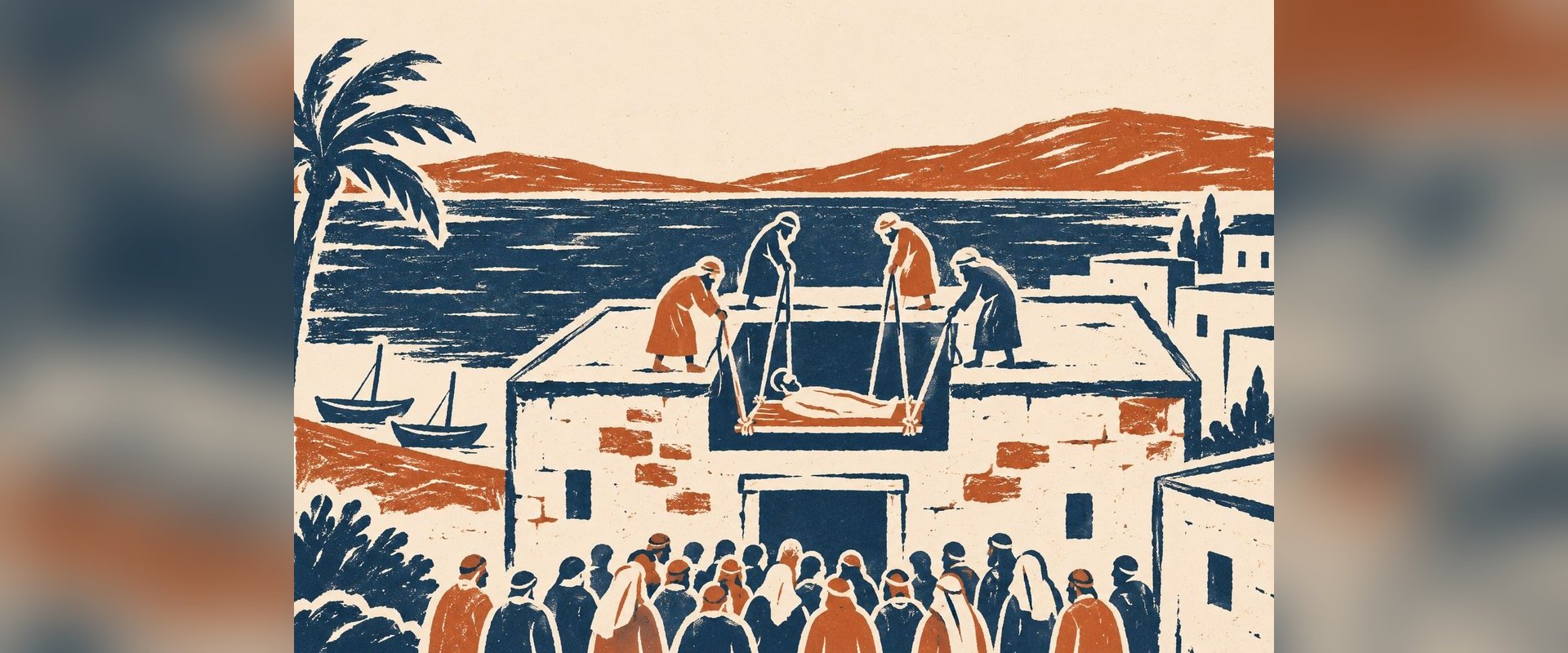
A family that had been in a home for generations had something better. A courtyard out front with benches for visitors. Sometimes a second story. And a good roof. Do you ever look at roofs as you drive through a neighborhood? I do. I like a metal roof. It just looks armored to me. In Jesus’ day, the roof told you everything. A poor family’s roof was branches and mud. A family with a generational home had a roof of clay tiles, a lot like the tiled roofs you still see across the Middle East today. A stairway or ladder ran up the outside of the house, because the roof was the family’s patio. People went up there to pray, to talk in the cool of the evening and, when the weather was nice, to sleep. Luke even tells us the friends lowered the man down “through the tiles” (Luke 5:19).
So picture a well-built family home with a tile roof and stairs up the outside. That’s where Jesus was. And word got out that he was home.
A Packed House
They came in such large numbers that there was no room left. Not inside. Not in the courtyard. Not even outside the door.
Some came because they wanted to hear him. Some came for the miracles. Some came hoping to catch him saying something they could use against him. Some came full of hope but sure they weren’t churchy enough for someone like him. If you back up and look at this one scene, you see Jesus’ whole ministry in a single room: a crowd, a teacher, people who needed healing, people who were curious, and people in the corner who were plotting.
And Jesus “preached the word to them.” What word? That anyone who wants to come to God can come. No matter what you’ve been through, no matter what happened to you, no matter what you did last year or last night, God loves you, and you are his kind of person.
That was a revolutionary message, and not everyone in the room liked it.
Talked About, Not Talked To
“Some men came, bringing to him a paralyzed man, carried by four of them.” (Mark 2:3)
Many scholars think this man was completely paralyzed, unable to use his arms or his legs. He was completely dependent on other people.
And his culture was brutal to him. In Jesus’ day, if you were blind or paralyzed or sick in a way people didn’t understand, they assumed you had done something to deserve it. Or your parents had. Some kind of cosmic payback. People were afraid that if they got too close, your bad luck would rub off on them, or that other people would judge them for being seen with you.
So people like this man were talked about, but never talked to. Usually they ended up begging by the side of the road. I can picture a father walking past with his kids, pointing at him: “You’d better behave, or that’s what happens to you.” He wasn’t a person to them. He was a prop. An object lesson.
Have you ever felt that way? Maybe not in church. I hope not in church. Maybe in a group of friends or your family. Something happens, and all of a sudden the conversation gets quiet when you walk in, and you realize you’ve gone from being on the prayer chain to being the subject of the prayer chain. Everyone’s suddenly in “bless her heart” mode. You’re on the outside.
This man had lived his whole life there.
And Jesus hated it. So did four of the man’s friends.
He wasn’t a person to them. He was a prop.
Four Faces in the Ceiling
“Since they could not get him to Jesus because of the crowd, they made an opening in the roof above Jesus by digging through it and then lowered the mat the man was lying on.” (Mark 2:4)
Imagine this happening in your church on a Sunday morning. The pastor is preaching. You start hearing scuffling up on the roof. A little drywall falls in the middle of the room. Security is getting alert. We’re all looking around at each other. The scuffling gets louder. Then you see daylight. Then a bigger hole. Then four faces looking down at you.
Then they start lowering a man on a mat right into the middle of the service.
And remember, this is probably Peter’s family home. I can only imagine Peter’s face as somebody pulls up the tiles on Grandpa’s roof.
Nothing like this had ever happened. And it was impossible to ignore.
In my mind, I picture that man about halfway down, hanging over the crowd, swaying a little on his mat. These are people who think that if they touch him, they’ll catch something. And here he is, hanging over their heads in the middle of their worship. If I’m him, part of me is wishing I were anywhere else.
And then, in my imagination, he locks eyes with Jesus. This part isn’t in the text. It’s just how I picture it. I see Jesus smiling at him. Maybe even laughing a little, because it’s quite the situation. And it’s like Jesus is saying, “Don’t look at them. Just look at me.”
That man could no more heal himself before he met Jesus than you or I can clean ourselves up before we meet him. He represents all of us. He represents your friends who don’t know Jesus yet.
A Word About Miracles
A miracle is something God does outside the natural order of things, outside the rhythms and laws God built into the universe to keep it running. It’s supernatural, which means you can’t predict it, control it or produce it on demand.
God still does miracles. But he does them according to his plan, for his purposes and for his glory. Many of us have prayed for miracles. Some of those prayers were for God’s glory. If we’re honest, some of them were for ours. And sometimes God, for reasons we don’t understand yet, has said not yet.
Here’s how the Trinity works in a miracle like this, as simply as I can put it: the Father wills it, the Holy Spirit provides the power, and Jesus carries it out. Three persons, one God, working together.
And in this story, it all begins with what Jesus noticed first:
“When Jesus saw their faith, he said to the paralyzed man, ‘Son, your sins are forgiven.’” (Mark 2:5)
Their faith. Not just the man on the mat. The four friends who carried him, climbed up there and dug through the roof.
Who were these guys? And what would it take for you and me to be friends like that? That’s next.
Talk It Over
- Was there a house where you felt at home growing up, even though it wasn’t yours? What made it feel that way?
- Have you ever been talked about instead of talked to? How did it feel?
- Who are the people in your world today who get talked about but not talked to?
- Picture yourself in this story. Are you in the crowd, on the roof, in the corner, or on the mat?
- What would it look like to dig through a “roof” for someone you love, to get them to Jesus no matter what’s in the way?
 Next in the seriesWho’s on Your Mat? Four Kinds of Friends Who Bring People to JesusFour Friends · Part 4Read it →
 The entire series · Free bookDirty ChurchBelong, believe, behave, from Mark 2Read it free →
 Capitol City Store · Everything is freeBooks, Bible studies, kids’ comics and short readsDozens of short reads like this one, plus free books, City Group studies, sermon notes, and kids’ comics and games. Read on your phone, print or share with a friend.Explore the store →
© 2026 Rick Melick. All rights reserved. Free to read and share for personal use. Not for resale.
Scripture quotations taken from The Holy Bible, New International Version®, NIV®. Copyright © 1973, 1978, 1984, 2011 by Biblica, Inc.™ Used by permission. All rights reserved worldwide.