Read First
Before we go any further, I want you to know what makes me tick. Not just as the person writing this, but as a follower of Jesus and a pastor.
I believe, with absolute conviction, that Scripture is true. It is our final authority for what we believe and how we live, and it’s as true today, whatever our culture is doing, as it was the day it was written.
I believe Jesus is the Son of God. I believe he is God. He came to earth as a real person, fully God and fully man at the same time. He lived a perfect, sinless life. He took the sins of the world on himself and died on the cross to pay a price you and I could never pay. He rose again and defeated sin, Satan and death once and for all, so that anyone who believes in him won’t spend eternity separated from God, but will spend it with him in heaven.
I believe Jesus is the only way to God. When he said, “I am the way and the truth and the life. No one comes to the Father except through me” (John 14:6), he meant it.
And I believe anyone can come.
That’s where I draw a distinction. Somewhere along the way, a lot of churches decided that only certain people could come, and the rest made us a little uncomfortable.
Where Jesus Chose to Sit
Here’s how I picture Jesus’ ministry.
Imagine walking into a room with one aisle down the middle. On one side are all the people who agree with you, the people you’re comfortable with, your people. On the other side is everybody else. The people you can’t relate to. The people who make you think, How in the world could anybody think that way?
The room is already divided. Everybody’s already seated. You’re standing in the back.
If you sit with your people, everyone will know you’re one of them. If you sit on the other side, your own people might never forgive you.
Jesus walked into a room like that and sat down with the people the religious crowd couldn’t stand. Not to agree with everything they did, but to start a conversation that didn’t divide. A conversation that brought people together at the foot of the cross. And where he chose to sit made some people hate him so much that they wanted him dead. In the end, he stretched out his arms and died. For everybody, on both sides of the aisle.
We live in a world where we want to win, and when we win, somebody else has to lose. As long as I’m right, I’m okay. And somewhere in the scuffle, the mission gets lost.
So how do we earn the right to share our faith? How do we become a voice people will actually listen to? Love that is only talked about won’t do it. Love has to be demonstrated. Jesus showed his love by where he chose to sit.
A Story for the Self-Righteous
Jesus told a story once, and before he even started, Luke tells us exactly who it was for:
“To some who were confident of their own righteousness and looked down on everyone else, Jesus told this parable.” (Luke 18:9)
When I first read that, my reaction was, Yeah! All those self-righteous people who look down on everybody else, they’d better listen up. Jesus is about to let them have it.
And then I took a step back. Oh. Oh, wait.
Am I confident in my own righteousness? Do I think I’m better than somebody because I’m right and they’re wrong? Because I’ve had experiences they haven’t?
Here’s the scary thing about self-righteous people. They are very rarely self-aware. They can look in a mirror and never see it. But everybody around them sees it.
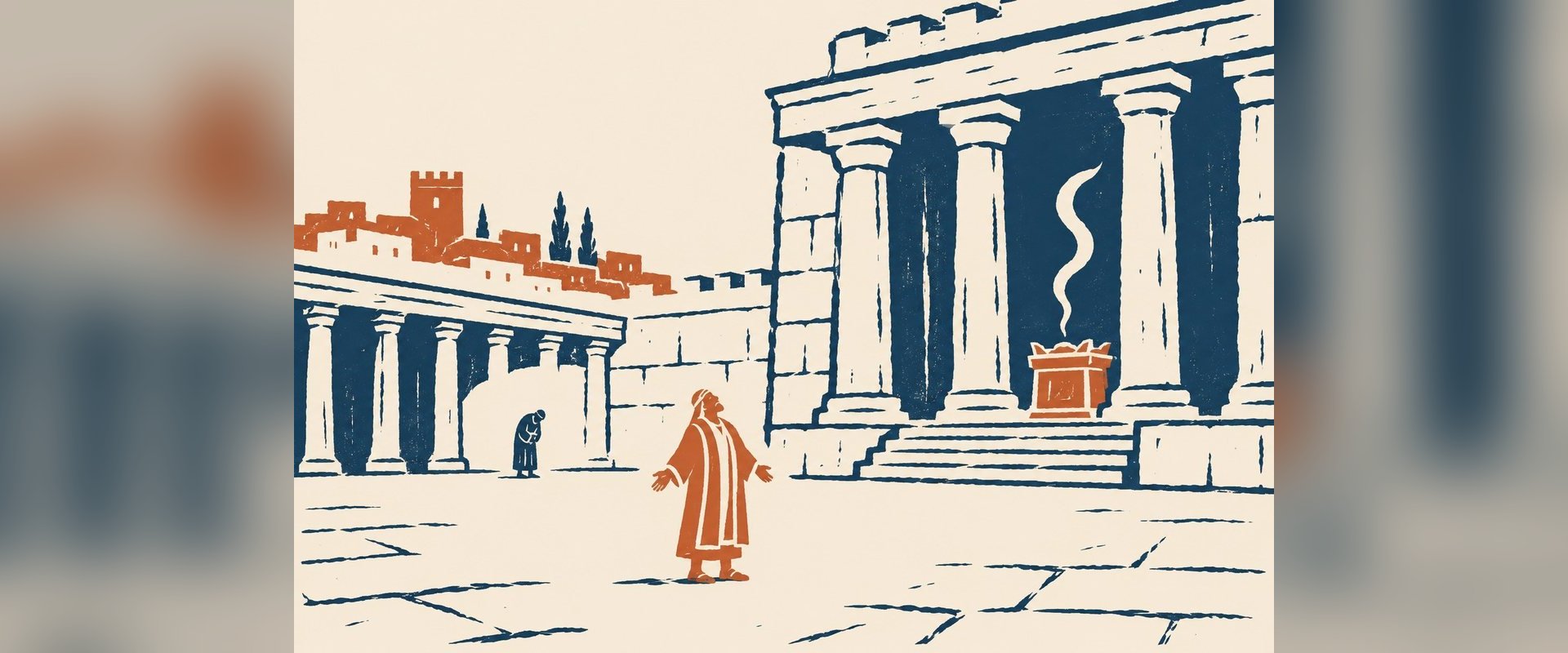
“Two men went up to the temple to pray, one a Pharisee and the other a tax collector.” (Luke 18:10)
A parable is a made-up story Jesus told to make a true point. And Jesus picked two characters from opposite ends of the world his listeners knew.
Jewish worshipers went to the temple to pray at set times each day, morning and afternoon, when the incense was burned and the sacrifices offered. They prayed out in the open courtyards, and as the smoke of the incense rose, it was a picture of their prayers rising to God.
The Pharisee was a respected religious leader. One of the rule makers. Everybody looked up to him.
The tax collector was the lowest of the low. He worked for the occupying Roman government and squeezed his own people for money. He was a traitor. Think of the person who got your grandmother evicted from her home. Everybody had been raised not to like this guy.
The Pharisee’s Résumé
“The Pharisee stood by himself and prayed: ‘God, I thank you that I am not like other people—robbers, evildoers, adulterers—or even like this tax collector.’” (Luke 18:11)
Can you imagine a prayer like that? God, thank you that I’m not like these other people.
Before we laugh at him, how many of us have thought something like that in the last few weeks?
If he’d stopped and said, God, thank you for saving me and not leaving me the way I was, that would have been a great prayer. But that’s not where he was going. He started naming people. Robbers. Evildoers, which covers just about everybody. Adulterers. And then, even like this tax collector, using a real person standing right there as his example. A person, not a prop.
Then he read God his résumé:
“I fast twice a week and give a tenth of all I get.” (Luke 18:12)
God’s law only required one day of fasting a year, on the Day of Atonement. But many Pharisees fasted twice a week, on Mondays and Thursdays, which also happened to be market days, when everybody was in town to see them looking hungry and holy. And they tithed down to the tiniest herb seeds in their gardens, so everyone could see how spiritual they were (Matthew 23:23).
Giving matters, by the way. Generous, sacrificial giving is part of following Jesus. But this man wasn’t worshiping. He was performing.
He forgot he was dirty.
He forgot he was dirty. And the people in the church who forget they’re dirty are part of the problem.
The Man in the Back
“But the tax collector stood at a distance. He would not even look up to heaven, but beat his breast and said, ‘God, have mercy on me, a sinner.’” (Luke 18:13)
That word but is huge.
The tax collector stood at the back, where nobody would notice him. He didn’t think he should be there. He didn’t feel like he belonged. He wouldn’t even lift his eyes.
And he beat his chest. To us that might look strange, but in that culture it was an expression of the deepest grief, something men almost never did. It shows up only one other time in the New Testament: when the crowd at the cross realized, too late, what they had done to Jesus (Luke 23:48). That’s how broken this man was.
He came in expecting to be kicked on the way in, because he knew he deserved it. I understand that man. Maybe you do too.
God, have mercy on me, a sinner.
He described himself exactly right. Then Jesus delivered the twist:
“I tell you that this man, rather than the other, went home justified before God. For all those who exalt themselves will be humbled, and those who humble themselves will be exalted.” (Luke 18:14)
The churchiest man in the room went home the same way he came. The man who knew he was dirty went home clean.
What Forgiveness Is Not
So what does this story teach us about forgiveness?
Being good does not equal forgiveness. Being good just leads to comparing yourself with someone else, and needing to win. It puts the job of your salvation back on you. Scripture never says that being good earns forgiveness.
Being smart does not equal forgiveness. The Pharisees knew every Bible story and every right answer. They could dazzle you. Jesus called them whitewashed tombs: beautiful on the outside, dead on the inside (Matthew 23:27).
Being in the right place does not equal forgiveness. The Pharisee was standing in the temple. So was the tax collector. Location didn’t save either of them.
Salvation through Jesus equals forgiveness. That’s it.
What’s the greatest thing Christianity has to offer the world? Not a moral code. Not a political platform. Not even inner peace, though peace comes with it. The greatest thing we have to offer is forgiveness of sin and a brand-new life. Old becomes new. Dead becomes alive. Lost becomes found.
::: myth
Myth: If I’m good enough, smart enough and show up in the right places, God will accept me.
Truth: Only Jesus forgives. The man who knew he was dirty went home clean.
:::
Too Good to Be True
Years ago I started a church in Marin County, California, just north of San Francisco, where very few people went to church. The people were smart, well educated and successful, and most of them had never set foot in a church.
I remember telling the story of Jesus to one man who sat on the board of a company whose products are probably all over your house right now. Nobody had ever connected the dots for him: sin, a Savior, forgiveness, a new life. And when it clicked, his first response was, “I have to tell my wife. I have to tell my kids.”
That happened again and again. People would bring their friends to me and say, “Tell them what you told me. It’s almost too good to be true.”
That church grew because people brought their friends to Jesus. They remembered what they had been without him, and they couldn’t keep it to themselves.
Outing Yourself
That’s hard for a lot of us. When you start nudging the people in your life toward Jesus, you out yourself as a Christian. And then they’re going to notice all the ways your life doesn’t measure up to Jesus.
When they point it out, here’s what you get to say: You’re right. I’m not perfect. I haven’t arrived. But I’m following Jesus, and he’s changing me.
That takes humility and honesty. It’s a lot easier to lob truth bombs over the fence and hope nobody throws one back. But the man in the back of the temple shows us the way. He knew he was dirty. And that’s exactly the person Jesus sends home clean.
Talk It Over
- In the room with one aisle, which side would you naturally sit on? Who’s on the other side?
- Where might you be “confident of your own righteousness” without realizing it?
- Which do you lean on most: being good, being smart or being in the right place?
- When has someone pointed out where your life doesn’t match Jesus? How did you respond?
- Who is one person in your life who might say, “That’s almost too good to be true,” if they really heard the gospel?
 Next in the seriesTake Off the Mask: Legalism, Culturalism and Traditionalism at ChurchCostumes · Part 7Read it →
 The entire series · Free bookDirty ChurchBelong, believe, behave, from Mark 2Read it free →
 Capitol City Store · Everything is freeBooks, Bible studies, kids’ comics and short readsDozens of short reads like this one, plus free books, City Group studies, sermon notes, and kids’ comics and games. Read on your phone, print or share with a friend.Explore the store →
© 2026 Rick Melick. All rights reserved. Free to read and share for personal use. Not for resale.
Scripture quotations taken from The Holy Bible, New International Version®, NIV®. Copyright © 1973, 1978, 1984, 2011 by Biblica, Inc.™ Used by permission. All rights reserved worldwide.