Read First
We go to the Bible for what we believe and practice. That’s why we baptize believers, by immersion, as a picture of death, burial, and new life.
When I teach, on whose authority am I speaking? My answer is the Bible. That sounds like a Sunday school answer, but it isn’t simple. Many faith traditions don’t arrive at truth that way.
We baptized people in the first service that morning, and I believe we’re heading into a harvest season like the fall a couple of years ago, when about thirty adults were baptized. Some of you have just decided to follow Jesus, and baptism is the next logical step. Some of you decided years ago and were taught about baptism differently. So this article is more informational than applicational. I’m not here to talk smack about any denomination or tradition. I just want you to know what we believe, why, and where it comes from.
You never know what you’ll find
In August, Joy and I made two trips to Arkansas to see the kids and my sister. Before we left, we agreed: we’ll be in the camper most of the time, so pack the bare necessities. Shorts, T-shirts, that’s it. She nodded. “Right. Bare necessities.”
When we got home, my parents were driving in from Arkansas to stay with us, and Joy was making beds. I decided to help by unpacking her duffel bag, which was still sitting on the dining room table. Now, I don’t mean unpack it and hang everything up in her closet. I’m not that thoughtful. I mean take everything out, leave it folded in piles on the table, and carry the bag down to storage.
I was expecting shorts and T-shirts, the bare necessities we’d agreed on. And at the very bottom I found not one but two pairs of high heels. For a camping trip. You never know when you’re going to need high heels when you’re basically camping.
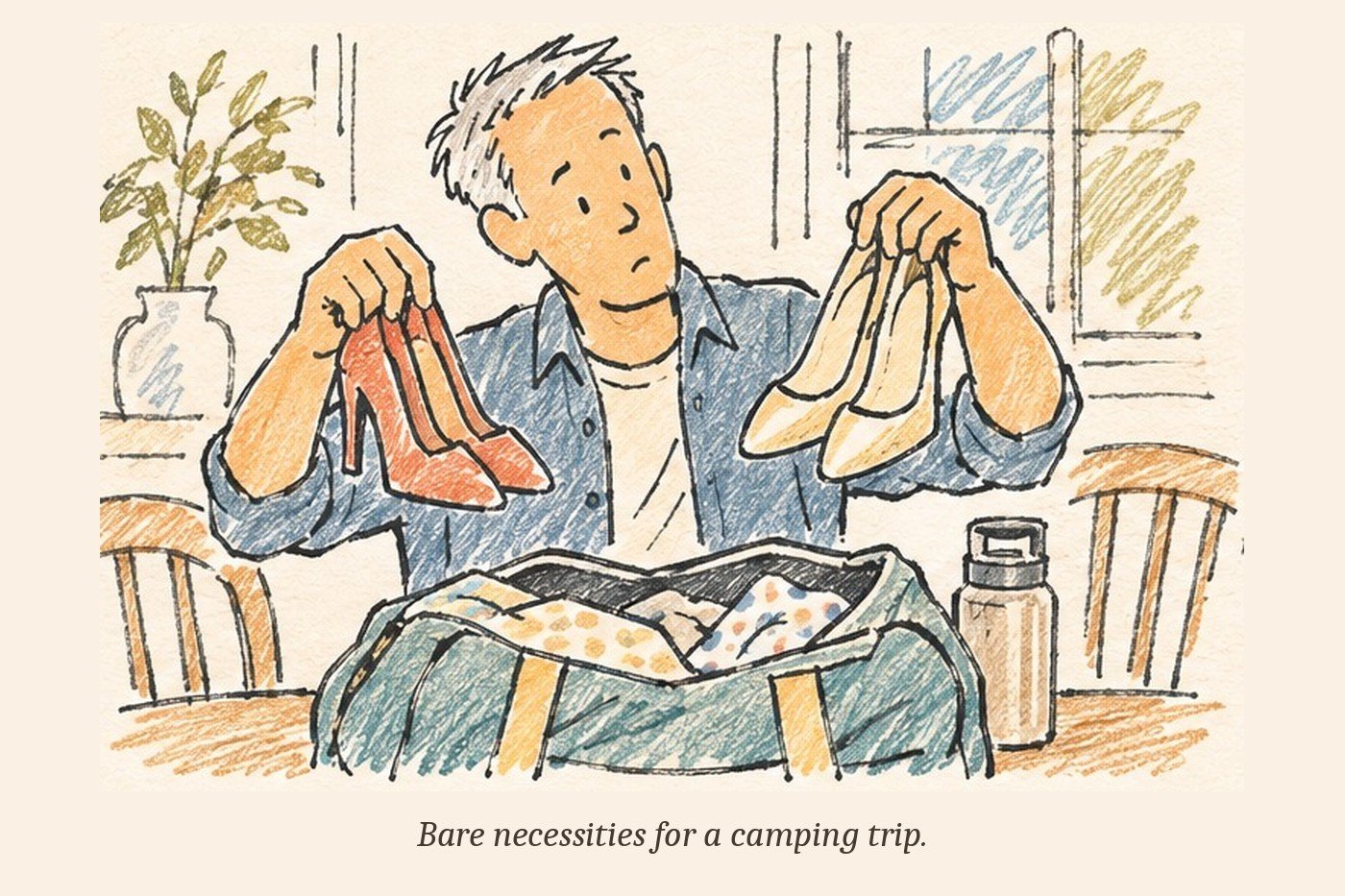
You never know what you’ll find when you start unpacking. That’s what happens when you read John with these questions in mind: What is God saying to me? What is he saying to someone close to me? You’ll find things you didn’t know were there.
Our authority
Here’s what we believe the Bible teaches about baptism:
- It comes after a decision to follow Jesus. Immediately after is what I think best reflects the teaching of Jesus, but it could be years later.
- It doesn’t save you. If baptism saved us, it would be a work. If we had to work for salvation, we’d have to work to keep it, and we would certainly mess it up.
- It’s a symbol. It identifies you with Jesus and tells the church and the world you’ve made this commitment.
- It’s done by immersion, because that’s the biblical practice and the clearest picture of the death, burial, and resurrection of Jesus.
- We don’t baptize babies, because a baby can’t choose to follow Christ.
If you disagree, I welcome the conversation. Come with Scripture, not opinion or tradition. And if this is different from what you were taught, ask your pastor or priest to show you where their practice comes from in the Word.
Baptism didn’t start with John
You might be surprised: baptism didn’t start with John the Baptist or with Jesus. It was already part of Jewish practice. When a Gentile wanted to convert to Judaism, there was a process. He ate a ceremonial meal, made an offering at the temple, and committed to the law of Moses. Men were circumcised, which would be a deal-breaker for a lot of guys if we put it in our membership class. And the last step was baptism.
The word simply means to wash, dunk, submerge, or immerse. Converts lowered themselves all the way under the water. It was a picture of leaving an old life behind and embracing a new one.
The Greek word wasn’t a churchy word at all. It described a ship that sank at sea. People who dyed cloth talked about baptizing a garment. Later it even showed up in a pickle recipe. The confusion came when the New Testament was translated into English. Instead of translating it as “immersed” or “washed,” translators carried the Greek word over as “baptized.” So every time you read “baptized” in the New Testament, you could read “immersed.”
John the Washer
John the Baptist was Jesus’ cousin, raised out in the wilderness, a little eccentric. They probably saw each other at family gatherings. Maybe Christmas and Easter. (Wait. They didn’t have Christmas and Easter yet. Those came after Jesus. The first service caught that one right away.)
“Baptist” wasn’t his last name. It was a nickname: John the Washer, John the Dunker. He was the first person we know of who baptized other people instead of them dunking themselves.
God called him to be a herald, the one who goes ahead of an important person, clears the potholes, and lets everyone know he’s coming. After about four hundred years of silence, John announced it: the Messiah is near. Get ready.
(There’s a funny story in Acts 19. Years later, after Jesus had died, risen, and ascended, Paul found some disciples who had only received John’s baptism. They were still waiting for the Messiah. Paul told them, “He already came!” and they were baptized in Jesus’ name.)
Jesus came up out of the water
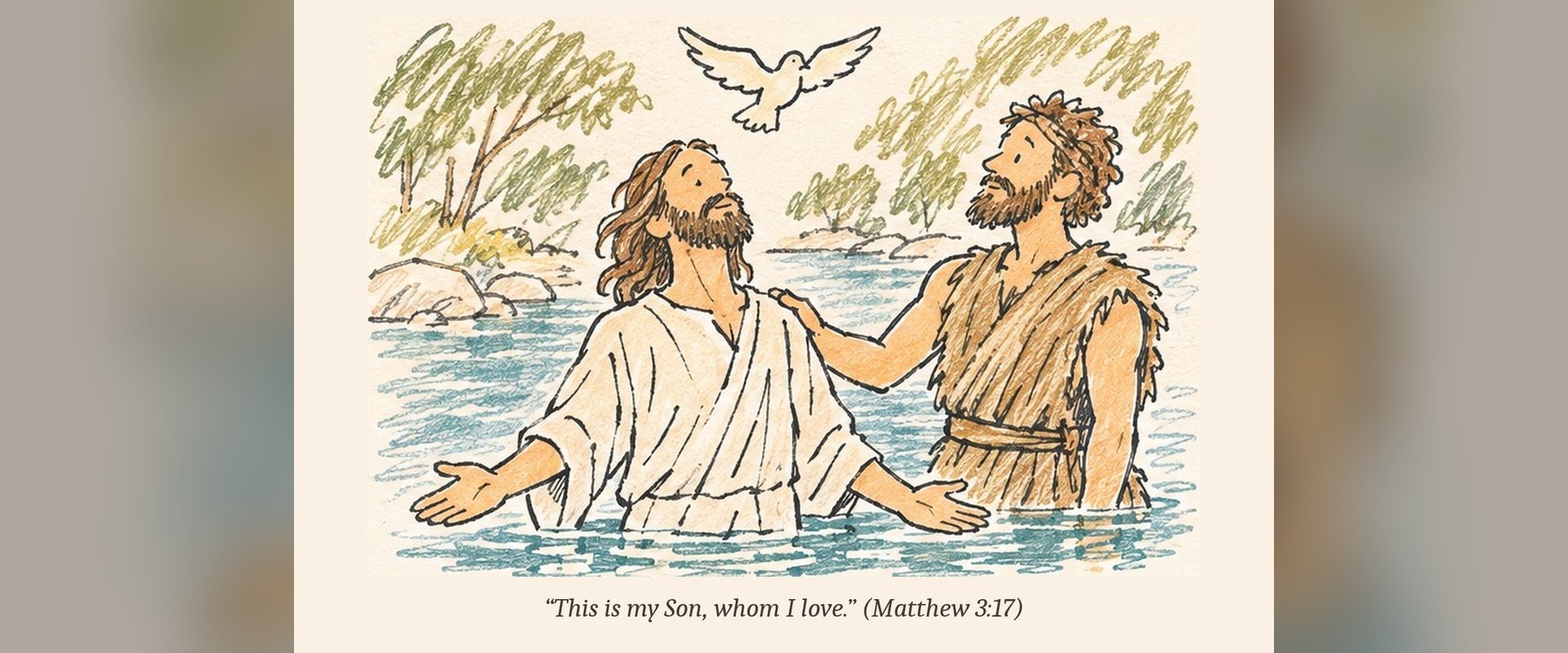
Then one day Jesus came from Galilee to the Jordan to be baptized. John tried to deter him. The word means back and forth, like ping-pong. “You baptize me.” “No, you baptize me.” Then John realized, I’m arguing with Jesus. I should probably be quiet.
Jesus said, “Let it be so now; it is proper for us to do this to fulfill all righteousness.” His baptism did three things. It confirmed John’s ministry. It set an example for every believer. And it marked the start of his three years of public ministry.
As soon as Jesus was baptized, he went up out of the water. At that moment heaven was opened, and he saw the Spirit of God descending like a dove and alighting on him.
Why did he come up out of the water? Because he was down in it. That’s what the language says, and that’s what baptism had meant for hundreds of years. And it just makes sense. We are buried with Christ in baptism (Romans 6:4), dead in sin, and raised to walk in newness of life. What better picture than being totally under and then totally alive?
And look: the whole Trinity is there. The Son comes up out of the water, the Spirit descends like a dove, and the Father speaks: “This is my Son, whom I love; with him I am well pleased.”
Sprinkling and infant baptism
I want to explain where two common practices come from, so you can research them yourself. I’m not making light of anyone’s experience.
Sprinkling doesn’t appear anywhere in Scripture. It became an accepted practice through church councils long after the New Testament, most often dated to the Council of Ravenna in 1311. The reasons were practical: some people were too sick to be immersed, and in some places the water was cold. I understand that.
I once baptized an older woman with breathing problems who would not have come up the same way if I’d put her under; her doctor helped us find a safe way. I also baptized a twelve-year-old boy with severe autism who practiced for weeks but couldn’t get his face under the water. He showed more courage than almost anyone I’ve baptized. Of course I baptized him.
But those were exceptions. Sprinkling as a regular practice comes from tradition, not from the Bible.
Different traditions arrive at truth in different ways. The Catholic Church holds Scripture together with church tradition and the teaching authority of the church. The Wesleyan tradition weighs Scripture most heavily but also tradition, reason, and experience. We try to let Scripture alone be our authority for what we believe and practice.
Infant baptism isn’t in Scripture either. It became widespread in the centuries after the apostles, at a time when many babies died and parents were afraid for them. I believe the Bible teaches that until a child is old enough to understand sin, grace, and salvation, God extends a special grace. If they die, they are with Jesus right now. Some people never develop to the point where they can understand, and I believe the same grace covers them.
Some point to the Philippian jailer, whose whole household was baptized (Acts 16:31–34). But how do we know there were infants in that house? We don’t. And the thief on the cross was never baptized at all, yet Jesus told him, “Today you will be with me in paradise” (Luke 23:43).
Infant baptism can cause real confusion. Parents wonder, Did my child ever actually decide to follow Jesus? That’s the question you want answered. So we dedicate babies instead. Parents promise to raise their child to know Jesus, the church promises to help, and the child makes their own decision when they’re ready.
All the way under
One of my best friends helped me plant a church. He was a solid Christian, the kind of guy whose faith I’d be happy to end up with. He was Presbyterian, sprinkled in college. I grew up Southern Baptist, and I was taught to be a little suspicious of Presbyterians. One of the hardest things for me as an adult is sorting out what was biblical from what my grandma taught me.
There was nothing wrong with my friend’s faith or obedience. He did what he believed he was supposed to do. After sitting through several of our baptism services, he came to me and said, “If it’s a symbol, the only thing that makes sense is going all the way under.” I told him I’d been saying that for two years, but I was glad he was thinking it through. He and his wife both wanted to be baptized by immersion.
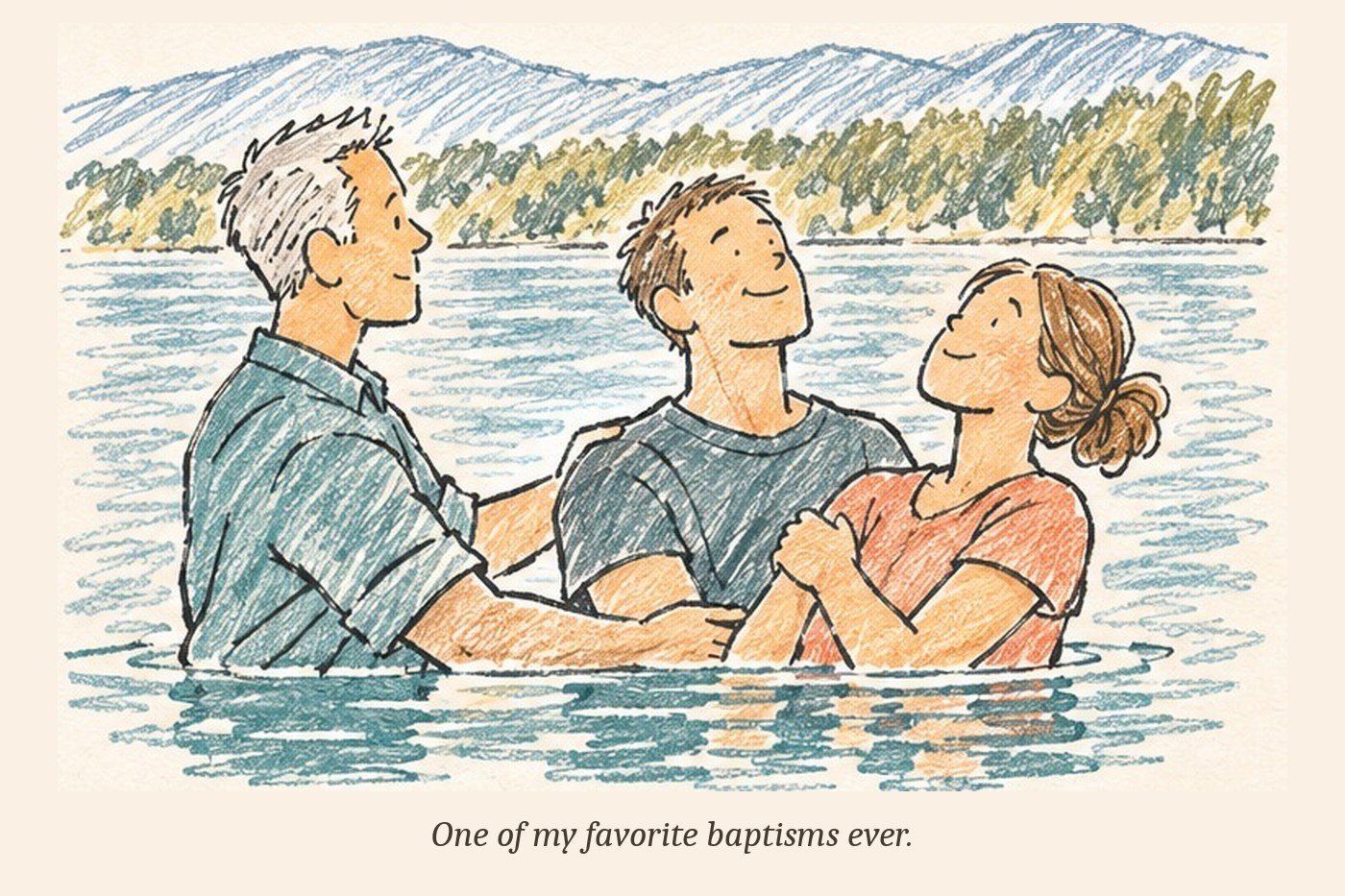
I’ve baptized people in the Pacific Ocean with sharks and rip currents, and I have plenty of baptism stories. One of my favorites is baptizing my friend and his wife in Norfork Lake, because they decided on their own. It took courage, and I respected it. If you were baptized as a believer by immersion, you don’t need to do it again. If you were sprinkled as a believer, I’m not calling your experience invalid or saying you’re a lesser Christian. I’m only asking you to ask God whether there’s a clearer way to tell the world you follow Jesus.
This Week
If you haven’t read all of John yet, read it. Then go back to the story that fits someone close to you: a coworker, a spouse, a child, an adult child. Share it with them. Not hellfire and brimstone, just encouragement from God’s Word, and why it made you think of them. And if baptism is your next step, tell a pastor.
Find Yourself, Find Someone Close
Find yourself. Jesus heard his Father say, “This is my Son, whom I love” (Matthew 3:17). Where are you in that story: still on the bank, wading in, or already coming up out of the water?
Find someone close. Who do you know who is standing at the edge of a big step, like my friend was? How could you encourage them without pressure or debate, just with your own story?
Talk It Over
- What’s the “two pairs of high heels” in your life: something you were sure you’d packed light on, until somebody started unpacking?
- When you were twelve, who told you what was true? Acts 17:11 praises a group of people who heard Paul preach and then checked the Scriptures themselves to see if he was right. What would it look like for you to do that, even with this article?
- Paul says baptism is like being buried with Jesus and raised to a new life (Romans 6:4). When have you felt like you went all the way under? What did coming back up look like, or what would it look like?
- Even John the Baptist tried to talk Jesus out of being baptized (Matthew 3:13–15). Jesus did it anyway, as an example. My church-planting friend changed his mind by watching people, not by arguing. Whose life has changed what you believe more than any argument could?
- When Jesus came up out of the water, a voice from heaven said, “This is my Son, whom I love; with him I am well pleased” (Matthew 3:17). That was before he’d preached a sermon or healed anyone. What would it do to you to believe God says something like that about you, before you’ve done anything?
 Next in the seriesDo You Want to Get Well? When Healing Doesn't ComeWhat Are We Waiting For? · Part 3Read it →
 The entire series · Free bookCome and SeeFinding yourself in the Gospel of JohnRead it free →
 Capitol City Store · Everything is freeBooks, Bible studies, kids’ comics and short readsDozens of short reads like this one, plus free books, City Group studies, sermon notes, and kids’ comics and games. Read on your phone, print or share with a friend.Explore the store →
© 2026 Rick Melick. All rights reserved. Free to read and share for personal use. Not for resale.
Scripture quotations taken from The Holy Bible, New International Version®, NIV®. Copyright © 1973, 1978, 1984, 2011 by Biblica, Inc.™ Used by permission. All rights reserved worldwide.