Read First
Sometimes Jesus heals. Sometimes he says no and gives grace instead. Either way, stop blaming and trust the one who walked right in.
So, what’s wrong with you? You may not need me to explain the question. You might already have a list. It might be the first thing you think about every morning.
All of us have something we wish God would change or take away. For some it’s obvious. Others are good at hiding it way down deep, but if we’re not careful, it spills out onto the people we love most.
Paul’s thorn
The apostle Paul had something wrong with him, and we don’t know what it was. I believe that’s on purpose, so none of us fills in the blank. Somebody else’s problem always seems easier to deal with than our own. Some think it was his eyes. Some think it was the damage from beatings and shipwrecks. Many think it was loneliness and rejection; he was hurt by people he loved. Christians can be some of the meanest people on earth.
Paul was one of the most effective church planters who ever lived. He believed, maybe like you, that if God would just remove this thing, he could serve better. And life would be a little more comfortable, too.
So he asked Jesus to take it away. Jesus said no.
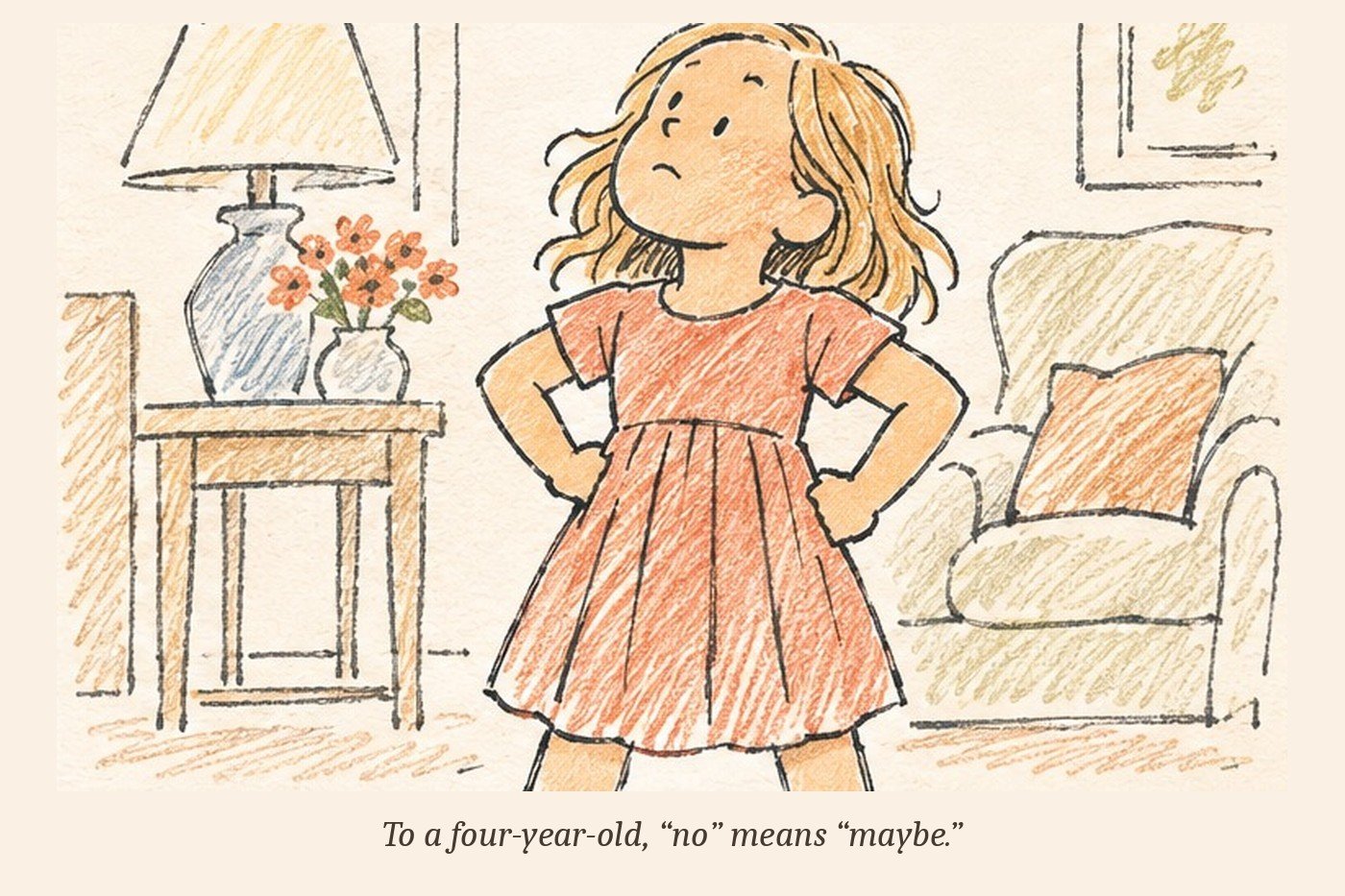
My granddaughter is four and a half, and she knows the word “no” now. She doesn’t like it one bit. If I tell her no, to her that means maybe. It’s the opening of a negotiation, and she will patiently explain to me why what she wants is what she should have, and why it’s the right way. And I do the very same thing with God all the time.
Paul asked a second time. No. He asked a third time. No. And then comes the part where faith comes in:
“My grace is sufficient for you, for my power is made perfect in weakness.”
If I were Jesus and something was hurting my wife, I’d take it away. If I had the power to take away your pain, I would. But I’m not Jesus. I don’t see what he sees. We live in a world broken by sin. Some of what’s wrong is what we did to ourselves, some is what others did to us, and some is just what we were born with. Jesus loves us enough not to always change what we ask him to change, because we’re part of something bigger. And sometimes that’s the way it is.
And sometimes it isn’t.
Using Scripture to prove a point
A friend said something to me not long ago: “Isn’t it great to use Scripture to encourage somebody instead of using it to prove a point?” Now you’re getting it, I thought. Then I realized I’d done it myself that very week. Joy told me not to tell this story. I asked the first service whether I should, and the vote was mixed. I’m telling it anyway.
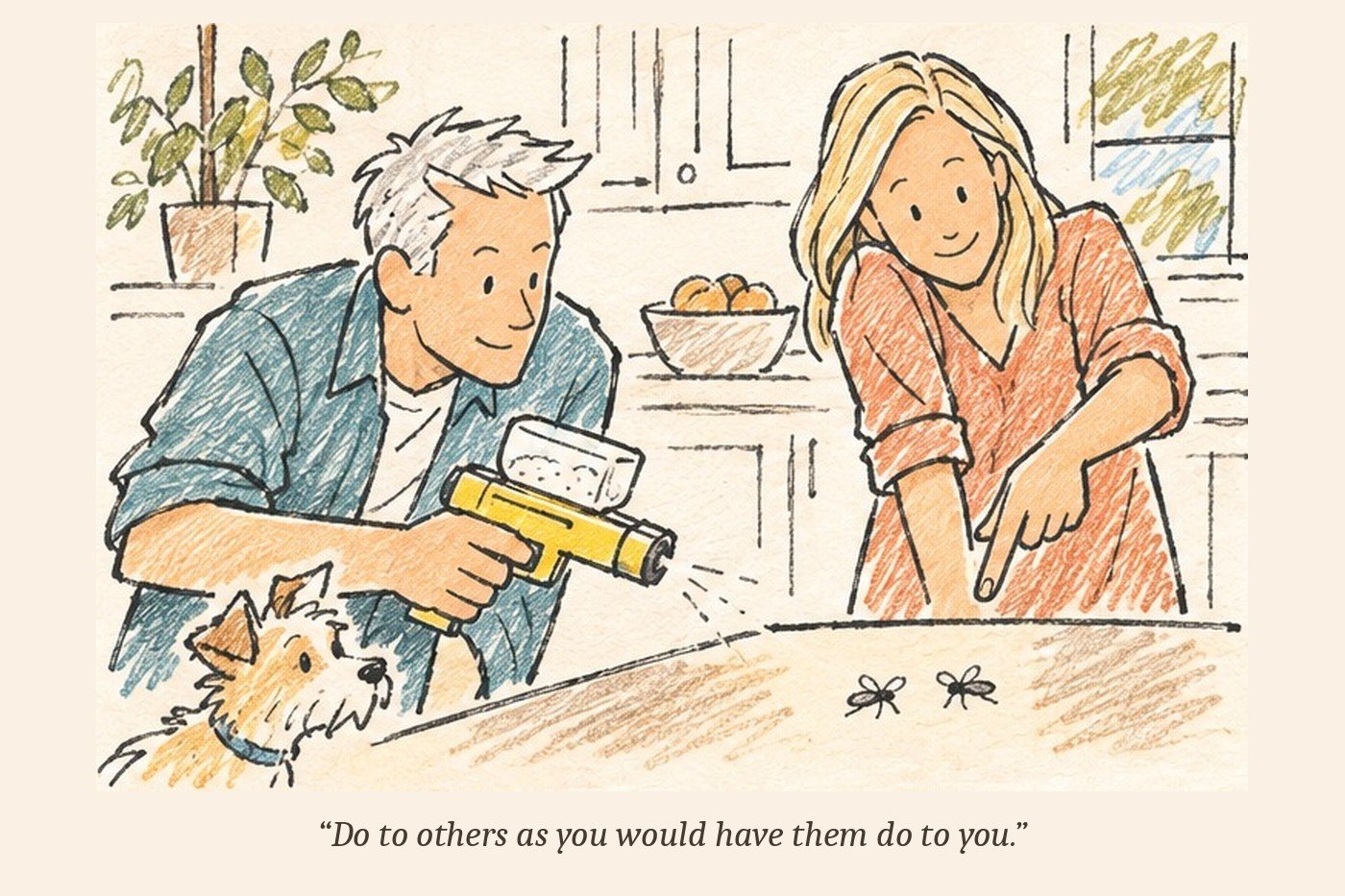
We have flies at our house. Not because we’re dirty. I promise you, we don’t have a dirty house. We live across from one of those natural habitats the city creates, right in the middle of a neighborhood. I call it the wasteland. Your tax dollars pay for it to grow mosquitoes, bugs, and coyotes, and I think we live a little too close. Every time I open the door to let my dog out, the flies come in.
So I have a spring-loaded gun that shoots salt and kills flies. I love it. When Joy says, “Rick, get the gun,” she isn’t saying get the gun. She means the fly gun. I run and get it, and I’m on the hunt. My little terrier mix is right there with me, ears up. (We don’t know who his dad is. It’s a long story. He’s with me.)
The other day there were two flies on the counter, and I want to explain this delicately because we are a family-friendly church. They had watched Netflix, and they were well into the chill. They were populating the earth. They were making more flies to inhabit the wasteland.
Joy said, “Shoot them!”
I said, “I’m going to wait a minute.”
She said, “Then you’ll have to shoot two of them, flying in different directions.”
I said, “Joy, as the Scriptures say, do to others as you would have them do to you” (Luke 6:31). So I waited. I shot them later. They’re still dead. But I felt good about myself.
That’s what we do sometimes. We weaponize Scripture. And that’s exactly why I’ve been asking you to read John: so the Holy Spirit can use it to speak to you and connect you to the people around you.
Why John?
Matthew, Mark, and Luke start with the manger. John starts “in the beginning.” Jesus was there. He was never created. He is God, and he spoke all things into existence.
Matthew, Mark, and Luke include exorcisms and parables. John has neither. John has seven miracles, and he calls them signs. A miracle points back to itself, to God’s power. A sign always points to something else. In John, it points to someone: Jesus.
John wrote last, as an old man, decades after the others, possibly dictating it after his exile on Patmos. He had walked with the Holy Spirit for years and had watched what Jesus did in people’s lives over time. So John fills in the heart. His Gospel is full of one-on-one encounters with Jesus. In the Upper Room chapters (John 13–17), you don’t find bread and wine. You find a basin and a towel. In John 17:20, Jesus prays for all who would believe later. That means he prayed for you.
John uses “believe” around a hundred times, and always as a verb, never as a noun. Belief isn’t a thing you put on a shelf at fifteen and pull back down at fifty. And John calls himself “the disciple whom Jesus loved.” I don’t think that’s arrogance. I think it’s an old man looking back: I don’t know everything, but I know this. Jesus loves me. His secret is in John 15: abide. Stick around. Don’t quit, even when Jesus says no.
The pool of grace
John 5 is a turning point. If you were polling people about Jesus, his numbers were doing fine through chapter 4. In chapter 5 they start to drop, and the plot to kill him begins. This sign is where it starts.
Near the Sheep Gate in Jerusalem was a pool called Bethesda, which means “house of mercy” or grace. It was surrounded by five covered colonnades. John describes it like a place everyone would know. You know the one. But it wasn’t a place of grace. It was a place of suffering, superstition, and false hope.
The blind, the lame, and the paralyzed lay there. Your Bible may have verse 4 in brackets or a footnote: an angel would stir the water, and the first one in would be healed. That line isn’t in the earliest manuscripts. It was added later to explain what people believed. In fact, the pool was fed by underground springs that bubbled up from time to time.
Picture it: people with no families, no future, and no way to support themselves, left in a heap beside a pool. They were hoping an angel would stir the water and they’d be lucky enough to get in first. Superstition had crept into religion. Some believed a disability was punishment for a parent’s sin, and that the sin would rub off if you got close, like cooties. Nobody wanted to go near that place.
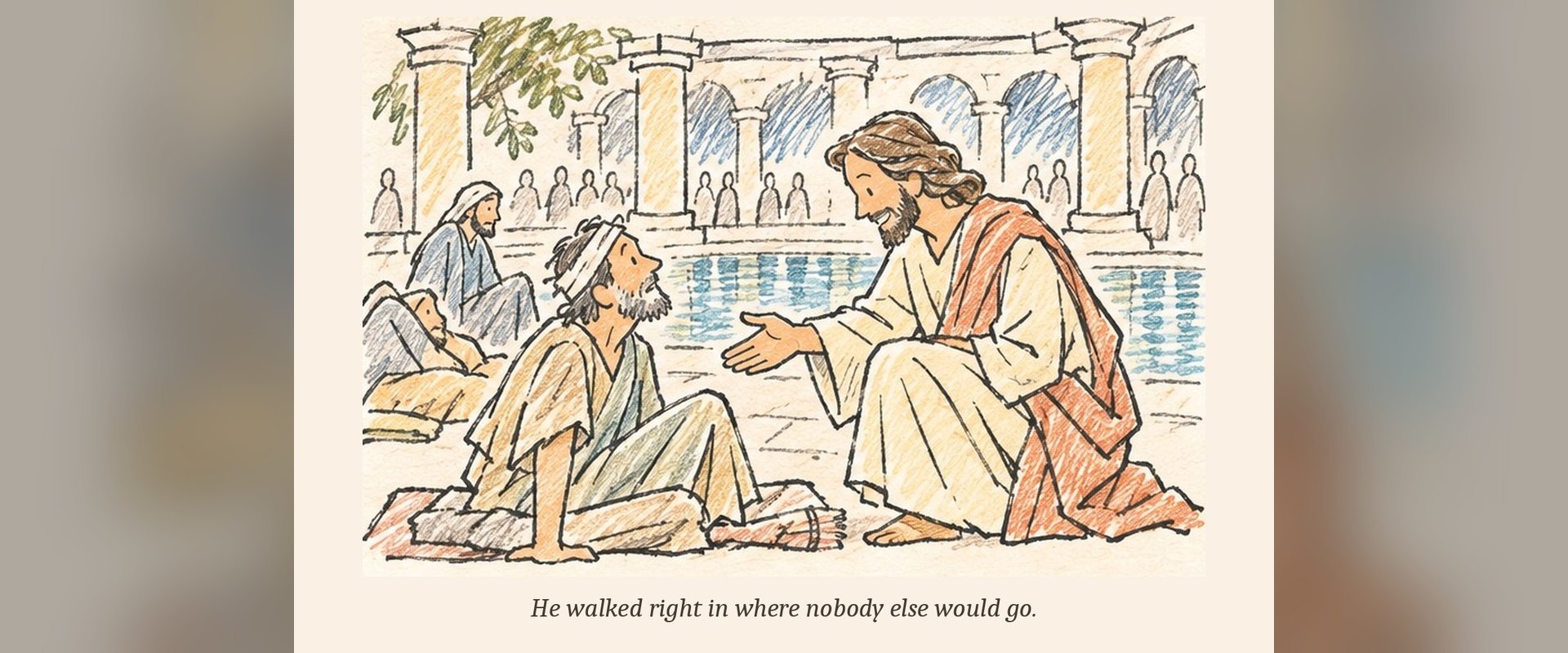
Here’s what Jesus did not do. He didn’t stand at the gate and shout, “Try harder! You can do it! Just get up!” He walked right in, where nobody else would go. He found one man in his pain and got up close to a messy life that nobody could straighten out. That’s what God wants us to know about himself.
“Do you want to get well?”
The man had been sick for thirty-eight years. Jesus asked him, “Do you want to get well?” That sounds like an obvious question. It isn’t.
The man answered, “Sir, I have no one to help me into the pool when the water is stirred. While I am trying to get in, someone else goes down ahead of me.” In other words: The people who should have been there weren’t. If they had loved me better, if God had put better people in my life, this wouldn’t be happening.
He blamed other people and circumstances. If I’m honest, I do the same thing. If my wife would change. If my kids would. Don’t you see what I’m dealing with? Other people and other stuff can justify us, excuse us, and keep us stuck. And when something has been around long enough, it becomes part of our identity. Some of us aren’t 100 percent sure we want to let it go, because we might not know who we are without it.
The man thought he was answering a stranger who hadn’t been paying attention. He was talking to the one person who could change everything. He only had faith in what he thought was possible. Jesus had something else in mind.
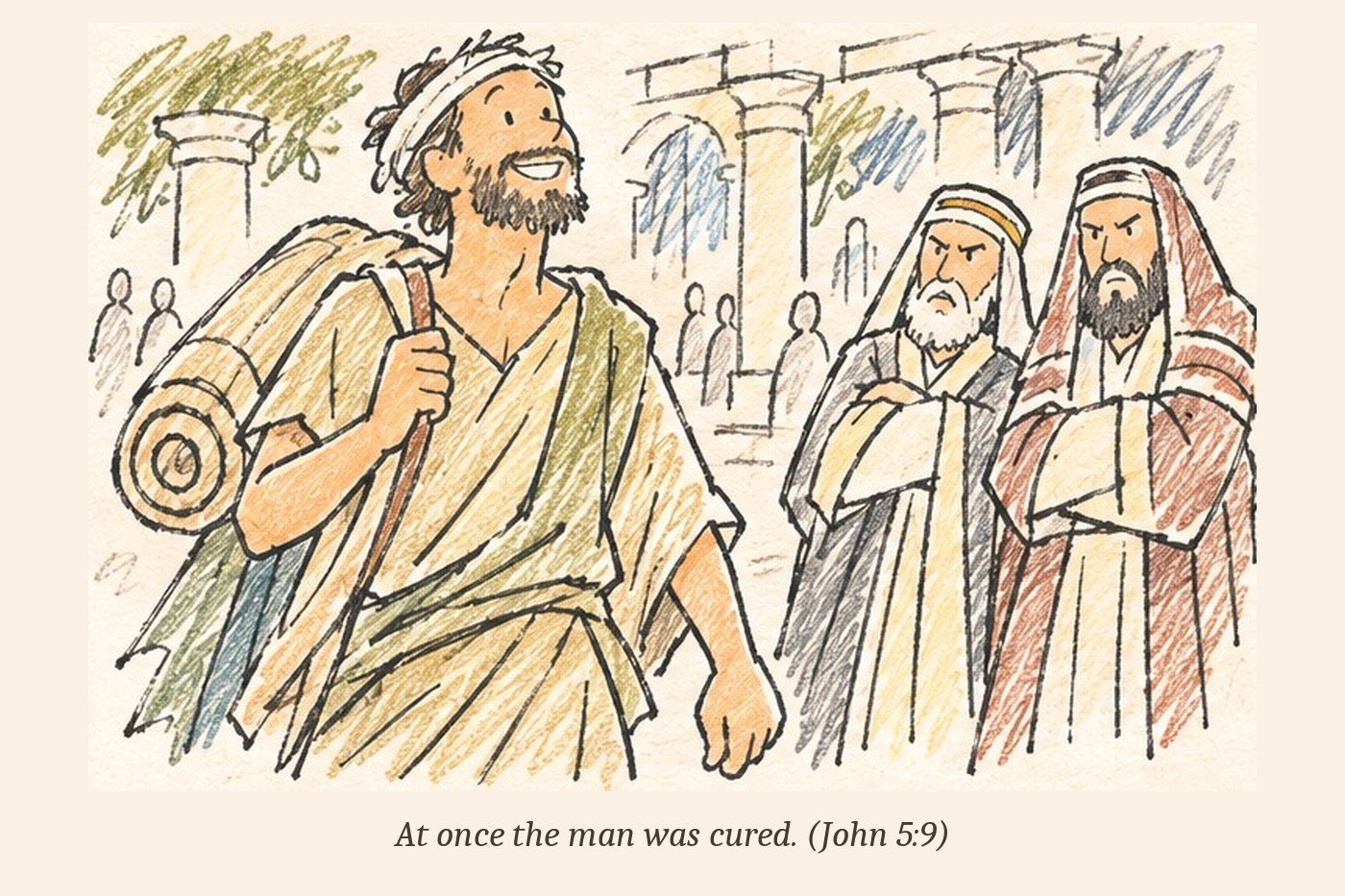
Then Jesus said to him, “Get up! Pick up your mat and walk.” At once the man was cured; he picked up his mat and walked.
Standing between Jesus and a person
Then the music changes from hopeful to ominous. It was the Sabbath. The religious leaders confronted the man for carrying his mat. That rule wasn’t even God’s law. It came from the scribes’ oral tradition, dozens of categories of rules they built around the commandment. “Who healed you?” He didn’t know. Jesus had slipped away.
Here’s a warning for all of us, especially Christians. When we use Scripture to win an argument or prove a point, what we’re trying to accomplish can become more important than the person Jesus is trying to reach. Then we’ve put ourselves in the most dangerous place there is: between Jesus and the mission he came to accomplish.
Later Jesus found the man in the temple and said, “Stop sinning or something worse may happen to you.”
Read it how you want. I like humor, and I think Jesus is joking. The religious leaders had told this man his whole life that he was sick because he was a sinner. Now here he is, up and walking. I think Jesus winks at him: Hey, man, you better stop sinning, or something worse might happen to you. Probably smacked him on the back and took off.
And the man chose to trust the one who came to him, not the group that put him there in the first place.
Just enough grace
Six years ago I was diagnosed with thyroid cancer. The doctors said, “Good news, bad news. It’s a pretty good kind of cancer. But you have a pretty bad case of it. You won’t die from it, but you’ll probably die with it.” They took my thyroid, and I didn’t ask God to put it back. It had failed me.
But because the cancer had spread to some lymph nodes, they treated it by keeping me in an extremely hyperthyroid state. My regular doctor would see my numbers and want to send me to the hospital. My cancer doctors said it was exactly where they wanted it.
It brought panic attacks out of nowhere: a racing heart, tunnel vision, my brain scrambling for no reason. That’s hard for anyone. It’s especially hard on a Sunday morning in front of a room full of people.
For about two years, I’d finish preaching, get in the car, and tell Joy, “I’m never doing this again. I quit.” We joke that I resigned to my wife seventy-five or eighty times over those two years. I’m not exaggerating. Every week. “Can’t do it, won’t do it. I’m going to find something else to do.”
Then by Wednesday, a message would start stirring in my spirit. Part of me would say, Thank you, God. Part of me would say, Oh great, I have to do this again.
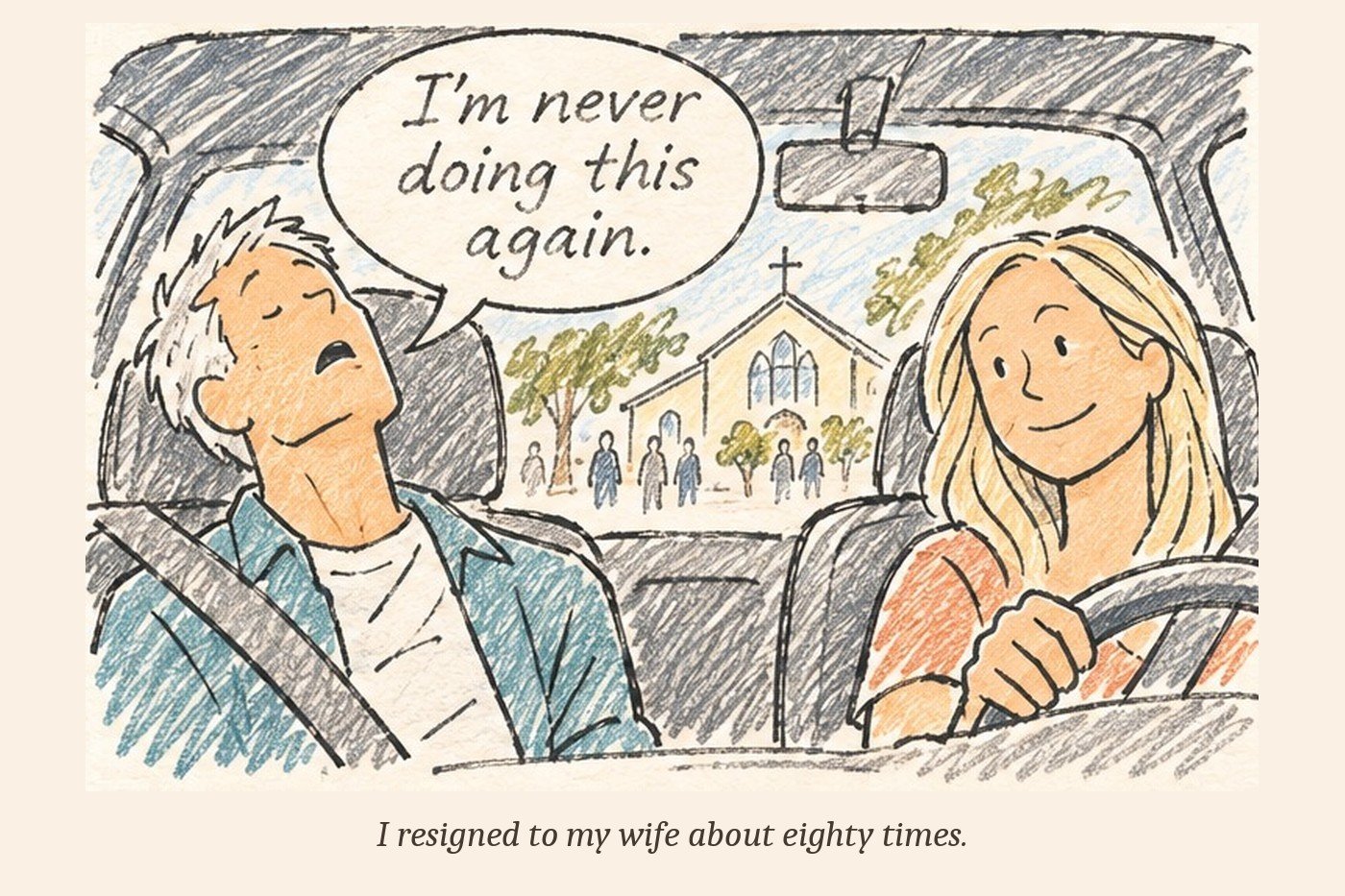
I begged God to take it away far more than three times. He gave me just enough grace, every week, to barely get by. And what I learned is that his grace was all I needed. When I’m at my weakest, that’s the best place for other people to see how strong God is. Some of you are carrying far heavier things right now: chemo, recovery, grief. This is the same principle, and it’s available to you too.
This Week
Name one person or circumstance you’ve been blaming. Write it down, then write underneath it: “My grace is sufficient for you.” Pray it every day this week, and take one small step you’ve been waiting for.
Find Yourself, Find Someone Close
Find yourself. Are you more like Paul, asking God for the third time to take something away (2 Corinthians 12:8–9), or the man at the pool, explaining why it’s someone else’s fault (John 5:7)? Be honest.
Find someone close. Who close to you feels stuck, maybe for years? Instead of telling them to try harder from the doorway, how could you walk in and sit with them the way Jesus did?
Talk It Over
- Paul begged God three times to take away his “thorn,” and God said no (2 Corinthians 12:7–9). If you made a list called “What’s wrong with me,” what would you put at the top? Is there one thing you would never say out loud?
- To a four-year-old, “no” means “maybe.” God’s answer to Paul was, “My grace is sufficient for you.” Who or what are you still negotiating with after you’ve already heard no? What would “enough” look like?
- A man had been lying beside a pool for 38 years when Jesus asked him, “Do you want to get well?” (John 5:5–6). Is there something you’ve lived with so long that you’re not sure who you’d be without it?
- Instead of saying yes, the man said, “I have no one to help me” (John 5:7). Fill in the blanks honestly: “Things would be different if ______ would just ______.” What could you do if that person never changes?
- Paul ended up saying, “When I am weak, then I am strong” (2 Corinthians 12:10). I’ve told my wife I quit about eighty times, and I showed up the next Sunday anyway. Where has your weakest moment turned out to show someone something good?
 Next in the seriesA Request Is Not a Promise: How to Pray When It Really MattersWhat If It’s Really Important? · Part 4Read it →
 The entire series · Free bookCome and SeeFinding yourself in the Gospel of JohnRead it free →
 Capitol City Store · Everything is freeBooks, Bible studies, kids’ comics and short readsDozens of short reads like this one, plus free books, City Group studies, sermon notes, and kids’ comics and games. Read on your phone, print or share with a friend.Explore the store →
© 2026 Rick Melick. All rights reserved. Free to read and share for personal use. Not for resale.
Scripture quotations taken from The Holy Bible, New International Version®, NIV®. Copyright © 1973, 1978, 1984, 2011 by Biblica, Inc.™ Used by permission. All rights reserved worldwide.