

Sized Up and Written Off
One of the biggest complaints people have about Christians is that we’re judgmental. Honestly, in a lot of cases, it’s true.
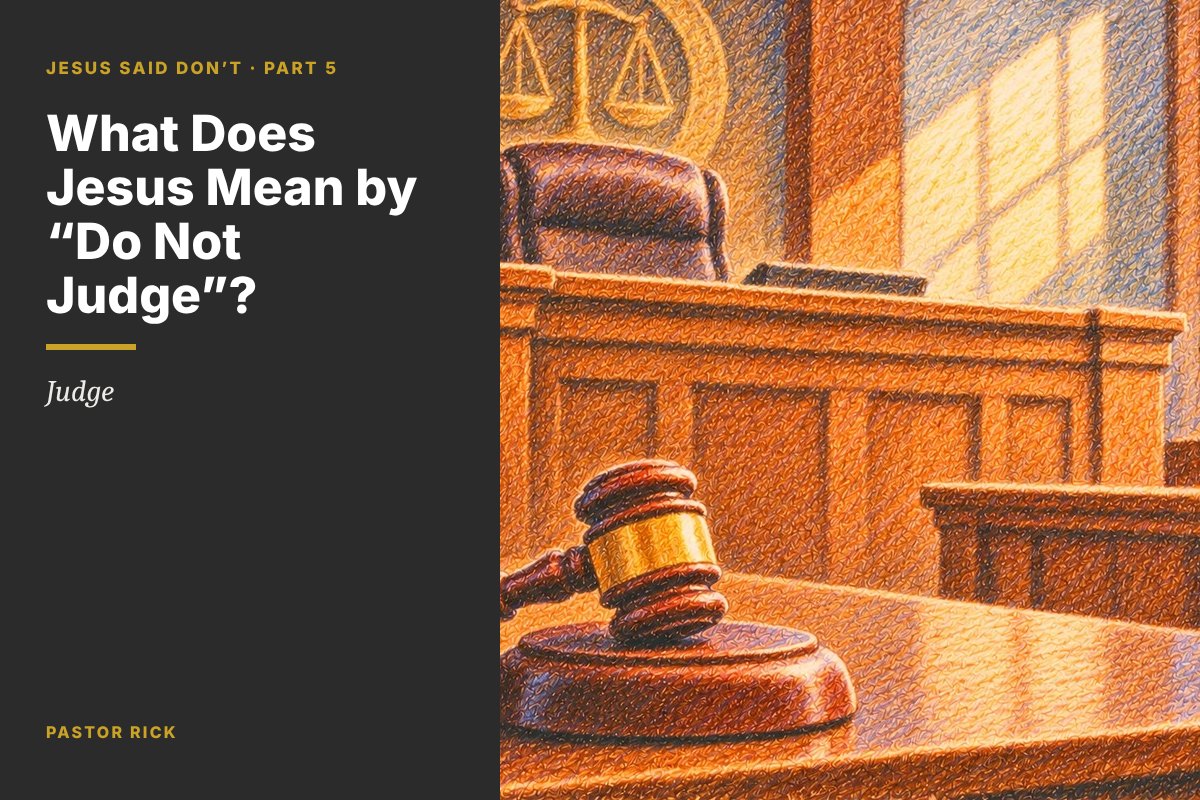
I sat down with a friend from our church who’s an attorney and asked her how judges decide a case. She explained that a judge applies the law, looks at past rulings and, when the rules allow, considers the background: what led a person to that moment.
Isn’t that what we want when we’re judged? We want people to see the context: how we grew up, what we’ve overcome, the kind of day we had. We want to be graded on a curve, with grace.
But when we judge others, we often take a single snapshot, decide what’s true and move on.
Here’s a simple definition: to judge someone is to size them up and write them off.
My Garage Problem
Not long ago, I discovered I judge people by their garages.
I’d recently gotten mine into great shape. A friend even refinished and painted the floor. So when I walk through the neighborhood and see an open garage that’s a mess, I think, Wow, their life must be out of control. It makes me feel better about myself.
How dumb is that? But we do it all the time. We get strong in one area and judge everyone who’s weak in it.
On one of those walks, I was listening to a sermon on this very passage. My wife was out of town with my earbuds, so it was playing on speakerphone in my pocket. (Sorry, neighbors.) A construction worker was walking the same direction behind me. The preacher said, “To judge someone is to size them up and write them off.”
I thought I heard someone behind me say, “Yep.”
The preacher said it again. “Yep.”
The third time, I turned around. He looked right at me and said, “Yep.” We had a moment. He knew exactly what it felt like to be judged.
Have you ever felt sized up and written off?
Why We Judge
The longer we’re Christians, the easier it gets to build a subculture that looks Christian. We dress a certain way, use certain words and pray in King James English. We think we’re becoming more holy. Everyone else thinks we’re becoming more weird.
I think we judge for two main reasons.
We’re jealous. Sin can be fun for a season. Sometimes Christians get snarky because it looks like other people are getting away with something. But if we really understood sin and the brokenness it brings, we’d feel compassion, not envy.
We’re self-righteous. This is what Jesus was confronting in the religious leaders of his day. They believed their good outweighed their bad and loved pointing out why yours didn’t.
Self-righteousness looks like this:
- It’s ignorant. It forgets how much we needed Jesus, our advocate who stood between us and the Judge and took our sentence himself.
- It underestimates God’s holiness and overestimates our own. God, you’re a little too merciful on this one. Have a seat. I’ll handle it.
- It’s critical. It traffics in criticism because being right matters more than anything.
- It’s rarely self-aware. Self-righteous people would never call themselves that. People talk about them, not to them. Family and friends quietly limit contact, not because the self-righteous are so holy, but because they won’t live in love.
My wife and I are learning how to parent adult children. What we want is for our kids to want a relationship with us long after they have to. And that starts while they still have to. Truth without love and relationship drives people away. Relationships aren’t microwaved. They’re baked, slowly, over time.
If the people around you share their victories but never their struggles, it might be worth asking whether Jesus is talking about you.
When Jesus confronted self-righteousness in the Gospels, he didn’t hold back. He saved some of his sharpest words for people who stood in the way of others coming to God (Matthew 23:13).
The Plank and the Speck
Notice what Jesus doesn’t say. He doesn’t say your brother has no speck. He wants me to know there’s a plank in mine, and often that plank is my own self-righteousness.
The word translated pay attention to means to look closely and carefully. Jesus uses it when he tells us to consider the lilies of the field (Luke 12:27). James uses it for gazing at your reflection in a mirror (James 1:23–24). It means to look hard, with humility, at your own life.
And a hypocrite, in Jesus’ sense, is someone more interested in other people’s flaws than in their own.
Three Kinds of People
1. Those who size people up and write them off. You’re not my kind of people. It might be politics, money, life choices, religion or your face. Some people even seem a little happy that there’s a hell, because they know a few folks who belong there.
That scares me. I believe Scripture teaches that hell is real. And I hate it. I wish with all my heart it weren’t true, because I deserve it as much as anyone. The only reason I’m not headed there is God’s grace through faith in Jesus. Who am I to decide who deserves it?
If that’s you, the answer is a two-syllable word: repent.
2. Those who size people up and keep their distance. They don’t hate anyone. They just use other people’s mess as a cautionary tale. See him? Don’t end up like that. They might put people on a prayer list and talk about them, but never to them. Learning from others is fine. But never getting involved is the opposite of love.
Years ago a seminary student visited my church. (I’ve been a seminary student many times, so I can say this. Some come in thinking they know everything and leave wanting to prove it.) After the service he shook my hand and said, “I have to tell you something. Your breath really stinks.”
I’d never met him. I was stunned. He told me, “It’s just my gift. I tell people what they need to hear.” I thought about recommending a good church up the street.
Here’s the thing: I probably did need to be told. Just not by him. He didn’t know me or love me, and he’d invested nothing in me.
He had three options. He could have written me off: That’s the church with the pastor with bad breath. He could have quietly checked his own breath and said nothing. Or...
3. Those who look at themselves first, then come alongside in love. They check their own breath first (and the spinach in their teeth). Then they put an arm around you and say, Hey, we’re friends. Everybody has a bad breath day. Today’s yours.
People who really understand sin know how much it has broken them. That’s exactly why they care enough to get involved in your life. They’ve deposited so much love that the truth can land, even when it stings.
Say It With Me
I have sinned and fallen short of God’s glory. I’m Rick, and I’m a sinner.
I do sin, even when I don’t want to.
I will sin.
“For the wages of sin is death, but the gift of God is eternal life in Christ Jesus our Lord” (Romans 6:23). Jesus is our advocate. He stands between us and the judgment we deserve.
My sin is as bad as yours, and yours is as bad as the sin of the people you can’t stand. “Whoever keeps the whole law and yet stumbles at just one point is guilty of breaking all of it” (James 2:10). The consequences may differ, but they’re God’s call, not ours.
Jesus was never scandalized by being close to sinners. Being with someone doesn’t mean you’ll become like them. If we’re so afraid of being influenced that we keep our distance, we need to grow, because Jesus told us to go.
Before I Pass Judgment
Here’s a line that sounds a little King James, but preachers love a rhyme:
Before I pass judgment on thee, I should stop and look for traces in me.
Then I go, in love and relationship, with the self-awareness that comes from facing my own issues, and walk side by side with you, pointing out the things that could destroy you, just as my own have tried to destroy me.
Live that way, and it will change your marriage, your parenting, your workplace, our church and our world.
Talk It Over
- When have you felt sized up and written off?
- What’s your “garage,” an area of strength you’re tempted to judge others by?
- Which sign of self-righteousness do you see creeping into your own life?
- Why do you think Jesus was so hard on self-righteous religious people?
- Which of the three kinds of people do you most often act like?
- Who in your life has earned the right to speak hard truth to you? Whose life have you invested in enough to do the same?
 Next in the seriesIs It OK for a Christian to Doubt?Doubt · Jesus Said Don’tRead it →
 Free · Short readsMore articles from Pastor RickSunday messages you can read in about 15 minutesSee them all →
 Capitol City Store · Everything is freeBooks, Bible studies, kids’ comics and short readsDozens of short reads like this one, plus free books, City Group studies, sermon notes, and kids’ comics and games. Read on your phone, print or share with a friend.Explore the store →
© 2026 Rick Melick. All rights reserved. Free to read and share for personal use. Not for resale.
Scripture quotations taken from The Holy Bible, New International Version®, NIV®. Copyright © 1973, 1978, 1984, 2011 by Biblica, Inc.™ Used by permission. All rights reserved worldwide.