Read First
You’re living in a rented house. God owns it, his Spirit lives in it, and one day you’ll hand back the keys.
This is not a diet plan. It isn’t a workout plan either. I won’t tell you what to eat or how many push-ups to do.
What I will tell you is that your choices matter. Your body is how you show up for your family, your friends, your church and the work God has given you. How you care for it shapes how much energy you bring, how long you’re here and how ready you are when God calls.
So what kind of tenant do you want to be?
A Church That Missed the Point
Paul wrote these words to a church in Corinth that had mixed religion with prostitution. It’s easy to read the passage, nod and think, Well, that’s not me.
But the Corinthians had a bigger problem underneath. They believed that as long as their spirit belonged to Jesus, it didn’t matter what they did with their bodies. Paul disagrees. Body and spirit both belong to God, and that truth reaches far beyond Corinth.
Paul makes his case in four steps. Each one comes with a question.
Step 1: You Were Bought With a Price
Who do I belong to?
My wife and I own a house in Arkansas that one of our sons rents from us. One day the water heater started acting up. He called me and said, “If it were my house, I wouldn’t worry about it. But it’s your house. I want to give it back to you in better shape than when I moved in.”
That’s the heart of this whole thing. Your body is a rented house, and God is the owner.
It’s also a house that ages. I once spent three hours helping a friend haul furniture and walked away thinking, We’ve still got it! The next morning I couldn’t straighten my hand. Every one of us is getting a little older every day. So what do we do with the time we have?
Now let me tell you what this verse does not mean. For a lot of people, “your body is a temple” sounds like a rule book. When I was growing up, church leaders used this verse to control people: no tattoos, no long hair on boys, nothing that didn’t fit their picture of a Christian.
That isn’t what Paul meant. Some choices are plainly destructive, and I’ll say so. But this passage isn’t a list of rules. It’s an invitation to freedom.
When you follow Jesus, you come under new ownership, not just new management. Jesus paid for you with his own life. That purchase set you free from God’s judgment, from sin’s grip, from your past and from other people’s expectations. That includes the world’s idea of beauty and success, and church rules that aren’t in the Bible.
You don’t have to measure yourself against an influencer, a gym crowd or anyone’s opinion. You live for an audience of One.
Step 2: Your Body Is Not Your Own
Whose approval am I living for?
The world has its own plan for your body, and it isn’t a good one. It pushes short-term goals: lose weight for the cruise, fit into the dress for the reunion, look good for the next photo. You lose 25 pounds, gain them back and start over. That cycle leaves people frustrated and worn out.
Paul offers a different way.
Notice the first thing Paul asks us to offer God: our bodies. Caring for them, for his sake, is an act of worship.
I separate two things that often get confused. Motivation is wanting to do it. It grows when you find exercise you actually enjoy. I enjoy lifting weights, and I listen to sermons on the treadmill. Discipline is doing it anyway, on the days you don’t feel like it. I’ll be honest: about two days out of five, I don’t want to go to the gym. I go anyway.
Your version won’t look like anyone else’s, and it doesn’t need to. My dad walks laps at the mall. A friend from church runs Ironman triathlons. I celebrate both. If you aren’t walking to the mailbox right now, walking to the mailbox is a great start.
For years I lost weight, gained it back and bought new “church pants” again and again. When a staff member asked what finally made the difference, I thought about it and said, “I was just done making excuses.”
Three reasons keep me going. I know a body can fail; I once woke up feeling fine and learned I had cancer. I love my family; when we neglect our health, we’re writing a check somebody else has to cash. And I belong to God; my greatest fear is that my own habits might cut short my usefulness to him.
Step 3: Your Body Is a Temple
Am I limiting what God can do through me?
When I was in first grade, my dad told me that strong athletes get their build from hard work in the gym. I decided to skip the work and just walk like an athlete. A month later my teacher called home to ask whether I needed physical therapy.
My dad set me straight: “You have to work for that. You can’t just show it.”
Faith works the same way. Some people start out excited and learn a lot. Then, slowly, they learn to say and do just enough to fit in at church, and they stop growing. Knowing more isn’t the same as growing deeper. Depth is applying the information you have.
For the Jewish people, the temple was the place where God’s presence lived. Paul tells believers that now God’s presence lives in them. The Holy Spirit seals our salvation, prays for us when we have no words, guides us into truth, grows good fruit in us and convicts us where something needs to change.
Where you are, God is. And where you go, God goes. That’s why this matters. If God works through your body, the way you treat your body can open doors for his work, or close them.
“Can I?” is a child’s question, and it’s a fine place to start. Growing believers learn to ask better ones. Not just “Can I?” but “Should I?” Not just “Is it okay?” but “Is it best?” The Holy Spirit doesn’t usually meet us in the cans. He meets us in the shoulds.
Here’s a sobering thought. We laugh about our weakness for donuts or fast food. If someone admitted a drug habit, no one would laugh. But both are ways of harming the body. One is just slower.
Step 4: Honor God With Your Body
Will I invite him into this part of my life?
Here’s some freedom: what religious people think about your body is not their business.
But here’s the catch. It’s easy to slide from “not their business” to “not anyone’s business,” and that includes God. When we close a part of our life to him, we stop growing there. If you feel defensive about this subject, pay attention to that feeling. The places we guard most closely are often where God most wants to work.
I once watched a six-foot-seven, 400-pound lineman clear the way for a touchdown. That man was built for exactly that job. Imagine if he spent his career wishing he were small like his coach. He’d miss the point. Be who God made you to be, and invite him in.
Injury, illness, age or a body you were born with: none of that puts you outside God’s care. He meets you exactly where you are. For some, getting up and walking to the mailbox is a real spiritual victory.
The Squeeze Test
My favorite experiment: take a donut, or a rolled-up slice of pizza, squeeze it, and watch what comes out. Then ask yourself whether you’d want that in your body.
One warning: don’t try it at a restaurant.
Before you choose, ask four questions. Can I? Is it within the boundaries? Should I? Is it the best choice, not just an acceptable one? Will it help? Will it give me more energy, more years or more readiness for God’s purpose? Who am I doing this for? God, or the mirror?
As I like to say, sometimes a donut has eternal consequences.
Try It This Week
- Hand over the keys. Read 1 Corinthians 6:19–20 and pray, “Lord, this house is yours.”
- Name your why. Finish this sentence: “I want to take care of my body so that I can ____.”
- Find your window. Look at your calendar and find 20 minutes. What can you set aside to make room?
- Move in a way you enjoy. Take a walk, ride a bike, visit the gym. Don’t compare.
- Ask “Should I?” Pick one food or drink you have often, and ask whether it helps you or holds you back.
- Pair body and spirit. Listen to Scripture, a sermon or worship music while you move.
- Open the door. Ask God where you’ve been guarded, and invite him in. Then tell a friend what you learned.
Talk It Over
- Have you ever heard “your body is a temple” used to shame someone? How has that shaped the way you read this passage?
- If God walked through your “rented house” today, is there a room you’d rather he skip?
- Judgment, sin, your past or other people’s expectations: which do you most need freedom from right now?
- Where might you be looking the part spiritually without doing the work?
- Energy, longevity or purpose: which one motivates you most, and why?
 Stay Out of My Comfort ZoneThe Myth of ModerationStart the series at Part 1Read it →
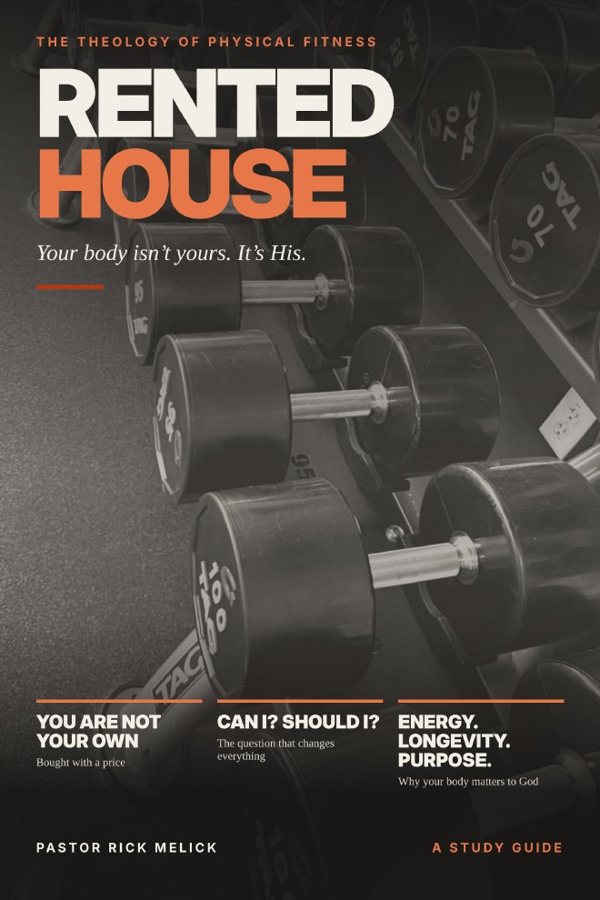 The entire series · Free bookRented HouseThe free study guide on health, fitness and faithRead it free →
 Capitol City Store · Everything is freeBooks, Bible studies, kids’ comics and short readsDozens of short reads like this one, plus free books, City Group studies, sermon notes, and kids’ comics and games. Read on your phone, print or share with a friend.Explore the store →
© 2026 Rick Melick. All rights reserved. Free to read and share for personal use. Not for resale.
Scripture quotations taken from The Holy Bible, New International Version®, NIV®. Copyright © 1973, 1978, 1984, 2011 by Biblica, Inc.™ Used by permission. All rights reserved worldwide.