‹ Book
Sticking AroundWelcome
‹ BackNext ›

Sticking Around: Faithfulness in Babylon, Daniel 1–6

Sticking Around: Daniel, by Rick Melick. Daniel stands above two lions, the fiery furnace and the dream statue, as four young captives walk through the blue gate of Babylon.
Before you turn the page

How to Use This Book

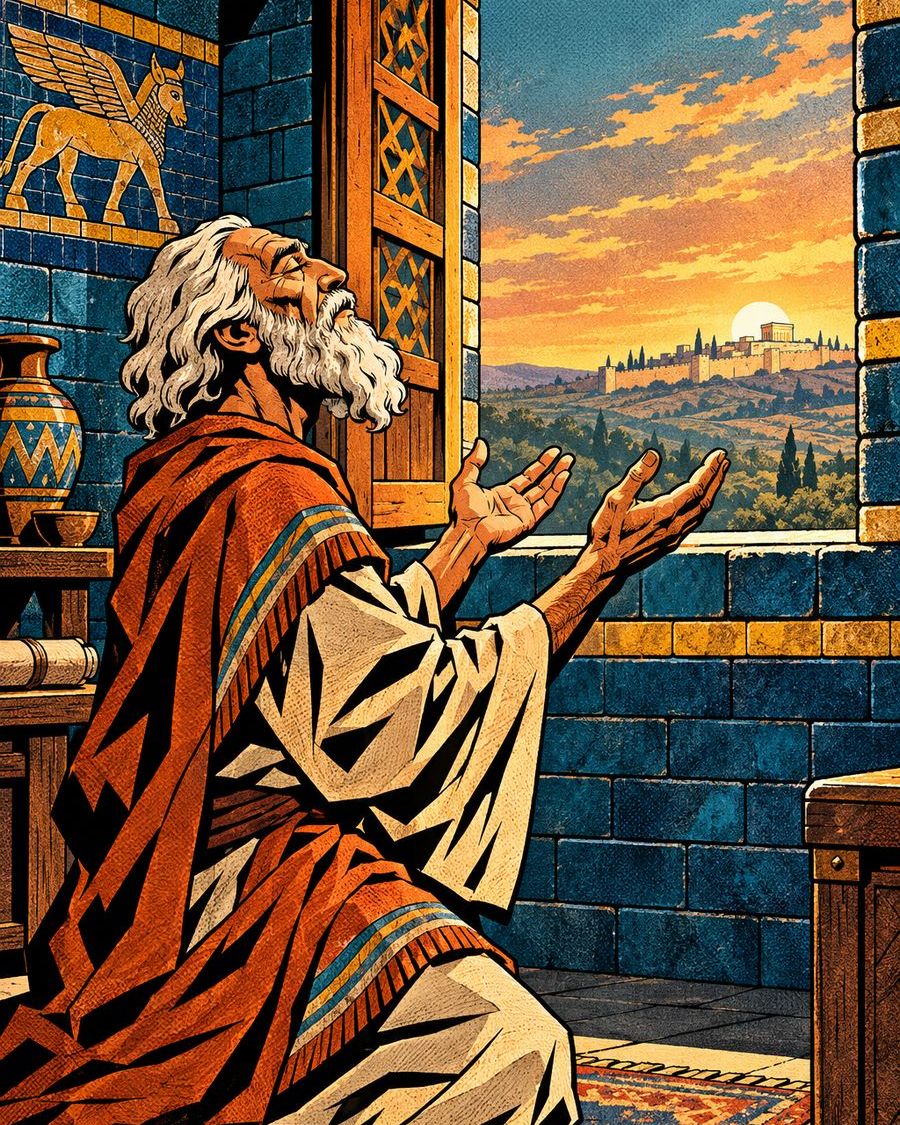
They were thirteen or fourteen when the soldiers came. Babylon’s army broke Jerusalem, and four boys from Judah’s royal and noble families were taken from their homes by force, marched hundreds of miles from everything they knew, stripped of their names, and handed to the most powerful king on earth to be remade in his image. Their identity would be challenged. Their friendship would be tested. Their lives would be threatened again and again. Their future would never be certain. Nobody would have blamed them for letting go of God. They never did. Seventy years later, one of them was still on his knees three times a day, even with the lions waiting. You never really know what a person’s faith is made of until it’s tested. Theirs was tested for a lifetime, and it stuck around.

This is a book about faith that sticks around: faith that’s built to last, through captivity, a death sentence, a blazing furnace, and a den of lions. It began as an eleven-week sermon series at Capitol City Church, and every message is still on YouTube, a QR code away. Watch first and then read, or read first and watch as a review. Either way, take your time. Faith that lasts is built the way theirs was: one small choice at a time.

1

The Story

The illustrations bring back the stories I told on Sunday. If you were there, you’ll remember them. If you weren’t, you’ll see why we laughed.

2

The Scene

The moment from Daniel, drawn big. Read the passage in your own Bible first. A paper Bible is best: circle, underline, and write in the margins.

3

The Teaching

The heart of the sermon, trimmed so it reads well. Look for the gold Key Verse box and the speech balloon with the line to remember.

4

Talk It Over

Five questions for your own reflection or a group. Some send you back to the text. Others send you into your own life.

5

This Week

One thing to do before next Sunday. Not five things. One. Little things become big things over time.

6

Watch It

Scan the QR code with your phone’s camera, or tap the button, to watch the full sermon on YouTube.

On your own

Take one chapter a week. Read the passage, then the chapter, then pick two questions to journal about. Do the “This Week” challenge and tell someone you’re doing it.

With a group

Give each person a week to read ahead. When you meet:

  1. 10 min: Look at the pictures. Who remembers the story?
  2. 15 min: Read the Daniel passage aloud.
  3. 25 min: Work through “Talk It Over.”
  4. 10 min: Share your “This Week” step and pray for each other.

With your kids

Start with the pictures. Ask them what’s happening in each picture, then read them the story from Daniel. These boys were about 13. Ask your kids what they would have done.

The Peter sermon that came just before the Daniel series opens the book as a prologue, because it set up everything that followed.

Prologue

Faithful

Matthew 14:22–33Preached April 12, 2026

The big ideaFaithfulness means following through: stepping out of the boat even when it doesn’t make sense.

Read first Matthew 14:22–33
Jesus Walks on the Water

14:22Immediately Jesus made the disciples get into the boat and go on ahead of him to the other side, while he dismissed the crowd. 23After he had dismissed them, he went up on a mountainside by himself to pray. Later that night, he was there alone, 24and the boat was already a considerable distance from land, buffeted by the waves because the wind was against it.

25Shortly before dawn Jesus went out to them, walking on the lake. 26When the disciples saw him walking on the lake, they were terrified. “It’s a ghost,” they said, and cried out in fear.

27But Jesus immediately said to them: “Take courage! It is I. Don’t be afraid.”

28“Lord, if it’s you,” Peter replied, “tell me to come to you on the water.”

29“Come,” he said.

Then Peter got down out of the boat, walked on the water and came toward Jesus. 30But when he saw the wind, he was afraid and, beginning to sink, cried out, “Lord, save me!”

31Immediately Jesus reached out his hand and caught him. “You of little faith,” he said, “why did you doubt?”

32And when they climbed into the boat, the wind died down. 33Then those who were in the boat worshiped him, saying, “Truly you are the Son of God.”

Before we ever opened Daniel, we spent a Sunday in a boat. The question that week shaped everything that came after: are you known for your follow-through?

We had just finished seven weeks on the fruit of the Spirit. We said it like this: what God plants within us grows, and what God grows within us shows. Faithfulness is one of those nine fruits. It’s stick-to-it-iveness: the ability to get knocked down, get back up, and keep going. A faithful person is someone who, in their faith, has resolved to follow through, even when it doesn’t make sense, even when it’s inconvenient, and even when the people they run with aren’t doing it.

Sent into the storm

Matthew 14 picks up on one of the hardest days of Jesus’ life. His friend and relative John the Baptist had just been beheaded. Jesus wanted to slip away and pray, but the crowds followed him. Most of them came for the show. He fed them anyway, five thousand men plus women and children.

John’s gospel tells us what happened next. The crowd decided to take Jesus by force and make him king. I’d guess the disciples were thrilled. After two years of living hand to mouth, they were finally going to get their seats at the table. But it wasn’t time, and Jesus did something none of them expected. He sent them away from the crowd, into a boat, toward a storm.

Read through Scripture and pay attention to the crowd. The crowd is almost always wrong. So ask yourself: is the crowd you run with pointing you toward the Lord or away from him? Sometimes being faithful means leaving your crowd behind.

Nine hours on the water

The trip across that part of the Sea of Galilee was a mile or two. These were fishermen; they’d made it a thousand times. That night they ended up three or four miles out, rowing against the wind for about nine hours. They were ready to die. And Jesus had sent them there.

Does he care? Is time running out? Is he even paying attention? Those are fair questions. A faithful person asks them, because God often takes us to that point. That’s where we grow.

Shortly before dawn, Jesus came to them walking on the lake. They screamed, “It’s a ghost!” He said, “Take courage! It is I. Don’t be afraid.”

“Take courage! It is I. Don’t be afraid.”
Matthew 14:27

Forget the boat. Count the steps.

Peter said, “Lord, if it’s you, tell me to come to you on the water.” He didn’t ask so he could post about it later. He wanted to get out of the boat because that’s where Jesus was.

Many of us have built a boat: a worldview that lets us keep one foot in and one foot out. We want to be faithful followers of Christ, and we also want everything else. Jesus says to leave the boat.

Everyone remembers that Peter sank. I’d rather you count how many steps he took first. Let’s say it was twelve. For the first three steps, the skeptics in the boat were sure he was going down. By step nine, maybe they were thinking about climbing out too. Then he saw the wind and started to sink. But those steps were success. The failures were the eleven who never got out of the boat.

Lord, save me. Three words. The prayer of a person who has stepped out of the boat.

And “immediately,” Matthew says, Jesus reached out his hand and caught him.

Peter climbs out of the boat in a storm, reaching toward Jesus standing on the waves
Then Peter got down out of the boat. (Matthew 14:29)

Three kinds of convictions

I believe we all carry three kinds of convictions.

Public convictions are the ones we want other people to think we have. Private convictions are the ones we honestly think we have, until a storm shows us we don’t. Core convictions are who we really are: what we do with our time, our schedule, and our money when life gets hard.

Here’s the formula I left with our church that day: core convictions plus follow-through equals faithful. Faithfulness isn’t reserved for the three percent of super-Christians. It’s one of the nine marks of what Christlike looks like. Do what you know to do, so God can do more.

Talk It Over

  1. When has your “crowd” pulled you away from what you knew God wanted?
  2. Jesus sent the disciples into the storm. How does that change the way you read your own hard seasons?
  3. What is your “boat,” the safe place that keeps you from stepping out?
  4. Which of your convictions are public, which are private, and which are core? Be honest.
  5. Peter’s prayer was three words long. When did you last pray something that simple and that desperate?

This Week

Name one thing you already know God wants you to do, and do it before Sunday. No excuses. Explanations are fine, but excuses are a choice.

Watch the sermon

Scan the code or tap below to watch “Faithful” on YouTube.

Watch on YouTube
Part One · Daniel 1

A Rope of Resolve

Four teenagers in a foreign city decide who they will be, one small choice at a time.

Chapter 1

Daniel’s Decision

Daniel 1:1–8Preached April 19, 2026

The big ideaStop telling the story that broke you. Decide to live as if God really is in control.

Read first Daniel 1:1–8
Daniel’s Training in Babylon

1:1In the third year of the reign of Jehoiakim king of Judah, Nebuchadnezzar king of Babylon came to Jerusalem and besieged it. 2And the Lord delivered Jehoiakim king of Judah into his hand, along with some of the articles from the temple of God. These he carried off to the temple of his god in Babylonia and put in the treasure house of his god.

3Then the king ordered Ashpenaz, chief of his court officials, to bring into the king’s service some of the Israelites from the royal family and the nobility— 4young men without any physical defect, handsome, showing aptitude for every kind of learning, well informed, quick to understand, and qualified to serve in the king’s palace. He was to teach them the language and literature of the Babylonians. 5The king assigned them a daily amount of food and wine from the king’s table. They were to be trained for three years, and after that they were to enter the king’s service.

6Among those who were chosen were some from Judah: Daniel, Hananiah, Mishael and Azariah. 7The chief official gave them new names: to Daniel, the name Belteshazzar; to Hananiah, Shadrach; to Mishael, Meshach; and to Azariah, Abednego.

8But Daniel resolved not to defile himself with the royal food and wine, and he asked the chief official for permission not to defile himself this way.

I meant to preach one Sunday on Daniel in the lions’ den. But every time I looked for the application in chapter 6, I ended up back in chapter 1. The faithfulness we see at the end started somewhere. So we started at the beginning.

Here’s the theme of the entire series, and especially of Daniel 1: it may be time to stop telling the story that broke you and start living the story that will transform you.

Baxter, a scruffy little terrier in a blue helmet, as hailstones bounce off his head
Baxter, our thirteen-pound theologian, during the hailstorm.

The God you serve threw rocks at me

One Wednesday afternoon, Joy and I got caught in a hailstorm in Johnston and pulled over until it passed. When we got home, Baxter, my thirteen-pound dog, would not go outside. He’d stick his head out the dog door, look at the sky, and shake. We finally figured out he’d been hailed on.

I sat him down. “Bax, it happened. Hailstorms come and go.” He looked right at me, and this is what he said: “The God you serve threw rocks at me. I’m going on the carpet. You deal with it.”

Maybe you feel that way. Maybe you feel like God threw rocks at you, and you’re not going any further. Daniel had every reason to feel that way too.

Four boys in Babylon

Around 605 B.C., Babylon was the center of the world, with massive walls, the best schools, and the law that went back to Hammurabi. Its new king, Nebuchadnezzar, was brilliant and ruthless. He had already conquered Judah once. When Judah rebelled, he crushed it and scattered its people.

From the captives he ordered his chief official to pick the best young men: no defects, handsome, quick to learn. They would get three years of training in the language and literature of Babylon, including its astrology and magic, and then serve the king. Daniel, Hananiah, Mishael, and Azariah were probably thirteen or fourteen years old. Picture a middle schooler. They had been pulled out of their homes, their hopes, and their future. They would likely never see their families again.

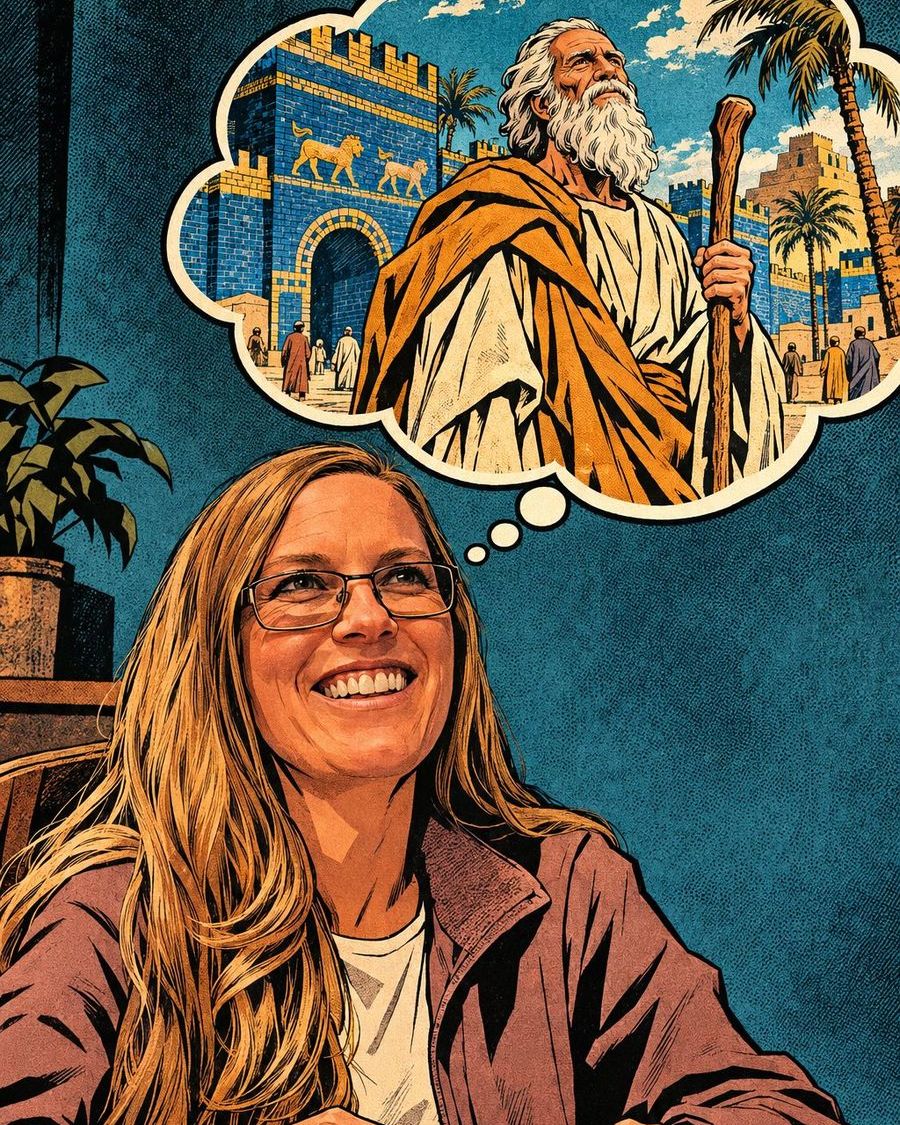
When I was working on this series, I had coffee with Ashlie Van Horn, our creative arts director. She told me she had always pictured Daniel, Shadrach, Meshach, and Abednego as old men with beards and robes. They did grow old. By the time Daniel faced the lions he was probably in his eighties. But when this story starts, they’re kids.

A woman reading her Bible imagines Daniel as an old man with a white beard outside Babylon's blue gate
Most of us picture Daniel with a long white beard. In chapter 1, he was about thirteen.

Then Babylon took their names. Hananiah became Shadrach, Mishael became Meshach, and Azariah became Abednego, each name honoring a Babylonian god. Daniel got the worst one: Belteshazzar, a name tied to Bel, the chief of all Babylon’s gods.

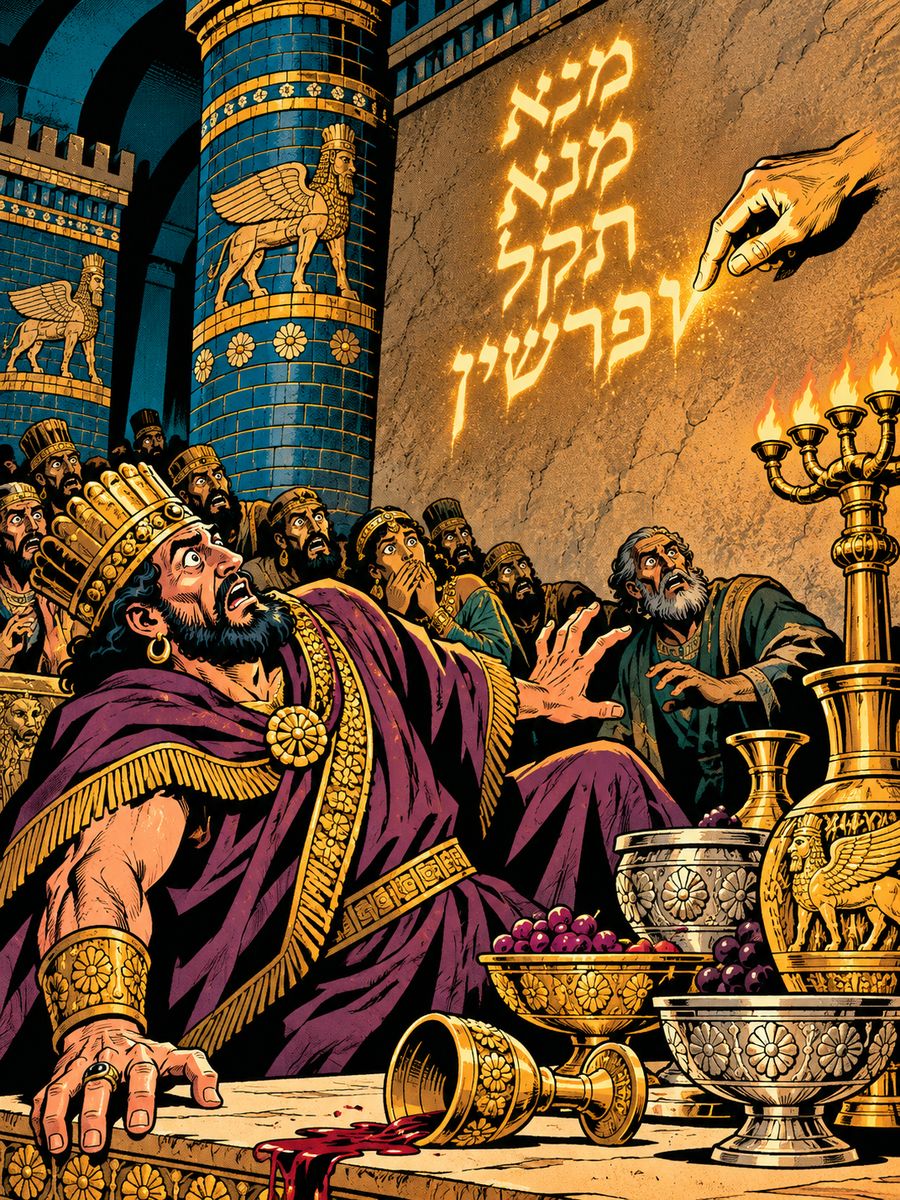
Circle one detail in verse 2: Nebuchadnezzar carried off articles from God’s temple. They come back later, in chapter 5.

Nobody would have blamed them if they had settled into the story that trapped them.

Who is really in control?

Three times in this chapter it looks like Nebuchadnezzar is calling the shots, and three times the text tells us who really is. In verse 2, the Lord delivered Jehoiakim into his hand. In verse 9, God caused the official to show favor. In verse 17, God gave the young men knowledge. Even when things looked terrible, God was working all things together for good.

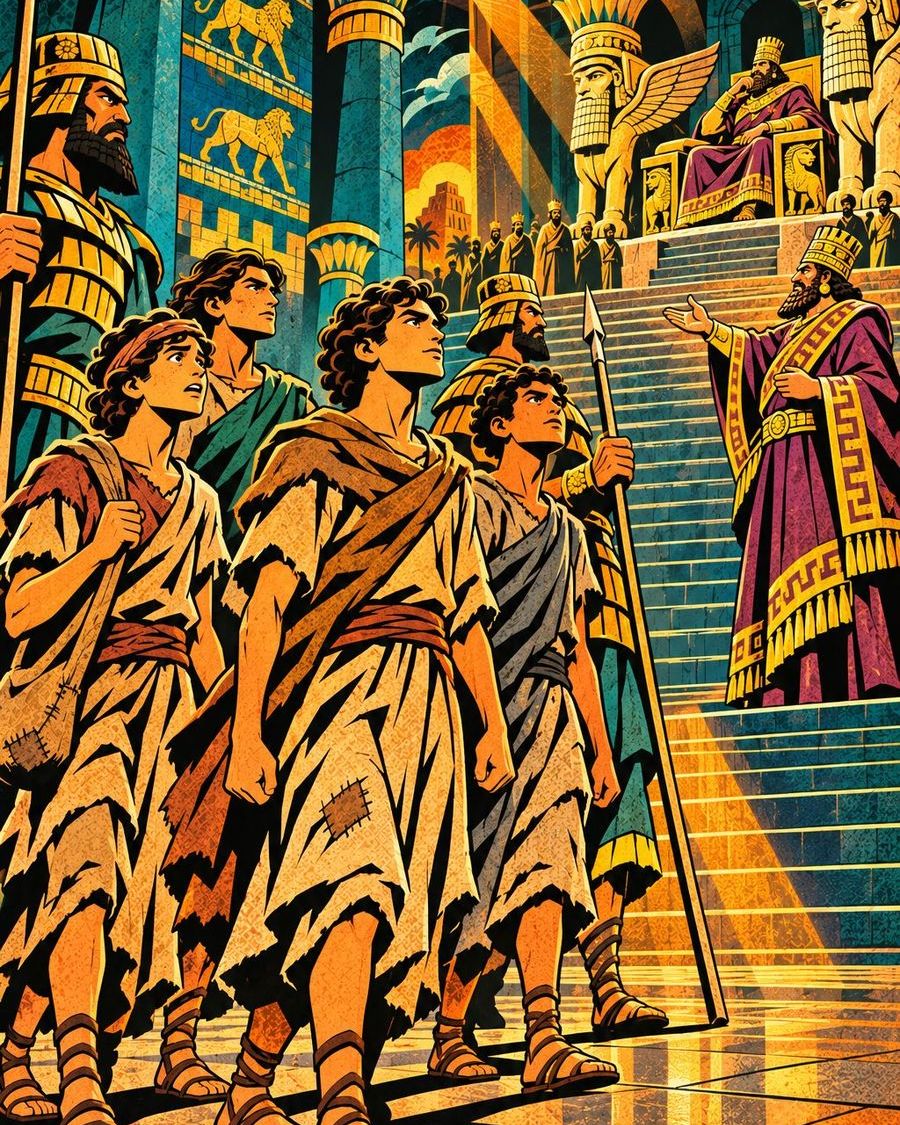
Four ragged teenage captives look up at the palace of Babylon as the king's official presents them
Babylon, about 605 B.C. Four teenagers, far from home, before the king who took them.

The decision

Then comes verse 8: “But Daniel resolved...”

But Daniel resolved not to defile himself with the royal food and wine, and he asked the chief official for permission not to defile himself this way.
Daniel 1:8

Daniel had to decide whether he simply believed in God, or whether he really believed God and his promises. He couldn’t put the choice off. The decision had found him.

When life looks bleak, you have to answer the same question Daniel did: how would I live if I really believed God was in control? How would it change the way I spend my time, what I think about, and what I do with what I have?

Weaving a rope

The Hebrew word behind “resolved” pictures making a rope. You take separate strands and weave them together. Daniel took the strands of his past (what his parents taught him, the Scriptures, the stories of faith he’d grown up on) and wove them into something strong enough to hold.

Resolve has nothing to do with emotion. You can be freaking out and still be faithful. Daniel simply decided to live as if God really was in control.

One thing

Later that week I told Baxter to go potty and go get his mom. He did both at once, on the bedroom carpet. So I’m not asking you to do two things or three. Pick one thing that will build faithfulness in you, and do it well.

Grace can inspire you, or it can enable you. When we lean on God’s forgiveness as a reason never to move forward, grace becomes one of the worst things in our spiritual life. When grace inspires and transforms us, it’s the best thing the Holy Spirit can use.

Talk It Over

  1. What “story that broke you” are you tempted to keep telling?
  2. List everything that was taken from these four boys. What do you think they had left?
  3. Find verses 2, 9, and 17. How does each one show God at work behind the scenes?
  4. What strands are woven into your rope? Where did they come from?
  5. Finish this sentence honestly: “If I really believed God was in control, I would...”

This Week

Add one thing to your life that will grow faithfulness in you. Just one. Ask the Holy Spirit to help you follow through, and tell someone what it is.

Watch the sermon

Scan the code or tap below to watch “Daniel’s Decision” on YouTube.

Watch on YouTube

For the kids in your life: the same story in the Kids' Edition, Chapter 1 · Comic, Issue 1: New Place, New Names

Chapter 2

Doing What You Can

Daniel 1:9–14Preached April 26, 2026

The big ideaTrust God with ALL your heart, and do what you can right where you are.

Read first Daniel 1:9–14

1:9Now God had caused the official to show favor and compassion to Daniel, 10but the official told Daniel, “I am afraid of my lord the king, who has assigned your food and drink. Why should he see you looking worse than the other young men your age? The king would then have my head because of you.”

11Daniel then said to the guard whom the chief official had appointed over Daniel, Hananiah, Mishael and Azariah, 12“Please test your servants for ten days: Give us nothing but vegetables to eat and water to drink. 13Then compare our appearance with that of the young men who eat the royal food, and treat your servants in accordance with what you see.” 14So he agreed to this and tested them for ten days.

Daniel and his friends found themselves in a foreign world with different rules. I found myself in one too. It’s called Walmart.

Pastor Rick in line at Walmart Returns and Exchanges, holding a box and a receipt
Customer service: “You’ll have to take it to FedEx. Two doors down.”

We are in Walmart

My son Richard sent his mama a popcorn popper, which was sweet, except we already had one. I offered to return it to Walmart for him. I brought the popper and the return receipt with the QR code to customer service. The young lady behind the counter said she couldn’t take it, because he’d checked a box to mail it back. “Good news, though,” she said. “There’s a FedEx two doors down.”

So I walked it down to the FedEx inside Walmart and asked what they would do with it. “We’ll mail it to Walmart.” I said, “We are in Walmart.”

At that point I could have had an aneurysm. I could have sent strongly worded emails. Or I could accept that I was in a different world with different rules, and just go with it.

That’s the choice Daniel, Shadrach, Meshach, and Abednego faced, with a lot more at stake than a popcorn popper.

With ALL your heart

All week I prayed one verse over our church family:

Trust in the LORD with all your heart and lean not on your own understanding; in all your ways submit to him, and he will make your paths straight.
Proverbs 3:5–6

If I were preaching this verse, the word I’d put in capital letters is ALL. Aren’t you tired of living with a divided heart, one foot in and one foot out, testing the water but never trusting? It’s exhausting, and it’s not the life you were made for. Trust him with all of it, and he will direct your path. The God-directed path is what I want for my wife, my kids, my grandkids, and you.

Curse the darkness, or light a candle?

There’s not one hint of bitterness, resentment, or entitlement in Daniel 1. Think about how much bitterness we carry over things that pale next to what these boys went through. They were dealt a hand, and they decided to play it God’s way.

Daniel didn’t focus on everything he couldn’t do. He didn’t wait for things to line up. This is the day the Lord has made. I am the me the Lord has made. These are the people the Lord has put around me. I’ll rejoice and be glad in it, and I’ll do what I can.

He asked

Notice how Daniel did it. He went to the very official holding him captive and asked permission. The word pictures a respectful, heartfelt request, submissive but still passionate. He wasn’t demanding his rights or insisting they ship in food from home. He said: just vegetables and water. Test us for ten days, then compare us with the others.

I know a Christian business owner who stopped hiring Christians because so many of them demanded that his workplace bend around their convictions. Daniel worked inside the system with respect, and God gave him favor.

The strands our kids see

Somebody had prepared these boys for Babylon. When the world hit them head-on, they had strands to weave a rope with, strands their parents and community had planted. Kids will weave a rope from whatever strands they’ve seen in us. Words are cheap. If we talk faith but live with one foot in the boat, our kids will do one of two things: deconstruct a faith they know isn’t real, or copy it. An authentic faith is the only faith worth sharing. A humble, broken, repentant, honest faith is what prepares a kid for Babylon.

Tell yourself no

Daniel’s resolve started with abstaining, telling himself no. When I was a young youth pastor, my senior pastor’s wife served us sandwiches and then chocolate cake. I dove in. He passed. When I asked him why, he said: “Sometimes you have to tell yourself no in the little things, because the big things are coming.”

So I quit caffeine (and begged Joy not to quit the same week). I challenged our staff to do the same. They gave up too much social media, energy drinks, doom-scrolling, phone games, and texting while driving. What they found was more confidence, more time, and room to think the thoughts they actually wanted to think.

Little things become big things over time.

Some of you need to cut out something bigger. We lie to ourselves most about three things: how much we drink, how much we eat, and how much we exercise. If it’s the right goal, for the right reason, with the Lord’s help and whatever help you need from others, he will help you succeed. And three days isn’t quitting. Try three months.

Talk It Over

  1. Where in your life are you living by “different rules” you didn’t choose? How are you responding?
  2. What would trusting God with ALL your heart change this week?
  3. Compare how Daniel asked with how Christians often push for their convictions. What can we learn?
  4. What strands of faith are the kids in your life actually seeing in you?
  5. What small thing could you tell yourself no to, just to prove you can?

This Week

Last week you added one thing. This week, remove one thing. Choose something that has a little control over you, cut it out, and tell someone you trust so they can ask how it’s going.

Watch the sermon

Scan the code or tap below to watch “Doing What You Can” on YouTube.

Watch on YouTube

For the kids in your life: the same story in the Kids' Edition, Chapter 2 · Comic, Issue 2: The Lunch Table

Chapter 3

One Step Out, One Step In

Daniel 1:15–17Preached May 3, 2026

The big ideaStep out of the crowd, and step in for the people closest to you.

Read first Daniel 1:15–17

1:15At the end of the ten days they looked healthier and better nourished than any of the young men who ate the royal food. 16So the guard took away their choice food and the wine they were to drink and gave them vegetables instead.

17To these four young men God gave knowledge and understanding of all kinds of literature and learning. And Daniel could understand visions and dreams of all kinds.

Before you read another word, settle one thing: this chapter is for you. Not your spouse, not your kid, not the friend you wish had been in church that Sunday.

Joy holds the shovel out to Rick in the backyard while Daisy the poodle sits proudly between them
“I don’t need a shovel. YOU need the shovel.”

Who needs the shovel?

Joy and I walked in the door one afternoon, and she called out, “Baxter pooped again.” Our house rule is that whoever finds it cleans it up, so I pretended not to hear. Then she said, “It’s not poop.” It was a baby bunny. Out back stood Daisy, our prim and proper standard poodle, right in the middle of four more, smiling like she’d done something worth doing.

Joy asked if I had a shovel. I said I’d be happy to get her one. She said, “I don’t need a shovel. You need the shovel.”

Don’t sit here thinking somebody else needs the shovel this morning. Let God’s Word land on you. Pick it up and do the work.

Real history, real choices

Daniel’s story isn’t make-believe. Around the same time, Aesop was telling his fables, the Maya were rising, and Phoenician sailors were rounding Africa. Nebuchadnezzar was real and terrifying. As a prince, he once raced an army five hundred miles in fourteen days to claim his father’s throne. Babylon had fifty miles of walls and a hundred bronze gates.

From Judah he took somewhere between a dozen and two hundred promising young men. We know the names of only four. Faithfulness begins with a choice. Choices become patterns, patterns become character, and character fulfills your purpose. Then one day you close your eyes here, open them in heaven, and hear, “Welcome home. You were good and faithful.”

The rope again

“Daniel resolved,” and that word still means weaving a rope. The rope you end up with shows who you really are. Why refuse the king’s food? First, it had been offered to idols. Second, sharing someone’s table meant identifying with them, in this case with the gods of Babylon. Faithfulness is taught, but it’s also caught.

At the end of the ten days they looked healthier and better nourished than any of the young men who ate the royal food.
Daniel 1:15
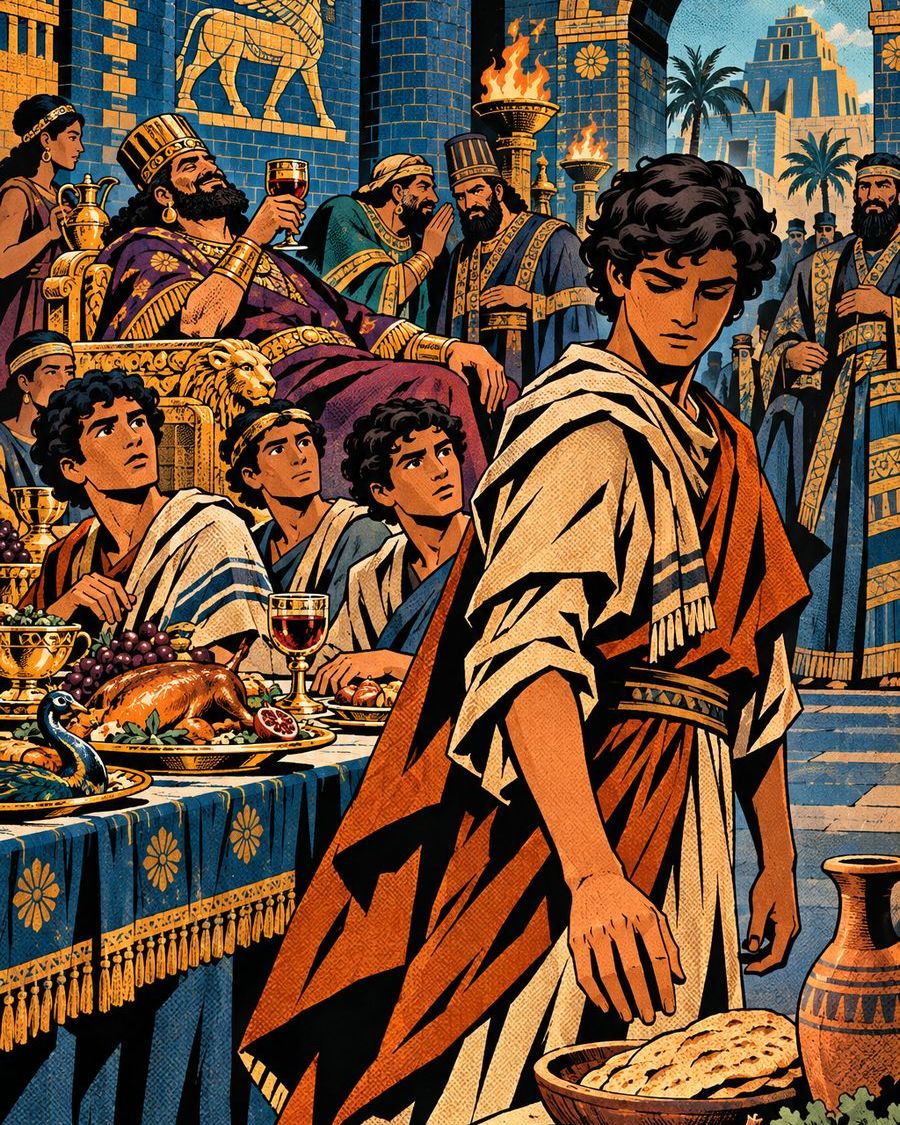
Daniel turns away from the king's feast toward a simple meal of bread and vegetables while his friends watch
One step out of the crowd. (Daniel 1:8)

One step out: leave the crowd

Most of the captured boys apparently took the king’s food. Daniel stepped away from that crowd, the guys he grew up with, his people. That was unpopular, probably unwise, and definitely scary.

The crowd is almost always wrong. It shouted “Hosanna” and, within a week, “Crucify him.” In Mark 6, Jesus taught in his hometown synagogue, and the people there said, “Isn’t this the carpenter? Isn’t this Mary’s son?” They took offense. Jesus left, and as far as we know he never went back. A life of faithfulness sets you apart. You serve a different master and spend your time and money differently, and people won’t always understand.

Show me your friends, and I’ll show you your future.

I think we need two kinds of relationships. The first is with people who don’t know Jesus. We love them, befriend them, pray for them, and gently nudge them toward him, without being obnoxious or religious. The second is with people of faithfulness. They aren’t perfect, but they genuinely want to walk with God. If there’s no room for those friends, make room. Joy calls it the friendship Lego: you only have so many holes. The most confusing friends are the ones who say they follow Christ but don’t back it up.

One step in: carry your inner circle

Then Daniel spoke up for Shadrach, Meshach, and Abednego. Pastor Brandon joked about what they might have said: Shadrach is still praying about it, Meshach isn’t sure, and Abednego needs to text his mom. Daniel said, “No, we’re doing this.” He did what he could with the people God had put closest to him.

And God showed up, as he always does for people who step out in faith. Your closest circle comes first. If you’re married, that’s your spouse, whether or not they’re doing their part. If kids are at home, it’s them. If your adult kids have wandered, it’s your responsibility and your privilege to stay present and keep building the bridge.

How would you blow it up?

Here’s an exercise I use. Think about how you could wreck a relationship, then do the opposite on purpose. With Joy, I’d ruin things by asking her to get to the point and skip the fluff. So I tell myself, my time is not more important, and I listen until she’s done. With my grown sons, I’d ruin things with too much advice. So before every call I remind myself: listen, encourage, and offer help if they want it.

You can’t cause an outcome, but you can create an environment for God to bless.

Talk It Over

  1. Who do you catch yourself wishing had heard a sermon? What would it look like to pick up the shovel yourself?
  2. Name a time your crowd was wrong. What did stepping away cost, or what would it cost?
  3. Count your “Lego holes.” Who fills them, and who’s missing?
  4. Who is your Shadrach, Meshach, and Abednego? Who do you speak up for?
  5. Pick one close relationship. What are two ways you could blow it up, and what are the opposites?

This Week

Choose one person in your inner circle. Write down two ways you could hurt that relationship, flip each one into a positive habit, and put those habits on your calendar so you can look back on Friday and call it a win.

Watch the sermon

Scan the code or tap below to watch “One Step Out, One Step In” on YouTube.

Watch on YouTube

For the kids in your life: the same story in the Kids' Edition, Chapter 2 · Comic, Issue 2: The Lunch Table

Chapter 4

Picking a Plan

Daniel 1:18–21Preached May 10, 2026

The big ideaGod’s will starts where you are: look for his hand, make a plan, and pray.

Read first Daniel 1:18–21

1:18At the end of the time set by the king to bring them into his service, the chief official presented them to Nebuchadnezzar. 19The king talked with them, and he found none equal to Daniel, Hananiah, Mishael and Azariah; so they entered the king’s service. 20In every matter of wisdom and understanding about which the king questioned them, he found them ten times better than all the magicians and enchanters in his whole kingdom.

21And Daniel remained there until the first year of King Cyrus.

On the road of life, things run out in front of you. You swerve, and you don’t know how long to swerve or when to swerve back. The time to know God’s voice is before the dog hits the road.

Rick grips the wheel of his truck as a husky darts across a winding Ozark road
The scenic route: a husky out of nowhere. Swerve!

Good reflexes

Joy and I drove home from Arkansas after her dad’s spine surgery (he’s doing fine). I like the scenic route, so we cut through the Ozarks, where the brush grows right up to the pavement. A big husky came flying out of the weeds with almost no time to react. I swerved as far as I could, swerved back, and heard his nose tap the side of the truck. In the mirror he was trotting along, happy as could be, with no idea how close he’d come.

Joy said, “Sweetheart, your reflexes are really good.” That doesn’t happen often while I’m driving.

Many of us wait until something runs out in front of us to ask, “All right, God, what’s your plan?” You don’t want to start from scratch in a crisis. That’s why we’re building a life of faithfulness now.

Three stages of God’s will

I believe God has a specific will for your life. He created you on purpose and for a purpose. There are three ways to think about his will, and they come in order. You can’t skip to the third.

1. God’s providential will. This is what God decides, and it’s above our pay grade: when to send the flood, or when to send Jesus. Here we decide whether we simply believe in God or actually believe him, trusting that even what doesn’t make sense to us has a point.

2. God’s moral will. These are the commands he’s already given us, the thou shalts and thou shalt nots. Jesus talks so much about forgiveness that we know it’s part of God’s will for us. If you’re holding a grudge, holding back your giving, or refusing to make peace when you know you should, you’re out of step. You won’t hear his personal will while you’re ignoring what he’s already said. God doesn’t wait for perfection, but he does want a body in motion.

3. God’s personal will. This is his plan that’s unique to you. It starts where you are right now, with the people closest to you.

Abram’s restlessness, Daniel’s ditch

In Genesis 12, God called Abram from Ur, not far from where Babylon would rise. Abram was seventy-five, with a family, a career, a savings account, and a retirement plan. He also had a restlessness in his soul he couldn’t name. God said, “Go,” and Abram went. Maybe nothing is wrong in your life, yet something is stirring. That’s an exciting place to be.

Daniel’s life was the opposite. Something ran in front of his truck that he didn’t cause, and he ended up in the ditch. Read only verses 1 to 14 and it looks like tragedy. God’s will reads a lot like Hebrew, which reads right to left: it’s much easier to see looking back.

I dare you to find one hint of bitterness in Daniel.

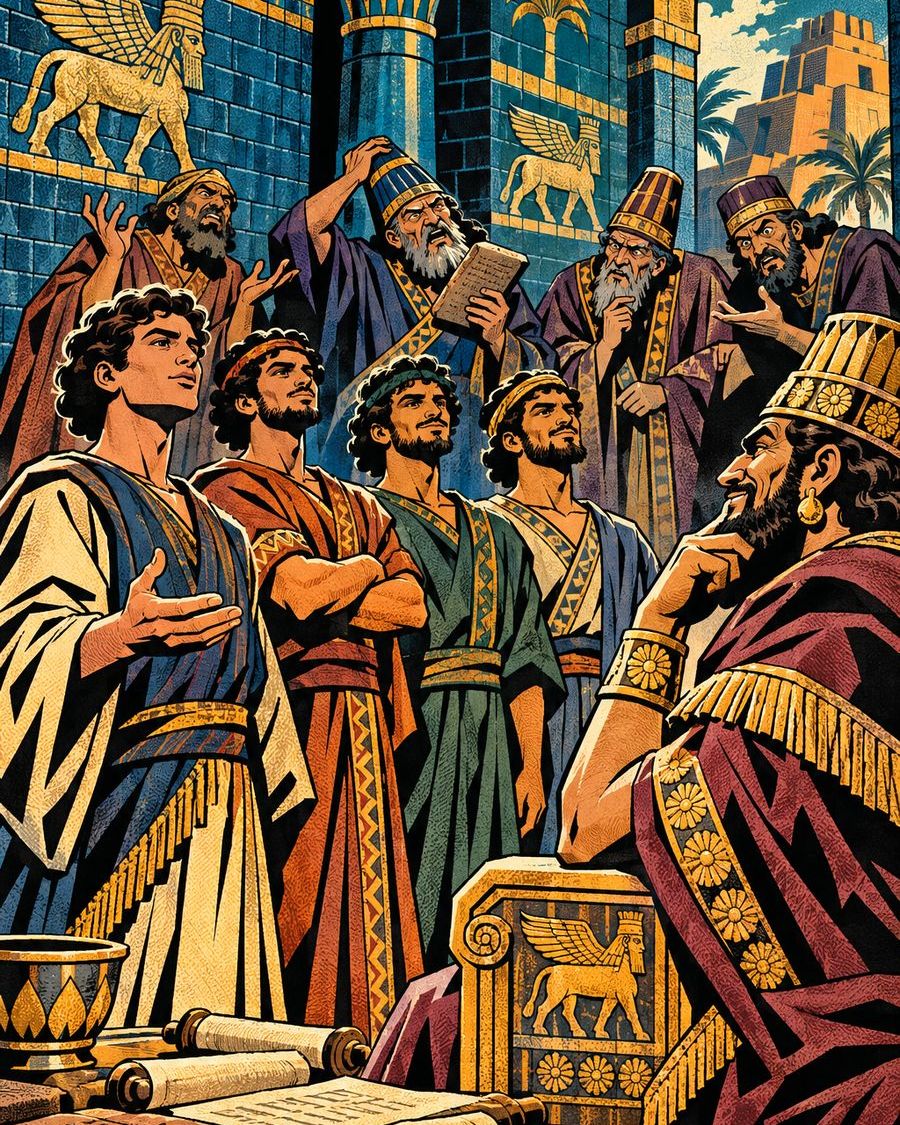
The four young men stand confidently before the smiling king while his magicians fume behind them
“Ten times better than all the magicians and enchanters in his whole kingdom.” (Daniel 1:20)

“God gave”

To these four young men God gave knowledge and understanding of all kinds of literature and learning. And Daniel could understand visions and dreams of all kinds.
Daniel 1:17

Circle “God gave.” He gave these boys mastery of subjects they never wanted to learn, taught by people who couldn’t care less about God, because God had a plan.

Babylon’s dream experts used a kind of code book. Dream about a ghost carrying salt, and it means somebody’s going to die. Dream about barley in a field, and it means prosperity. If your dream wasn’t in the book, they added it. Daniel didn’t need the book. He had the Spirit of God.

At their final exam, the king found them ten times better than all his magicians. God made them thrive right where they were: not where they wanted to be, not where they demanded to be, and not where they felt entitled to be. Some of us wait, bitter, for God to move us somewhere better, and we miss the point.

How to find God’s personal will

Look for his providence. God uses ordinary things to bring about supernatural results: a person you don’t know today and will meet tomorrow, or a door that isn’t there yet.

Make a plan. Daniel couldn’t do everything, but he could do something, so he made a plan. You can’t get in shape without one, and you won’t get a better marriage or better parenting without one either. If you don’t have a plan, it isn’t really important to you. Any plan is better than the one you don’t have.

Pray powerfully. I’m less concerned about how long I pray than about how much time goes by between my prayers. At 9:00 every morning my phone reminds me: This is the day the Lord has made.

Look for his providence. Make your plan. Pray. You’ll find it.

Talk It Over

  1. When something “ran out in front of your truck,” were you prepared spiritually, or starting from scratch?
  2. Is there a step of God’s moral will (forgiveness, giving, making peace) you’ve been avoiding?
  3. Do you relate more to Abram’s restlessness or Daniel’s ditch right now?
  4. Looking back, where can you now read God’s will “right to left”?
  5. What’s one area where you need an actual plan, not just good intentions?

This Week

Write a simple plan for one area that matters to you, such as your marriage, your kids, or your walk with God. Then set a recurring phone reminder to stop and pray at least once a day.

Watch the sermon

Scan the code or tap below to watch “Picking a Plan” on YouTube.

Watch on YouTube

For the kids in your life: the same story in the Kids' Edition, Chapter 3 · Comic, Issue 3: Your Closest Friends

Part Two · Daniel 2

The King’s Bad Dream

A death sentence, a long night of waiting, and four friends on their knees.

Chapter 5

Fear’less: Behind the Scenes and Bad Dreams

Daniel 2:1–16Preached May 17, 2026

The big ideaWhile you are waiting, God is working.

Read first Daniel 2:1–16
Nebuchadnezzar’s Dream

2:1In the second year of his reign, Nebuchadnezzar had dreams; his mind was troubled and he could not sleep. 2So the king summoned the magicians, enchanters, sorcerers and astrologers to tell him what he had dreamed. When they came in and stood before the king, 3he said to them, “I have had a dream that troubles me and I want to know what it means.”

4Then the astrologers answered the king, “May the king live forever! Tell your servants the dream, and we will interpret it.”

5The king replied to the astrologers, “This is what I have firmly decided: If you do not tell me what my dream was and interpret it, I will have you cut into pieces and your houses turned into piles of rubble. 6But if you tell me the dream and explain it, you will receive from me gifts and rewards and great honor. So tell me the dream and interpret it for me.”

7Once more they replied, “Let the king tell his servants the dream, and we will interpret it.”

8Then the king answered, “I am certain that you are trying to gain time, because you realize that this is what I have firmly decided: 9If you do not tell me the dream, there is only one penalty for you. You have conspired to tell me misleading and wicked things, hoping the situation will change. So then, tell me the dream, and I will know that you can interpret it for me.”

10The astrologers answered the king, “There is no one on earth who can do what the king asks! No king, however great and mighty, has ever asked such a thing of any magician or enchanter or astrologer. 11What the king asks is too difficult. No one can reveal it to the king except the gods, and they do not live among humans.”

12This made the king so angry and furious that he ordered the execution of all the wise men of Babylon. 13So the decree was issued to put the wise men to death, and men were sent to look for Daniel and his friends to put them to death.

14When Arioch, the commander of the king’s guard, had gone out to put to death the wise men of Babylon, Daniel spoke to him with wisdom and tact. 15He asked the king’s officer, “Why did the king issue such a harsh decree?” Arioch then explained the matter to Daniel. 16At this, Daniel went in to the king and asked for time, so that he might interpret the dream for him.

Daniel 2 is about a king’s nightmare, but this chapter is about waiting. You may be waiting right now. If not, you have been, and you will be again.

Joy as a secret agent in a trench coat on a rainy London night, Big Ben behind her
The dream: Joy, secret agent for the British government. “I’ve sworn an oath.”

My wife, the secret agent

One Friday night I dreamed Joy had been a secret agent our entire thirty-six-year marriage, working for the British government. She’s from Arkansas. She wouldn’t tell me her secrets, because she’d “sworn an oath.” I said, “You can’t possibly take an oath to the British seriously.” I woke up grouchy. (We had just finished a British spy show.) I never told her about the dream, because she would have given me a look that made me wonder.

Dreams and visions

There are twenty-one dreams recorded in Scripture, and ten of them are in Genesis. Two belong to Joseph. Only one woman’s dream is recorded: Pilate’s wife, during Jesus’ trial. God spoke through dreams mostly before the Holy Spirit came to live in believers at Pentecost. Visions continue in the New Testament. A true vision from God almost always puts you in a place of sacrificial service, not at the center of the story.

Start where you are

By Daniel 2 the four had finished, or nearly finished, Babylon’s university. Instead of growing bitter, they decided to be faithful right where they were. So accept where you are. If life is comfortable, don’t cling to that comfort, because God is always up to something next. If you’re somewhere you never wanted to be, let go of the bitterness.

A word about the dark arts

These boys had to sit through classes in magic, astrology, and dream reading, and sort truth from error. The occult is real. Fortune-telling, astrology, mediums, and Ouija boards all open doors in your mind that are hard to close. How far away should you stay? All the way. It’s impossible to protect our kids from the world, but we can prepare them, because Babylon is coming.

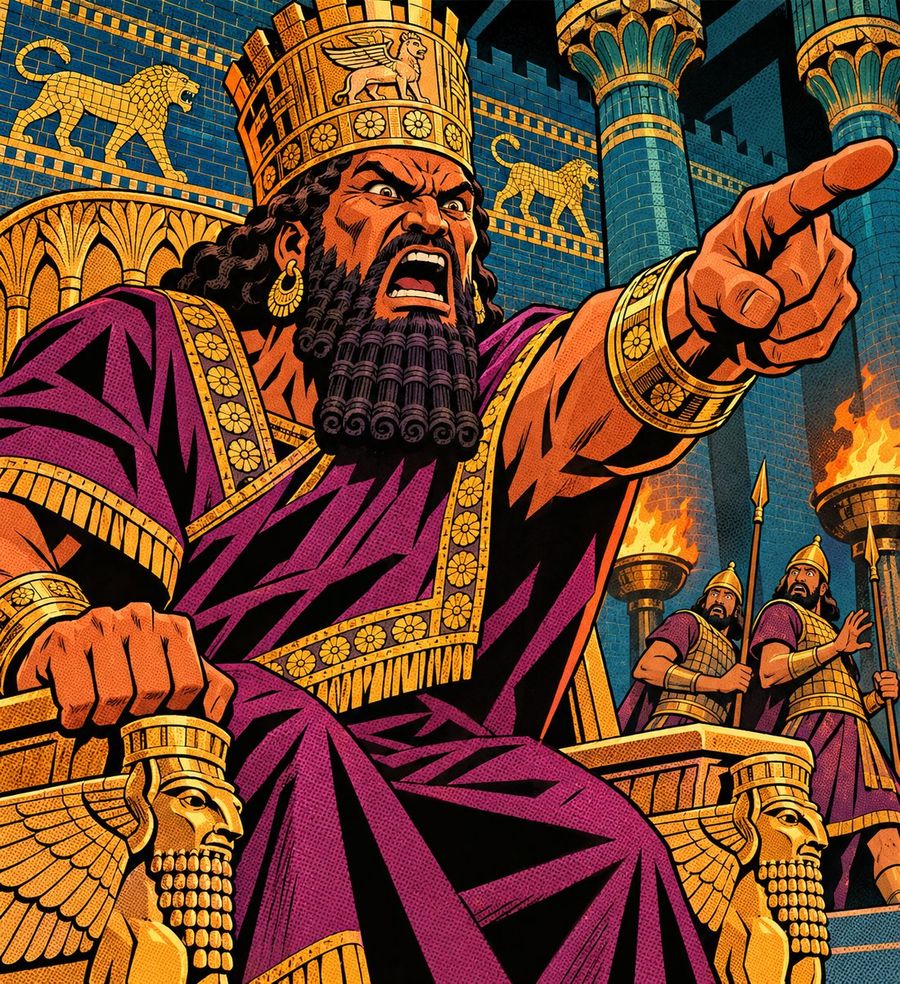
King Nebuchadnezzar on his throne, furious, pointing as his guards recoil
“If you do not tell me what my dream was and interpret it, I will have you cut into pieces.” (Daniel 2:5)

The impossible demand

Nebuchadnezzar remembered his dream. But he knew his experts were reading from a code book, so he changed the rules: tell me the dream and what it means, or I’ll have you cut into pieces. They answered that no one on earth could do that, only the gods, “and they do not live among humans.” Furious, the king ordered every wise man in Babylon executed. Daniel and his friends were on that list.

Notice how Daniel responded. He spoke to Arioch, the commander, “with wisdom and tact” (2:14). I long for Christians to be articulate voices in the marketplace of ideas, with wisdom and tact rather than anger and hatred. Daniel’s life was on the line, and he still didn’t fight the Lord’s battles with the devil’s ways.

Then Daniel asked the king for time. He put himself in a place of waiting.

While you are waiting, God is working.
And we know that in all things God works for the good of those who love him, who have been called according to his purpose.
Romans 8:28

“I waited, and I waited”

Psalm 40:1 says, “I waited patiently for the LORD.” The Hebrew literally says something like, I waited, I waited for the Lord. It doesn’t have to mean calmly; it could have been frantic. David learned to wait faithfully because he learned that God always hears.

Four D’s: why waiting is wise

Danger. Waiting often reveals dangers we can’t see. Good decisions are rarely made in a hurry, and we rush the bad ones so nobody can talk us out of them.

Developing circumstances. You aren’t the star of the show; we’re all supporting actors. Your wait may be because God is blessing someone else. Friends of ours were waiting for their house to sell. Maybe another family’s circumstances aren’t lined up yet. The hard part is that you’re the one paying the mortgage, whether financial or emotional.

Determining motives. Waiting lets you see why you want what you want.

Divine power. Sometimes God gives you the power to wait before he gives you the power to move, along with a peace that passes understanding. “Follow your heart” is terrible advice, because the heart is deceitful above all things (Jeremiah 17:9).

Three A’s: what to watch for while you wait

Anger: when God doesn’t follow the job description I wrote for him. Apathy: when I’ve prayed the same prayer so long I’m just done. Anxiety: when I’m not controlling the billions of details, and it makes me uneasy. Guard against all three.

Talk It Over

  1. What are you waiting on right now?
  2. How did these boys keep their faith while studying the very things God forbids? How can we prepare kids, not just protect them?
  3. Where do you need wisdom and tact in a hard conversation?
  4. Which of the four D’s do you most need to believe today?
  5. Which A shows up most when you wait: anger, apathy, or anxiety?

This Week

Write down the thing you’re waiting on. Under it write, “While I am waiting, God is working,” and give it back to him each morning (1 Peter 5:7).

Watch the sermon

Scan the code or tap below to watch “Fear’less: Behind the Scenes and Bad Dreams” on YouTube.

Watch on YouTube

For the kids in your life: the same story in the Kids' Edition, Chapter 4 · Comic, Issue 4: Tie the Knot

Chapter 6

Sleep’less

Daniel 2:17–23Preached May 24, 2026

The big ideaTie a knot with faithful friends, and build a pattern of prayer.

Read first Daniel 2:17–23

2:17Then Daniel returned to his house and explained the matter to his friends Hananiah, Mishael and Azariah. 18He urged them to plead for mercy from the God of heaven concerning this mystery, so that he and his friends might not be executed with the rest of the wise men of Babylon. 19During the night the mystery was revealed to Daniel in a vision. Then Daniel praised the God of heaven 20and said:

“Praise be to the name of God for ever and ever;
wisdom and power are his.
21He changes times and seasons;
he deposes kings and raises up others.
He gives wisdom to the wise
and knowledge to the discerning.
22He reveals deep and hidden things;
he knows what lies in darkness,
and light dwells with him.
23I thank and praise you, God of my ancestors:
You have given me wisdom and power,
you have made known to me what we asked of you,
you have made known to us the dream of the king.”

By now these young men, probably seventeen or eighteen, had faced death three times: when they were kidnapped, when they refused the king’s food, and now under the king’s decree. Each time they had to decide whether God was more powerful than the threat. Each time they decided he was.

Wisdom and tact, both

Daniel spoke to the king’s commander “with wisdom and tact.” Wisdom without tact makes you irrelevant, even if you’re right. A person who is all truth and no grace does more harm to the cause of Christ than ten people who keep quiet. All grace and no truth is no good either. You need both.

He told his friends

After asking the king for time, Daniel went home and explained everything to Hananiah, Mishael, and Azariah. He had spoken for them once before, in chapter 1. Soon they would have to stand without him.

On the way back from a trip, Joy and I stopped at a bakery in Pella. I wanted to buy a Dutch letter F for a new baby in our church family. Joy said, “They only sell S’s.” Then why call them Dutch letters? Just say Dutch S! Say what you mean. (We bought five. I won’t say who ate what.) Sometimes Scripture is plain, and sometimes it’s worth looking behind the words.

“Friends” is one of those words. The word picture I see in it is tying a knot. Remember “resolved,” weaving a rope? When two people who have each woven a rope of faithfulness decide to walk together, they tie a knot. Usually it’s a small group of people who want what God wants for their lives, and for yours, more than they want their own way.

Show me your friends, and I’ll show you your faith future.

What a knot looks like

Remember the fruit of the Spirit. Patience in a friendship is choosing to go at someone else’s pace, as long as they’re heading toward faithfulness. Gentleness is offering your strength where they’re weak. Humility is receiving their strength when you’re the weak one. Leadership means being half a step ahead, not five or six.

Tying the knot makes us think of marriage, and it fits. A knot can free you or strangle you. I married Joy when I was twenty, and I shouldn’t have been trusted with big decisions at twenty, but God was gracious. If you don’t have a friend like that, pray for one, find one, and be one.

That half-step is what I aim for as a pastor too. I want the slowest of us included, the fastest of us included, and all of us growing together.

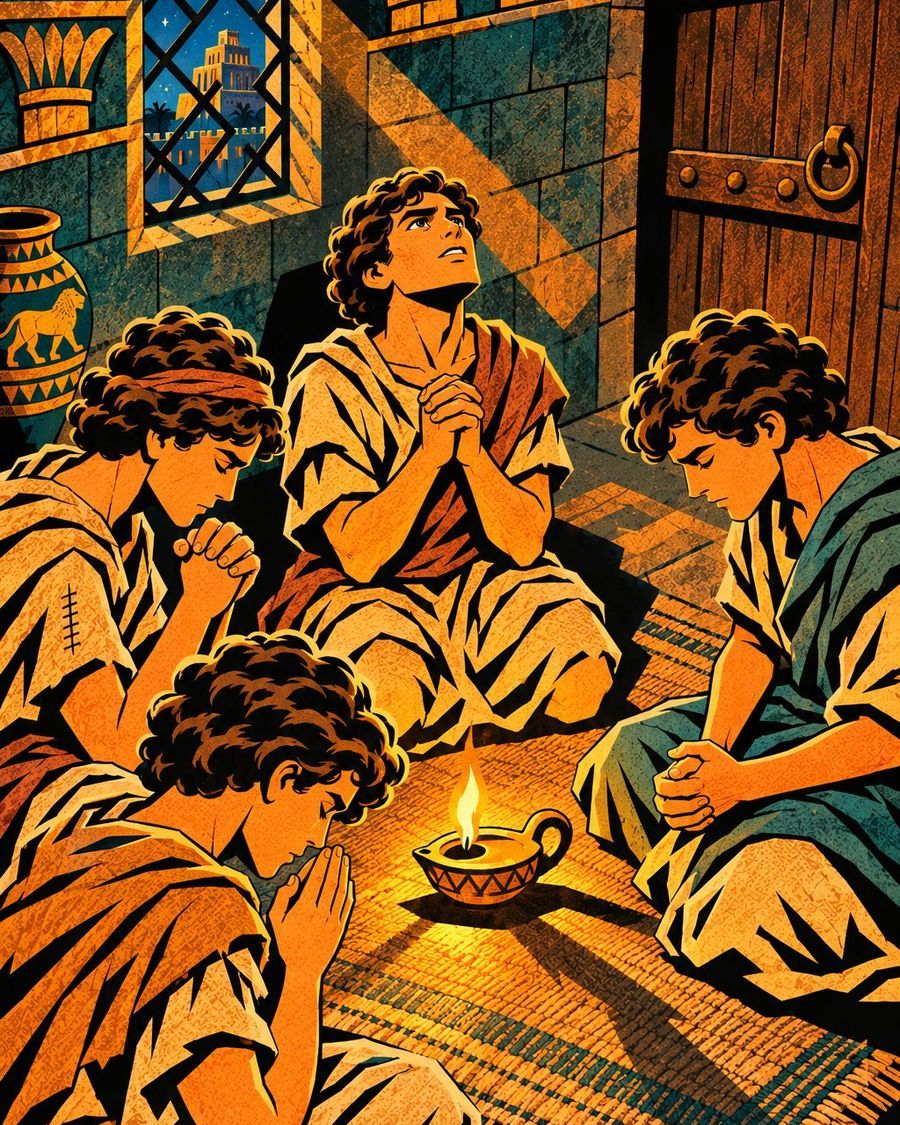
Daniel and his three friends pray by lamplight in a stone room at night
He urged them to plead for mercy from the God of heaven. (Daniel 2:18)

He urged them to pray

Daniel asked his friends to plead for mercy. They had plenty of motivation, since they were going to die too. But Daniel also knew they would soon need a prayer life of their own.

King David was busy, with sheep, then Saul, then a kingdom. Even so, he wrote, “In the morning, LORD, you hear my voice; in the morning I lay my requests before you and wait expectantly” (Psalm 5:3). Peter adds: humble yourselves under God’s mighty hand, that he may lift you up in due time (circle that). Cast all your anxiety on him. “Cast” pictures throwing a blanket over a donkey’s back and watching it walk away.

My pattern of prayer

My prayers can turn into worrying out loud. So I set four recurring reminders on my phone, Monday through Friday, with a different tone from my other alarms:

  • 9:00 — my kids, daughters-in-law, and grandkids, by name. My sons are about an hour into their workday by then.
  • 12:00 — our church family.
  • 3:00 — the things Joy and I are seeking God about together.
  • 6:00 — Joy, which softens my heart before our evening.

On Saturdays there’s no alarm. I look back at what God did that week. It has freed me. When worry creeps in, I can say, “I prayed about that. He’s got it. I’ll pray again tomorrow.” I’ve watched him answer prayers I didn’t have the faith to expect. Mine isn’t the best plan. But if you don’t have one, mine is better than yours.

Daniel’s “Saturday”

God revealed the mystery to Daniel in a vision. Before he ran to the king, he stopped and gave thanks.

Praise be to the name of God for ever and ever; wisdom and power are his. He changes times and seasons; he deposes kings and raises up others.
Daniel 2:20–21

He thanked God for four things, and they’re worth being thankful for every day:

  1. God controls everything. He works the good and the bad together for good.
  2. God knows everything. He is never surprised.
  3. God reveals what we need to know, when we need to know it, and not before (James 1:5–6).
  4. God has a plan, and he really does bless faithfulness.

Faithfulness doesn’t begin after the hard season, the promotion, or the busy stretch. It begins right now, with the people you’ll see this afternoon.

Talk It Over

  1. Are you more prone to truth without grace or grace without truth?
  2. Who have you “tied a knot” with? Whose pace are you walking at?
  3. When have you needed to receive someone else’s strength? Was that hard?
  4. What does your current pattern of prayer actually look like?
  5. Which of Daniel’s four thanksgivings is hardest for you to say and mean?

This Week

Build your own prayer pattern. Set two to four recurring reminders, name who or what each one is for, and save Saturday for looking back at what God did.

Watch the sermon

Scan the code or tap below to watch “Sleep’less” on YouTube.

Watch on YouTube

For the kids in your life: the same story in the Kids' Edition, Chapter 4 · Comic, Issue 4: Tie the Knot

Part Three · Daniel 2–3

Even If He Does Not

A ninety-foot image of gold, a furnace seven times hotter, and a fourth man in the fire.

Chapter 7

Smoke’less

Daniel 2:24–3:18Preached May 31, 2026

The big ideaGod can. He may. And even if he does not, I will not bow.

Read first Daniel 2:24–3:18
Daniel Interprets the Dream

2:24Then Daniel went to Arioch, whom the king had appointed to execute the wise men of Babylon, and said to him, “Do not execute the wise men of Babylon. Take me to the king, and I will interpret his dream for him.”

25Arioch took Daniel to the king at once and said, “I have found a man among the exiles from Judah who can tell the king what his dream means.”

26The king asked Daniel (also called Belteshazzar), “Are you able to tell me what I saw in my dream and interpret it?”

27Daniel replied, “No wise man, enchanter, magician or diviner can explain to the king the mystery he has asked about, 28but there is a God in heaven who reveals mysteries. He has shown King Nebuchadnezzar what will happen in days to come. Your dream and the visions that passed through your mind as you were lying in bed are these:

29“As Your Majesty was lying there, your mind turned to things to come, and the revealer of mysteries showed you what is going to happen. 30As for me, this mystery has been revealed to me, not because I have greater wisdom than anyone else alive, but so that Your Majesty may know the interpretation and that you may understand what went through your mind.

31“Your Majesty looked, and there before you stood a large statue—an enormous, dazzling statue, awesome in appearance. 32The head of the statue was made of pure gold, its chest and arms of silver, its belly and thighs of bronze, 33its legs of iron, its feet partly of iron and partly of baked clay. 34While you were watching, a rock was cut out, but not by human hands. It struck the statue on its feet of iron and clay and smashed them. 35Then the iron, the clay, the bronze, the silver and the gold were all broken to pieces and became like chaff on a threshing floor in the summer. The wind swept them away without leaving a trace. But the rock that struck the statue became a huge mountain and filled the whole earth.

36“This was the dream, and now we will interpret it to the king. 37Your Majesty, you are the king of kings. The God of heaven has given you dominion and power and might and glory; 38in your hands he has placed all mankind and the beasts of the field and the birds in the sky. Wherever they live, he has made you ruler over them all. You are that head of gold.

39“After you, another kingdom will arise, inferior to yours. Next, a third kingdom, one of bronze, will rule over the whole earth. 40Finally, there will be a fourth kingdom, strong as iron—for iron breaks and smashes everything—and as iron breaks things to pieces, so it will crush and break all the others. 41Just as you saw that the feet and toes were partly of baked clay and partly of iron, so this will be a divided kingdom; yet it will have some of the strength of iron in it, even as you saw iron mixed with clay. 42As the toes were partly iron and partly clay, so this kingdom will be partly strong and partly brittle. 43And just as you saw the iron mixed with baked clay, so the people will be a mixture and will not remain united, any more than iron mixes with clay.

44“In the time of those kings, the God of heaven will set up a kingdom that will never be destroyed, nor will it be left to another people. It will crush all those kingdoms and bring them to an end, but it will itself endure forever. 45This is the meaning of the vision of the rock cut out of a mountain, but not by human hands—a rock that broke the iron, the bronze, the clay, the silver and the gold to pieces.

“The great God has shown the king what will take place in the future. The dream is true and its interpretation is trustworthy.”

46Then King Nebuchadnezzar fell prostrate before Daniel and paid him honor and ordered that an offering and incense be presented to him. 47The king said to Daniel, “Surely your God is the God of gods and the Lord of kings and a revealer of mysteries, for you were able to reveal this mystery.”

48Then the king placed Daniel in a high position and lavished many gifts on him. He made him ruler over the entire province of Babylon and placed him in charge of all its wise men. 49Moreover, at Daniel’s request the king appointed Shadrach, Meshach and Abednego administrators over the province of Babylon, while Daniel himself remained at the royal court.

The Image of Gold and the Blazing Furnace

3:1King Nebuchadnezzar made an image of gold, sixty cubits high and six cubits wide, and set it up on the plain of Dura in the province of Babylon. 2He then summoned the satraps, prefects, governors, advisers, treasurers, judges, magistrates and all the other provincial officials to come to the dedication of the image he had set up. 3So the satraps, prefects, governors, advisers, treasurers, judges, magistrates and all the other provincial officials assembled for the dedication of the image that King Nebuchadnezzar had set up, and they stood before it.

4Then the herald loudly proclaimed, “Nations and peoples of every language, this is what you are commanded to do: 5As soon as you hear the sound of the horn, flute, zither, lyre, harp, pipe and all kinds of music, you must fall down and worship the image of gold that King Nebuchadnezzar has set up. 6Whoever does not fall down and worship will immediately be thrown into a blazing furnace.”

7Therefore, as soon as they heard the sound of the horn, flute, zither, lyre, harp and all kinds of music, all the nations and peoples of every language fell down and worshiped the image of gold that King Nebuchadnezzar had set up.

8At this time some astrologers came forward and denounced the Jews. 9They said to King Nebuchadnezzar, “May the king live forever! 10Your Majesty has issued a decree that everyone who hears the sound of the horn, flute, zither, lyre, harp, pipe and all kinds of music must fall down and worship the image of gold, 11and that whoever does not fall down and worship will be thrown into a blazing furnace. 12But there are some Jews whom you have set over the affairs of the province of Babylon—Shadrach, Meshach and Abednego—who pay no attention to you, Your Majesty. They neither serve your gods nor worship the image of gold you have set up.”

13Furious with rage, Nebuchadnezzar summoned Shadrach, Meshach and Abednego. So these men were brought before the king, 14and Nebuchadnezzar said to them, “Is it true, Shadrach, Meshach and Abednego, that you do not serve my gods or worship the image of gold I have set up? 15Now when you hear the sound of the horn, flute, zither, lyre, harp, pipe and all kinds of music, if you are ready to fall down and worship the image I made, very good. But if you do not worship it, you will be thrown immediately into a blazing furnace. Then what god will be able to rescue you from my hand?”

16Shadrach, Meshach and Abednego replied to him, “King Nebuchadnezzar, we do not need to defend ourselves before you in this matter. 17If we are thrown into the blazing furnace, the God we serve is able to deliver us from it, and he will deliver us from Your Majesty’s hand. 18But even if he does not, we want you to know, Your Majesty, that we will not serve your gods or worship the image of gold you have set up.”

Lives of faith are never built overnight. The people we call spiritual giants got there one slow step and one choice at a time. These four had now faced death three times, and little things had become big things.

Quick recap of where we’ve been. Week one: add one thing. Week two: remove one thing. Week three: invest in your inner circle. Week four: discover God’s will for your life.

What if death isn’t the worst thing?

I grew up hearing heaven described in a way that made me not want to go. Streets of gold? I’d take a picture, but I don’t care about gold streets. Pearly gates? I’ve never even bought my wife pearls. Singing forever? I’m not a musician. Will there be AC/DC?

God says, “I’ve prepared a place. Trust me,” and leaves an ellipsis. Then he drops Easter eggs throughout Scripture: no sin, no pain, no sorrow, a new earth, believers reunited, and Jesus himself. Until we really believe what’s waiting is better than what we have, we’ll never have a fearless faith.

Paul says, “Set your minds on things above, not on earthly things” (Colossians 3:2). C. S. Lewis observed that if we find a desire nothing in this world can satisfy, maybe we were made for another world. Death was Satan’s weapon, and Jesus turned it into an entrance.

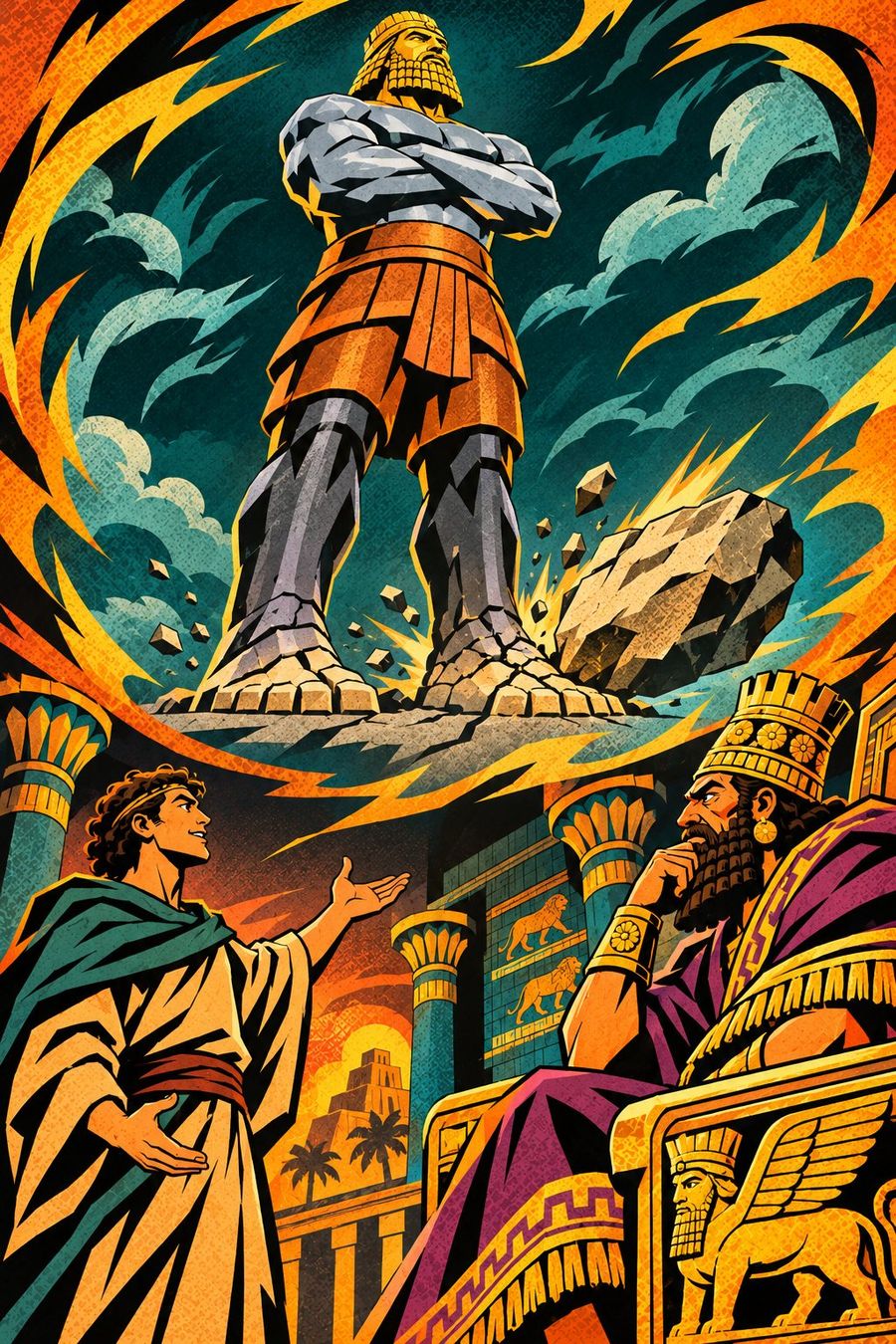
Daniel explains the dream to the king as a giant statue of gold, silver, bronze and iron is struck by a rock
“Your Majesty, you are that head of gold.” (Daniel 2:37–38)

The statue in the dream

Daniel told the king his dream. There was an enormous statue: a head of gold, chest and arms of silver, belly and thighs of bronze, legs of iron, and feet of iron mixed with clay. A rock cut out, but not by human hands, struck its feet. The whole thing shattered into dust, the wind blew it away, and the rock became a mountain that filled the earth.

“You, Your Majesty, are that head of gold.” Kingdoms would follow, many believe Medo-Persia, then Greece, then Rome. People debate the details. History has seen roughly twenty-seven great empires, and every one of them shares something: they’re gone.

I’m not telling you not to care, not to vote, or not to love your country. I’m saying that if your faith is in your country, it’s in the wrong place. That’s why the news, the economy, and gas prices rock us so badly. The rock in the dream is God’s kingdom, and we know it as Jesus and the gospel, which fill the earth.

The king seems to have heard only the first part: I’m the gold! He promoted Daniel, and Daniel remembered his friends. Shadrach, Meshach, and Abednego got important jobs in the province.

Fifteen years later

Chapter 3 picks up as if no time has passed. But an ancient Greek translation says this happened in the eighteenth year of Nebuchadnezzar’s reign. If that’s right, the “boys” were now in their thirties, with fifteen years of small faithful choices behind them.

The king built a 90-foot image of gold on the plain of Dura, probably gold over a wooden frame. Had he forgotten the dream? When the music played, everyone had to bow, or be thrown into a blazing furnace. And everyone bowed except three. Daniel was likely away on the king’s business. Their mentor was gone, and they stood alone.

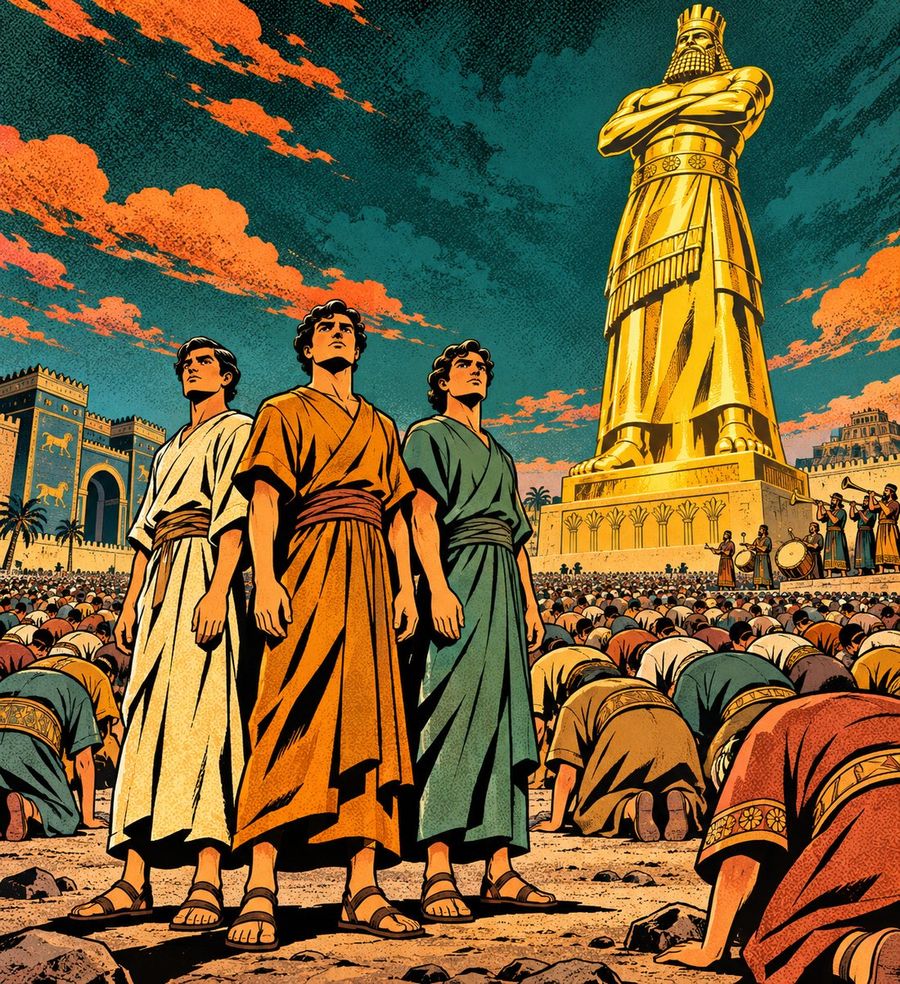
Shadrach, Meshach and Abednego stand while a huge crowd bows before a giant gold statue
The music played. Everyone bowed except three.

“Maybe you didn’t get the memo”

Some jealous officials told on them. I think the king liked these three, so he gave them another chance. A pragmatic person would weigh the odds: God forgives, right? Bow now, ask forgiveness later, and stay alive. But these men had walked through small trials, like ten days of vegetables, and seen God come through. So they answered:

If we are thrown into the blazing furnace, the God we serve is able to deliver us from it, and he will deliver us from Your Majesty’s hand. But even if he does not, we want you to know, Your Majesty, that we will not serve your gods or worship the image of gold you have set up.
Daniel 3:17–18

Can he? Will he? Even if not.

Can he? “My God can.” He can heal, restore families, and give direction, and he can suspend the laws of nature to carry out his plan. It’s easy to believe he can for somebody else and wonder if he can for you.

Will he? That’s the real elephant in the room.

But even if he does not. This is where faith and God’s providence meet a broken spirit that’s run out of answers. Even if my prayer isn’t answered, even if the thing I fear most happens, I still believe God is in control. I still believe he knows everything, that his plan is better than mine, and that my life is a small part of it.

Do you have an “even if not” kind of faith?

If you’re waiting for God to hold up his end before you start following him, you’ll never live in the rhythm of the Holy Spirit. The king got mad, then got madder, and ordered the furnace heated seven times hotter than usual.

To be continued.

Talk It Over

  1. How do you picture heaven? Does it make you want to go?
  2. Where are you tempted to put faith in a “statue,” like a nation, an economy, or a leader?
  3. What small faithful choices over many years prepared these three men for one huge moment?
  4. Can he? Will he? Even if not? Where are you in that progression with your biggest prayer?
  5. What would “even if not” faith sound like, said out loud about your situation?

This Week

Write your own “even if not” statement: “God, I know you are able to ____. Even if you do not, I will ____.” Pray it every morning this week.

Watch the sermon

Scan the code or tap below to watch “Smoke’less” on YouTube.

Watch on YouTube

For the kids in your life: the same story in the Kids' Edition, Chapter 5 and Chapter 6 · Comic, Issue 5: Don't Forget Your Friends · Comic, Issue 6: Stand Together

Chapter 8

Smoke’less, Part 2

Daniel 3:19–30Preached June 7, 2026

The big ideaSometimes faithfulness leads into the fire, and Jesus meets you there.

Read first Daniel 3:19–30

3:19Then Nebuchadnezzar was furious with Shadrach, Meshach and Abednego, and his attitude toward them changed. He ordered the furnace heated seven times hotter than usual 20and commanded some of the strongest soldiers in his army to tie up Shadrach, Meshach and Abednego and throw them into the blazing furnace. 21So these men, wearing their robes, trousers, turbans and other clothes, were bound and thrown into the blazing furnace. 22The king’s command was so urgent and the furnace so hot that the flames of the fire killed the soldiers who took up Shadrach, Meshach and Abednego, 23and these three men, firmly tied, fell into the blazing furnace.

24Then King Nebuchadnezzar leaped to his feet in amazement and asked his advisers, “Weren’t there three men that we tied up and threw into the fire?”

They replied, “Certainly, Your Majesty.”

25He said, “Look! I see four men walking around in the fire, unbound and unharmed, and the fourth looks like a son of the gods.”

26Nebuchadnezzar then approached the opening of the blazing furnace and shouted, “Shadrach, Meshach and Abednego, servants of the Most High God, come out! Come here!”

So Shadrach, Meshach and Abednego came out of the fire, 27and the satraps, prefects, governors and royal advisers crowded around them. They saw that the fire had not harmed their bodies, nor was a hair of their heads singed; their robes were not scorched, and there was no smell of fire on them.

28Then Nebuchadnezzar said, “Praise be to the God of Shadrach, Meshach and Abednego, who has sent his angel and rescued his servants! They trusted in him and defied the king’s command and were willing to give up their lives rather than serve or worship any god except their own God. 29Therefore I decree that the people of any nation or language who say anything against the God of Shadrach, Meshach and Abednego be cut into pieces and their houses be turned into piles of rubble, for no other god can save in this way.”

30Then the king promoted Shadrach, Meshach and Abednego in the province of Babylon.

Last week ended with three men tied up at the mouth of a furnace. Before we find out what happened, let’s settle who we serve.

Following the snacks

Our dogs love Costco rotisserie chicken night. One evening Joy was pulling the chicken apart in the kitchen while I was eating in the other room. The dogs couldn’t decide where the snacks would come from. They’d sit and stare at her, hear me eating, run and stare at me, then run back. They were so stressed out going back and forth that I think they missed snacks they would have gotten if they had just picked a spot and stayed there.

We do the same thing. We run between two worlds and two masters, living by faith some days and faithlessly on others. Choose who you are. Resolve. Tie the knot with friends who’ve chosen the same. When the snacks come, enjoy them. When they don’t, it doesn’t mean you jump ship to a different master.

Strongholds

For though we live in the world, we do not wage war as the world does. The weapons we fight with are not the weapons of the world. On the contrary, they have divine power to demolish strongholds.
2 Corinthians 10:3–4

A stronghold, or an idol, is anything that sets itself up against what God wants and against who he wants you to be. It could be a fear, a goal, a person, a habit, a hobby, or a preoccupation. We’d never bow to a 90-foot statue, yet we bow to all kinds of things all week long.

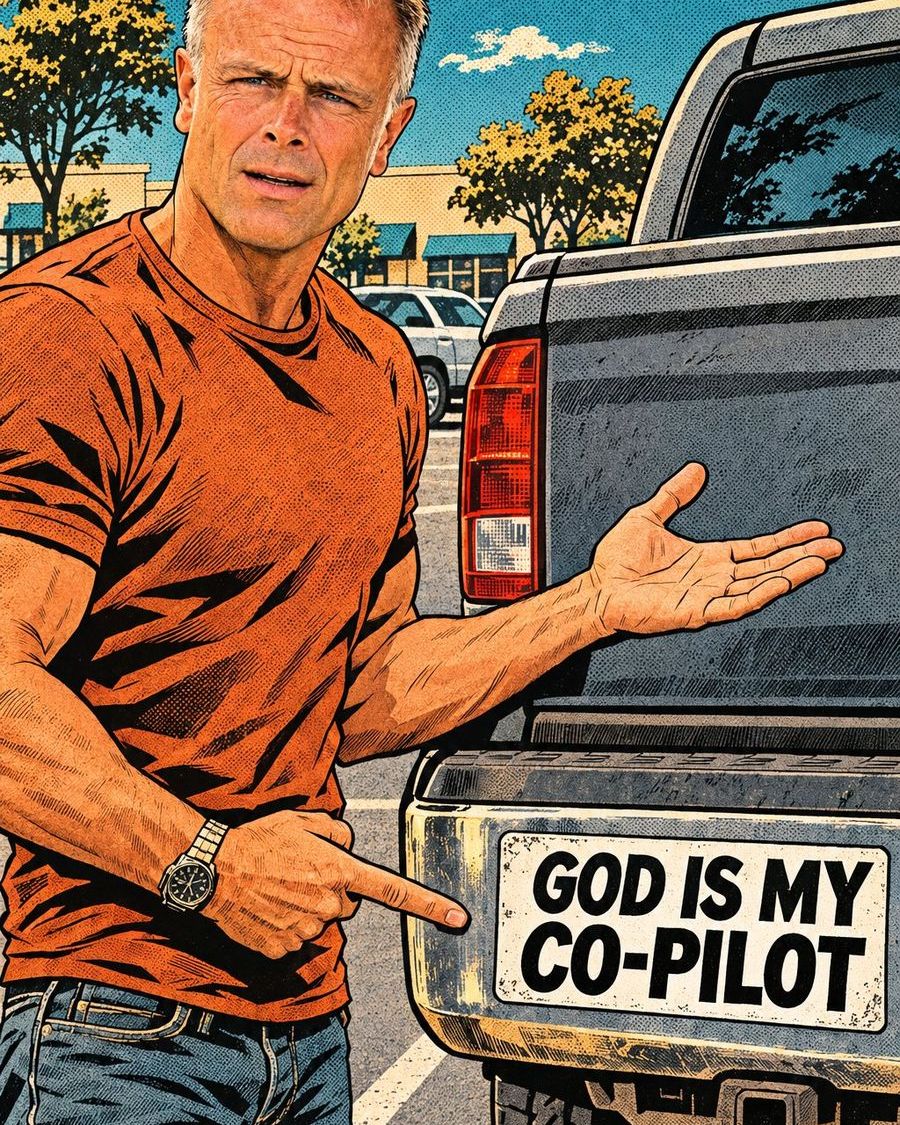
Remember the “God is my co-pilot” bumper sticker from the seventies? It sounds nice, but there’s only one driver’s seat. A faithful life is lived with God as the pilot. I’m the co-pilot, the flight attendant, or a passenger.

Pastor Rick points at a “God is my co-pilot” bumper sticker on a pickup truck
There’s only one driver’s seat.

Three kinds of will, one furnace

Back in Chapter 4 we looked at three stages of God’s will. This week we used a different set of three to watch how God works inside one story.

Providential, God’s no-matter-what will: a king took power, and nobody could change that. Circumstantial, God’s behind-the-scenes will: one day there was no statue, and the next day there was a 90-foot one. In college Joy had to train a rat in a maze. She’d slide plastic pieces in to limit its choices, but the rat could always go forward, stop, or turn back. Personal: in this circumstance, what does God want me to do today?

For these three men, all three kinds of will led to one place: the furnace. We like a Pollyanna God, where if we obey, everything works out our way. Sometimes faithfulness leads you straight into the fire.

Stand without making a spectacle

The government commanded something God forbade (“You shall have no other gods before me”), so they didn’t do it. But they didn’t gather a crowd or make a scene. They answered the king with respect, wisdom, and tact. Their testimony was seen more than their protest. God gave them a platform they never demanded.

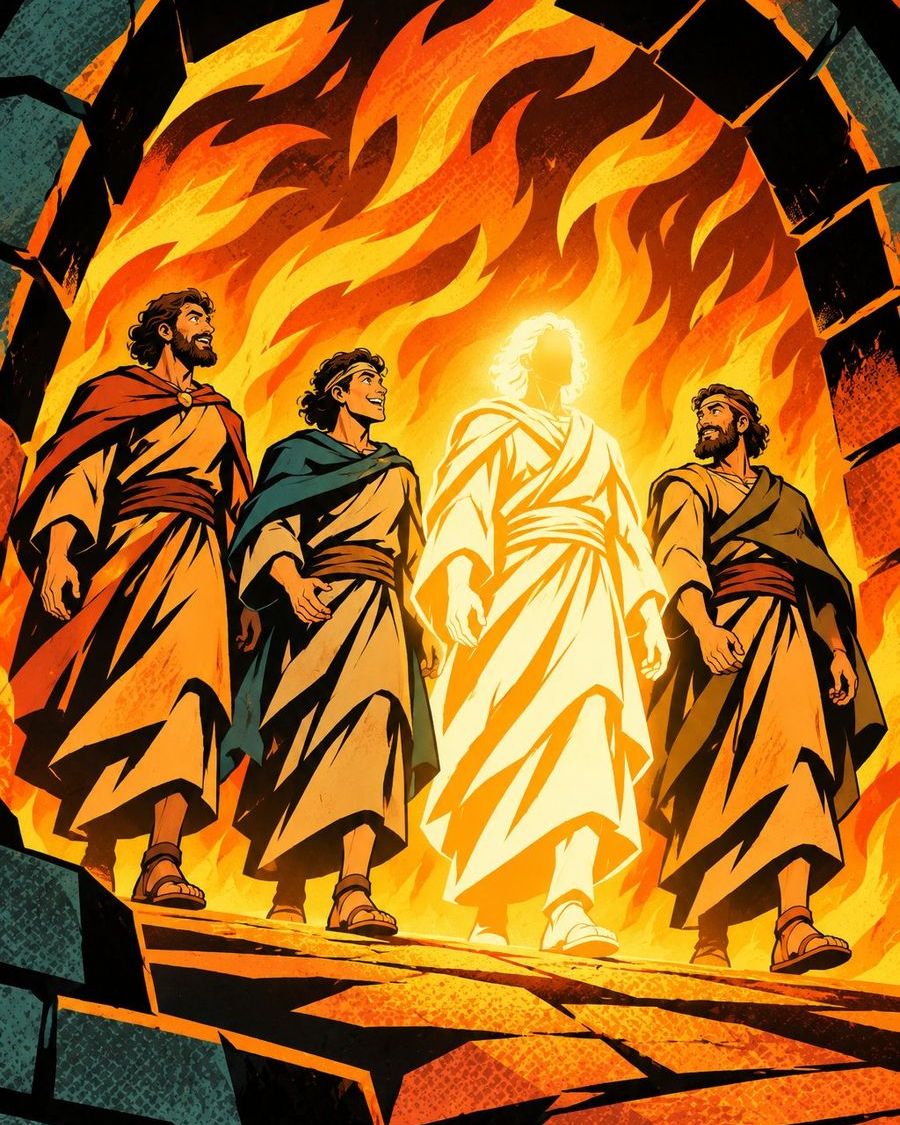
Three men and a glowing fourth figure walk unharmed through the flames of the furnace
The fourth man in the fire.

Four men in the fire

The fire was so hot it killed the soldiers who threw them in. Then the king leaped to his feet: “Weren’t there three men that we tied up and threw into the fire?” (How many people do you have to throw in a furnace before you lose count?)

He said, “Look! I see four men walking around in the fire, unbound and unharmed, and the fourth looks like a son of the gods.”
Daniel 3:25

I believe the fourth man was Jesus himself, appearing before his birth in Bethlehem. When they came out, not a hair was singed, their robes weren’t scorched, and they didn’t even smell like smoke. The only things that burned were the ropes that bound them. The king protected their right to worship and promoted them, a God promotion and not a self-promotion, so that everyone could see how real their God was.

Die for him, or live for him?

People say, “I hope I’d be willing to die for Jesus.” I hope so too. The question I care more about is this: am I willing to die to myself today and live for Jesus? One heroic moment might be easier than putting down my idols every single day. I’d protect Joy with my life, but will I live for her every day? I’d die for my kids, but will I parent them, say no, and live a faith in front of them they won’t have to deconstruct?

Years ago a man told one of our pastors he thought God was calling him to ministry. The pastor asked: Do you worship regularly? “When it’s convenient.” Do you give? “Money’s tight.” Do you serve? “I’m busy.” We have no business dreaming about the furnace while we skip the basics.

Stephen’s furnace

Not every faithful person walks out of the fire. In Acts 7, Stephen preached boldly and was stoned for it. As he died he looked up and saw Jesus standing at God’s right hand. He forgave his killers and gave up his spirit. He lived by the power of the Holy Spirit, so he could die by it too.

Sometimes God delivers us from the furnace. Sometimes he doesn’t deliver the way we want. But if we really believe in heaven, that is deliverance too, and maybe the best kind.

The only things that burned were the ropes that bound them.

Talk It Over

  1. Where are you running back and forth between two masters?
  2. Name a stronghold competing for the driver’s seat in your life.
  3. How did these men stand firm without making a spectacle? How does that apply to how Christians engage today?
  4. “Die for Jesus” or “die to myself and live for Jesus”: which is harder for you, and why?
  5. What “ropes” has God burned off you in a hard season?

This Week

Check the basics: worship, giving, serving, and time with God. Pick the one you’ve been skipping and do it this week, before you pray about anything bigger.

Watch the sermon

Scan the code or tap below to watch “Smoke’less, Part 2” on YouTube.

Watch on YouTube

For the kids in your life: the same story in the Kids' Edition, Chapter 7 · Comic, Issue 7: The Fourth Man in the Fire

Part Four · Daniel 4–5

The Tree and the Wall

A proud king humbled, a family that never learned, and a hand that writes on the wall.

Chapter 9

Apples and Trees

Daniel 4–5Preached June 21, 2026

The big ideaSuccess is finishing well and passing faith to the people behind you.

Read first Daniel 4:1–5:31
Nebuchadnezzar’s Dream of a Tree

4:1King Nebuchadnezzar,

To the nations and peoples of every language, who live in all the earth:

May you prosper greatly!

2It is my pleasure to tell you about the miraculous signs and wonders that the Most High God has performed for me.

3How great are his signs,
how mighty his wonders!
His kingdom is an eternal kingdom;
his dominion endures from generation to generation.
4I, Nebuchadnezzar, was at home in my palace, contented and prosperous. 5I had a dream that made me afraid. As I was lying in bed, the images and visions that passed through my mind terrified me. 6So I commanded that all the wise men of Babylon be brought before me to interpret the dream for me. 7When the magicians, enchanters, astrologers and diviners came, I told them the dream, but they could not interpret it for me. 8Finally, Daniel came into my presence and I told him the dream. (He is called Belteshazzar, after the name of my god, and the spirit of the holy gods is in him.)

9I said, “Belteshazzar, chief of the magicians, I know that the spirit of the holy gods is in you, and no mystery is too difficult for you. Here is my dream; interpret it for me. 10These are the visions I saw while lying in bed: I looked, and there before me stood a tree in the middle of the land. Its height was enormous. 11The tree grew large and strong and its top touched the sky; it was visible to the ends of the earth. 12Its leaves were beautiful, its fruit abundant, and on it was food for all. Under it the wild animals found shelter, and the birds lived in its branches; from it every creature was fed.

13“In the visions I saw while lying in bed, I looked, and there before me was a holy one, a messenger, coming down from heaven. 14He called in a loud voice: ‘Cut down the tree and trim off its branches; strip off its leaves and scatter its fruit. Let the animals flee from under it and the birds from its branches. 15But let the stump and its roots, bound with iron and bronze, remain in the ground, in the grass of the field.

“‘Let him be drenched with the dew of heaven, and let him live with the animals among the plants of the earth. 16Let his mind be changed from that of a man and let him be given the mind of an animal, till seven times pass by for him.

17“‘The decision is announced by messengers, the holy ones declare the verdict, so that the living may know that the Most High is sovereign over all kingdoms on earth and gives them to anyone he wishes and sets over them the lowliest of people.’

18“This is the dream that I, King Nebuchadnezzar, had. Now, Belteshazzar, tell me what it means, for none of the wise men in my kingdom can interpret it for me. But you can, because the spirit of the holy gods is in you.”

Daniel Interprets the Dream

19Then Daniel (also called Belteshazzar) was greatly perplexed for a time, and his thoughts terrified him. So the king said, “Belteshazzar, do not let the dream or its meaning alarm you.”

Belteshazzar answered, “My lord, if only the dream applied to your enemies and its meaning to your adversaries! 20The tree you saw, which grew large and strong, with its top touching the sky, visible to the whole earth, 21with beautiful leaves and abundant fruit, providing food for all, giving shelter to the wild animals, and having nesting places in its branches for the birds— 22Your Majesty, you are that tree! You have become great and strong; your greatness has grown until it reaches the sky, and your dominion extends to distant parts of the earth.

23“Your Majesty saw a holy one, a messenger, coming down from heaven and saying, ‘Cut down the tree and destroy it, but leave the stump, bound with iron and bronze, in the grass of the field, while its roots remain in the ground. Let him be drenched with the dew of heaven; let him live with the wild animals, until seven times pass by for him.’

24“This is the interpretation, Your Majesty, and this is the decree the Most High has issued against my lord the king: 25You will be driven away from people and will live with the wild animals; you will eat grass like the ox and be drenched with the dew of heaven. Seven times will pass by for you until you acknowledge that the Most High is sovereign over all kingdoms on earth and gives them to anyone he wishes. 26The command to leave the stump of the tree with its roots means that your kingdom will be restored to you when you acknowledge that Heaven rules. 27Therefore, Your Majesty, be pleased to accept my advice: Renounce your sins by doing what is right, and your wickedness by being kind to the oppressed. It may be that then your prosperity will continue.”

The Dream Is Fulfilled

28All this happened to King Nebuchadnezzar. 29Twelve months later, as the king was walking on the roof of the royal palace of Babylon, 30he said, “Is not this the great Babylon I have built as the royal residence, by my mighty power and for the glory of my majesty?”

31Even as the words were on his lips, a voice came from heaven, “This is what is decreed for you, King Nebuchadnezzar: Your royal authority has been taken from you. 32You will be driven away from people and will live with the wild animals; you will eat grass like the ox. Seven times will pass by for you until you acknowledge that the Most High is sovereign over all kingdoms on earth and gives them to anyone he wishes.”

33Immediately what had been said about Nebuchadnezzar was fulfilled. He was driven away from people and ate grass like the ox. His body was drenched with the dew of heaven until his hair grew like the feathers of an eagle and his nails like the claws of a bird.

34At the end of that time, I, Nebuchadnezzar, raised my eyes toward heaven, and my sanity was restored. Then I praised the Most High; I honored and glorified him who lives forever.

His dominion is an eternal dominion;
his kingdom endures from generation to generation.
35All the peoples of the earth
are regarded as nothing.
He does as he pleases
with the powers of heaven
and the peoples of the earth.
No one can hold back his hand
or say to him: “What have you done?”
36At the same time that my sanity was restored, my honor and splendor were returned to me for the glory of my kingdom. My advisers and nobles sought me out, and I was restored to my throne and became even greater than before. 37Now I, Nebuchadnezzar, praise and exalt and glorify the King of heaven, because everything he does is right and all his ways are just. And those who walk in pride he is able to humble.

The Writing on the Wall

5:1King Belshazzar gave a great banquet for a thousand of his nobles and drank wine with them. 2While Belshazzar was drinking his wine, he gave orders to bring in the gold and silver goblets that Nebuchadnezzar his father had taken from the temple in Jerusalem, so that the king and his nobles, his wives and his concubines might drink from them. 3So they brought in the gold goblets that had been taken from the temple of God in Jerusalem, and the king and his nobles, his wives and his concubines drank from them. 4As they drank the wine, they praised the gods of gold and silver, of bronze, iron, wood and stone.

5Suddenly the fingers of a human hand appeared and wrote on the plaster of the wall, near the lampstand in the royal palace. The king watched the hand as it wrote. 6His face turned pale and he was so frightened that his legs became weak and his knees were knocking.

7The king summoned the enchanters, astrologers and diviners. Then he said to these wise men of Babylon, “Whoever reads this writing and tells me what it means will be clothed in purple and have a gold chain placed around his neck, and he will be made the third highest ruler in the kingdom.”

8Then all the king’s wise men came in, but they could not read the writing or tell the king what it meant. 9So King Belshazzar became even more terrified and his face grew more pale. His nobles were baffled.

10The queen, hearing the voices of the king and his nobles, came into the banquet hall. “May the king live forever!” she said. “Don’t be alarmed! Don’t look so pale! 11There is a man in your kingdom who has the spirit of the holy gods in him. In the time of your father he was found to have insight and intelligence and wisdom like that of the gods. Your father, King Nebuchadnezzar, appointed him chief of the magicians, enchanters, astrologers and diviners. 12He did this because Daniel, whom the king called Belteshazzar, was found to have a keen mind and knowledge and understanding, and also the ability to interpret dreams, explain riddles and solve difficult problems. Call for Daniel, and he will tell you what the writing means.”

13So Daniel was brought before the king, and the king said to him, “Are you Daniel, one of the exiles my father the king brought from Judah? 14I have heard that the spirit of the gods is in you and that you have insight, intelligence and outstanding wisdom. 15The wise men and enchanters were brought before me to read this writing and tell me what it means, but they could not explain it. 16Now I have heard that you are able to give interpretations and to solve difficult problems. If you can read this writing and tell me what it means, you will be clothed in purple and have a gold chain placed around your neck, and you will be made the third highest ruler in the kingdom.”

17Then Daniel answered the king, “You may keep your gifts for yourself and give your rewards to someone else. Nevertheless, I will read the writing for the king and tell him what it means.

18“Your Majesty, the Most High God gave your father Nebuchadnezzar sovereignty and greatness and glory and splendor. 19Because of the high position he gave him, all the nations and peoples of every language dreaded and feared him. Those the king wanted to put to death, he put to death; those he wanted to spare, he spared; those he wanted to promote, he promoted; and those he wanted to humble, he humbled. 20But when his heart became arrogant and hardened with pride, he was deposed from his royal throne and stripped of his glory. 21He was driven away from people and given the mind of an animal; he lived with the wild donkeys and ate grass like the ox; and his body was drenched with the dew of heaven, until he acknowledged that the Most High God is sovereign over all kingdoms on earth and sets over them anyone he wishes.

22“But you, Belshazzar, his son, have not humbled yourself, though you knew all this. 23Instead, you have set yourself up against the Lord of heaven. You had the goblets from his temple brought to you, and you and your nobles, your wives and your concubines drank wine from them. You praised the gods of silver and gold, of bronze, iron, wood and stone, which cannot see or hear or understand. But you did not honor the God who holds in his hand your life and all your ways. 24Therefore he sent the hand that wrote the inscription.

25“This is the inscription that was written:

26“Here is what these words mean:

Mene: God has numbered the days of your reign and brought it to an end. 27Tekel: You have been weighed on the scales and found wanting. 28Peres: Your kingdom is divided and given to the Medes and Persians.” 29Then at Belshazzar’s command, Daniel was clothed in purple, a gold chain was placed around his neck, and he was proclaimed the third highest ruler in the kingdom.

30That very night Belshazzar, king of the Babylonians, was slain, 31and Darius the Mede took over the kingdom, at the age of sixty-two.
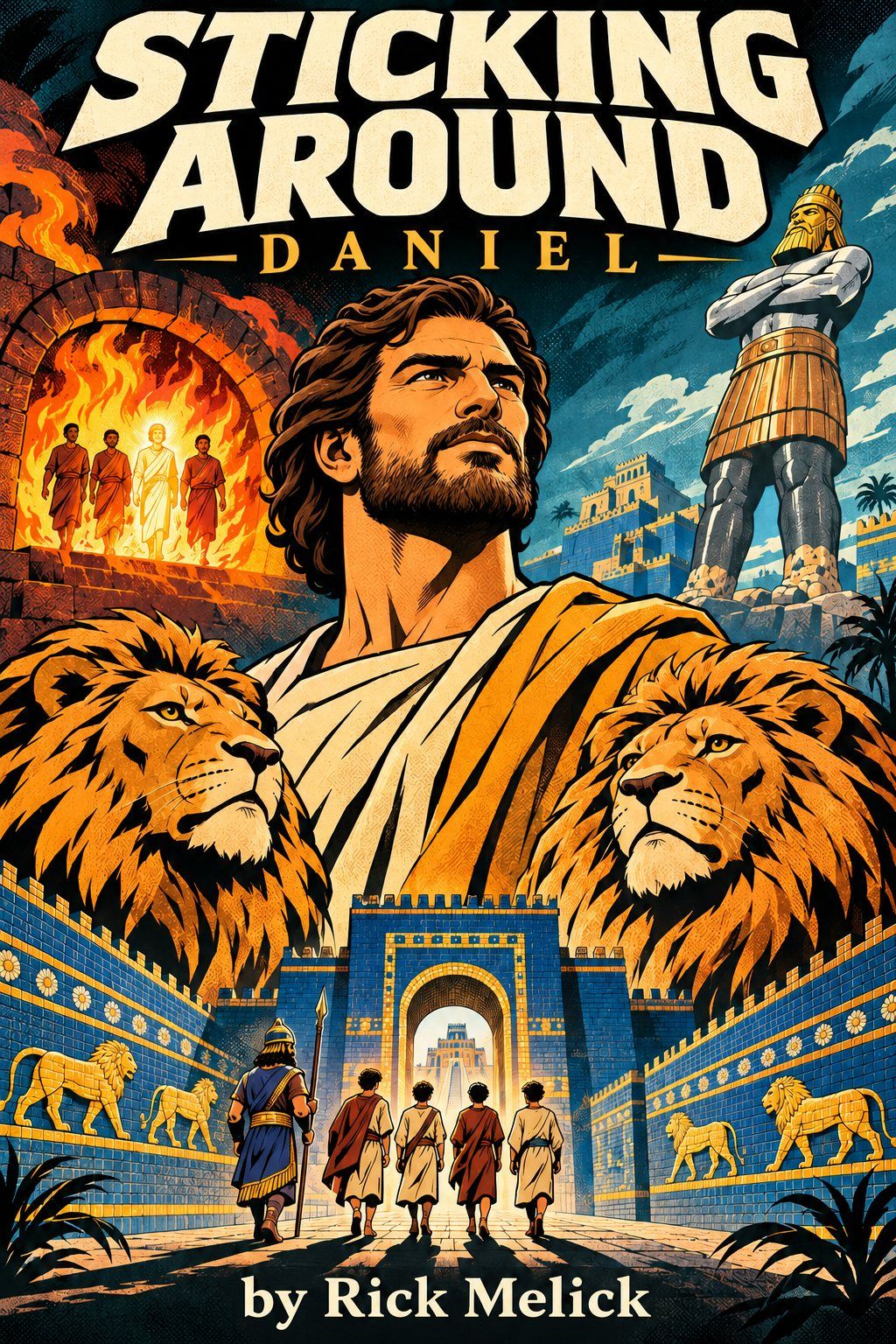
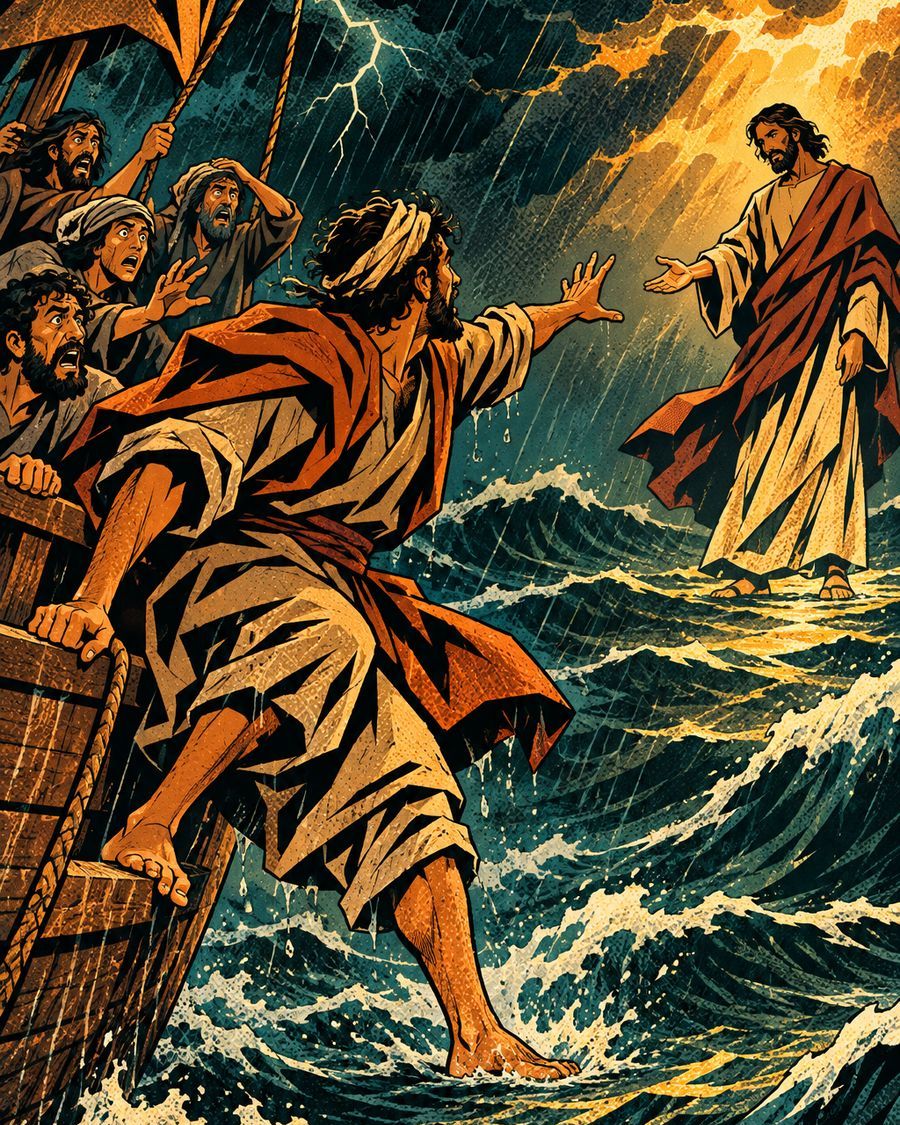
This chapter isn’t really about Daniel or his friends. It’s about a king God humbled, a king God gave a second chance, and a family that never learned what he learned. Underneath it is one question: how do you define success?

Richard squeezed onto the bottom bunk of the camper, his wife on the top bunk, their toddler son and daughter sitting in front
The first family camping trip: Dad on the kids’ shelf. Aching back, full heart.

Aching back, full heart

It was Father’s Day. My oldest, Richard, had just bought a little 20-foot bunkhouse camper for his young family. I warned him the dinette that folds down into a bed would wreck his back. The next morning he called: “Dad, my back is killing me.” I said, “I told you about that dinette.” He said, “No, the baby ended up in bed with his sister, so I slept all night on the bottom kids’ shelf.”

That’s a lot of what being a dad is: setting aside your own comfort so your kids have a good experience. You wake up with an aching back and a full heart. Carry that into the rest of life. Set aside your own preferences so the people you influence have a good experience of faith.

“Are you for real?”

When I moved to Arkansas to plant a church, a man named Glenn came alongside me. He was short, round, and red-faced, a truck driver with a flatlander accent I could barely understand. He and a group of retired men built our church while I mostly fetched lunch.

Glenn was in his seventies and had failed at most of what mattered. He’d been through two marriages, and his adult kids wouldn’t speak to him. He told me, “My passion in life is to share my failure, so no young man coming behind me makes the same mistakes.” One day he asked me to coffee, though he didn’t drink coffee, and burst into tears. “Are you for real? So many men don’t finish well. Isn’t there anybody who will finish well?”

You don’t know how you’ll finish until you’re done. But as long as you’re still here, you still have a chance to finish well. I watched Glenn do it.

The tree that reached heaven

Nebuchadnezzar was wildly successful. Archaeologists still dig up bricks stamped with his name. He was also ruthless and self-centered, and at this point I’d call him a failure. Remarkably, Daniel 4 is told largely in his own words, and it’s the story of his failure and his redemption.

He dreamed of a tree that touched the sky, giving food and shelter to the whole earth. A messenger from heaven called out: cut it down, but leave the stump, bound with iron and bronze, and let him live like an animal until seven times pass. The other interpreters wouldn’t touch it. Daniel reluctantly told him the truth: “Your Majesty, you are that tree!”

A year went by. He had been impressed by God at the furnace, but he hadn’t been changed. One night, walking on his palace roof, he said:

Is not this the great Babylon I have built as the royal residence, by my mighty power and for the glory of my majesty?
Daniel 4:30

That very hour it happened. He was driven out to live like an ox, his hair grew like eagle feathers, and his nails like claws. For seven seasons, likely seven years, he lived that way. Then he lifted his eyes to heaven, his sanity returned, and he praised the Most High: “those who walk in pride he is able to humble” (4:37). Sometimes God gives us the gift of rock bottom, the place where we finally look up.

I believe Nebuchadnezzar died a believer. Remember Jesus’ parable of the vineyard workers: the one hired at the last hour gets the same reward. The greater reward belongs to those who got to walk with God their whole lives instead of wasting them.

But his family didn’t finish well

Nebuchadnezzar reigned forty-three years, which puts Daniel and his friends somewhere in their late fifties by then. His son took the throne and was evil. A few more kings came and went, and then Belshazzar ruled, a descendant who called Nebuchadnezzar “father” the way people then honored an ancestor. Whatever Nebuchadnezzar learned late in life, he didn’t pass on. His late faith didn’t cost him heaven, but the wasted years before it cost the people coming behind him. That’s tragic, and it’s preventable.

King Belshazzar recoils in terror as a glowing hand writes on the palace wall and his guests stare
Belshazzar’s feast: the writing on the wall. (Daniel 5)

The writing on the wall

Belshazzar threw a feast for a thousand nobles and called for the gold and silver goblets Nebuchadnezzar had taken from God’s temple, the ones I asked you to circle back in chapter 1. They drank from them and praised their idols. Suddenly the fingers of a human hand appeared and wrote on the plaster wall. The king turned pale, and his knees knocked. (If a hand writing on the wall is just a normal Friday for you, push the glass away.)

The queen remembered Daniel, and they pulled him out of retirement. My paraphrase of the message: Your days are numbered. You’ve been weighed and found wanting. It’s about to happen. Behind the scenes, the Medes and Persians were outside the walls, and they diverted the Euphrates to march in through the riverbed. That very night Belshazzar was killed. He had known the story of his grandfather and never humbled himself.

If you’re still breathing, there’s still time.

Quantity, then quality

When your kids are young, you’re responsible for the quantity of your words. When they’re grown, you’re responsible for their quality, because you get fewer of them. Faith isn’t perfection. Glenn shared his worst moments, and God used them. Regret can be a powerful motivator. What do you want for the people closest to you?

Talk It Over

  1. How do you define success? Does your definition include anyone else?
  2. Where might God be giving you “the gift of rock bottom”?
  3. What’s the difference between being impressed by God and being changed by him?
  4. What patterns, good or bad, have been passed down to you, and what are you passing on?
  5. Who is coming behind you, and what will they see in your faith?

This Week

Choose one person who is coming behind you: a child, grandchild, coworker, or friend. Tell them one story of how God met you, failures included.

Watch the sermon

Scan the code or tap below to watch “Apples and Trees” on YouTube.

Watch on YouTube

For the kids in your life: the same story in the Kids' Edition, Chapter 8 · Comic, Issue 8: Just As He Had Done Before

Part Five · Daniel 6

The Old Fly in the Lions’ Den

Seventy years later, Daniel does exactly what he has always done.

Chapter 10

Darius and the Den of Lions

Daniel 6Preached June 28, 2026

The big ideaWhen the stakes go up, keep doing what you’ve always done.

Read first Daniel 6:1–28
Daniel in the Den of Lions

6:1It pleased Darius to appoint 120 satraps to rule throughout the kingdom, 2with three administrators over them, one of whom was Daniel. The satraps were made accountable to them so that the king might not suffer loss. 3Now Daniel so distinguished himself among the administrators and the satraps by his exceptional qualities that the king planned to set him over the whole kingdom. 4At this, the administrators and the satraps tried to find grounds for charges against Daniel in his conduct of government affairs, but they were unable to do so. They could find no corruption in him, because he was trustworthy and neither corrupt nor negligent. 5Finally these men said, “We will never find any basis for charges against this man Daniel unless it has something to do with the law of his God.”

6So these administrators and satraps went as a group to the king and said: “May King Darius live forever! 7The royal administrators, prefects, satraps, advisers and governors have all agreed that the king should issue an edict and enforce the decree that anyone who prays to any god or human being during the next thirty days, except to you, Your Majesty, shall be thrown into the lions’ den. 8Now, Your Majesty, issue the decree and put it in writing so that it cannot be altered—in accordance with the law of the Medes and Persians, which cannot be repealed.” 9So King Darius put the decree in writing.

10Now when Daniel learned that the decree had been published, he went home to his upstairs room where the windows opened toward Jerusalem. Three times a day he got down on his knees and prayed, giving thanks to his God, just as he had done before. 11Then these men went as a group and found Daniel praying and asking God for help. 12So they went to the king and spoke to him about his royal decree: “Did you not publish a decree that during the next thirty days anyone who prays to any god or human being except to you, Your Majesty, would be thrown into the lions’ den?”

The king answered, “The decree stands—in accordance with the law of the Medes and Persians, which cannot be repealed.”

13Then they said to the king, “Daniel, who is one of the exiles from Judah, pays no attention to you, Your Majesty, or to the decree you put in writing. He still prays three times a day.” 14When the king heard this, he was greatly distressed; he was determined to rescue Daniel and made every effort until sundown to save him.

15Then the men went as a group to King Darius and said to him, “Remember, Your Majesty, that according to the law of the Medes and Persians no decree or edict that the king issues can be changed.”

16So the king gave the order, and they brought Daniel and threw him into the lions’ den. The king said to Daniel, “May your God, whom you serve continually, rescue you!”

17A stone was brought and placed over the mouth of the den, and the king sealed it with his own signet ring and with the rings of his nobles, so that Daniel’s situation might not be changed. 18Then the king returned to his palace and spent the night without eating and without any entertainment being brought to him. And he could not sleep.

19At the first light of dawn, the king got up and hurried to the lions’ den. 20When he came near the den, he called to Daniel in an anguished voice, “Daniel, servant of the living God, has your God, whom you serve continually, been able to rescue you from the lions?”

21Daniel answered, “May the king live forever! 22My God sent his angel, and he shut the mouths of the lions. They have not hurt me, because I was found innocent in his sight. Nor have I ever done any wrong before you, Your Majesty.”

23The king was overjoyed and gave orders to lift Daniel out of the den. And when Daniel was lifted from the den, no wound was found on him, because he had trusted in his God.

24At the king’s command, the men who had falsely accused Daniel were brought in and thrown into the lions’ den, along with their wives and children. And before they reached the floor of the den, the lions overpowered them and crushed all their bones.

25Then King Darius wrote to all the nations and peoples of every language in all the earth:

“May you prosper greatly!

26“I issue a decree that in every part of my kingdom people must fear and reverence the God of Daniel.

“For he is the living God
and he endures forever;
his kingdom will not be destroyed,
his dominion will never end.
27He rescues and he saves;
he performs signs and wonders
in the heavens and on the earth.
He has rescued Daniel
from the power of the lions.”
28So Daniel prospered during the reign of Darius and the reign of Cyrus the Persian

This is the story everybody waited for. But listen to it as if it’s the first time. God’s Word never changes, but our lives change all the time, and the timeless Word lands differently on a changing life.

Pastor Rick crouches in his kitchen aiming a salt bug gun at a fly on the counter
Young flies are frantic. Old flies land, wait, and hop away.

God, help me

Joy got new contacts in the mail: two boxes, two prescriptions, and no label saying which eye was which. She called her optometrist while I listened on speaker in the car. She read the first prescription, and the lady said, “That’s your right eye.” That should have settled it. Two eyes, two boxes. Then I watched Joy pick up the second box, and I prayed, “God, help me. God, help me.” I wouldn’t have been able to keep my mouth shut. At the last second they both realized it and giggled.

Some “God, help me” prayers are small, and some are huge. Either way, it’s the right prayer for every situation. By Daniel 6, that kind of prayer had become Daniel’s habit.

The old fly

There always seem to be two flies in our house. Baxter spots them, and I hunt them with a salt-shooting bug gun. Young flies are frantic and never land. Old flies land right in front of you, wait until you’re in range, and hop away. Missed me.

By chapter 6, Daniel was an old fly. He wasn’t the teenager in the children’s Bible pictures. He was probably in his mid-eighties, and he had served under one king, regime, or administration after another for about sixty years. He had seen kings come and go, and he had watched God bless faithfulness again and again. He wasn’t frantic anymore.

The trap

King Darius (“Darius” may be a title, something like “holder of the scepter”) set three administrators over 120 satraps. Daniel was one of the three, and the king planned to put him over the whole kingdom. His rivals searched six decades of his life and found nothing. No corruption, no negligence. So they went after his God.

They flattered the king into signing a decree: for thirty days, anyone who prayed to any god or person except the king would be thrown to the lions. Under the law of the Medes and Persians, a decree could not be revoked.

Watch this story from three camera angles. God’s angle: providentially, he had put Darius on the throne. Circumstantially, he allowed a decree made behind Daniel’s back. Daniel’s angle: personally, he had to decide how to play the hand he was dealt. Then there’s Darius’s angle, and we’ll come back to that.

Old Daniel kneels at his open window, hands raised, facing Jerusalem at sunset
Toward Jerusalem, just as he had done before.

Just as he had done before

Now when Daniel learned that the decree had been published, he went home to his upstairs room where the windows opened toward Jerusalem. Three times a day he got down on his knees and prayed, giving thanks to his God, just as he had done before.
Daniel 6:10

The stakes went up, but his pattern didn’t change. Look at what he did:

  1. He went to his upper room. He didn’t post about it or gather a think tank. He met with God privately.
  2. He faced Jerusalem, the place of sacrifice. For us that points to Jesus. We pray through the Spirit, in Jesus’ name, to the Father.
  3. He knelt, a sign of humility and focus. Do something that sets your prayer time apart.
  4. He gave thanks, even with his life on the line. God is in control, God knows everything, and I have a part to play.
  5. He asked for help. God, help me be faithful, whatever today brings.

My 9-12-3-6 phone alarms are still going off. At dinner with friends recently, my 6:00 reminder buzzed. I said, “Sorry, that’s my reminder to pray. Which way is Jerusalem?” They laughed. They hadn’t read Daniel 6 yet.

Daniel disobeyed the king’s order because it opposed his God’s command. But he accepted the consequences, and he did it with respect. He was faithful without trying to hurt anyone who was unfaithful.

Trial by the gods

Darius was “greatly distressed” and worked until sundown to save Daniel. He had been tricked. In that culture, lions symbolized royalty and the power of the gods. If you were thrown in and survived, the gods had spoken: the charges were false, and even an unchangeable decree could be set aside.

As they sealed the stone, the king said, “May your God, whom you serve continually, rescue you!” Continually. Darius didn’t believe in Daniel’s God yet, but he believed in Daniel’s faith. People rarely get argued into heaven. They watch how you live through hard times and good times.

The king spent the night without food, without entertainment, and without sleep. At dawn he ran to the den: “Daniel, servant of the living God, has your God, whom you serve continually, been able to rescue you from the lions?”

Daniel could have spiked the football. Instead he said, “May the king live forever! My God sent his angel, and he shut the mouths of the lions.” (He drops that angel and moves right along. I want to know how! Did the angel say “bad kitty”? Someday I’ll ask.)

Old Daniel stands praying in a shaft of light while lions rest quietly around him
“My God sent his angel, and he shut the mouths of the lions.” (Daniel 6:22)

Darius in the lions’ den

I think this story was really about Darius. God used Daniel’s faithfulness to move the pieces.

The king wrote to every nation: “I issue a decree that in every part of my kingdom people must fear and reverence the God of Daniel. For he is the living God and he endures forever” (6:26). As I understand the history, the hearts of the Persian kings softened toward the Jewish people. They were allowed and even helped to go home and rebuild. A generation of exile turned around through a pagan king’s decree, because a boy taken at thirteen had resolved to be faithful.

Little things become big things over time.

It starts now

Do you want to change your marriage? Live for Jesus. Your family, your workplace, your community, your state, your world? Live for Jesus. Who does it start with? Me. Where does it start? Right here. When? Right now.

Talk It Over

  1. Are you a young fly or an old fly in your faith right now? What would help you settle?
  2. If someone investigated your last ten years, what would they find?
  3. Which of Daniel’s five prayer habits do you most need to adopt?
  4. Darius believed in Daniel’s faith before he believed in Daniel’s God. Who might be watching yours?
  5. Looking back over all of Daniel 1–6, what one or two lessons do you want to stick?

This Week

Pick your “upper room”: a time, a place, and a posture for prayer. Go there every day this week, on the good days and the bad ones, “just as you have done before.”

Watch the sermon

Scan the code or tap below to watch “Darius and the Den of Lions” on YouTube.

Watch on YouTube

For the kids in your life: the same story in the Kids' Edition, Chapter 8 · Comic, Issue 8: Just As He Had Done Before

The End, and a beginning

Little Things Become Big Things

Daniel 1–6A review of the series

Faithfulness is never built in a day. Here is how one boy’s rope was woven, strand by strand, over about seventy years.

Age ~13 Taken to Babylon, renamed, and enrolled in the king’s school. Daniel resolved. (Daniel 1)
Age ~13 Ten days of vegetables and water. He asks with respect, steps away from the crowd, and speaks up for his friends.
Age ~16 Graduates ten times better than the king’s magicians. God gave. (1:17–20)
Age ~17 A death sentence. He asks for time, gathers his friends to pray, and gives thanks before he speaks. (Daniel 2)
Age ~30s His three friends stand alone before the gold image. Even if he does not. A fourth man walks in the fire. (Daniel 3)
Later A proud king is humbled and restored. (Daniel 4)
Much later The writing on the wall. Babylon falls in a night. (Daniel 5)
Age ~85 Three times a day, toward Jerusalem, on his knees, just as he had done before. The lions’ mouths are shut. (Daniel 6)

Ten strands to weave

  1. Decide. Believe God, not just believe in God. How would you live if he really is in control?
  2. Add one thing that grows faithfulness.
  3. Remove one thing. Tell yourself no in the little things.
  4. Step out of the crowd. Step in for your inner circle.
  5. Make a plan. Look for God’s providence, and pray often.
  6. Wait well. While you are waiting, God is working.
  7. Tie a knot with a few faithful friends. Go at their pace, and stay half a step ahead.
  8. Keep an “even if not” faith.
  9. Finish well, and pass it on to the people coming behind you.
  10. Keep your pattern when the stakes go up.
Who does it start with? Me. Where? Right here. When? Right now.

Father, thank you for every person holding this book. Make us people who resolve, who weave a rope of faithfulness and tie it to a few faithful friends. When the music plays and everyone else bows, give us the courage to stand, with wisdom and with grace. Let the people closest to us see your strength in our weakness. When we finish, may we hear, “Welcome home. You were good and faithful.” In Jesus’ name, amen.

Back to contents
About the Author
Rick Melick

Rick Melick

Rick Melick has served as senior pastor of Capitol City Church in Des Moines, Iowa, since November 2016. A pastor and church planter for more than three decades, he planted congregations in San Anselmo, California, and Cotter, Arkansas, and has served churches in Texas, Tennessee, and Washington.

In 2017 he founded City Serve DSM, a nonprofit that partners with Capitol City Church to bring businesses, schools, and community organizations together to serve the teachers, first responders, and military personnel of Greater Des Moines. He also serves as a chaplain with the Iowa State Patrol.

Rick studied at The Criswell College and Golden Gate Baptist Theological Seminary, and did doctoral work at San Francisco Theological Seminary and Midwestern Baptist Theological Seminary.

He and his wife have been married thirty-six years. They have two grown sons, two daughters-in-law, and grandchildren who call him Bapo.

Rick wants what will be most important to him five minutes after he dies to be most important to him every day.

Capitol City Church · Des Moines, Iowa