

Same School, Different Worlds
A friend on our staff and I went to the same high school. We met in eighth grade. He was an all-star basketball player, recruited by colleges as a sophomore. He told me recently about the day our coach pulled up in front of his house in a big black Buick and asked him to come play.
“Did he ever recruit you like that, Rick?”
My basketball career went like this: I was the last guy allowed on the team. During warmups I stood under the basket, rebounding for everybody else and trying not to get hit in the face.
So no. If that coach had ever pulled up to my house and asked me to get in the car, the only reason I could imagine was that I’d dated his daughter.
Same school. Night-and-day experiences.
We live in the same world, too. But you never fully understand what someone else is going through, because you’ve never been them. And everybody is going through something.
Don’t Quit
This series has been about becoming more like Jesus, one small step at a time. Transformation. Today is the day the Lord has made. Prayer. Scripture. Intentionally loving the people God has given us.
This last step is the simplest and maybe the hardest: don’t quit.
You will be tempted to. Things will happen that make you question God. You’ll get tired. You’ll get disillusioned. You may even demand answers.
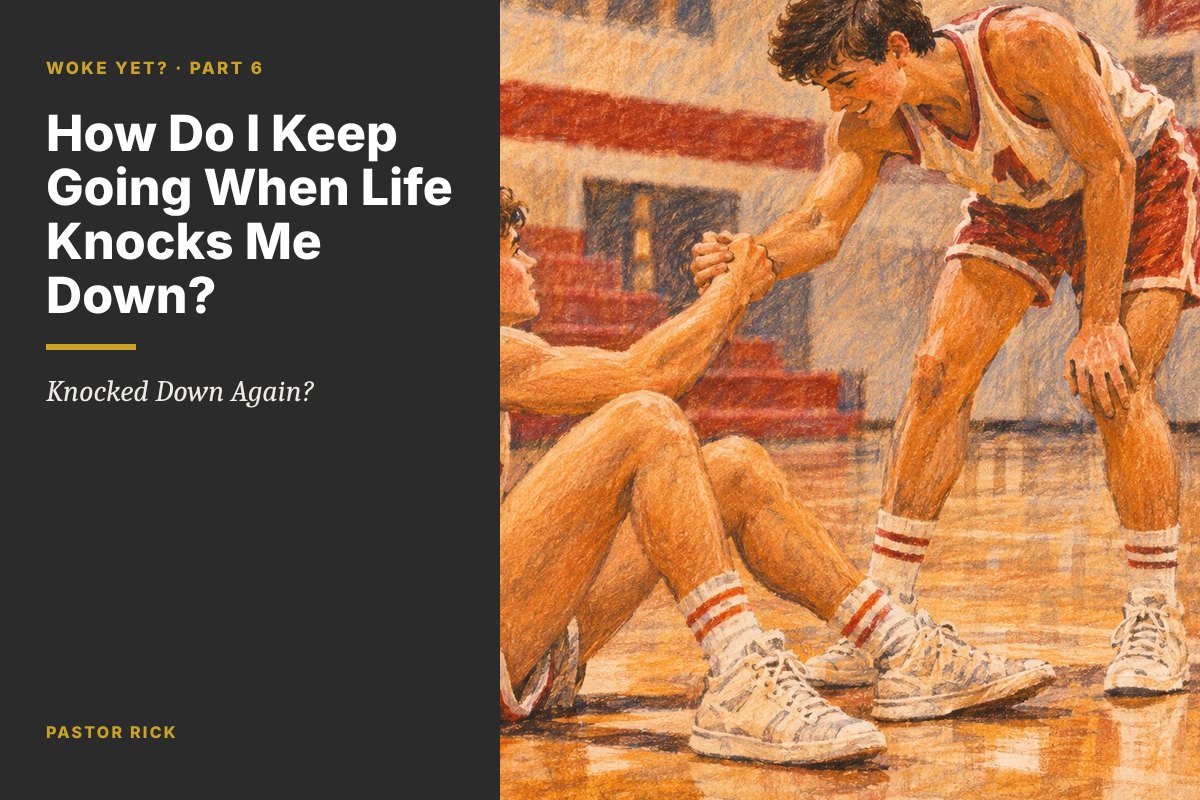
All we really offer God is our endurance. We get knocked down, and we get back up. We keep going, even tired. And God takes that endurance and turns it into perseverance, and perseverance into transformation.
Here’s a simple definition of perseverance: becoming increasingly able to keep the commitments that ought to last a lifetime. To your spouse. To your kids. To Jesus. Especially when keeping them gets hard.
When life gets tough, all bets seem to be off. We make excuses, or let other people make them for us, and we walk away. James says, don’t. Hebrews says the same thing: “Let us run with perseverance the race marked out for us” (Hebrews 12:1).
Trials of Many Kinds
“Trials of many kinds” isn’t about how many. It’s about how different they are. A disappointment. A disease. A disaster. A divorce. Getting fired. A child making choices that break your heart.
If you’ve never had any of that, please see me after church. I’d love to know your secret.
I was shopping not long ago while my wife looked for Easter things. (That can take a while.) Near me, a sweet older couple was browsing. The husband had wandered off, and his wife called him back and said, completely seriously, that she was flummoxed by this fabric.
I just about lost it. That was the most intelligent weird thing I’d ever heard. I ducked into a dressing room and looked it up, just to be sure. Flummoxed: bewildered, perplexed.
Trials come in every size. I hope yours are more like the fabric. But being flummoxed is part of being human.
The Danger of Demanding Answers
One of the most dangerous things we can do when we’re bewildered is demand answers from God. (I’m pointing at me too.) It’s one of the biggest reasons people walk away.
God promises us wisdom and perspective. He doesn’t promise us specific answers.
Bad things happen to good people and bad people, believers and unbelievers, those who deserve it and those who don’t. Jesus said God “sends rain on the righteous and the unrighteous” (Matthew 5:45). You can find a book in the bargain bin promising that if you live right, give enough and believe hard enough, life will always go your way. That’s a lottery ticket. James isn’t handing you a lottery ticket. He’s telling you how to grow up in your faith.
And mature and complete, not lacking anything isn’t a promise of money, health or a breeze at your back. It’s a promise about who you become.
So when trouble comes, we have a choice. We can stamp our foot and say, God, I don’t believe you, and I don’t trust you, and slide back to square one. Or we can say, God, I wish this weren’t happening. I can’t see you in the middle of it. But I trust you.
That’s what Peter said when many followers were walking away:
I’m in. I’ll endure. And staying in the game makes room for the Holy Spirit to do a miracle in you: a softer heart, a gentler spirit, more humility and more love.
The World’s Worst Patient
I was sick recently, which happens about once every thirty years, so don’t worry. And I’ll admit it: I’m a terrible patient. I whine.
One night I was so dramatic I was convinced I wasn’t going to make it. I folded my clothes on the dresser and laid out my insurance card, just in case. I had the whole thing planned.
I didn’t die. (I’m happy about that.)
At one point I told my wife how awful I felt, and she said, “I had what you have.” She was being sweet. She’s the best nurse in the world, patient beyond imagination. And I got mad. You did not have what I have. Mine is much worse. My fever’s higher. Even Motrin isn’t working. She was smart enough to change the subject and walk away.
And you know what people do when you’re sick? They tell you about everyone else they know who’s sick. I didn’t care. I’m the one going through it. You don’t know how I feel.
It’s a good thing I wasn’t preaching that week.
But underneath the whining, there’s something true. Nobody fully understands what you’ve been through, because nobody else has been you going through it.
Do You Want to Heal?
That leads to a hard question: do you want to heal?
Some of us don’t, not really. We’ve turned the events of our past from explanations into excuses, and they keep us trapped in a time that no longer exists.
I’m not belittling what you’ve been through. It may have been terrible. But God gives us grace for today, today, and grace for tomorrow when tomorrow comes. He doesn’t give us grace to live in the past.
The Wheelbarrow and the Trash Can
Picture two things on the stage: a wheelbarrow and a trash can.
With every hard thing in your past, you have to decide what goes in the trash and stays there, and what goes in the wheelbarrow and comes with you.
Why a wheelbarrow? Because nobody gets through life without carrying something. Jesus said his yoke is easy and his burden is light (Matthew 11:30). But the burdens we pile on ourselves can cripple us.
Many of us have never sorted it out. We’ve never felt the feelings we need to feel, learned the lessons we need to learn or thought the thoughts we need to think. We put them off, or took them out on someone else, and relationships blew up. Distance grew between us and God.
Here’s a tool to help you sort it out.
The Four F’s
Years ago I studied counseling in college, and I’ve served as a chaplain with first responders after hard calls. This simple pattern shows up in many forms, and it works. I’ve shaped it here for our walk with Christ.
Pick two hard events from your life. The worst two, or the most recent two. This is private, just between you and God, unless you choose to share it.
1. Facts. Write a short, plain account of what happened. Just the facts, as if you were a reporter writing about someone else. Who, what, where, how. It’s harder than you think to be objective about yourself. (I had to ask my wife whether I was being honest.) Sometimes seeing it in black and white makes you say, That was an awful thing to go through. It was. And it’s yours.
2. Feelings. Now be completely honest. Not churchy, not super-spiritual. I was scared. I was angry. I felt abandoned. I felt disrespected. I was flummoxed. Guys, I know some of us say we don’t like feelings. We do; we just don’t like anyone seeing us have them.
Here’s where many of us get stuck. We go from facts to feelings and back to facts and back to feelings, a loop that traps us in the past. It’s spiritual Chutes and Ladders: decide to grow, start to grow, hit a hard thing, slide back to square one. The break comes with the third F.
3. Findings. What did I learn? About God? About myself, even if it’s ugly? About the people around me? Sit with it.
4. Future. This is the F that leads to freedom. Based on the facts, and in spite of the feelings, what will I do with what I found? What goes in the wheelbarrow? How can I use this to serve the Lord? How can I come alongside someone going through something similar? What someone meant for harm, God can use for good (Genesis 50:20).
You don’t make that happen. God does, as he changes the way you think about your life and builds the character of Jesus in you. You just put yourself where he can work.
Where Did You Find God?
I added one last question almost as an afterthought, and it turned out to be my favorite:
Where did I best sense God’s presence in this? Through people? Places? Circumstances?
When I worked through the four F’s myself, I used my thyroid cancer diagnosis and the start of treatment. I don’t talk about it much. When I got to places, my first thought was that I hadn’t found God in any place.
Then I realized that wasn’t true. One of the places I found him was in the middle of a PET scan. I wanted to find him in the parking lot, because that’s where I wanted to be. But the times I had supernatural peace were the scariest times, lying there with a needle in my neck.
Where did you find God? Which people showed up? What circumstances let you see him?
Try it. Then you can tell me if it works.
Get Up Again
James says, “You know that the testing of your faith produces perseverance.” That’s the kind of knowing that comes with time: trial and error, victory and defeat, over the years. It’s how you learn what to throw away for good and what to keep for next time and for the people you’ll help.
We closed that Sunday by belting out a catchy old pop song about getting knocked down and getting back up again. (I’m not endorsing the band.) It was loud and a little weird, and it made the point:
When you get knocked down, get up again.
Endure. Don’t give up. Let perseverance finish its work, and you’ll become mature and complete, not lacking anything.
That’s what it’s all about.
Talk It Over
- Think of someone who went through the “same” thing you did but had a completely different experience. What did that teach you?
- Which kind of trial are you facing right now?
- Have you ever demanded answers from God? What happened?
- “Explanations, not excuses.” Is there anything from your past you’ve turned into an excuse?
- Pick one hard event. What belongs in the trash can, and what belongs in the wheelbarrow?
- Where have you best sensed God’s presence in a hard time: people, places or circumstances?
 Free · Short readsMore articles from Pastor RickSunday messages you can read in about 15 minutesSee them all →
 Capitol City Store · Everything is freeBooks, Bible studies, kids’ comics and short readsDozens of short reads like this one, plus free books, City Group studies, sermon notes, and kids’ comics and games. Read on your phone, print or share with a friend.Explore the store →
© 2026 Rick Melick. All rights reserved. Free to read and share for personal use. Not for resale.
Scripture quotations taken from The Holy Bible, New International Version®, NIV®. Copyright © 1973, 1978, 1984, 2011 by Biblica, Inc.™ Used by permission. All rights reserved worldwide.