Read First
Shake It
I’ll confess right up front: this is one of the ones I struggle with. Not the long-term grudges. I’ve gotten pretty good at letting go of the big things. It’s the short-term stuff. You push me, I push back. You say something, I say something. It pops up in my marriage and in my closest relationships, and it’s just being prickly like a porcupine when there’s no need for it.
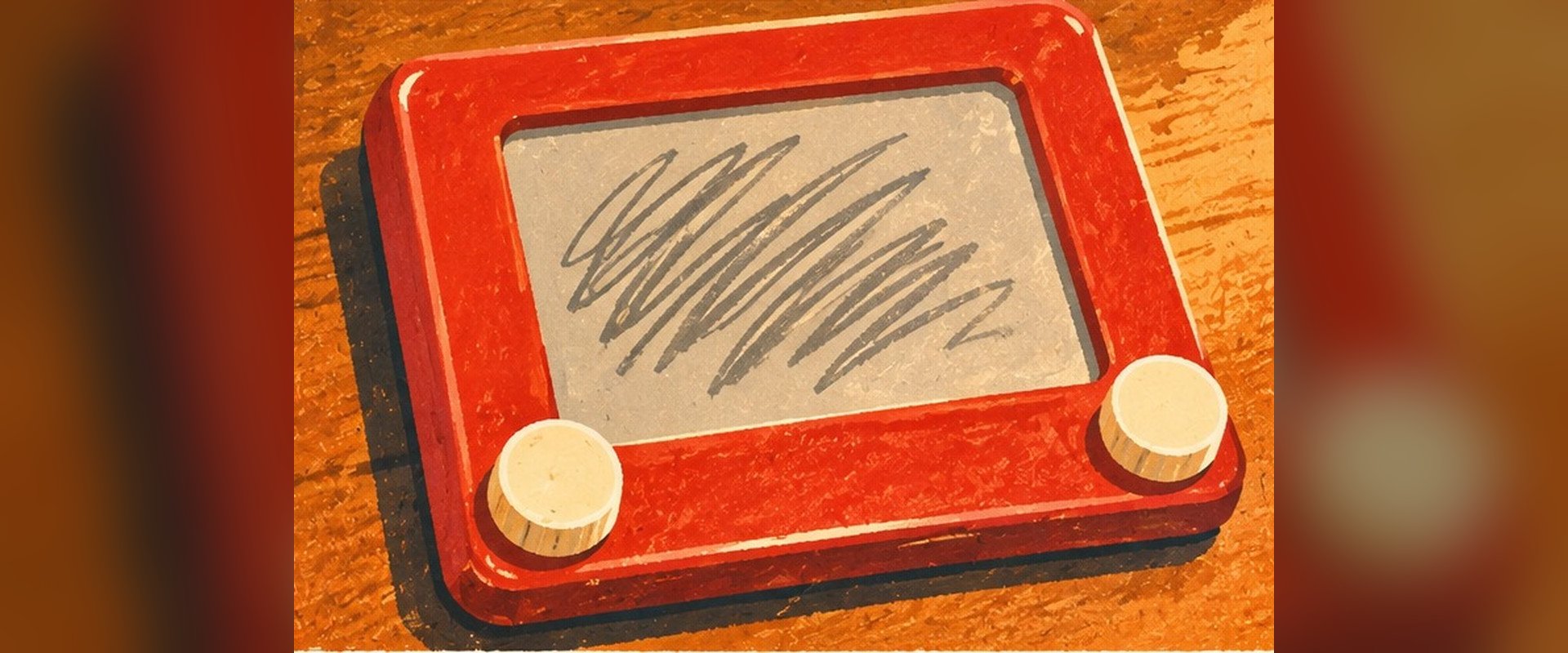
When I first taught this at our church, a young friend helped me with an Etch A Sketch. I like to call him my assistant pastor. Someday I hope he takes over, and I’ll be the one assisting him. We had to teach him what it was. He wanted to know where you plug it in and where the screen was. He figured it out fast, and while I talked, he drew a picture. When he was done, there really was a picture on that screen. It looked a little like downtown Des Moines from the air.
Then I asked him, “How do you erase an Etch A Sketch?” And he shook it. Hard.
And the picture was gone. No record of it at all.
No Ledger
When Paul says love “keeps no record of wrongs,” he uses an accounting word on purpose. It means to keep track the way an accountant keeps track of dollars and cents, payables and receivables. And in accounting, you don’t approximate.
Paul uses the same kind of word in Romans: “Blessed is the one whose sin the Lord will never count against them.” (Romans 4:8) God doesn’t post our sins to a column to reconcile later.
Love does the same. When someone wrongs you, you don’t put it in a column to bring up later. You look at it and decide, You don’t owe me anything. And you don’t decide it a week later, a month later or a year later. You decide it in real time, as it happens. You shake it.
I’m not talking about things that are dangerous, things that threaten your life or your family. I’m talking about insults, slights and the everyday friction of people living close together, the things that tempt you to tit for tat. Love has a short memory. A Teflon soul.
The Go-Bag
A while back Iowa had about twenty-eight tornadoes in one day. An F4 tore through a town near us, and people in our church lost trees and more.
Neither my wife nor I grew up with tornadoes. She’s from Arkansas, where they had them, but not really. I grew up in South Florida with hurricanes, and we weren’t scared of those at all, which we probably should have been.
A few days before the storm, my wife and I talked about what we’d do if a tornado came. She said, “I don’t know how I feel about being stuck in the basement for five days with the house collapsed on top of us. Maybe it would be better to just be dead.”
Very dramatic. She was trying to decide whether she’d rather be trapped or dead.
I said, “Well, you choose.”
She thought about it and said, “I guess dead would be better.”
So I said, “All right. Ride or die. We’ll stay up on the main floor together, and if it comes, we go see Jesus together.” I’ve seen the movie Twister. I figured it would be fine.
Then the storm came. I wasn’t terribly worried. I knew the tornadoes were around, but not in our backyard. So I went out on the front porch to film it, because after seven years in Iowa, that’s what you do. I was thinking, My wife and I are in this together, all the way. The wind was blowing hard, and the trees in the median of our street were bent over. I was on the safe side of the house. I was fine. Then all at once the trees flipped and bent the other way. I thought, Uh-oh. That’s a bad sign. I ran inside to find my wife so we could go to the basement.
She was already headed down the basement stairs. With a bag. Wearing two watches, hers and mine.
I said, “What are you doing?”
She said, “Going to the basement. I packed some clothes. If I’m stuck down there, I want to be able to get dressed. And if I end up on the news, I want to look presentable.” You’ve seen those people on the news. I think she’s right. They get dressed for it.
I said, “Weren’t we going to do this together? Ride or die? Were you going to leave me on the front porch while you went to the basement fully dressed, wearing my watch?”
She had a plan. She’d just forgotten to include her husband.
But she had the right idea. She didn’t know what was coming, but she knew she needed to be clothed and ready.
That’s exactly what Paul says. “Clothe yourselves.” Pack your go-bag before the storm, with the right things to put on, because you don’t know what’s coming next.
What to Pack
Paul names five things to put on.
- Compassion: being moved by someone else’s pain and circumstances, instead of only noticing how their behavior affects you.
- Kindness: mellowing anything in you that’s harsh. Sanding down the rough boards.
- Humility: not thinking less of yourself, just thinking about yourself less often.
- Gentleness: being willing to take an injury rather than always choosing to inflict one.
- Patience: our old friend makrothumia. You could get even, and you’re probably good at it. You choose to let it go.
Then he gives two instructions that make it possible.
Bear with each other. You can’t really love someone with one foot out the door. If you’re always looking for something better, you become critical of what you have. The grass looks greener on the other side, but most of the time you just need to water your own yard.
Forgive one another. “Forgive as the Lord forgave you.” You have to deal with the past before you can live in the present. And then, “over all these virtues put on love, which binds them all together.” Love is the belt that holds the rest of the outfit together.
The Gap
Between every offense and your reaction, there’s a gap. Sometimes it’s a split second. But it’s there. I made it into an acronym. It’s a little corny, but it works for me: GAP. Gasp, Action, Plan.
Something happens. My wife tells me how to drive. I saw that truck! Doesn’t she know I don’t run into cars when she’s not with me? That’s the gasp.
Then comes the action. The problem is that most of our actions are really reactions, fueled by hurry and temper. A reaction is an action without a plan.
The plan is where we prepare ahead of time. We pray, and we decide in advance that Jesus is going to be Lord of the gap. We’re going to let grace live in the gap.
Now, I had spent a whole week studying this and writing daily devotionals to help our church get good at it. And on Saturday morning, the day before I was going to teach it, my wife and I were getting ready for the day. Normal Saturday. Couple of cups of coffee. Everything fine.
She asked, “Are we going to Home Depot after we get ready?”
Perfectly normal question. But I heard it like a disagreeable person, and I said, “No. We ought to go to Home Depot before we get ready.”
I don’t know why I said it. I wasn’t mad. I was having a good Saturday. It just popped out.
She didn’t deserve it, and whatever came back to me, I would have deserved. Do you know what she did in the gap? She looked at me and said, “Well, that wasn’t very nice.” And she walked on. She didn’t hold it against me. She didn’t huff. She didn’t make me pay for it. She didn’t bring it up later. She just let it go.
I thought, I want to be like that. Where I deserved a slap, she let grace live in the gap.
Myth: An Eye for an Eye
Jesus said, “You have heard that it was said, ‘Eye for eye, and tooth for tooth.’ But I tell you, do not resist an evil person. If anyone slaps you on the right cheek, turn to them the other cheek also.” (Matthew 5:38–39)
“An eye for an eye” really is in the Bible. It shows up three times in the Old Testament, and similar laws go back to the Code of Hammurabi. It was a step toward fairness: the punishment had to fit the crime, decided by a judge. Before that, if you scuffed the wrong person’s shoes, he could kill you. But it was a principle for courts, not a guide for relationships. It never meant, If my wife calls me a name, I get to call her five. If you cut me off in traffic, I get to make a gesture.
The religious leaders had turned it into exactly that. They were the prickliest people imaginable, and nobody could see God in them.
Now look at the slap. Most people are right-handed. If I hit you with my right hand, I hit your left cheek. To hit your right cheek, I have to backhand you. In Jesus’ culture, a backhanded slap wasn’t about injury. It was an insult, the most contemptuous thing you could do to someone. It meant, You’re not worth my time. Some slaves said they’d rather be beaten than slapped that way.
So Jesus isn’t talking here about self-defense, protecting your family or war. Other passages deal with those. He’s talking about insults. Don’t pick a fight with everyone who picks a fight with you. Someone says something, and you don’t have to say something back. “Do not be overcome by evil, but overcome evil with good.” (Romans 12:21)
You worry about your character, and let God worry about your reputation. Ask him for thicker skin.
Everyone Is Fighting a Hidden Battle
There’s a term for something we all do: the fundamental attribution error. When I do something wrong, it’s because of my circumstances. I didn’t see you. I had a bad day. I didn’t sleep. I have a headache. When you do something wrong, it’s because of your character. That guy’s a jerk. Who raised him?
Love gives the benefit of the doubt. Everybody you meet is fighting a hidden battle that maybe one other person knows about, and most likely nobody.
One of the most important things I learned as a parent is that kids are allowed to have a bad day. They’re not allowed terrible actions, any more than adults are. But they can have a bad day. You don’t have to drive them into submission every time they have that look on their face. Pick your battles. And it’s not just kids. Your spouse is allowed a bad day. So are your friends, your coworkers and your staff.
Hurting people hurt people. I’ve lain awake at night wanting to fight back, defend my reputation and set the record straight. And after prayer, and sometimes a lot of lost sleep, I’ve realized it’s not only futile. If I do it, what’s lost is someone else’s chance to see Christ in me.
The call ahead of you is so much more important than the offense behind you.
What Forgiveness Isn’t
A lot of people won’t forgive because they think forgiveness means something it doesn’t. So let’s clear that up.
- It isn’t saying it was no big deal. Sin is a big deal. Forgiveness is costly because the wrong was real.
- It isn’t letting it keep happening. You can forgive someone and still tell them, This has to stop.
- It isn’t pretending it didn’t happen. You were sinned against. Forgiveness starts by admitting that.
- It isn’t waiting for an apology. Some people will never say they’re sorry. You can still be free.
- It isn’t forgetting. “Forgive and forget” isn’t in the Bible. You’ll remember. You just stop keeping the record.
- It isn’t the end of the hurt. If it still hurts, that doesn’t mean you didn’t forgive.
- It isn’t one and done. Sometimes you forgive the same thing again tomorrow.
- It isn’t ignoring what’s right. Forgiving someone doesn’t mean there are no consequences, or that you stay somewhere unsafe.
- It isn’t automatic trust. Trust is earned back slowly. Forgiveness is given.
- It isn’t always reconciliation. That takes two people. Forgiveness only takes one. “If it is possible, as far as it depends on you, live at peace with everyone.” (Romans 12:18)
What Holding On Costs You
Scripture is full of this.
“A person’s wisdom yields patience; it is to one’s glory to overlook an offense.” (Proverbs 19:11)
“Bear with each other and forgive one another if any of you has a grievance against someone. Forgive as the Lord forgave you.” (Colossians 3:13)
“Mercy triumphs over judgment.” (James 2:13)
Jesus even said that if you’re on your way to worship and remember someone has something against you, stop and go make it right first. (Matthew 5:23–24) And he taught us to pray, “Forgive us our debts, as we also have forgiven our debtors.” (Matthew 6:12)
Here’s what unforgiveness does. It keeps you living in the past. It grows into bitterness. It puts distance between you and God. And it gives the devil a foothold. (Ephesians 4:26–27) The person who hurt you may have moved on years ago. Unforgiveness keeps you locked in the room with them.
Try It This Week
- Monday · What forgiveness isn’t. Forgiveness isn’t pretending it didn’t hurt, excusing it or trusting someone unsafe. Ask: am I even willing to forgive?
- Tuesday · Pray for them. List the people you still haven’t forgiven. Pray for each one by name.
- Wednesday · Check yourself. How do you know you’ve really forgiven? You stop replaying it, stop retelling it and can wish them well.
- Thursday · Plan for the gap. Decide now how you’ll respond the next time someone close to you says the wrong thing. Make Jesus Lord of the gap.
- Friday · Shake it. Every time something small happens today, picture shaking an Etch A Sketch. Let it go in real time.
Talk It Over
- Are you more likely to hold long-term grudges or to push back in the moment?
- Which of the five things in your go-bag do you most need to put on this week?
- Describe a time someone let grace live in the gap for you.
- Where do you need to give someone the benefit of the doubt?
 Next in the seriesTruth Loved Is Truth Lived: How to Speak the Truth in LoveCan You Handle the Truth? · Part 8Read it →
 The entire series · Free bookLove Intentionally1 Corinthians 13, one color of love at a timeRead it free →
 Capitol City Store · Everything is freeBooks, Bible studies, kids’ comics and short readsDozens of short reads like this one, plus free books, City Group studies, sermon notes, and kids’ comics and games. Read on your phone, print or share with a friend.Explore the store →
© 2026 Rick Melick. All rights reserved. Free to read and share for personal use. Not for resale.
Scripture quotations taken from The Holy Bible, New International Version®, NIV®. Copyright © 1973, 1978, 1984, 2011 by Biblica, Inc.™ Used by permission. All rights reserved worldwide.