Why I Wrote This
Most of us are drawn to our origin story: creation and the very beginning. But many of us never get around to thinking about the final chapter, how things end for us and what eternity holds.
In more than three decades of ministry, I had never taught a full series on how the story ends: Jesus’ return, heaven, hell and the life to come. I’ve led Bible studies, preached single messages and answered questions along the way, but never a series that walked through it from start to finish.
Since how the story ends is such an important part of our Christian worldview, I prayerfully set out to create one for our church: a journey that every age could take together. Over eight weeks, our entire church walked through it, from family-friendly Sunday worship to conversations at home, in the car, at bedtime or anytime.
I wrote this for our own church family, and I pray it serves many others as well. May it help you answer the question at the heart of this series: What will matter most to us five minutes after we die?
— Pastor Rick Melick
Before You Begin
These chapters began as sermons. From September through November 2026, Pastor Rick Melick led Capitol City Church in Des Moines, Iowa, through an eight-week series called See You on the Other Side, a walk through what the Bible says, and doesn’t say, about heaven, hell, and the life to come.
The messages have been edited for reading. Rick’s voice, stories, and humor are kept. Some repetition, announcements, and references to the room have been trimmed, and each chapter ends with questions for personal reflection or small-group discussion, adapted from the church’s City Group guides.
The personal stories you may remember from the series are set off by before and after, and many come with an illustration featuring people you might recognize.
The whole book rests on one question: What will matter most to you five minutes after you die? Rick’s prayer through the series was simple: that whatever will matter most then would matter most now.
The chapters build on one another, just as the sermons did. Each week added a piece to a timeline that runs from this present age to the age to come. The Road Map on the next page lays out the whole timeline, and every chapter opens with a You are here marker on it, followed by the chapter’s main Scripture passage. You don’t need to have heard the sermons; if you’d like to, every chapter links to the videos.
Reading Tips
- Read it in a reading app. On iPhone or iPad, tap the file, then Share › Books. On Android, open it in Google Play Books or your PDF reader. It stays in your library and remembers your place.
- Getting back after a link. After you tap a link, use your app’s Back button to return to where you were (in Apple Books, tap Back to page at the bottom of the screen).
- Lost? Tap Contents (or Menu) at the edge of any page to jump to any chapter. Tap any stop on a You are here marker to see the whole Road Map.
- Writing notes on a tablet. Open the tablet edition in GoodNotes, Notability or any note-taking app and write in the Notes column with a stylus or Apple Pencil.
Unless otherwise noted, Scripture quotations are from the New International Version.
The Road Map
Every story is headed somewhere, and so is yours. Scripture divides all of time into two ages: the present age, the one we live in now, and the age to come, the forever God is preparing for his people. Every stop on the road between them is marked below.
Know where you are on this map, and you’ll never lose your place in the story.
Paradise · where believers go at death,
today
Instantly with Jesus; the body stays behind. Luke 23:43; 2 Corinthians
5:1–10. Chapter 2 ›
Hades · the anti-paradise
Personal, painful, permanent, preliminary. Luke 16:19–31. Chapter 4 ›
The Tribulation · seven years that end the
present age
Three and a half years of false peace, then three and a half years of
persecution, ending at Armageddon. Christians differ on whether
believers are gathered before or after it. Matthew 24. Chapter 3 ›
The Second Coming · the sheep and the
goats
Jesus comes as King and Judge. Matthew 25:31–46. Chapter
5 ›
The Millennial Kingdom · a thousand-year reign
of Christ
Satan is bound; believers in glorified bodies serve and reign with
Jesus; a final rebellion is crushed. Revelation 20:1–10. Chapter 6 ›
The Great White Throne · final
judgment
Hades gives up its dead; all whose names are not in the Lamb’s Book of
Life go to the lake of fire. Revelation 20:11–15. Chapter
6 ›
The New Heaven and New Earth ·
forever
God dwells with his people in the New Jerusalem. No more death,
mourning, crying, or pain. Revelation 21–22. Chapter 7
›
Who We’ll Be · forever with Jesus
Still ourselves, made like Jesus, worshiping, serving, and reigning with
him. 1 Corinthians 15; Revelation 22:3–5. Chapter 8
›
Along the way you’ll also meet the judgment seat of Christ (2 Corinthians 5:10), where believers, already saved by grace, are rewarded for how they lived (Chapter 2 ›).
Through all of it, one thing never changes: the deciding factor is what you decide about Jesus.
From the Stage
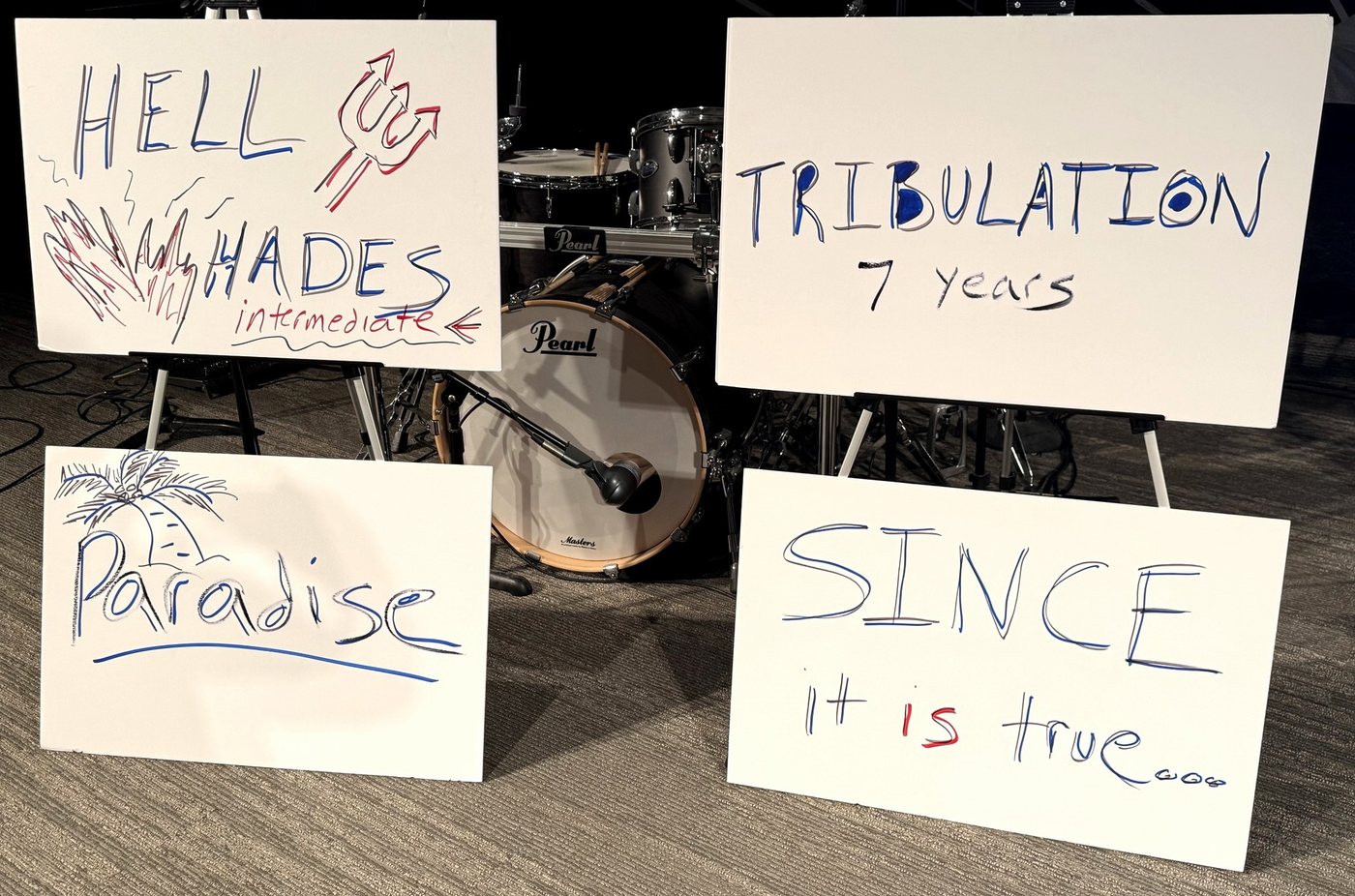
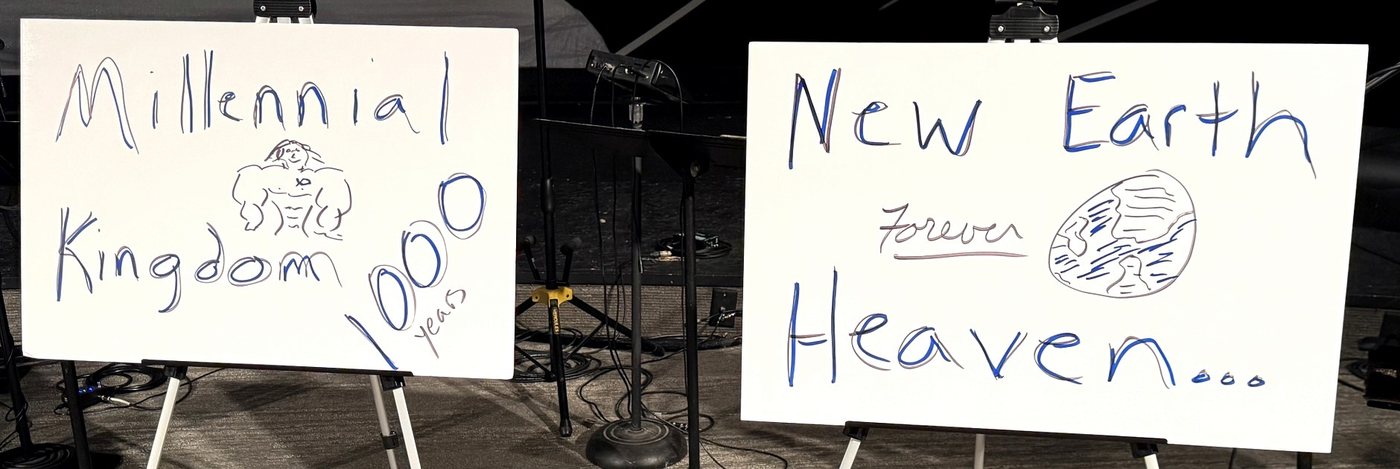
Rick had screens, projectors, and a production team at his disposal. For this series, he chose foam board and markers instead. He bought them himself at Hobby Lobby, which he calls close to his own personal version of hell. Each week a new board joined the row across the stage: Paradise, Hell and Hades, the Tribulation, the Millennial Kingdom, the New Earth and Heaven, and the line that held it all together: Since it is true… Every Sunday began by walking the timeline again, so no one, first-time guest or longtime member, lost their place in the story.
The Road Map is the printed version of these boards.
Punching My Ticket
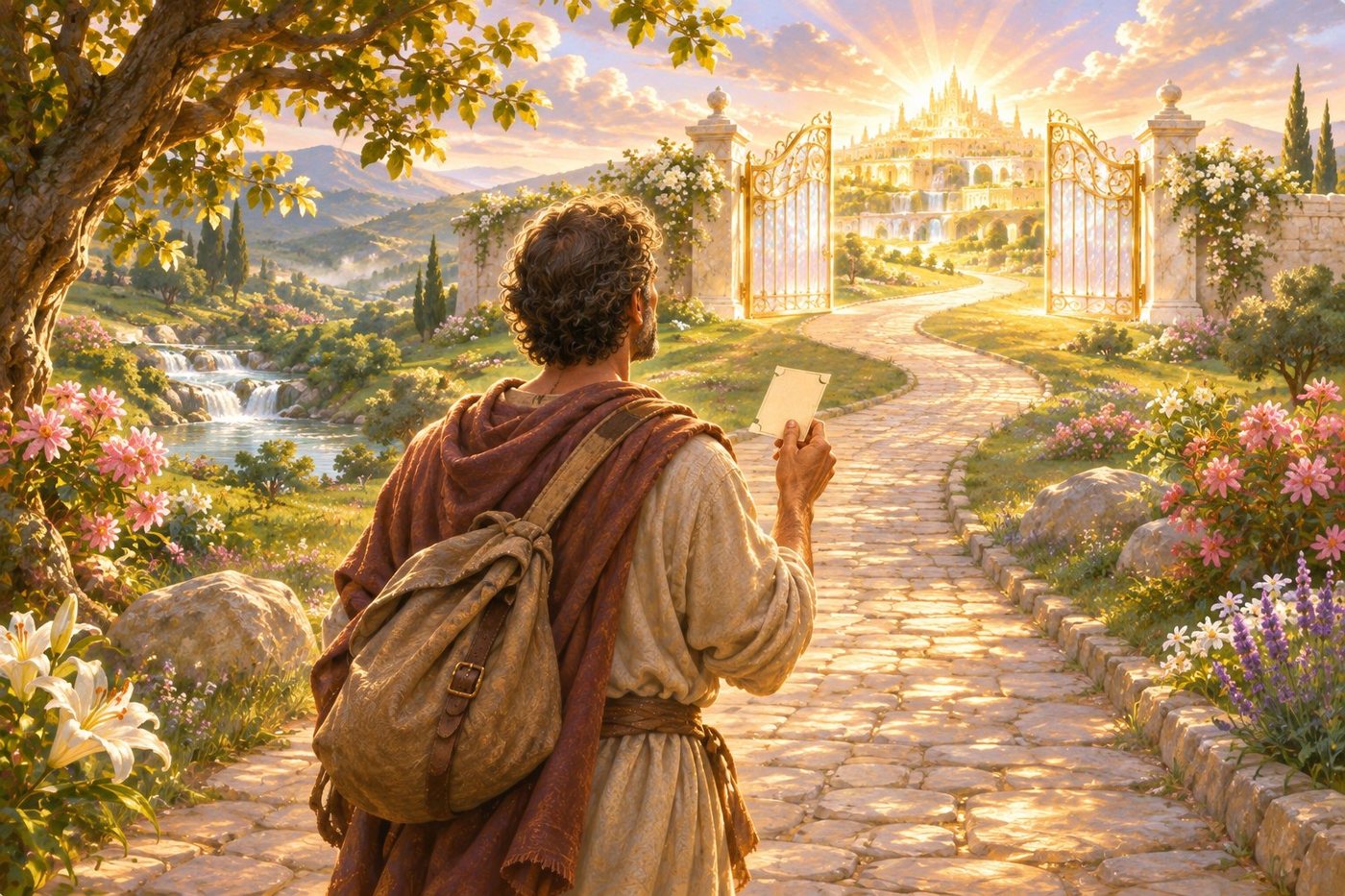
The Sermon at a Glance
- Good people go to heaven? · Romans 3:23–24
- So what’s the deal? · Romans 3:20
- What do I do? · Romans 6:23
You are here the whole road, and who gets
there
Paradise & Hades → Tribulation →
Second Coming → Thousand Years →
Great White Throne → New Earth →
Who We’ll Be · Road Map ›
Read First · Romans 3:20, 23–24; 6:23
Romans 3:20
20 Therefore no one will be declared righteous in God’s sight by the works of the law; rather, through the law we become conscious of our sin.
Romans 3:23–24
23 for all have sinned and fall short of the glory of God, 24 and all are justified freely by his grace through the redemption that came by Christ Jesus.
Romans 6:23
23 For the wages of sin is death, but the gift of God is eternal life in Christ Jesus our Lord.
There is a way to know for sure that you are going to see the people who have died in Christ on the other side. There is a way to know for sure that you will spend eternity in heaven with Jesus. That’s what this book is about.
It’s going to take some honesty from you and some honesty from me. So let me say this up front: I will never, for one second, be dismissive or disrespectful toward God’s Word. I believe the Bible is one hundred percent true. I believe it is inspired by God, that the Holy Spirit moved human authors to write the Scriptures we study, and that in its original form every bit of it is true. It tells us everything we need to know about how to live, how to treat each other, and who God is. I take it very, very seriously.
My religious tradition growing up, though? The things I was taught, the folklore and superstition that drifted into my belief system over the years? That’s fair game. Make fun of it if you want, because all of us have picked up ideas we can’t trace. We’re not sure whether it was Grandma, a Looney Tunes cartoon, or some preacher we heard along the way.
My goal is to help you understand what the Bible says about heaven, and what it does not say. And I want you to ask yourself one question all the way through: What will matter most to me five minutes after I die? Whatever the answer is, that’s what should matter most to me now. I can’t do that perfectly in eight chapters. No chance. There’s too much. But I want to do it honestly: for those of you who aren’t yet followers of Christ, for those of you who are new in your faith, and for those of you who, like me, have been at this a long time.
I was born into the church. I like to say I started attending at negative nine months. I made a personal decision to follow Jesus as a child and followed that with baptism as a public profession of my faith. I grew up learning about heaven, and I wouldn’t trade that for anything. But I also know that some of what I was taught didn’t line up with Scripture. Over the years I’ve been trying to sort out what’s what, and I want you to do the same.
What Comes to Mind?
When I say heaven, what do you picture?
I’ve asked a lot of people that question, people in our church and friends who don’t attend anywhere. I’ll tell you right off the bat that women do a much better job describing heaven than men do. You’ve imagined it. You’re looking forward to meeting Jesus, and you have some kind of picture in your mind.
Between services one Sunday, I asked a good friend of mine, one of our deacons, what he pictures when he thinks about heaven. He’s a smart guy who loves the Lord and grew up practicing his faith.
“Well,” he said, “I picture meeting Jesus.”
“Yep. Me too.”
“And then my dad’s going to be standing right behind Jesus, and I’m going to get to see my dad.”
“Yep. What’s next?”
“I don’t know.” Then he said, “Hopefully there’s an orientation class. Heaven 101. You jump on the tram and take the tour.”
Maybe that’s what we need: an orientation. Maybe this book can be a kind of orientation class. We’ll never know everything outside of what Scripture tells us clearly and concretely, so I’ll try to mark that line as best I can.
Everybody Has a Heaven
My wife and I had dinner with some friends recently, and we got to talking about heaven. Isn’t it interesting that other religions and cultures have their own versions of heaven, and they’re usually spelled out pretty clearly? You could draw a picture of them.
I like Vikings. If I had to be born into a different culture, Vikings would be near the top of my list. That may say some bad things about me. The Vikings knew exactly what their heaven would be like. They called it Valhalla. If you were a warrior and you died with honor and your sword in your hand, you went to Valhalla, a great lodge in the sky. Of course, when I imagine myself as a Viking, I’m not the guy chained to an oar rowing the boat. I’m a warrior. I’m a leader.
In Valhalla you are escorted in by your shield maiden, the woman of your dreams, whose job for eternity is to take care of you. For my purposes, that would be my wife, my shield maiden. Once you get there, you eat all the food you want and never get fat. You drink all the mead you want with no health consequences. You fight all day, never die, get up the next day, and do it again.
My buddy and I were all in. Our wives raised a point of order. “Um, what about us? We don’t want to be shield maidens for eternity.” He and I said, “What are you talking about? You get to serve us forever. What could be better?” They weren’t buying it.

Isn’t it interesting how often women aren’t really considered in other religions’ definitions of heaven? You start to suspect that men wrote a lot of those stories. Some versions of Mormon teaching describe a man populating his own planet with his wives, who live under his authority forever. Some Muslims believe that a man who dies under the right circumstances receives dozens of women to meet his needs for eternity. Buddhists don’t believe in a permanent heaven at all. They believe in a temporary heavenly state you reach through good karma, where you stay until the karma runs out and then come back to live another life. Hindus believe much the same.
When you break it down, you see how controlled and specific these stories are, and how few of them have a good outcome for women. Isn’t it great that Jesus was different? He valued both men and women, and he showed it over and over again.
Here’s what I believe. Christianity teaches that there is a literal heaven and a literal hell. They are places. They are also states, and they may be dimensions. There is heaven and there is hell, but there is no purgatory. I believe, along with many conservative Bible scholars, that purgatory was an invention built on a misinterpretation of Scripture. Eternity is an eternal state, and the deciding factor in where you spend it is what you’ve decided about Jesus.
Myth: St. Peter at the Pearly Gates
There are lots of myths about heaven. Let’s start with the big one.
When you think about heaven, many of us picture the pearly gates. They’ve been taught to us for decades. And who is sitting in front of them? St. Peter. The gates are always shut and locked. There’s a long line of people waiting to get in. Peter has a clipboard with a list of names. Maybe he’s updated to an iPad by now. It would certainly be an iPad, not an Android.
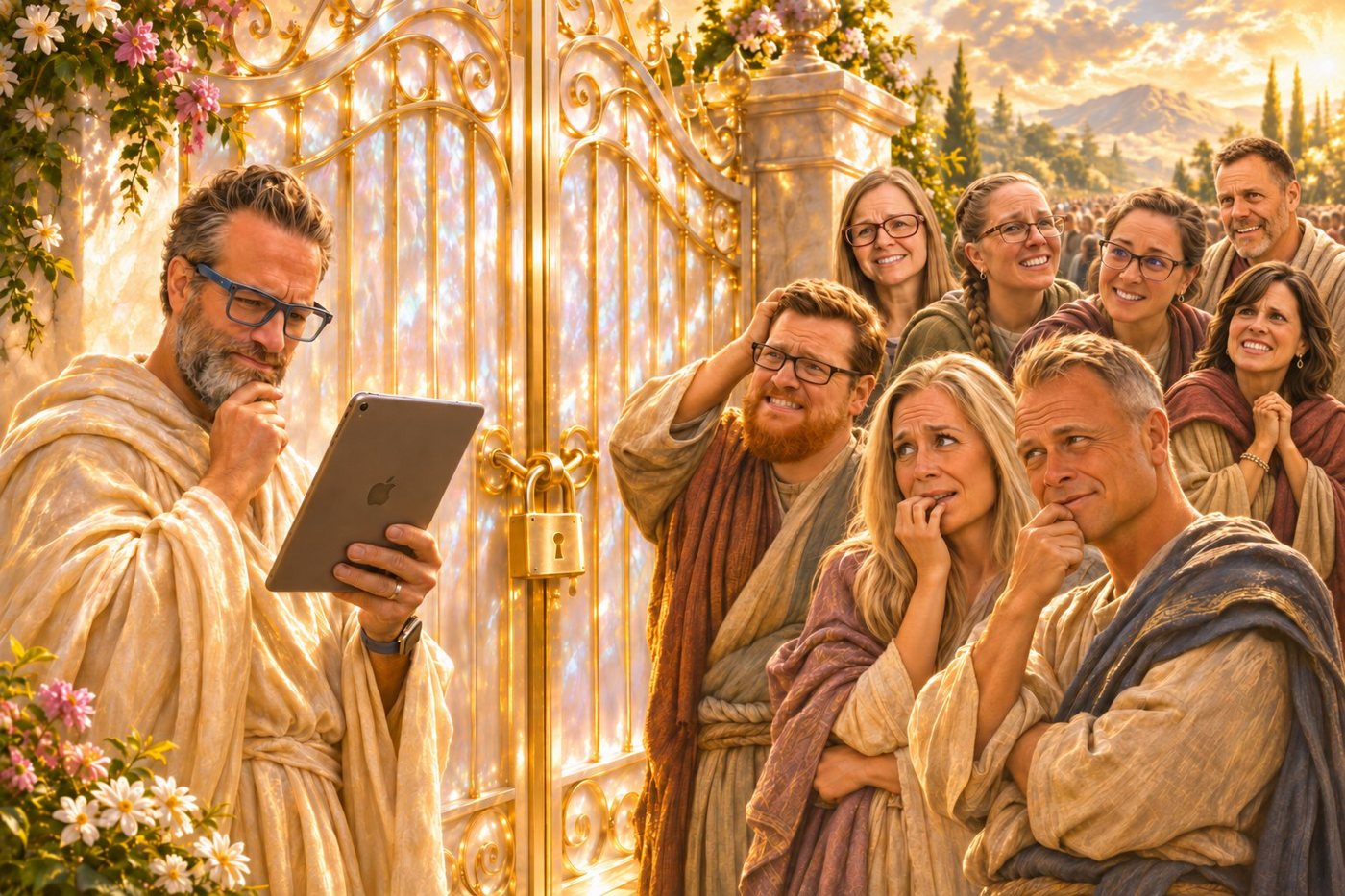
You get to the front of the line and you’re sweating it, because you don’t know for sure.
Anybody remember Monty Python and the Holy Grail? (If you’re under forty, ask your parents.) The heroes have to cross an abyss, and a bridgekeeper asks each of them three questions. Answer correctly and you cross. Answer wrong and you’re tossed into the abyss.
That’s how a lot of us picture getting into heaven. Peter scrolls through the list. You were taught there’s a list, and your name had better be on it, a little like Santa Claus. He gets all the way to the bottom: Melick. There he is. Maybe I’m written in pencil. Then he says, “Okay, answer the questions.” If I give the right answers, the gates swing open. If I don’t, into the abyss I go.
That’s how many people believe heaven works, and it just isn’t true.
There are pearly gates. But they are not the entrance to heaven. There are twelve of them, and they have nothing to do with getting in.
How Heaven Unfolds
To explain that, we have to wade into the deep weeds for a minute. If this is new to you, I apologize in advance. There’s a lot packed into what I’m about to say, and I’ll come back to all of it in the weeks ahead.
Heaven is the place where God is. It’s where he dwells, and it’s where Jesus is, where he rules. In essence it never changes. But the Bible describes heaven differently at different points in the story, in purpose if not in essence.
There was heaven as it existed when God created the universe, before the fall of Adam and Eve. When Adam and Eve chose to sin, something changed. God didn’t change. He is the same yesterday, today, and forever (Hebrews 13:8). We did.
In the Old Testament, the realm of the dead is called Sheol, sometimes Hades, and it has two divisions. Devout Jews, God’s followers, went to one side to wait. I don’t believe that waiting was any kind of distress. I think it was paradise. Those who didn’t believe went to the other side, what we’d now call hell, a place of punishment and of waiting.
When Jesus died on the cross, rose again, and ascended into heaven, the way we think about heaven shifted again. It is still an intermediate state. We are living right now in what the Bible calls the last days, the time between Jesus’ ascension and the day he comes back to collect us to be with him forever. If you have a grandparent, a husband, a wife, or a child who has died, and they either were too young to decide for themselves or had given their lives to Jesus, they went instantly into the reality of heaven. They are with Jesus right now. But it isn’t yet the heaven we’ll know for eternity.
So what are we waiting for? Some of this depends on whether you believe Jesus will gather his people before or after the tribulation, and we’ll take that up in Chapter 3. But for the sake of argument, say Jesus comes and gathers the Christians who are still alive along with those who have already died. We receive perfect bodies. There’s a period of tribulation. After it comes the millennial kingdom (not the Millennium Falcon), a thousand-year reign of Jesus on earth. We’ll have work to do there with Jesus.
I’ve watched some really bad sermons on heaven while preparing this series, ones that left me more distressed than encouraged. One guy could only talk about how we’re going to reign when we get to heaven. We get to be in charge! I’m thinking, Have you ever supervised anybody? Why would you want to spend eternity being the boss of a bunch of people? There will be roles and responsibilities during the millennium; that’s where the idea comes from. But that isn’t the point of heaven.
At the end of the thousand years there’s a massive battle, and Satan is thrown into what will be hell from that point on, along with his demons and everyone who rejected Jesus. Then God creates a new earth, and that is where we’ll live forever in glorified bodies. That’s what will always be known as heaven.
Clear as mud? I know it’s a lot. In my notes it’s five bullet points. We’ll walk through each piece in the chapters ahead.
The New Jerusalem
This is where the pearly gates come in, and where myth meets reality. On the new earth there is a city called the New Jerusalem. For our understanding, it’s where God reigns from. He is everywhere, but in some way it will be his home base.
The New Testament writers lived in the first century. They didn’t have ChatGPT or animation or world travel. They hadn’t had the experiences you and I have had, so they didn’t have our ways of describing things. The apostle Paul was given a vision of heaven and talked about being caught up into “the third heaven” (2 Corinthians 12:2). People get strange about that.
Most Bible scholars understand it this way: the first heaven is what you see when you walk outside, the clouds and the wind. The second is space, what you see through a telescope. The third is something else entirely, a different realm or dimension. Paul said he wasn’t even permitted to describe what he saw. John, however, was told to describe it, and he did his best. He was a first-century man who had a vision that blew his mind and tried to put it into words. That doesn’t make it any less true. It means he described it as well as he could.
The dimensions are given in Revelation 21, and I’d encourage you to read the whole chapter more than once. It’s a massive city. If you do the math, its base would cover about two-thirds of North America, and if you counted its height in stories, it would be around 280,000 stories tall. It’s a cube.
It has twelve gates, and each gate is made of a single pearl. Pearly gates! So where does the St. Peter idea come from? In Matthew, Jesus told Peter he would receive the keys of the kingdom (Matthew 16:19). That meant something completely different in its context. But somebody heard keys, pictured a locked gate, attached the pearly gates, and suddenly it was easy to believe. It isn’t in the Bible.
Revelation 21 says there are twelve gates: three on the north, three on the south, three on the east, and three on the west. Each is named for one of the tribes of Israel. The city has twelve foundations named for the twelve apostles. And the gates are never shut. They are always open. They’re the entrances to the New Jerusalem.
The walls are made of jasper. We don’t even know what color jasper meant when John wrote; it could have been yellow, red, brown, or green. The streets are made of gold, but the description suggests something so clear and shining that gold was the closest word John had.
There is no pearly gate blocking the road to heaven. St. Peter will not be sitting there quizzing you to decide whether you get in.
Myth: St. Peter stands at a locked pearly gate with a list, quizzing people to decide who gets in.
Truth: There are twelve gates, each made of a single pearl. They are the entrances to the New Jerusalem, and they are never shut (Revelation 21:21, 25).
Good People Go to Heaven?
So how do you make sure you’ve punched your ticket? How do you know for sure that you’ll see your loved ones on the other side?
Here’s what most people say: I’m a good person. Good people go to heaven.
Last week my wife and I visited a friend who is in a nursing home under hospice care. There’s a possibility the Lord will restore her health, but she has been forced to think about her death. She’s a believer, the kind whose Bible is worn out, which I thought was kind of cool.
Before we left, she asked me to read Psalm 37 to her. You should know two things about me: I wear contact lenses, and I need reading glasses. Her Bible had about a ten-point font. I offered to use my phone, with my fourteen-point backlit Bible. “No,” she said. “Use my Bible.” So my wife held her phone’s flashlight so I could see, like a little old couple helping each other in our infirmity. I’d never read Psalm 37 to someone in that situation. It’s a good one.
When I’m with someone in that place, I always ask, “Are you at peace?” It may sound invasive, but I think it’s one of the most important questions there is.
She said, “I just wish I could have done more for Jesus.”
That set off an alarm for me, because so many people believe that if they just do enough, if they’re just good enough, they’ll tip the cosmic scales and slide into heaven.
I stopped her, gently. “I can answer that,” I said, though she hadn’t really asked a question. “You haven’t done enough.” Then I paused, because pastors like dramatic pauses. “And I haven’t done enough. It’s impossible to do enough, because salvation has nothing to do with what we do.”
“Oh, I know,” she said. “Salvation comes by God’s grace, and all I have to do is believe. I just wish I’d done more to serve the Lord.”
I’m on board with that. If I’m given the chance to look back on the day of my death, I’ll probably feel the same way. So I asked the question another way: “Are you afraid?”
“Oh, no,” she said. “I’m not afraid. I’m ready to see Jesus, if that’s what he wants.”
So What’s the Deal?
So many of us hang our hats on being a good person. And we always think we’re good. We think the people around us maybe aren’t quite as good. So we measure ourselves against each other. I’m pretty good. Probably better than one of our staff members. And he’s thinking, Well, I’m probably better than the pastor’s wife. Pretty soon you have a whole church full of people trying to figure out who’s more spiritual than whom, and assuming God will give us grace because we’re living a better life than someone else.
But here’s the reality: there has never been a comprehensive, consistent definition of good that holds across every generation. What is good? Doing good things. What are good things? Not hurting anybody. What counts as hurting somebody? Can you do a good thing that hurts somebody, for the greater good?
I won’t even take you back through world history. Just think about American history and what our society has collectively called good. Not long ago, owning slaves was considered good. In churches, no less, it was not only acceptable but a goal to have enough money to own another human being. I think it’s one of the worst things any society has ever practiced. But at the time it was called good. So if you have to be a good person to get to heaven, and those people thought they were good, does that mean none of them made it?
If that example doesn’t land for you, try this one. Not long ago in our country, men didn’t care enough about women’s opinions to let them vote, and that was considered good. Society practiced it. I hope you’d agree with me that it was shortsighted, disrespectful, and un-Christlike. But at one point it was called good.
You don’t know what good is, and neither do I, apart from the person of Jesus.
Are you going to trust the collective sense of good from people who don’t know Jesus to tell you whether you’ll make it to heaven? Then you’re in trouble, my friend.
Then you might say, “Well, Scripture will tell us what’s good.” Find it. If you think the Bible gives a formula for being good enough to get to heaven, find it. It isn’t there. You can’t open the Old Testament and say, “Here’s how to get to heaven: one plus two equals three.” You can’t open the New Testament and say, “Good people go to heaven, and here are the verses to prove it.” In fact, Jesus taught the opposite. The people who thought they were good, who graded themselves against everyone else and decided what counted as good, were the ones he was most critical of.
Jesus never gave a formula for being good enough. He defined good. The Sermon on the Mount set the standard. And only one person in all of human history has been good: Jesus Christ, the perfect God-man who came to earth, lived a perfect life, and died a death he didn’t deserve to pay the price for you and me, because we are sinful.
Think about it. If you had to be good enough to get to heaven, how would you know not only what’s good but whether you’d done enough? Do your thoughts and intentions count? What if you die one good deed short, with no way to go back and make it up? What if you’ve been so bad that you don’t have enough days left to offset it, so that nothing you do between now and the day you meet your Maker could save you? It’s a preposterous theory, and it leads people down a slippery slope to self-deception. You don’t know what good is, and neither do I, apart from the person of Jesus.
Nobody Is Good Enough
The apostle Paul called himself the worst of sinners. Yet before he met Jesus, he was one of the best rule-keepers who ever lived. He followed the Jewish law better than anyone, to the letter. But he mistreated people.
Have you ever mistreated anyone? Gossiped about somebody? Said something you wish you hadn’t? By Jesus’ standard, you don’t make the cut. There’s been one good person. One. Paul said, in effect, I was the worst of the bad, even though I was the best of the good, because I mistreated people.
Here’s what he wrote in Romans 3:
Therefore no one will be declared righteous in God’s sight by the works of the law; rather, through the law we become conscious of our sin… for all have sinned and fall short of the glory of God, and all are justified freely by his grace through the redemption that came by Christ Jesus. (Romans 3:20, 23–24)
No one. You and I are included in the no and the one. Nobody is good enough, not you and not me. Now, after you meet Jesus, he does call you to good works, and the Holy Spirit empowers you to do them as you become more like Christ. But before you meet him, nobody is good enough in God’s sight by anything they can do. Trying to keep all the rules only shows us that we fall short. The Old Testament law was given so we would know we couldn’t measure up. Break one rule and you might as well have broken a million. It doesn’t matter if you’re better than your neighbor or your ex. We all fall short.
Flip it around. Nobody is good enough to impress God, tip the scales, and slide through the cracked-open gate of heaven. Nobody.
All have sinned and fall short of the glory of God. And all are justified freely, as the free gift of God, by his grace, through the redemption that came through Christ Jesus and Jesus alone.
Not the Minimum Requirements
So how do you know? How do you punch your ticket?
Have you given yourself to Jesus Christ?
Jesus is not nearly as concerned about getting you up there as he is about getting there into you, right here.
Too many people want to meet the minimum requirements. I checked a card when I was a kid. I went through confirmation. I know my catechism. I got baptized. I wrote the date in my Bible. I’ve got the minimums down, so I can live however I want, be whoever I want, and do whatever I want. Then when I get to the pearly gates, I’ll know the magic answers.
Let me ask you something. I’ve been married to my wife for thirty-six years, and I love it. She’s my shield maiden, though she’s not on board with that yet. Imagine that on our wedding day I had said, “Honey, what are the minimum requirements I need to meet to stay married to you? Nothing extra. None of this romance stuff, none of this relationship stuff. I don’t want a divorce, but I don’t want to do anything else. Just give me the minimum.”
Jesus is not nearly as concerned about getting you up there as he is about getting there into you, right here.
Would you call that a marriage?
Yet so many of us treat our faith that way. When you throw yourself into the relationship, the minimum requirements take care of themselves, because the kingdom of God starts being lived out through you as you’re prepared for the kingdom to come. The magic answers, the hope of squeaking by, become a distant memory, because you’ve become a follower of Jesus.
What Do I Do?
Here’s how you do it.
Paul puts it plainly elsewhere: “The wages of sin is death, but the gift of God is eternal life in Christ Jesus our Lord” (Romans 6:23). A wage is earned. A gift is received.
You agree with God and say, I’ve sinned. I’ve fallen short. I am one of the “all.” I may be better than somebody else, but I’m still not good enough.
You believe who Jesus is, even though you don’t know everything about him. I believe he is God, that he lived a perfect life, that he died for me, and that he rose again so I could have heaven as my home, know him, and live this life with purpose.
And you say, I’m not interested in the minimum requirements. I want the full deal. I want the relationship. I’m going to follow Christ.
Tell him in whatever way you want. Write it, think it, or say it out loud. In that moment you pass from death to life, from old to new, from lost to found. You become a child of God with heaven as your home. Your life here will change. From then on you will know for sure that you can’t be good enough, but Jesus was, and he has claimed you as his own.
So when someone asks, Why should you be here? you’ll have the only answer that matters:
I don’t know. He said I could come.
Key Truths
- Nobody is good enough. All have sinned and fall short of the glory of God (Romans 3:23).
- Eternal life is a gift to receive, not a wage to earn (Romans 6:23).
- Faith isn’t a list of minimum requirements. It’s a relationship with Jesus.
For Reflection
- When you hear the word heaven, what is the first image that comes to mind? Where do you think that picture came from: Scripture, church, family, movies, or something else?
- Which popular idea about heaven do you think people are most likely to believe, even though it isn’t taught in Scripture?
- Romans 6:23 calls death the wage of sin but eternal life God’s gift. What’s the difference between receiving a wage and receiving a gift?
- Why are we often more comfortable trying to earn something from God than simply receiving his grace?
- Where do you need to stop keeping score and start trusting God’s grace?
For the kids in your life: the same truth in the Kids' Edition, Chapter 1 · Comic, Issue 1: Punching My Ticket
Prepare for Landing
The Sermon at a Glance
- We are going to die (once). · Hebrews 9:27
- We leave our body here (for now). · John 11:25–26; 2 Corinthians 5:1–8
- We will be judged by Jesus (but it’s okay). · 2 Corinthians 5:10
You are here paradise, where believers go
at death
Paradise & Hades → Tribulation → Second Coming →
Thousand Years → Great White Throne → New Earth → Who We’ll Be · Road Map ›
Read First · 2 Corinthians 5:1–10
2 Corinthians 5:1–5
1 For we know that if the earthly tent we live in is destroyed, we have a building from God, an eternal house in heaven, not built by human hands. 2 Meanwhile we groan, longing to be clothed instead with our heavenly dwelling, 3 because when we are clothed, we will not be found naked. 4 For while we are in this tent, we groan and are burdened, because we do not wish to be unclothed but to be clothed instead with our heavenly dwelling, so that what is mortal may be swallowed up by life. 5 Now the one who has fashioned us for this very purpose is God, who has given us the Spirit as a deposit, guaranteeing what is to come.
2 Corinthians 5:6–10
6 Therefore we are always confident and know that as long as we are at home in the body we are away from the Lord. 7 For we live by faith, not by sight. 8 We are confident, I say, and would prefer to be away from the body and at home with the Lord. 9 So we make it our goal to please him, whether we are at home in the body or away from it. 10 For we must all appear before the judgment seat of Christ, so that each of us may receive what is due us for the things done while in the body, whether good or bad.
I was at the gym last week when an older lady said something strange to me. She was older than me, which means she was an older lady. When I do cardio, I’m a little grumpy. I put my headphones in, get on the treadmill, and don’t really want to talk to anybody. My shoe came untied, so I lifted my foot up onto the rail of the treadmill to tie it. Maybe not great manners, but it’s a gym.
The lady next to me said something. I couldn’t hear her over my music, so she said it again. I took my earbuds out.
“Quit bragging.”
“What are you talking about?”
“You’re bragging that you can lift your leg up that high, aren’t you?”
“No,” I said, “I’m not bragging. I can’t squat down to tie my shoes. I’ve got bad knees.”
“Oh,” she said. “For me it’s easier to squat down than to lift my leg up.”
I said, “You know what? In heaven we’re not going to have to worry about it. See you on the other side.” She moved down a treadmill, and I had my privacy for the rest of my workout.

See you on the other side. No pain, no sadness, no disappointment, no sorrow, no sickness. All of it a distant memory. But what does that mean? What’s it going to be like?
Welcome Home
I rarely make gender-specific assumptions, and this is only anecdotal, based on people in our congregation. But women do a much better job imagining heaven than men do. You picture fields of color, music, scenery, nature. Whether or not it’s accurate, it lives in your mind. We men run out of things to say pretty quickly.
Something happened this week that struck a chord with me. I’m not a Buffalo Bills fan; if you are, that’s between you and Jesus. But I’m a fan of moments. The Bills built a new stadium, and their longtime quarterback, Josh Allen, who helped bring it about, got to run out into it for the very first time. The tunnel, the noise, the crowd on their feet.
Hebrews 12 tells us we are surrounded by a great cloud of witnesses. I believe those witnesses are the people who have gone before us: the people of the Old Testament, the people we study in the New, and the believers we’ve known who have passed on. I don’t believe they’re sitting around watching us. They’re doing whatever people do in paradise. But I know they rejoice when we arrive. The angels rejoice when even one person repents and decides to follow Jesus (Luke 15:10). When we get there, there will be a celebration.
Maybe it looks a little like that tunnel. Maybe not. But to me it says: You’re here. You made it.
First, You Die
So what happens? The first thing is that you die. Did you know that? How do you get to heaven? You have to die. Everybody dies, unless Jesus comes back first. Hebrews 9:27 says that people are destined to die once, and after that to face judgment. Once. Put that in your back pocket.
In Chapter 1 we sketched how heaven unfolds, and the Road Map at the front of this book lays it out. Here’s the short version. If you die today in Christ, you go to paradise. Then comes the seven-year tribulation. It could start today, tomorrow, in ten years, or in a thousand; every generation since Jesus has thought it saw the signs of the times. After that comes the thousand-year millennial kingdom, and you’ll receive your perfect body before it begins. (I take the thousand years literally, because Revelation repeats it several times. If you see it differently, it won’t change much here.) Last comes the new earth, forever. Most of the time when Scripture talks about heaven, that’s what it’s describing.
This chapter is about paradise, because it comes first. When I picture paradise, I picture a palm tree. I’ll tell you now there are no palm trees there; it won’t have the same physical properties as earth. But a palm tree makes me happy.
Myth: You Become an Angel
A lot of people believe that when you die you become an angel. You get your wings and spend eternity looking down, or playing music, or doing something. If you believe that, I’m not making fun of you. I just want to tell you what Scripture says.
Angels are created beings. They are spiritual beings created by God, and they are not human. Humans were never intended to become angels. Angels serve a different purpose. They don’t need forgiveness for original sin or salvation the way humans do. There is no connection between humans dying and becoming angels. It’s folklore, not Christianity.
Myth: When you die, you become an angel.
Truth: Angels are a separate kind of created being. You were created human, and you’ll stay you, with a resurrected body still to come.
For a while I lived in fear that I’d become one of those fat, naked, bald baby angels sitting on a cloud playing a harp for a thousand years. That sounds terrible. Rest assured, it’s not in Scripture.
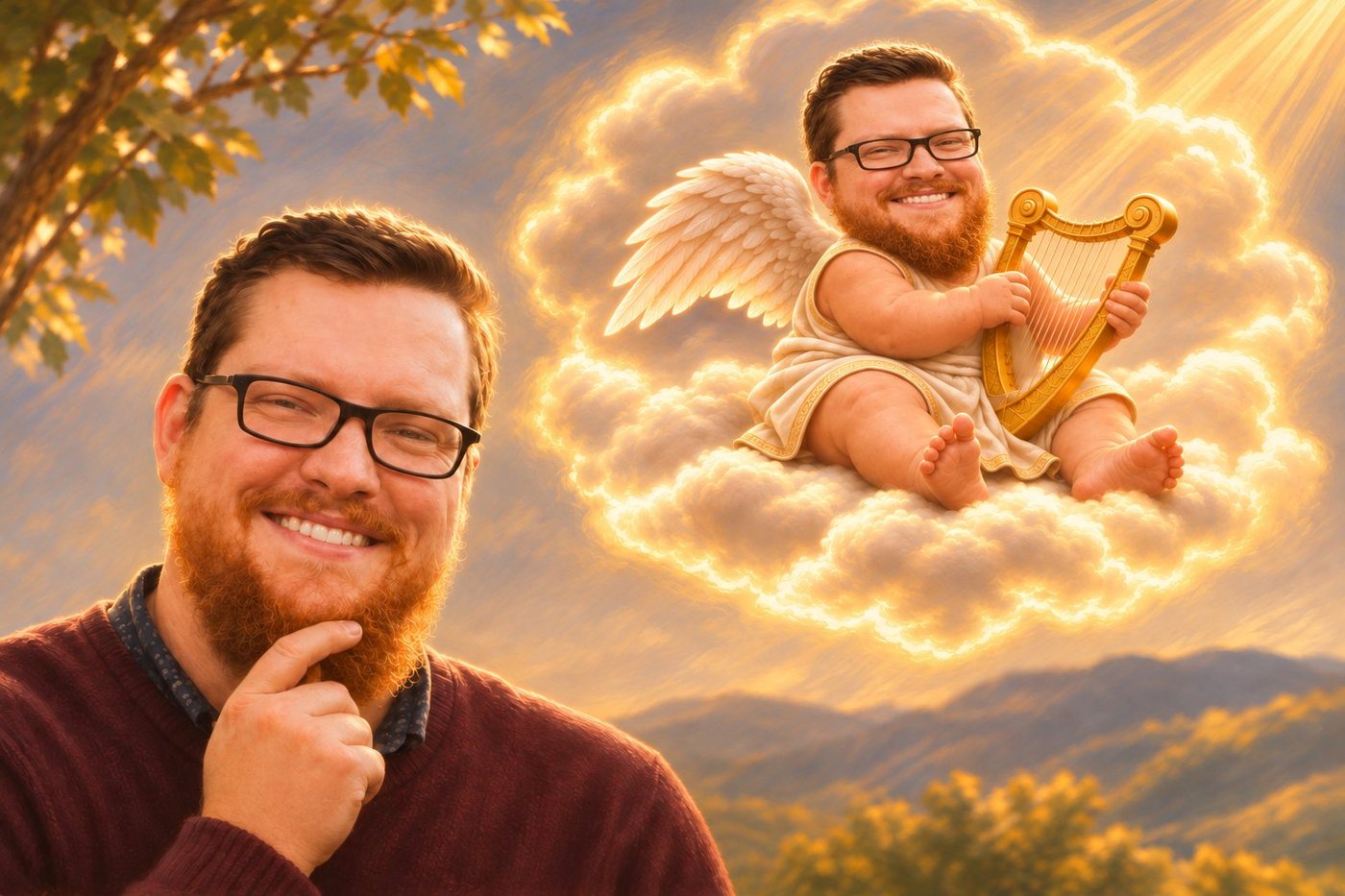
You were created human. What makes you eternal is your soul. Your body is not eternal. You’re going to get a new one, and we’ll talk about that later. The one you have now is failing you. Can you see it? I can see mine. If you can’t see yours, ask someone close to you; they’ll point it out. It’s a humbling experience. I experienced it at the gym: I can’t squat down. I’ve got bad knees. One day, see you on the other side. No more failing bodies.
Your Body Is a Tent
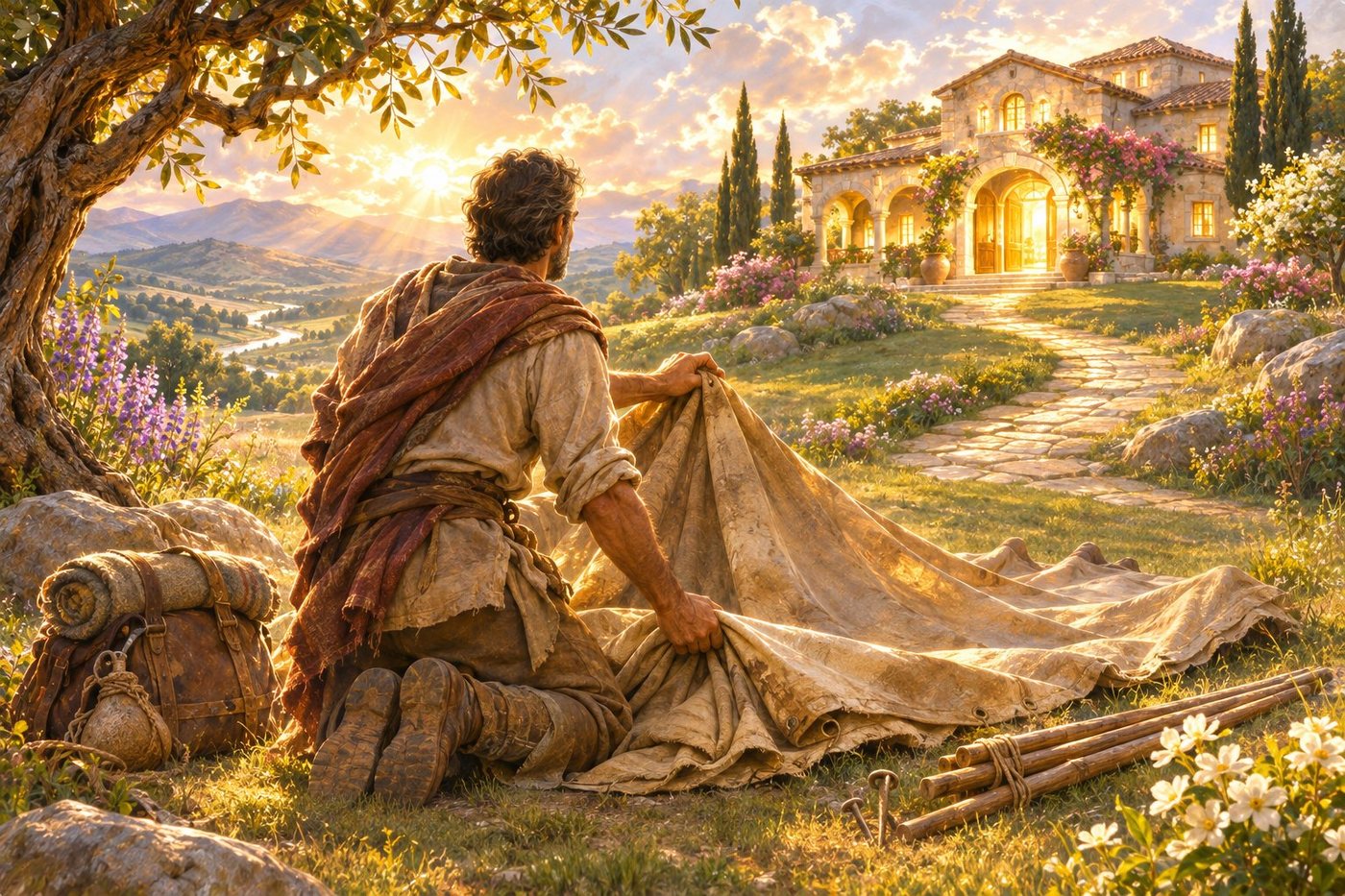
So what happens when we die? The apostle Paul talks about it in 2 Corinthians 5. Paul was many things, but one way he supported himself, when he wasn’t being paid for ministry or while he was planting churches, was as a tentmaker. So he uses an illustration from his trade: your body is like a tent, and your soul is the person living inside it.
Eugene Peterson’s paraphrase, The Message, puts it in a way I love. Not a translation, but an interesting read. The tent you live in now will one day be folded up and put away, because you won’t need it anymore. The one you’ll get later is far better, eternal, made by God for the life to come.
I want you to find yourself in Scripture. I want that more than I want you to learn facts. This is where I am. This is what will happen to me. This is what I can expect. This is where I’m going. The periods and definitions I’m walking you through aren’t speculation or deep-weeds theology. They’re at the center of what we’d call evangelical Christianity. Interpretations differ slightly by tradition, but nearly everyone accepts this. So research it for yourself; I want you to. But if this already sounds a little weird, relax. Just because something is weird doesn’t mean it isn’t true. The way it all began, in Genesis, was a little weird too. It takes faith. And this is where it all ends up.
For we know that if the earthly tent we live in is destroyed, we have a building from God, an eternal house in heaven, not built by human hands. Meanwhile we groan, longing to be clothed instead with our heavenly dwelling. (2 Corinthians 5:1–2)
We all die
Paul says if. He says it because he thought Jesus might come back while he was still alive. Nobody knows the day or the hour, so if is fair. But for our purposes, we could say since. Since this tent is going to fail us and be folded up and put in the corner…
Paul’s readers had watched people they loved laid out by a tomb, ready for burial, and it looked to them like the end. They didn’t have much Christian teaching yet. Paul tells them not to worry. Yes, we die. But the body is just a tent. We should respect it and keep it healthy so we can live with purpose without being held back by it unnecessarily. But it stays here. The eternal part of us, the spirit, goes to be with Jesus.
Meanwhile, Paul says, we groan. We feel the disappointment and sadness of this life. We feel the sin we experience, the hard days, and a world set up against following Jesus. We feel the pull toward evil in the world and inside ourselves, and the times we slip and fall. It exhausts us. And so we long for home. Paul says: lean into the groaning. Lean into the pain. Living in this imperfect world, in this imperfect body, with this imperfect spirit, will make you want heaven more and more. Yes, we have to die. But that’s not bad news.
We leave this body behind
I’ve done several funerals this year, and many of you have been to funerals. You look at someone who has been embalmed and prepared for burial.
Living in this imperfect world, in this imperfect body, with this imperfect spirit, will make you want heaven more and more.
They’re not there.
When you bury someone and put a marker over the grave with their name and two dates that bracket their life, they’re not there. That’s where they used to live.
You can go back to the grave and remember. You can tell the stories and thank God for the time you had. But that’s for you, not for them. They are not there, and they don’t care. The body stays here. The spirit goes on.
Now the one who has fashioned us for this very purpose is God, who has given us the Spirit as a deposit, guaranteeing what is to come. (2 Corinthians 5:5)
If you’re a believer in Jesus Christ, the Holy Spirit has sealed your salvation. You cannot lose it. He guarantees that you will end up with Jesus. When you die and leave this body behind, you will instantly awaken to the reality of paradise.
When Jesus hung on the cross beside the thief and had that compassionate, loving, theologically groundbreaking conversation with him, he said, “Today you will be with me in paradise” (Luke 23:43). Today.
Some religions teach that the soul sleeps for a while after death; that’s a Jehovah’s Witness teaching, and some Christian backgrounds have dabbled in “soul sleep.” It isn’t biblical. Others, primarily Catholic teaching, hold that most souls go to purgatory, where you keep working on it until you make your way into heaven. At times there’s been a financial component tied to that, and corruption came from it. I’m not pointing fingers; our own churches have been corrupt from time to time too. But the Bible teaches that you instantly awaken to the reality of heaven.
Like that quarterback running out of the tunnel. Maybe not exactly. I can’t run; in heaven you can. I’ve got bad knees; in heaven you won’t. No one’s waiting for me; in heaven they are. No one will be excited when I get there; yes, they will. There will be cheering. You’ll see Jesus with his arms outstretched, and he’ll say, “Welcome home. You were good and faithful.” You will be welcomed in if you’ve decided to follow him and trust him as your Lord and Savior.
If, and only if. Because paradise is a temporary holding place for those who are in Christ, and there is an opposite holding place, one we would call hell. It is the immediate destination for those who die having rejected Jesus. That reality begins immediately, and it is final.
We will give an account
So we make it our goal to please him, whether we are at home in the body or away from it. For we must all appear before the judgment seat of Christ, so that each of us may receive what is due us for the things done while in the body, whether good or bad. (2 Corinthians 5:9–10)
I’ll read that again in case you skimmed it. We must all appear before the judgment seat of Christ.
Does that sound ominous? I thought paradise was a happy place. Now I have to stand before Jesus and give an account?
Growing up, I believed, and it scared me, that when I got to heaven I’d be ushered into a screening room. Jesus would be sitting next to me, probably with my grandma and maybe a Sunday school teacher, and I’d have to watch every event of my life play out in front of them and answer for every shameful thing I’d ever done. Frankly, I wasn’t excited for Jesus to see it, even though he already knows. I certainly wasn’t excited for my Sunday school teacher to see it, though she probably suspected. But I think I was more scared of my grandma than of either of them.
So let me explain, because we will be judged.
Scripture mentions two judgments. One is the great white throne, which happens for certain at the end of the millennial kingdom, before the new earth. You can read ahead about it in Revelation 20. That judgment is mainly for those who have not received Jesus. For us, John says, our names are written in the book of life. We go on to the new earth to be with Jesus forever. Satan is thrown into the lake of fire forever, along with all who chose not to follow Jesus. We’ll get there in Chapter 6.
You are saved by grace, but you are judged by works.
The other is the judgment seat of Christ, and that’s what Paul is talking about here. Some believe it happens around the tribulation. I believe it happens as soon as we die and enter heaven.
The word Paul uses is bema. It referred to a raised platform or podium. The picture that would have come to mind for his first readers was an athletic competition, something like the Olympics. You ran the race, you were welcomed across the finish line, and then your performance was evaluated. The runners who didn’t finish first, second, or third weren’t mocked. After all, they finished. But those who finished well were rewarded.
So how can there be no sadness in heaven if I have to give an account for everything I’ve done?
Let me be very clear. If you’re a follower of Jesus Christ, you have been forgiven. The Bible says your sin has been removed as far as the east is from the west (Psalm 103:12). You’ve been washed white as snow (Isaiah 1:18). Your old life has been replaced with a new one. You never have to worry about your eternal security again. You are saved by grace, but you are judged by works.
That’s where a lot of us get it wrong. The Holy Spirit seals and secures your salvation. But you will give an account for what you did with your life:
- how you treated people
- the words you spoke
- how you endured suffering
- how you gave and asked for forgiveness
- your generosity toward the kingdom of God
- the effort you made to share your faith
- how generous you were with your time
The word Paul uses for bad here isn’t the word for morally evil. It means useless, frivolous, unnecessary. Jesus will separate the works of your life that were aimed at the kingdom and counted from the works that were aimed at yourself and were wasted. Remember, your purpose isn’t out there somewhere. It’s right where he has put you, with your people, applying the principles of God’s Word to the life he’s given you. It begins with the people closest to you. You’ll be judged by how you invested or squandered your life, and rewarded accordingly.
How does that work? I don’t know. The Bible talks about five crowns believers can receive. John gives us a glimpse of people taking their crowns and laying them at Jesus’ feet as an offering of gratitude. Not all the dots are connected. But Paul says that whether we’re here or there, our goal is to please him.
Minimum-Requirement Faith
That brings me back to the minimum requirements from Chapter 1. Too many people have a minimum-requirement faith: Just tell me what I need to do to make sure I get into heaven. That would be like my wife and me at our wedding. Truth be told, she chose me; I wanted to marry her long before she agreed. Imagine if I’d stood there and said, “I choose you, but tell me the minimum requirements to stay married. I don’t want a divorce, but I don’t want to go overboard either. Just the bare necessities.”
That would be preposterous in a marriage. Yet people treat faith that way all the time. Jesus is far more concerned about getting heaven into people here than about convincing people to go to heaven. If we understood that, we’d never worry about the minimums, because we’d be living to please God. When you understand eternity, it changes the way you live now. There’s no way it can’t. If it doesn’t change the way you live, you probably don’t understand it, and you may not have it. Scripture is that clear.
What Is There to Look Forward To?
So we prepare for landing. I know I’ll leave this body behind. That’s fine. There’ll be a funeral, and I won’t care, because I won’t be there. I know Jesus will judge me at some point, but I also know he’ll welcome me home. I won’t be ridiculed or raked over the coals or forced to explain every sin I’ve ever committed. It’s a judgment, but a different kind.
But what is there to look forward to? What will I do when I get there?
There’s a curious lack of description in Scripture, and I think it’s there for a reason. I think that if you and I really understood what paradise will be like, then in our weak moments we might want to hasten our journey there. The Bible teaches that life is a trust and a test, and we live until our days are done. We don’t set the number of our days. God does. I also think we’d be so preoccupied with heaven that we’d be no good here at all. That’s a theory, not something spelled out in Scripture. But it still leaves me wanting.
Paradise is mentioned only three times in the Old Testament, depending on how you count, and three times in the New. “Abraham’s side” is mentioned once more, and you could count that as a fourth, since it refers to the same place. Scripture is specific that paradise exists, that you’ll be perfectly at peace in the presence of Jesus, and that it’s a guaranteed promise. But it’s vague in description.
Thin Places
Early Celtic Christians wrestled with this. So do I. I want answers. I want to paint you a picture.
The Celts had something they called thin places. They believed paradise was another dimension, existing around us though we don’t experience it, not bound by space and time the way we are. Many people believe something like that today. Maybe it’s another universe. Nobody knows for sure. The Celts believed this long before anyone studied dimensions or black holes.
They believed there were certain geographic places, where people had worshiped for a long time, where heaven and earth kind of merged. I don’t really go there. There are probably places where it’s easier to worship than others. But they also believed there were moments in life when you could be overwhelmed by God’s Spirit, when he could take something ordinary and point you toward the extraordinary.
I’m not a mystic who wanders around looking for signs. Maybe I should be a little more that way. But four times in my life I think I may have encountered a thin place. I’m comfortable saying so because even if I’m wrong, each one pointed me to Jesus. I’m not asking you to have my experiences. I’m not starting a cult. I’m sharing something personal. Let me tell you about the most recent one, and maybe you can watch for moments like it in your own life, moments that give you a foretaste of heaven.
I bought a house in Arkansas where, Lord willing, my wife and I will retire fifteen years or so from now. My youngest son leases it. Out back is a shop building with a shingled roof, double-pane windows, and a concrete foundation. The previous owner was a professional woodworker who taught at Arkansas State. When we bought the place, I looked at that little shop and thought, This could be where we stay. Our kids keep having babies, and when you’re a grandparent you run out of guest-room space and end up on the floor.
So the plan was to turn it into a little one-room efficiency, 480 square feet. I called it the Shabin: half shack, half shop, half cabin. People thought that was weird. My grandkids call me Bapo, and they said “Bapo’s Shabin” sounded like something out of a true-crime show. So think of it as a cabin, or a hotel room.
I don’t have a lot of money and can’t hire a contractor. But I have a younger son who is really skilled with carpentry and remodeling, and an older son who knows electrical work and is super handy. They must have gotten that from their mom, because I went to seminary and can’t do any of it.
In June of 2024 we were finishing up, putting down the floors. We’d worked for a week. It was late in the day and raining, and I was cold. My job was to carry the empty flooring boxes from the shop to the burn pile. I remember how hard it was to slog through the tall grass and mud across the yard, throw the boxes on the pile, and come back.
At the end of that day, soaking wet and cold, I was walking back for another load. We hadn’t put the blinds up yet. The light was on inside, and all my people were in there: my sons, their wives, and my grandkids. I think we’d ordered pizza. (Don’t tell anybody. I’m not a big proponent of pizza, but that night we deserved it.) They were getting along, working together, accomplishing something.
I stopped in the middle of that yard, overcome with emotion. Not because of the shack, but because of my family and what we were doing together. I was so overwhelmed with gratitude that I took a picture. And it was almost as if the Holy Spirit spoke, nearly audibly, as I stood there crying in the rain:
You think this is good? Just wait till you get home.

I stood there and soaked it in. I took him at his word. Then I went back to hauling boxes to the burn pile and getting wet.
Remember, the Garden of Eden was paradise only because of the presence of God. That’s what will make paradise paradise. Not palm trees. Him.
Heaven is a place you need some handholds to get excited about. Maybe thin places can be one of them.
Nothing Amiss
Romans 8:28 may be one of the most misused verses in the Bible, but it’s also one of the most powerful:
And we know that in all things God works for the good of those who love him, who have been called according to his purpose. (Romans 8:28)
So many of us have been through so much. So many bad things happen. Life itself can seem unfair. Heaven is where you will finally see and understand how and why all things worked together for good for those who love him.
I can’t remember a morning when I woke up, thought about my life, and didn’t have some prayer request: a burden, something heavy, something amiss to lay at God’s feet and ask him to fix. More often than not it’s for someone else, like my wife, my kids, or the church. But something is always wrong.
Heaven is where you’ll wake up and realize that nothing is amiss. Nothing is out of place. There is no request still waiting for an answer. Nothing is wrong.
Your soul will be at home. Your soul will be at peace.
Well done. You were good and faithful. You made it.
So live in a way that isn’t concerned with the minimums of your faith, but is wholly taken up with what it means to live as a person of faith, with the reality of heaven in mind.
Key Truths
- We are going to die once, and the body is just a tent (Hebrews 9:27; 2 Corinthians 5:1).
- Believers wake instantly to paradise with Jesus. No soul sleep, no purgatory.
- At the judgment seat of Christ, we’re rewarded for how we lived, not judged for salvation.
For Reflection
- Before reading this chapter, what did you imagine happens immediately after someone dies?
- Paul calls our body a tent and what God has prepared an eternal house. What do you think he is trying to communicate?
- We are saved by grace but rewarded for works. How do those two truths fit together?
- Of the seven areas we’ll give an account for, which challenges you most right now?
- Have you ever had a thin place moment, when God’s presence seemed especially close? What happened?
For the kids in your life: the same truth in the Kids' Edition, Chapter 2 · Comic, Issue 2: Prepare for Landing
Meeting in the Middle
The Sermon at a Glance
- Perception: don’t be deceived. · Matthew 24:4–5, 23–26
- Peace: don’t panic. · Matthew 24:6
- Perseverance: don’t quit. · Matthew 24:12–13
- Productivity: don’t waste the wait. · Matthew 24:45–46
- Preparation: be ready, stay ready. · Matthew 24:42–44
You are here the seven years that end this
age
Paradise & Hades → Tribulation → Second Coming →
Thousand Years → Great White Throne → New Earth → Who We’ll Be · Road Map ›
Read First · Matthew 24 (selected)
Matthew 24:4–6
4 Jesus answered: “Watch out that no one deceives you. 5 For many will come in my name, claiming, ‘I am the Messiah,’ and will deceive many. 6 You will hear of wars and rumors of wars, but see to it that you are not alarmed. Such things must happen, but the end is still to come.”
Matthew 24:12–13
12 Because of the increase of wickedness, the love of most will grow cold, 13 but the one who stands firm to the end will be saved.
Matthew 24:42–46
42 “Therefore keep watch, because you do not know on what day your Lord will come. 43 But understand this: If the owner of the house had known at what time of night the thief was coming, he would have kept watch and would not have let his house be broken into. 44 So you also must be ready, because the Son of Man will come at an hour when you do not expect him. 45 “Who then is the faithful and wise servant, whom the master has put in charge of the servants in his household to give them their food at the proper time? 46 It will be good for that servant whose master finds him doing so when he returns.”
You are entitled to your own opinions, but you’re not entitled to your own facts. So how do we separate fact from opinion when it comes to heaven? What does the Bible actually say?
Heaven may be one of the most controversial, most discussed, and most avoided subjects we talk about as Christians. In some places the Bible says quite a lot about it. In others it is painfully silent. I usually want more detail from Scripture on almost every story. I want to read between the lines. When it comes to what happens after we die and what the afterlife will look like, I’d love more information.
But here’s what we know for sure. At the end of this life, whether through physical death, which will likely come for all of us, or through Jesus coming again to take us to be with him, the only decision that matters is the one you’ve made about Jesus Christ. If you have confessed your sin, believed who Jesus is, and chosen to follow him as both your Savior and your Lord, then when you die or when he returns, you are guaranteed to spend eternity at home with Jesus in heaven.
That’s the foundational fact. It makes all the difference in the world. Conversely, if you reject Jesus in this lifetime, the time for choosing ends when your biological life ends or when Jesus comes again. Your eternal state is then fixed, sadly, in separation from Jesus and in punishment in hell. We’ll talk about that in Chapters 4 and 5.
A Biblical Fence
In this chapter we’re going to talk about something that may sound a little strange. If you’re new to church or to Christianity, you may not have heard of it at all. If you’ve been around church a while, you’ve probably heard several different versions. My goal is to tell you what Scripture says for sure, what it doesn’t say for sure, and where you’re free to make up your own mind.
I want to build a biblical fence. Some conversations go too far, to the point where the Bible clearly says, No, that isn’t possible. We don’t want to climb over that fence. But inside the fence of sound doctrine, there is a lot of freedom and latitude.
Pastors teach from different perspectives. Some tell you their opinion and tell you to believe it. That works until your faith is tested. When it is, and you realize you believed something only because I told you to, you’re likely to deconstruct your faith and go through a season of doubt and spiritual distress.
So I want to share the truths of Scripture. I’ll be careful to tell you what I believe we know for sure. I’ll tell you what I think where I believe there’s strong evidence. And I’ll tell you where you can relax, take your time, study if you’re interested, and decide for yourself. This is one of those subjects.
We’ll wade in up to our knees, then our waists, then about chest deep. I’ll keep your head above water, but you’ll need to pay attention.
Two Ages
Our subject is the tribulation. You might wonder what that has to do with heaven. I hope to convince you it has everything to do with heaven, or at least with eternity.
The tribulation is the event that changes everything about how we understand eternity. The Hebrews, the Jewish people the Old Testament was written about, understood time in two parts. Much of the New Testament adopts the same way of keeping time and understanding history. Grab these two ideas and put them in your pocket, because you’ll need them:
- The present age: today, tomorrow, and on until something changes.
- The age to come: what happens after that change.
The tribulation is the transition from the present age to the age to come.
Here’s where it fits. Paradise is where you’d go if you died today. When the Bible says heaven, it usually means what Revelation describes: the new earth, our forever home. In between come the tribulation and the thousand-year millennial kingdom (see the Road Map at the front of the book). This chapter is about the hinge between the two ages: the tribulation.
But know this: you will be with Jesus the whole way through. If you die tomorrow, you’ll be with Jesus in paradise. Is that heaven? For our purposes, absolutely, one hundred percent. Will you be with Jesus during the millennial kingdom? Absolutely, if you’re a follower of Christ. On the new earth? One hundred percent, at home with Jesus and at peace forever. Never think you’ll be unhappy or unsettled, or that something will be wrong. This is simply how the Bible describes the process that leads us to our destiny.
A lot of Christians don’t talk about this. It’s kind of weird. Jesus talked about the kingdom constantly. When his disciples asked him to teach them to pray, he said, “Our Father in heaven… your kingdom come, your will be done, on earth as it is in heaven” (Matthew 6:9–10). Jesus wanted the kingdom lived out here, not just waited for. When all we care about is getting into heaven, we forget the relationship: the dynamic trust and the following of Jesus that consumes our life, shapes our identity, and secures our future. What we do between now and then matters, and what I’m about to describe makes all the difference.
The kingdom is already here, because Jesus is at work building it on earth. But one day a seven-year period will come that brings this present age to an end and opens the age to come. That period is the tribulation.
This is where I wish we were sitting over coffee, so you could tell me where I’m not communicating well. Stay with me. We’ll get very practical at the end.
Before or After?
The tribulation is coming. The question is whether Jesus will come before it starts and take Christians to be with him, or whether he’ll wait until it’s over and then begin his millennial kingdom with the Christians who lived through it and all who died before.
These are called the pre-tribulation and post-tribulation rapture positions. If you’ve been around church, you know people argue about this. Churches have split over it. Some denominations make it a huge issue.
I want to be completely honest with you, as I always try to be: nobody knows for sure which position is correct. Even the most adamant professors who train pastors, when pressed, will tell you, I convictionally believe this, but I wouldn’t swear to it. There isn’t enough conclusive evidence to stake your life on either one.
So you get to choose. Don’t choose because you don’t want to be here for the tribulation. Choose because you’ve studied the Scriptures, thought it through, and understand the passages.
You’ve probably heard the term rapture. The word itself isn’t in the Bible, but the idea is drawn from Scripture. It refers to Jesus coming again and gathering the Christians who are still living, while the dead in Christ rise and everyone receives a new, glorified body.
The pre-tribulation view says this happens before the tribulation. Jesus comes and gathers us. The bodies of those who have died are raised, we receive our heavenly bodies, and we go up, out, or over to be with Jesus. Then the seven-year tribulation passes. At the end of it comes the second coming, when Jesus returns to earth with all the Christians in their new bodies. There is a battle, and then we live here in the millennial kingdom. You go up, you skip the seven years, and you come back down.
If you hold that view, you might decide the tribulation isn’t very important. I’d tell you that’s a mistake. Even if you won’t be here, doesn’t it still matter how you live? Doesn’t it still matter how you view eternity? The point is that this moment is coming, and the Bible says it will come suddenly, when no one expects it. A trumpet will sound, and in the twinkling of an eye (Bible twinkling, not Santa Claus twinkling) everything will change in an instant. Eternal destinies will be sealed. Heaven or hell hangs in the balance. So how we live today matters enormously: how you raise your family, how you nudge and encourage your grandchildren, whether you’re preparing your life. Are you living as if what will matter most to you five minutes after you die, or five minutes after Jesus comes, matters most to you now?
The post-tribulation view says the church, meaning Christians, will still be here when the tribulation begins. At the end of it, the second coming and the rapture happen together. The souls of believers who have already died come with Jesus, the dead in Christ rise, we’re given glorified bodies, and we begin life with Jesus in the millennial kingdom. In this view, we live through the seven years. We have to survive them.
There’s also a mid-tribulation position. I’ll tell you honestly that I don’t find enough biblical support for it to treat it as a third option. If you hold it, I don’t mean to insult you. Even many scholars have moved away from it as our understanding of Scripture has improved. I just don’t put it on the same level as the two I’m asking you to choose between.
Matthew 24 is one of the main passages to study.
Go Deeper
Want to work through pre- and post-tribulation for yourself? The Tribulation and the Millennial Kingdom, my two-chapter study guide, lays out the main views side by side, the Scripture behind each, and questions to help you reach a conclusion you can support. Open the guide ›
Seven Years
Where do we get seven years? Daniel speaks of it subtly (Daniel 9:27), and Revelation reinforces it. The tribulation unfolds in stages.
The first three and a half years will be a time of great prosperity. The world will seem to be doing great. A leader will come onto the scene, and everyone will think he’s all that and a bag of chips. He’ll unite the world and do things nobody thought were possible. The Bible calls him the Antichrist. At first he won’t be scary at all. He’ll just be a guy you’d probably vote for if you weren’t paying attention.
At the midpoint comes what Scripture calls the abomination of desolation. It’s when the Antichrist pulls off the mask and shows who he really is. If this were a Scooby-Doo episode (and I’m not making light of it), it’s the moment you see who the villain is. The next three and a half years are really, really bad.
That means that if Christians are here, if you’re here, or your kids, your grandkids, or your great-grandkids, there will be economic persecution and social persecution. Their lives will be threatened. You’ll need to help them build the kind of faith that can survive the worst circumstances imaginable.
We have work to do. The kind of faith we build doesn’t survive much, does it? We get distracted the moment we’re inconvenienced. We live toward whatever we’re most looking forward to: the next vacation, the next sports season, the next promotion, the next purchase. Pretty soon we’re caught in what the author of Ecclesiastes calls chasing after the wind (Ecclesiastes 1:14). When you catch it, your hands are empty, but you keep chasing. Then when the trials of life come, whether during the tribulation or next week, next month, or next year, our faith crumbles. And we build the same kind of crumbling faith into our kids.
The tribulation ends with a battle, the Battle of Armageddon. Did you know that’s a real thing? If you’re not a person of faith, I understand how crazy this sounds. When I step back and say it out loud, it takes faith to trust that Scripture is true and that this is how things will end. I believe it, concretely. I’m not a robot, and I haven’t been programmed. I’ve spent three decades immersed in this, studying it and trying to be as honest with myself as I can. I’ve concluded it’s worth staking my life on, and I believe you will too.
At Armageddon the nations rise up to try to defeat Jesus. Christians head for the hills. Jesus comes again and rallies an army he doesn’t need. He takes care of Satan, Satan is banished, and the thousand-year millennial reign begins.
Until Then, What Do We Do?
That brings us back to where we are right now, in the present age, looking ahead to the tribulation that will turn the page to the age to come, to the day Jesus comes to collect us, or the day we leave this biological life behind and are with Jesus forever.
Until then, what do we do?
The disciples asked that question. Often Jesus didn’t answer their questions directly. When they tried to go deep, he’d redirect them: Don’t worry about the deep stuff until you’ve got the simple stuff. Worry about how you live. Worry about how you forgive. Worry about whether you’re influencing the people around you. Sometimes he let them go a little deeper. This was one of those times. All right, boys. You want to go deep? Let’s go deep.
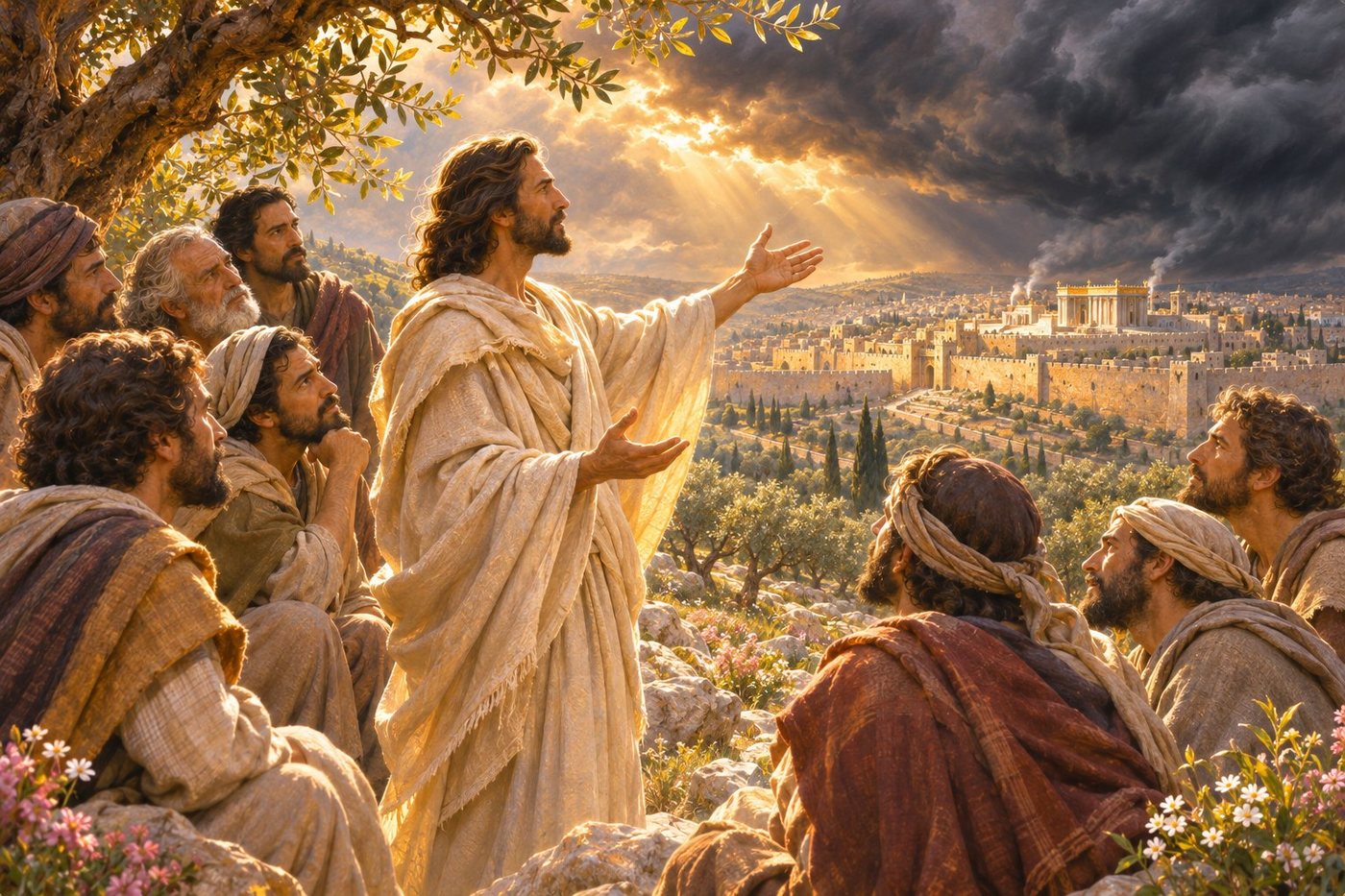
It’s called the Olivet Discourse, which is just what Bible people call the talk Jesus gave on the Mount of Olives. In Matthew 23, Jesus had just lit into some hyper-religious, judgmental people. You have to read it; it shows a side of Jesus that isn’t sinful but is very assertive. Then in Matthew 24 his disciples pull him aside: Just tell us what this is going to look like. What do we look for? You keep dropping hints, but we don’t know. And this time Jesus says, Come here. I’ll explain it to you.
What follows is the most concise and informative teaching on these things in the Gospels. (The chapter breaks were added much later.) In Matthew 25 he gives examples, which we’ll look at in Chapter 5. In Matthew 24 there are five things Jesus tells us to do while we live in the present age and look toward the age to come.
1. Be perceptive
Jesus answered: “Watch out that no one deceives you. For many will come in my name, claiming, ‘I am the Messiah,’ and will deceive many.” (Matthew 24:4–5)
“At that time if anyone says to you, ‘Look, here is the Messiah!’ or, ‘There he is!’ do not believe it. For false messiahs and false prophets will appear and perform great signs and wonders to deceive, if possible, even the elect. See, I have told you ahead of time.” (Matthew 24:23–25)
People will come claiming to know the truth and claiming their way is the way to heaven. It can be subtle, inside a religious system. Or it can be the claim that no religious system matters, that you can live for yourself and still end up in heaven. It can be someone who starts a movement, maybe even calls it a ministry, that steers people away from the truth. Jesus says: Don’t be deceived. Stay sharp. Let Scripture be your guide and the Holy Spirit within you direct you.
Here’s what I believe should tip you off. People who become hyper-focused on this subject, who think they have cornered the market on the signs of the times and when Jesus is coming, often start, sometimes not even subtly, pointing attention toward themselves: how much they know, how much they’ve studied, how they can read society better than anyone else. Gradually people turn to them for answers Scripture doesn’t give. People begin to follow a person, a school of thought, or a method, and they’re deceived. It happens every day in churches and in our world.
A false teacher always, in some way, points back to himself. If someone is pointing you to Jesus and encouraging you to read the Bible for yourself, you’re at least off to a good start.
2. Don’t panic
“You will hear of wars and rumors of wars, but see to it that you are not alarmed. Such things must happen, but the end is still to come.” (Matthew 24:6)
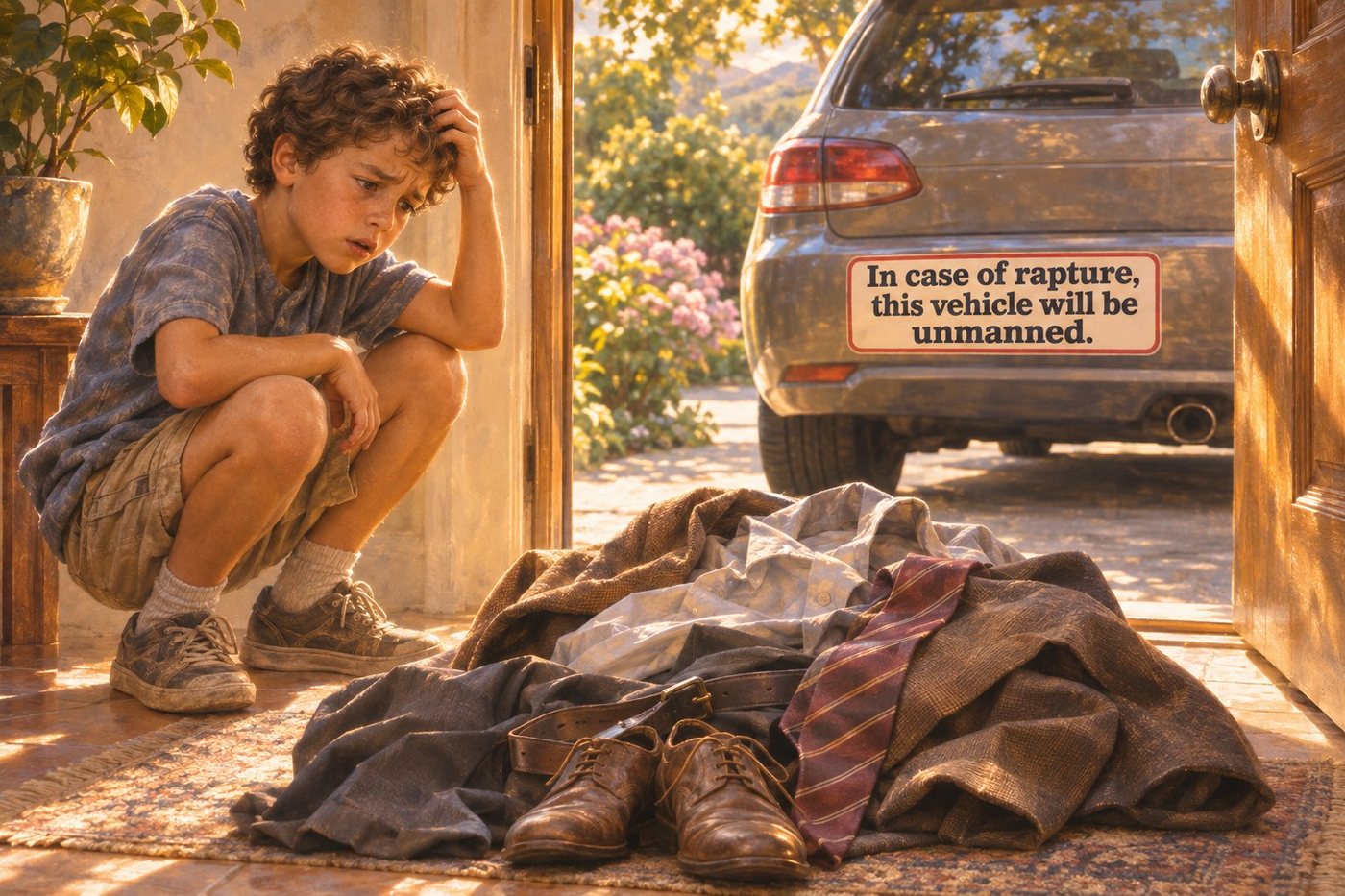
Have you heard “wars and rumors of wars” thrown around in churches that are a little scary about the end times? I grew up scared to death of the end times, the second coming, and the rapture. I’m sure my church didn’t intend that. People had bumper stickers that said, In case of rapture, this vehicle will be unmanned. I imagined Jesus coming back and finding nothing but a pile of clothes where my mom used to be while I was left behind. Part of me thought, Maybe it’ll be like Home Alone. I’ll have the house to myself. Then, Wait, I’m going to hell. It got confusing and terrifying, and that’s not how it’s meant to be. This teaching is meant to help us and point us toward hope. Its finality should create a sense of urgency, not panic.
Everybody quotes the first half of that verse and skips the second. See to it that you are not alarmed. Wars will happen, but the end is still to come. Earthquakes will happen, but the end is still to come. The world will get worse, but the end is still to come.
How much worse can it get? A lot worse. How much longer can it take? A lot longer. People love to tell you how much worse things are than last month, last year, or five years ago. I wholeheartedly agree that we’re one day closer to Jesus’ return than we were yesterday. But you can’t read the signs of the times any better than I can. Scripture gives no definite markers tied to our calendar or current events that let us check off boxes. We guess, we hope, and we look to Scripture.
Jesus said: Don’t panic. Don’t be alarmed. The next time we’ll have true, lasting peace is when Satan is banished, Jesus is on his throne, and we’re living in the millennial kingdom.
How much worse can it get? A lot worse. How much longer can it take? A lot longer.
3. Persevere
“Because of the increase of wickedness, the love of most will grow cold, but the one who stands firm to the end will be saved.” (Matthew 24:12–13)
Don’t quit. Don’t give up. Don’t let your love grow cold. When following Jesus gets hard, and Jesus is honest that it will, stand firm.
4. Be productive: don’t waste the wait
“Who then is the faithful and wise servant, whom the master has put in charge of the servants in his household to give them their food at the proper time? It will be good for that servant whose master finds him doing so when he returns.” (Matthew 24:45–46)
Jesus eases the tension a little with an example: a servant left in charge of the household while the master is away. The servant who does a faithful job will be rewarded when the master returns. He’s productive. He lives in a way that makes a difference after he’s gone.
Remember the judgment seat of Christ from Chapter 2. It isn’t about answering for every sin you’ve committed. It’s about the things in your life that counted for the kingdom, the things that will last in your life and in the lives of the people around you after you’re gone. Those are what you’ll be rewarded for. Everything else, the neutral stuff and the rest, just fades away. What remains is your faithfulness, your influence, your impact.
That doesn’t mean you have to become someone else. You don’t have to become a missionary or a pastor, go to seminary, and overhaul your life. You need to focus on the people God has put in your life. If you’ve made a mess, do your best to unmake it. If you haven’t, do your best to improve things. Point your world toward Jesus in the most humble, sincere, open, and transparent way you can.
Maybe this life isn’t meant to be spent however you want. Maybe it’s meant to be invested the way Jesus has called you to invest it. Maybe there is a purpose, a plan, and a will that goes far beyond the bare minimum of making sure you’re a Christian and hoping you slide in. That life is available to you.
5. Be ready, and stay ready
“Therefore keep watch, because you do not know on what day your Lord will come. But understand this: If the owner of the house had known at what time of night the thief was coming, he would have kept watch and would not have let his house be broken into. So you also must be ready, because the Son of Man will come at an hour when you do not expect him.” (Matthew 24:42–44)
Be prepared. Live so that you’re ready. Live so that your kids are ready. Live so that if Jesus comes today, you have no regrets and you’re ready to go.
In my world, that looks like a couple of things.
First, I need to be sure, for me. The Bible says some people will tell Jesus, I’m one of yours, and he’ll say, I never knew you (Matthew 7:21–23). There are churches full of people who think they’re followers of Christ but have never committed to Jesus beyond the superficial. They want only the minimum requirements to avoid hell and have never embraced the relationship with Jesus that transforms a life. So I have to ask myself: Am I really a follower of Christ? Am I prepared? Are my priorities as close as possible to what they’ll be five minutes after I meet Jesus? Am I living toward the things that last, or am I constantly distracted by the temporary and the superficial?
Second, am I doing my best with the people God has trusted to me most? Am I helping make sure my wife is prepared? Not in an authoritarian or dictatorial way. She has the same responsibility to God for me. We’re in each other’s grill twenty-four seven. She’s the first person I see in the morning (she smells my morning breath; she doesn’t have any, of course) and the last person I see at night. I’m responsible for her, and she’s responsible for me. I have to do everything I can to be the person I say I am and the person Jesus would have me be. I need to honor the trust he’s given me with the woman he calls his daughter, the woman I’ve been married to for thirty-six years.
Then the next circle: my kids. Even though they’re adults and I can’t do as much, I can do something. Nudging adult kids is hard and has to be subtle. Nudge too hard and they say, See you. So you encourage. You add value. You come alongside. You live with transparency and humility, and you try to model a faith that won’t need to be deconstructed. You’re there when they need you. You repair when you need to. And you’re ready to answer to God for how you’ve influenced the people closest to you.
Because Jesus could come any day. If we’re taken before the tribulation, wonderful, as long as the people around me are with me. If we live through it, maybe I’ll have done my part to prepare them for a time when most people’s faith will crumble.
Then there’s another circle for me: helping you prepare and live that life as we wait.
Don’t Waste the Wait
Jesus said that in an instant, in the blink of an eye, at the sound of a trumpet, he will come again, and we will be with him forever.
So live tomorrow with your priorities lined up with what you’ll believe is most important five minutes after you’re dead. Live with the end in mind.
Don’t waste the wait.
Key Truths
- Christians differ on whether believers are gathered before or after the tribulation. Study it and decide.
- Whatever you decide: don’t be deceived, don’t panic, don’t quit, don’t waste the wait, and stay ready.
- Readiness isn’t something you can schedule for later.
For Reflection
- Do you expect Jesus to return in your lifetime? If he doesn’t, why does this teaching still matter?
- Jesus says, See to it that you are not alarmed. What’s the difference between being aware of the world and living in fear of it?
- If you knew Jesus were returning one year from today, what would you want him to find you faithfully doing?
- Whether the church is gathered before or after the tribulation, what kind of faith should we be building in the people we influence now?
- Either Jesus returns in our lifetime or our life ends. What is one step you need to take now to live ready?
For the kids in your life: the same truth in the Kids' Edition, Chapter 3 · Comic, Issue 3: Meeting in the Middle
Eternity Reveals What Life Conceals
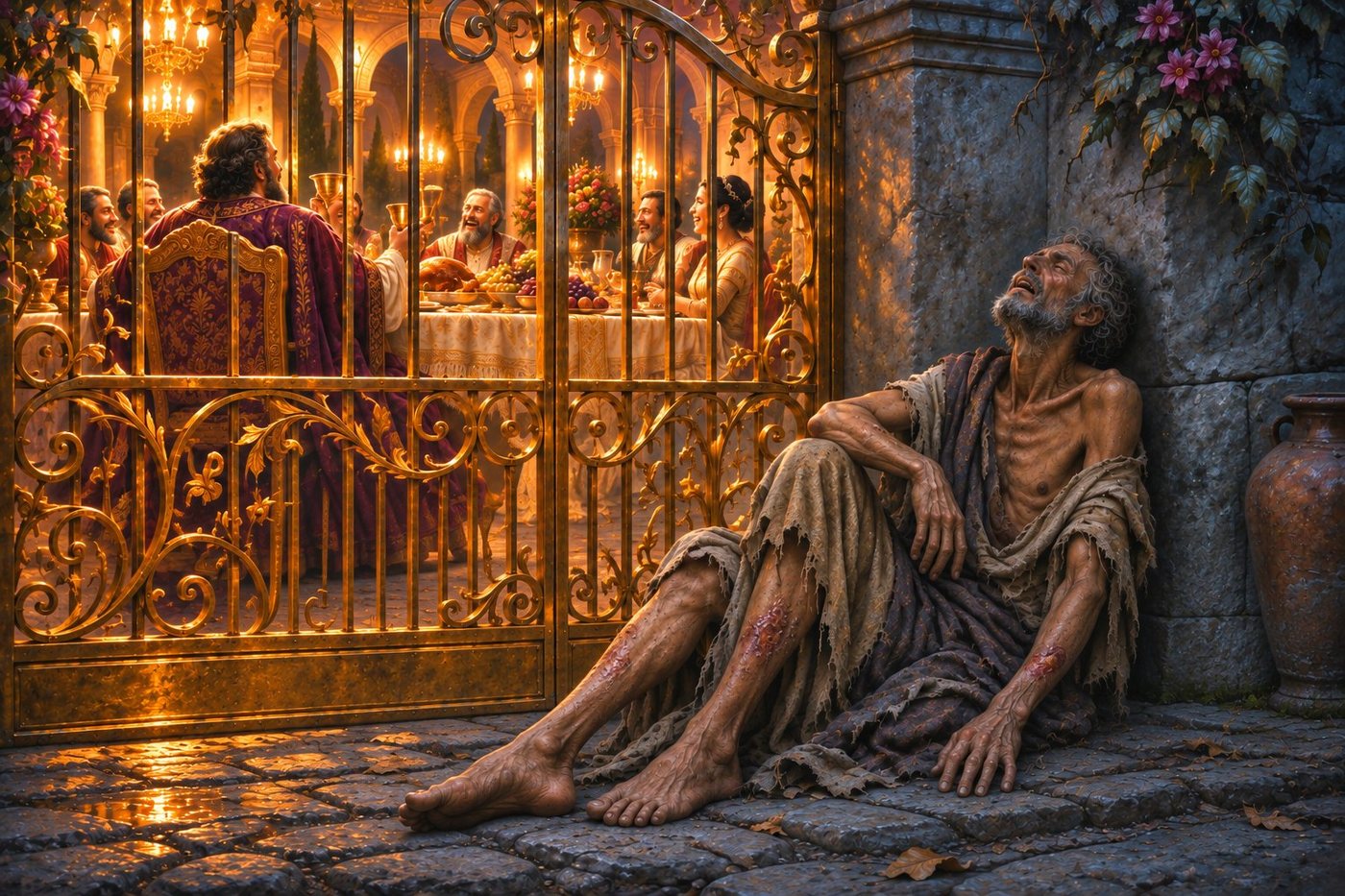
The Sermon at a Glance
- The Contrast: what we see now. · Luke 16:19–21
- The Crossing: death reveals reality. · Luke 16:22–26
- The Choice: respond while there’s still time. · Luke 16:27–31
You are here Hades, the anti-paradise
Paradise & Hades → Tribulation → Second Coming →
Thousand Years → Great White Throne → New Earth → Who We’ll Be · Road Map ›
Read First · Luke 16:19–31
The Rich Man and Lazarus
19 “There was a rich man who was dressed in purple and fine linen and lived in luxury every day. 20 At his gate was laid a beggar named Lazarus, covered with sores 21 and longing to eat what fell from the rich man’s table. Even the dogs came and licked his sores.
22 “The time came when the beggar died and the angels carried him to Abraham’s side. The rich man also died and was buried. 23 In Hades, where he was in torment, he looked up and saw Abraham far away, with Lazarus by his side. 24 So he called to him, ‘Father Abraham, have pity on me and send Lazarus to dip the tip of his finger in water and cool my tongue, because I am in agony in this fire.’
25 “But Abraham replied, ‘Son, remember that in your lifetime you received your good things, while Lazarus received bad things, but now he is comforted here and you are in agony. 26 And besides all this, between us and you a great chasm has been set in place, so that those who want to go from here to you cannot, nor can anyone cross over from there to us.’
27 “He answered, ‘Then I beg you, father, send Lazarus to my family, 28 for I have five brothers. Let him warn them, so that they will not also come to this place of torment.’
29 “Abraham replied, ‘They have Moses and the Prophets; let them listen to them.’
30 “‘No, father Abraham,’ he said, ‘but if someone from the dead goes to them, they will repent.’
31 “He said to him, ‘If they do not listen to Moses and the Prophets, they will not be convinced even if someone rises from the dead.’”
It was a Wednesday. It wasn’t my fault, but it’s a sad story.
My dog Baxter (thirteen pounds, unknown origin; if anybody wants him, I’ll throw in a bag of dog food) woke me up at three in the morning, as he likes to do. He needed to go out. But Baxter doesn’t like to go out when it’s raining, and it had been raining in Iowa for two weeks. I think he’d been holding it for a while.

So at three a.m. he was scratching, scratching, scratching. (My wife told me not to tell this story. One of our staff members said it was fine. If you don’t like it, you know whom to blame.) I got up, opened the sliding glass door, and leaned my head against the wall, exhausted, while Baxter wandered around looking for rabbits. He finally came in. I walked back toward the bedroom in pitch darkness, barefoot, and stepped in something.
You don’t want to look, but you have to look. I flipped on the light. Sure enough, barefoot, in Baxter’s poop, in the carpet. I yelled for my shield maiden. She wasn’t far away. “What?” “Baxter.” I went and stuck my foot in the shower and scrubbed and scrubbed while my wife cleaned up the carpet. It was a bad day.
Fast-forward to Friday. I’m going somewhere with this, I promise. I was at the gym, hurrying to the restroom, and when I came around the corner, there on the floor outside the door was something that looked exactly like what Baxter had left in my bedroom.
I stopped. Not on a Friday. Not today, Satan. I’m awake. I’m alert. I stood there staring. Somebody else walked up and stared too. Something’s wrong here. If it was what I thought it was, I was changing gyms. I was already on my phone looking up other gyms in Ankeny that didn’t have poop on the floor. Three or four of us were standing around when someone finally said, “I’ll go get the manager.” Good idea.
The manager came over with one of those towels you wipe your sweat with, picked the thing up, and said, “It’s not poop.”
I didn’t believe him. I wanted proof, because if it was poop, I was gone and never coming back. If it was true, it changed everything.
“How do you know?”
“It’s got grass in it. It’s mud.”

Not exactly conclusive, but I gave him the benefit of the doubt. Since that was true, I’d stick around. If it had been the other thing, everything would have changed. But since I’d decided it was probably okay, I stayed.
From If to Since
Those two words, if and since: the distance between them can take people a lifetime to cross.
A good friend helped me clear this up in my mind this week. Many people live from the perspective of if this is true. If it’s true, it changes everything.
Some of you haven’t even reached if yet. You’re thinking, This can’t be true. The story of the Bible, the story of creation, and especially the end story we’re working through feel impossible: a paradise that’s a holding place where we’re with Jesus but without our bodies; a tribulation; a rapture before or after it, depending on what you believe; new bodies for believers; a thousand-year millennial kingdom with Jesus; a great white throne where unbelievers who have gone to the anti-paradise, Hades, receive their bodies and are cast into the lake of fire; and eternity on a new earth with Jesus. It’s hard to believe. People step back and say, “The facts just don’t stack up.”
The distance between if and since can take people a lifetime to cross.
Moving from skeptic to if is a gift from God. It represents the seeds of faith. My job is to do everything I can, and the Holy Spirit’s job is to nudge you, beyond if to since.
When you start reading the Bible from since it’s true, you have changed positions. Many so-called believers live from if. The moment life rocks them, the moment a question or a doubt comes, they start to drift. Shipwreck can happen, because every time they come back from the storms of the soul, they return to a rock with no solid foundation: the rock of if.
But when you move to the rock of since, when you’ve decided that even if it doesn’t always make sense to you, it is true, then when you go through the storms of life, you come back to a solid foundation of faith. You start building your story, your narrative, your worldview, and you begin to understand why you were created in the first place.
Many of you are on the road between if and since, and I love that. It’s my job, and my joy, to teach you what the Bible says.
Why Talk About Hell?
If all you cared about was growing a church, you wouldn’t talk about hell. You wouldn’t talk much about sin either. You’d skip it, or mention it once in a while. People don’t want to hear it. You’d quietly assume a universalist perspective: all good people end up in heaven; it all works out in the end; don’t worry about it.
The biggest lie Satan wants you to believe is that hell isn’t real and heaven is boring. Don’t think about it. Don’t worry about it.
My challenge to you is the same one I’ve given myself, and the prayer I’ve been praying every day: I want eternity to shape the way I live today. I want what will be most important to me five minutes after I die to be most important to me now. I don’t mean being so focused on heaven that you’re no earthly good. I mean letting eternity become part of your narrative, part of your inner spiritual monologue.
It’s easy in a message like this to point the finger: I don’t like this pastor. I don’t like what he’s saying. So let me remind you that my only authority comes from the Word of God. When I preach, I preach from the Bible. Where I interpret, I try to tell you. Where you have to choose between interpretations, I’ll show you, and I may nudge you toward one. But in the end you have to decide what you think about Jesus and whether he tells the truth. You have to decide what you think about the Bible and whether you’ll believe it. And you have to decide whether you’ll make the journey from if to since. I believe saving faith is found in since.
This subject is hard to talk about and hard to hear. But it’s real, and Jesus talked about it. Not a lot, but he did. So we will too. Deep breath, everybody. I started with a poop story to lighten the mood. We all went back to junior high for a minute. Now let’s dive in.
Story or Parable?
The Bible doesn’t give us much information about the afterlife. Paul, in 2 Corinthians, says he had a vision of heaven so overwhelming that he wasn’t permitted to describe it and didn’t have the words if he had been. John, in Revelation, tells us some things about the new earth and the New Jerusalem, and we’ll get there. But here we’re beginning two chapters on the anti-paradise: hell, or Hades as it’s called in this present age. Scripture gives us a glimpse of the afterlife from the perspective of someone who rejected the truth and ended up in eternal separation from God. Jesus gave us that glimpse as a gift.
Right away there’s a decision to make. You might think you know the answer, but you don’t. If you do know for sure, you’re smarter, better informed, and walking more closely with God than anyone I know of who has studied and preached Scripture. The evidence is inconclusive. But it does matter what you decide, because the decision tips dominoes down the rest of the timeline.
The passage is Luke 16, a story Jesus told about a rich man and a poor man, a beggar named Lazarus. Is it a story, meaning something that literally happened to real people in a real place? Or is it a parable, a story Jesus made up to sit alongside a real spiritual truth? There were no actual workers in the vineyard. Jesus made up the vineyard and the workers, but the point he made was true.
Reasons some believe it’s a literal story:
- Lazarus is named. In none of Jesus’ other parables is a person named. Abraham is named too, the only time that happens. When Jesus names someone for the first time, you have to ask why. It must be significant. But it could be because Lazarus means “the one whom God helps,” and Jesus wanted to add that meaning to the story.
- Jesus never interprets it the way he does some parables, and Luke never calls it a parable. But Jesus doesn’t always explain his parables either.
The biggest challenge with reading it as literal history is this. In the present age, when we die, we leave our bodies behind. Our souls go either to be with Jesus in paradise or to Hades, a place of punishment and torment, but the bodies stay here. Yet Luke 16 describes the rich man as if he has a body: a tongue, a thirst. Unbelievers don’t receive their bodies again until the great white throne judgment. If you take the story literally, that decision ripples all the way down the timeline. (I know I’ve lost some of you. Thanks to those still with me.)
Reasons to read it as a parable:
- It sits in a section of parables, all of Luke 16.
- It opens the way other parables do: “There was a rich man…”
- It’s built like a parable, and parables were Jesus’ primary teaching method. Jesus wasn’t random. He didn’t have the squirrel brain I sometimes do. He wouldn’t have jumped from a run of parables into a literal account and back again; that would have been confusing.
- The early church father Tertullian said you never build doctrine from a parable. You build doctrine from Scripture and then interpret parables by it.
I believe it’s a parable. If you disagree, that’s perfectly fine; nobody knows for sure. But make at least a temporary decision. Put a pin in it as we walk into the story.
The Comparison
There was a rich man who was dressed in purple and fine linen and lived in luxury every day. (Luke 16:19)
This is not about rich and poor. It’s not saying rich people go to hell and poor people go to heaven. Jesus tips his hand in verses 14 and 15. He was talking to the Pharisees, the religious leaders who used God and religion as a weapon to control people, and Luke says they loved money.
That doesn’t mean they loved the money itself. It means they loved this life and the things they could have and buy and find in it. They’re the people who would be on social media trying to prove they have the best life ever, that they’ve arrived. All they think about is the next vacation, the next promotion, the next purchase. They’re consumed with this life, materialistic, never thinking about what will matter after they’re gone. They love this life and this life only.
It has nothing to do with money as such. God gives some people money and expects them to give generously. When they stand before the judgment seat of Christ and everything else burns away, the money they invested in the kingdom will be one of the things they’re honored for. God trusts some people with that.
In verse 15 Jesus says the Pharisees cared most about what other people thought of them. If they’d had social media, the lighting would have had to be perfect, and if a post had only eighteen likes after an hour, they would have deleted it. They wanted to be popular and envied. Life was about them. They were the main character, and everyone else was a supporting actor. That’s who this parable was aimed at.
So the rich man is dressed in purple, a dye made from shellfish, hard to get and very expensive. He’s shopping at the very best stores and wearing the very best. What’s the problem? He’s also dressed in fine linen. One historian of the period said you could sell a single linen garment and feed a poor person for a year. Is it wrong to dress nicely for a special occasion? Of course not. But Jesus says he lived like this every day. He was dressed to the nines to impress. He cared what people thought. He wanted to look better and more successful than everyone else and put it in their faces. It dominated his life.
I grew up on reruns of Leave It to Beaver. June Cleaver always wore pearls and a pressed dress, served hors d’oeuvres, and ran around in high heels. I’ve been married thirty-six years and that hasn’t happened once. It’s not reality, and I wouldn’t want it to be. But that was the impression, and the rich man trafficked in impression management, manipulation, and envy.
At his gate was laid a beggar named Lazarus, covered with sores and longing to eat what fell from the rich man’s table. Even the dogs came and licked his sores. (Luke 16:20–21)
The gate would have stood at the end of a long walkway in a wealthy neighborhood. It provided protection, it was probably ornate, and it was how people recognized the house. The word laid literally means tossed or chucked. Someone dumped Lazarus at the gate. And yet somebody cared enough to drag him away from the crowd of beggars at the town gate and drop him in a rich neighborhood, where someone might take pity on him. It’s a little like trick-or-treating: if you want full-size candy bars, you go to the rich neighborhood. (I’m not telling you to trick-or-treat. It’s an illustration.)
The religious leaders of the day believed anyone who was poor or sick deserved it, or their parents had done something to deserve it. They didn’t want to get their hands dirty helping such people, because they had a twisted belief that helping them would hurt their own standing with God. It was disgusting.
Lazarus was covered with sores. The word means ulcers, oozing and painful. He longed to eat what fell from the rich man’s table. Some translations say crumbs, but historians of the period describe the custom. People ate with their hands, dipping them in oil and sauces, and then wiped their hands on pieces of bread, the reject bread, like the crusts your mom cut off your sandwich, and tossed them under the table. Lazarus longed to eat the bread these people had wiped their hands on. And for whatever reason, they wouldn’t even give him their trash.
Even the dogs came and licked his sores. These weren’t friendly, fluffy little dogs like Baxter. The dogs in this story were mangy, predatory pack animals roaming the streets for garbage. They were eating him before he was dead. That’s enough; you get the picture.
How low was Lazarus? He couldn’t get any lower. How high was the rich man? He couldn’t get any higher. The religious people of the day would have said the beggar had it coming and the rich man was blessed by God and headed for heaven.
The Crossing
The time came when the beggar died and the angels carried him to Abraham’s side. (Luke 16:22)
Everyone listening would have thought, Finally. Put him out of his misery. Then something interesting happens. Notice three things.
First, the angels carried him. The Bible hints that one of the jobs of angels is to accompany the soul of a believer into paradise when they die. I don’t know whether it’s a hundred angels or one, and Scripture doesn’t say much, so don’t get carried away. But it’s a comforting thought. When I die, if I see angels carrying me to be with Jesus, that’s pretty cool. It gives me goosebumps.
Second, there would have been no funeral. No one would have paid respects. No one would have given to charity in his name or sent flowers. His body would have been carried outside the city and thrown into the burning pit where unclaimed, unloved people, dead animals, and trash were dumped. It was called Gehenna, a word you’ll need again later.
Third, Abraham’s side. People wonder what that means, but it’s simple. It’s where Abraham went when he died. It’s paradise, the Old Testament way of describing it. To any Jew, Abraham was the greatest of the great, the father of the faith, someone who wouldn’t have given Lazarus a second glance. And here is Lazarus at Abraham’s side, the two of them like buddies. That blew the minds of the people hearing the story.
The rich man also died and was buried. In Hades, where he was in torment, he looked up and saw Abraham far away, with Lazarus by his side. (Luke 16:22–23)
The crowd would have gasped. The rich man would have had a great funeral: donations, flowers, an obituary, maybe a church service, and lots of mourners.
So Lazarus went to paradise and the rich man went to Hades. What is Hades?
Hades is the anti-paradise. It’s where Satan wants you to go, and he’ll meet you there. It is a place of punishment and torment, where your conscience is fully awake. You’ll be in physical pain, as we’ll see, but you’ll also understand spiritually the choice you refused to make, to accept Jesus Christ as your Savior, and you’ll live knowing you could have changed it.
From this parable we learn four things about Hades:
- It’s personal. It happens immediately at death. Lazarus was carried to paradise and the rich man went to Hades, not after a period of sleep or a pause but at once. Both were awake, active, conscious, and aware of what was happening.
- It’s painful, as we’re about to see.
- It’s permanent. It can’t be reversed.
- It’s preliminary. This one may raise a question. Just as paradise will be called something different after the tribulation and the millennial kingdom, when we get to what we’d call heaven, hell has different names in Scripture too. Hades is the intermediate state: still punishment, still permanent, still eternal. But Revelation says that when the millennial kingdom is over, Hades will give up its dead. Those who died rejecting Christ will receive their bodies, and instead of going to the new earth they will be sent to the lake of fire, Gehenna, with Satan, the Antichrist, and the demons, forever. The name changes, but the reality is the same.
It’s tragic, but it’s what Scripture teaches.
Hell is personal, painful, and permanent. But it is preventable.
So he called to him, “Father Abraham, have pity on me and send Lazarus to dip the tip of his finger in water and cool my tongue, because I am in agony in this fire.” (Luke 16:24)
Notice that Lazarus never says a word. Does he even see what’s happening? Probably not. Who knows? This is one more reason I believe it’s a parable. There’s no evidence elsewhere in Scripture that people in heaven can see people in hell or talk with them. That fits the pattern of a parable: a story built to make a point that reflects reality.
I could describe all the elements of hell and try to scare you, and we’ll talk more about it in the next chapter. It terrifies me. I’ve thought about it many nights before going to sleep these past weeks. It shakes a person to the core to grasp even a piece of how personal, how painful, and how permanent it is, and that you’re there fully aware that you could have done something to change it.
The rich man is now living with what should matter to us right now. What we’ll experience five minutes after we die, and what will matter to us then, should matter most to us now. For him it’s too late. For you and me, it isn’t.
But Abraham replied, “Son, remember that in your lifetime you received your good things, while Lazarus received bad things, but now he is comforted here and you are in agony.” (Luke 16:25)
Circle the word now. Paradise is where we’ll see that all things work together for good for those who love God and are called according to his purpose (Romans 8:28). In this life you don’t always see things working together for good. Lazarus’s life was not good. But in paradise he saw how all of it had worked together for good. You will too, if you have a personal relationship with Jesus Christ.
“And besides all this, between us and you a great chasm has been set in place, so that those who want to go from here to you cannot, nor can anyone cross over from there to us.” (Luke 16:26)
Set in place means permanently fixed. There is heaven, there is hell, and there is a chasm between them that makes it permanent and impassable. Period. End of that part of the story.
Then the rich man shifts, and I almost like him a little for it. Now he’s thinking not just about himself, which you and I should be doing on this side of eternity, but about the people closest to him, the ones he was most responsible for.
He answered, “Then I beg you, father, send Lazarus to my family, for I have five brothers. Let him warn them, so that they will not also come to this place of torment.” (Luke 16:27–28)
The word translated then has the sense of Okay. He accepts that he will never be freed from this pain. So, Okay, then I beg you. Now he’s thinking about his brothers, his family, the people he had influence over. He’s concerned now, when he had no concern before, except to impress, entertain, and distract.
Abraham replied, “They have Moses and the Prophets; let them listen to them.”
“No, father Abraham,” he said, “but if someone from the dead goes to them, they will repent.”
He said to him, “If they do not listen to Moses and the Prophets, they will not be convinced even if someone rises from the dead.” (Luke 16:29–31)
For them, “Moses and the Prophets” meant the Scriptures. Abraham is saying, They have the Word. John’s Gospel says the same thing: what we need to know about Jesus is revealed in God’s Word. You have the facts. You have the gospel. You have everything you need to wake up. The rich man’s brothers had it too, and it made no difference.
Notice the foreshadowing: even if someone rises from the dead. Jesus is pointing toward his own death, burial, and resurrection.
That’s why I don’t preach opinion to you. I’m not telling you what Rick thinks will happen. I’m telling you what the Bible says will happen. If you don’t like it, your problem isn’t with me; it’s with Scripture. And I’m okay with that, because everyone moves from if to since at their own pace.
Well, that’s bleak. Church is supposed to make you feel good, mess up your hair, and send you home, right? This is the kind of passage pastors like to avoid. I wasn’t looking forward to preaching it, and I didn’t look forward to writing it down either. But I felt compelled, because I love you. I care far more about you building a life of faith on the foundation of since than about building a big church where everyone is lulled into thinking everything’s okay.
The Choice
Look at it one more time. In this life, the rich man could have walked through his own gate to Lazarus at any time. He never did. The gate he would not cross became the chasm he could not cross.
So let me ask you: Who is at your gate? The need may be in your home, your neighborhood, your workplace, your family. And the bigger question: What will you do with Jesus? His brothers still had something the rich man no longer had. They had time. So do you.
You have the comparison between Lazarus and the rich man. You have the crossing into the afterlife, which happens to all of us. And now you have the choice you have to make.
The determining factor between heaven and hell is not whether someone was a good person or lived a good life. It’s the decision they made about Jesus Christ: whether they chose to follow him, confessing their sin, trusting him as Lord and Savior, and becoming his disciple.
One of the biggest disservices people like me do to people like you is to wrap all this up in a phrase that makes everyone feel better but can be deceptive: Well, only God knows the heart. We say it, we smile, we nod. And it’s true. One hundred percent. Only God knows the heart.
But God isn’t looking at the heart through some arbitrary set of rules where he just decides to let things slide. Only God knows the heart because eternity reveals what life conceals. And the only thing that will determine eternity, for you and for the people you love, is the decision a person makes about Jesus Christ. Hell is personal, painful, and permanent. But it is preventable.
And if you’re thinking, you’ll ask a fair question: How could a loving God do this?
God is bound by only one thing: his own nature. By nature he is loving and merciful, which is why we have Jesus. But he is also just and holy, and his holiness and justice require that sin be punished. That is the curse every one of us was born under. Paul says we are all born sinful. All have sinned and fall short of the glory of God (Romans 3:23). The wages of sin is death, but the gift of God is eternal life in Christ Jesus our Lord (Romans 6:23).
His justice demands a penalty. His love provides a Savior. Jesus himself said in John’s Gospel, “I am the way and the truth and the life. No one comes to the Father except through me” (John 14:6). This life and the life to come. Anyone who wants to come to the Father can come through him. Is he the only way? Yes. And that’s the decision you have to make.
The Bible teaches that hell will be full of religious people. You can blend into a church crowd, know Bible verses, and be a chameleon who moves easily between different worlds. But eternity reveals what this life conceals. When it all shakes out, the only decision that matters is whether you decided to follow Jesus.
How to Follow Jesus
It isn’t a magic formula. It’s a commitment of the heart.
You come to the point of realizing you’re part of the problem. You’ve sinned. You may not be a terrible person, but the Bible teaches that one sin or a million, it doesn’t matter. All have sinned and fall short of the glory of God.
So you confess your sin and ask forgiveness. Scripture says that if we confess our sins, he is faithful and just and will forgive us our sins and purify us from all unrighteousness (1 John 1:9). It’s right for him to forgive you. If you ask, you receive it.
Then you make a simple commitment, the same one we’re trying to live out together: I’m going to do my very best to live my life as a person of faith, a follower of Jesus Christ. I’m going to live today with what will matter most to me five minutes after I’m dead. I’m going to live so that when I stand before the judgment seat of Christ and everything else falls away, what I have to offer him will mean something, so that I can leave this life knowing I found my purpose and made a difference, and hear, “Welcome home. You were good and faithful.”
Not one of us is perfect. You know that. But we do it together.
So whether you’re on the journey from if to since, or you’ve arrived at since and are working it out, I want you to find yourself in this story. Know the facts. Know the timeline. Pass the test. But see yourself in the story God himself placed you in. There’s a reason he put you there, and he’ll show you if you ask him.
Key Truths
- Hell is personal, painful, permanent, and preliminary.
- Death fixes our destination. The rich man’s brothers still had time, and so do we.
- Who is at your gate? And what will you do with Jesus?
For Reflection
- What details in Luke 16:19–21 reveal the contrast between the rich man and Lazarus? What does the rich man’s lack of response show?
- Abraham points the rich man’s brothers to Moses and the Prophets. What does that teach about the authority and sufficiency of Scripture?
- Parable or actual account? Does anything essential about Jesus’ message change depending on your answer?
- Who is at your gate? Are you overlooking a need nearby while focusing on needs far away?
- Eternity reveals what life conceals. What is one thing this passage challenges you to see or do differently?
For the kids in your life: the same truth in the Kids' Edition, Chapter 4 · Comic, Issue 4: Eternity Reveals What Life Conceals
One Way or the Other
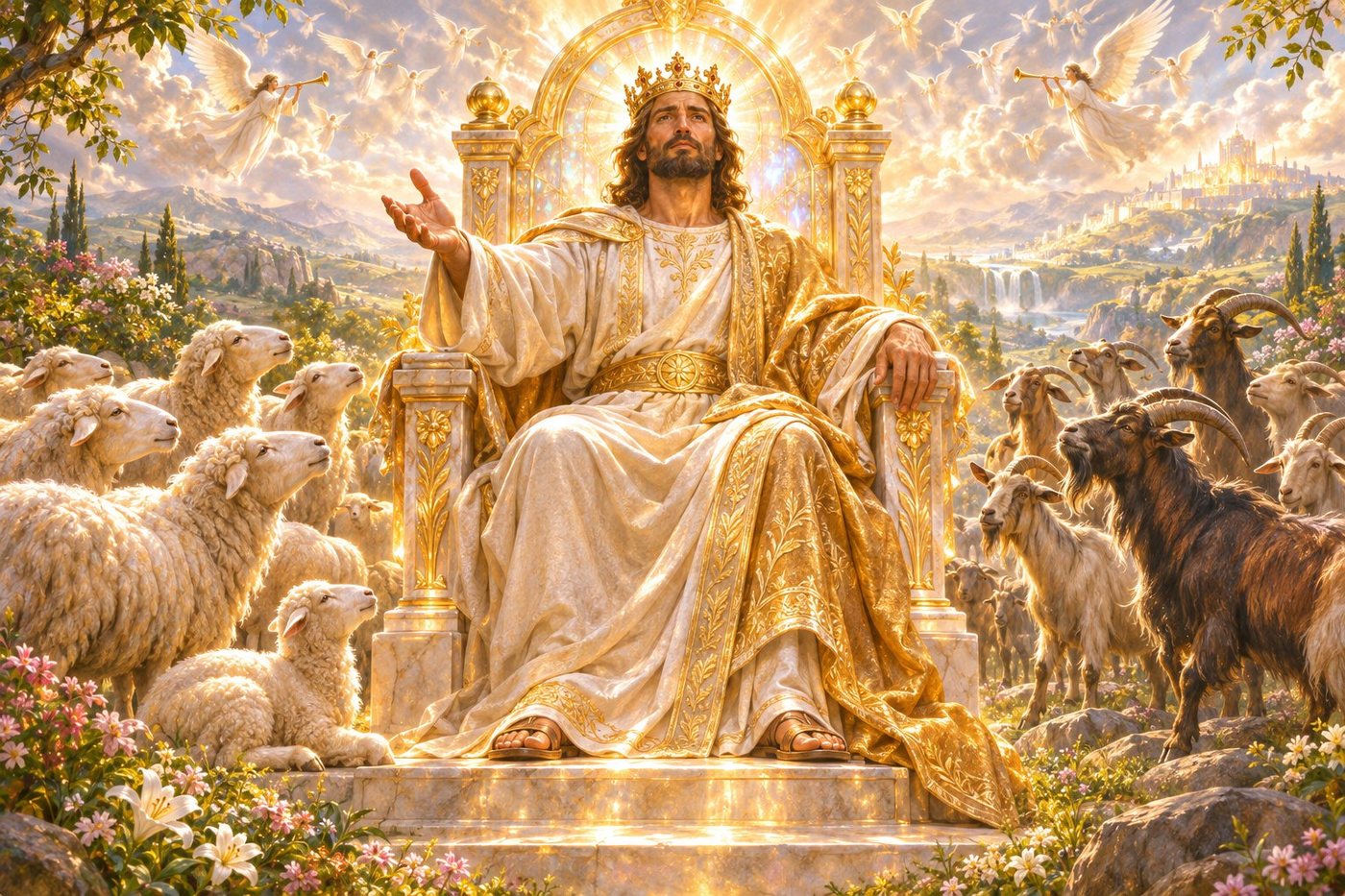
The Sermon at a Glance
- When? The return. · Matthew 25:31
- Who? The gathering. · Matthew 25:32–33
- Why? The evidence. · Matthew 25:34–45
- Where? Two destinations. · Matthew 25:46
You are here Jesus returns and separates
all people
Paradise & Hades → Tribulation → Second Coming →
Thousand Years → Great White Throne → New Earth → Who We’ll Be · Road Map ›
Read First · Matthew 25:31–46
The Sheep and the Goats
31 “When the Son of Man comes in his glory, and all the angels with him, he will sit on his glorious throne. 32 All the nations will be gathered before him, and he will separate the people one from another as a shepherd separates the sheep from the goats. 33 He will put the sheep on his right and the goats on his left.
34 “Then the King will say to those on his right, ‘Come, you who are blessed by my Father; take your inheritance, the kingdom prepared for you since the creation of the world. 35 For I was hungry and you gave me something to eat, I was thirsty and you gave me something to drink, I was a stranger and you invited me in, 36 I needed clothes and you clothed me, I was sick and you looked after me, I was in prison and you came to visit me.’
37 “Then the righteous will answer him, ‘Lord, when did we see you hungry and feed you, or thirsty and give you something to drink? 38 When did we see you a stranger and invite you in, or needing clothes and clothe you? 39 When did we see you sick or in prison and go to visit you?’ 40 “The King will reply, ‘Truly I tell you, whatever you did for one of the least of these brothers and sisters of mine, you did for me.’
41 “Then he will say to those on his left, ‘Depart from me, you who are cursed, into the eternal fire prepared for the devil and his angels. 42 For I was hungry and you gave me nothing to eat, I was thirsty and you gave me nothing to drink, 43 I was a stranger and you did not invite me in, I needed clothes and you did not clothe me, I was sick and in prison and you did not look after me.’
44 “They also will answer, ‘Lord, when did we see you hungry or thirsty or a stranger or needing clothes or sick or in prison, and did not help you?’ 45 “He will reply, ‘Truly I tell you, whatever you did not do for one of the least of these, you did not do for me.’ 46 “Then they will go away to eternal punishment, but the righteous to eternal life.”
I hate waiting in line. Nobody likes it, but I hate it more than most.
This week my wife and I were shopping at one of those places with a long row of registers. You can tell it’s a classy place, because each register has a light that comes on when it’s open, and a voice announces, “Register number five is available.” Anyone who has shopped somewhere like that knows the unspoken rule: when a register opens, the person at the front of the line goes.
I was in a hurry. I had nowhere to be afterward. I just don’t like lines. The lady in front of me was talking on her phone, loudly enough that everyone could enjoy her conversation. And she was next.
Ding. “Register number five is available.”
She didn’t move. She kept talking. My wife and I looked at each other. We waited. Finally, in the nick of supernatural time, she put her phone down. But instead of walking to register five, she turned around to address the rest of the line, kicked her leg out for some reason, and said, “Hee hee! I’m multitasking!”

My eyes got big. I was ready to explain that this wasn’t multitasking at all. It was annoying. Multitasking is doing two things at once, which would mean walking to the register while you’re on the phone and keeping the line moving. She was barely tasking.
Wherever You’re Starting From
Whether you’re just tasking, figuring all this out for the first time, or multitasking, having wrestled with it for years, take a deep breath. The ground is level at the foot of the cross. If you’re skeptical, or you’ve only made it as far as if, you’re welcome here. You’re about to read what Jesus himself said about how things will end. If you have a red-letter Bible, Matthew 25 is printed in red, and those are the most important words you will ever read. Where I move beyond what the text says and give you my interpretation, I’ll tell you.
An Apology Up Front
This chapter ends with one of the hardest truths in Christianity. It’s the second of two chapters on hell and eternal judgment. That truth is in the Bible, so it matters. But it is not what most of the New Testament is about, and it isn’t where Jesus started. So let’s start where he did.
Life is pressure. Pressure to become, to decide, to be somewhere. Pressure because you don’t know the future and you’re not sure what other people will do. Part of it comes from having to chart your own course: you lick your finger, check which way the wind is blowing, and do your best. And Jesus says:
Come to me, all you who are weary and burdened, and I will give you rest. Take my yoke upon you and learn from me, for I am gentle and humble in heart, and you will find rest for your souls. For my yoke is easy and my burden is light. (Matthew 11:28–30)
Eugene Peterson’s paraphrase, The Message, puts it this way. Jesus asks if you’re tired, worn out, burned out on religion. (I am.) Come to me. Get away with me and you’ll recover your life. Walk with me and work with me; watch how I do it. And then this:
Learn the unforced rhythms of grace.
I don’t know everything those rhythms are, but I want to learn them. Jesus promises that he won’t lay anything heavy or ill-fitting on you, and that if you keep company with him, you’ll learn to live freely and lightly.
That’s what he had in mind in John 14 when he said, “I am the way and the truth and the life. No one comes to the Father except through me.” Some people hear that as exclusive. But his arms were open wide: Anyone who wants to come can come. You come through me.
And he spent three years proving it.
Learn the unforced rhythms of grace.
He started at a wedding, for two people nobody really knew in a tiny town nobody cared about, and he stayed for the celebration. Jesus didn’t pound a pulpit and tell everyone to turn or burn. He hung out, and he performed a miracle of compassion that foreshadowed much of the New Testament.
I officiated a wedding for some friends just this week. Weddings are growing on me. My kids are in town too, both my sons, my daughters-in-law and my grandkids, plus a couple of their friends. That’s ten people in my house and four dogs. My wife and I are used to rattling around the house like a couple of old people, and we love having people around. Jesus loved a good celebration too.
When religious leaders dragged in a woman caught in adultery, Jesus knelt in the dirt beside her. In effect: If you want to get to her, you’ll have to throw those rocks at me first. This is the kind of person I came for. When he met Matthew, a tax collector and a lowlife in Jewish society, he went to his house and invited Matthew’s friends too.
His arms were open. His invitation was inclusive. He spent three years proving it.
How It Ends
By Matthew 24 and 25, those three years are nearly over. The religious establishment wants him dead. Jesus is about to die on the cross for our sin and rise again, defeating sin, Satan, and death. And his disciples are still asking, Jesus, how does this end for us? They pictured a big house, a big American Express card, a big Popemobile: their kingdom, now. So Jesus gathered them and laid out the final chapter. It’s beautiful and sobering, encouraging and terrifying. And it’s real.
When the Son of Man comes in his glory, and all the angels with him, he will sit on his glorious throne. (Matthew 25:31)
Son of Man is a title for Jesus; Daniel defines it (Daniel 7:13–14). On the Road Map, we’re now past the tribulation, at the beginning of the age to come. The word to focus on is when.
When? The Second Coming
When the Son of Man comes. When Jesus comes again: not if, but when.
There are two ways to meet Jesus: we die, or he comes back. Nobody knows when either one will happen. It could be today. It could be in our great-grandkids’ lifetimes. But we know he’s coming.
I like to schedule. The world divides into people who like to ride and people who like to drive. Riders don’t mind: I’ll get there when I get there. I like to drive. I want information and a timeline. So in Matthew 24, just before this passage, Jesus gives people like me a little more about the when.
“But about that day or hour no one knows, not even the angels in heaven, nor the Son, but only the Father.” (Matthew 24:36)
There’s an ongoing wedding analogy in Matthew 24 and 25 drawn from first-century marriage customs. The betrothal process was long. After the groom proposed, he went back to his father’s house and built a room onto it, an apartment, or a little house in the family compound. The bride waited at her home with her bridesmaids, ready. When the father finally said, All right, you’ve done what it takes; go get your bride, the groom set out with his groomsmen, usually at night, like a thief, because nobody knew when he was coming. They’d collect the bride. It wasn’t a kidnapping, but there was a lot of fun drama about it: She’s gone! Then everyone went back to the groom’s house for a party that lasted seven days.
Remember when Jesus said in John 14, “I am going there to prepare a place for you”? That’s what he was talking about. The analogy runs throughout Scripture.
“As it was in the days of Noah, so it will be at the coming of the Son of Man. For in the days before the flood, people were eating and drinking, marrying and giving in marriage, up to the day Noah entered the ark; and they knew nothing about what would happen until the flood came and took them all away. That is how it will be at the coming of the Son of Man.” (Matthew 24:37–39)
Why bring up Noah? It can sound random, like one of my squirrel moments at the dinner table. It isn’t. Everyone listening knew the story. Jesus isn’t saying the people of Noah’s day were evil and needed judgment, though they were. He’s saying they were simply going about life, paying no attention to the things that matter after death. They were having weddings, going to work, buying things, taking vacations, achieving, enjoying. They weren’t thinking about what would matter to them five minutes after they were dead. And one day the waters came, and they were surprised.
Jesus says it will be like that. People will live in their three-foot world, so consumed with their own lives, their own stuff, and their own achievements that they see nothing beyond arm’s length. Even good things can become distractions.
Then his illustrations get harder for me.
“Two men will be in the field; one will be taken and the other left. Two women will be grinding with a hand mill; one will be taken and the other left. Therefore keep watch, because you do not know on what day your Lord will come.” (Matthew 24:40–42)
Here’s what really makes me stop and think. In Jesus’ day, two men working the same field were almost certainly related, most likely father and son. Two women grinding at the same mill were almost certainly mother and daughter, or sisters.
Living as people did in the days of Noah, with little regard for our kids or our families, and no effort to nudge them toward purpose, while we direct them toward all the temporary things that pass away in our three-foot world, with no thought for eternity: one will be there, and one will be gone.
Remember the rich man in the last chapter? When he realized there was no relief in Hades, his heart went straight to his family. Can’t someone at least warn them? And the answer was no. It was too late.
Wouldn’t it be wise to decide that what will matter most to us five minutes after we die should matter most to us now? That’s what Jesus is saying. Come to me, all who are weary and burdened, and I’ll give you rest. I’ll lead you into the unforced rhythms of grace. But you come through him. You don’t go around him. You don’t invent your own way. You can’t be good enough; remember Chapter 1. You can’t be smart enough. You can’t figure it out or make it up. But it’s offered to anyone who will come.
The throne
Back to Matthew 25:31: he will sit on his glorious throne. We don’t really have thrones today, except in Netflix movies. It means Jesus is going to come, literally. Scripture says his feet will touch the Mount of Olives (Zechariah 14:4), the very hill where he sat when he gave this talk. When they do, a new kingdom begins, the millennial kingdom, and he takes his seat as judge.
Here is the hardest truth in all of Christianity, the one I softened by showing you the heart of Jesus first, so it lands with both grace and truth. If I didn’t love you, I wouldn’t tell you.
The decision you make about Jesus in this life will determine your eternity. Period.
The time for choosing ends when we die or when Jesus comes again, whichever comes first. Chapter 4 was about death. This chapter is about his return. Either way, the only thing that will matter is the decision we made in this life.
Who? The Gathering
“All the nations will be gathered before him, and he will separate the people one from another as a shepherd separates the sheep from the goats. He will put the sheep on his right and the goats on his left.” (Matthew 25:32–33)
Jesus isn’t calling you a sheep or a goat. I had goats once. My boys might remember. They’re the nastiest animals you could ever own. Being called either one wouldn’t be much of a compliment in my book. But Jesus was talking to people for whom shepherding was part of daily life. They walked past shepherds all the time. Sheep were raised mostly for wool and goats mostly for meat, and for practical reasons they were kept in the same herd. As the herd moved from place to place during the day, you often couldn’t tell which was which. But at night the shepherd separated them, because goats are a little rascally. They don’t get along with sheep, don’t eat well with them, and don’t rest well with them. Everyone listening would have understood immediately.
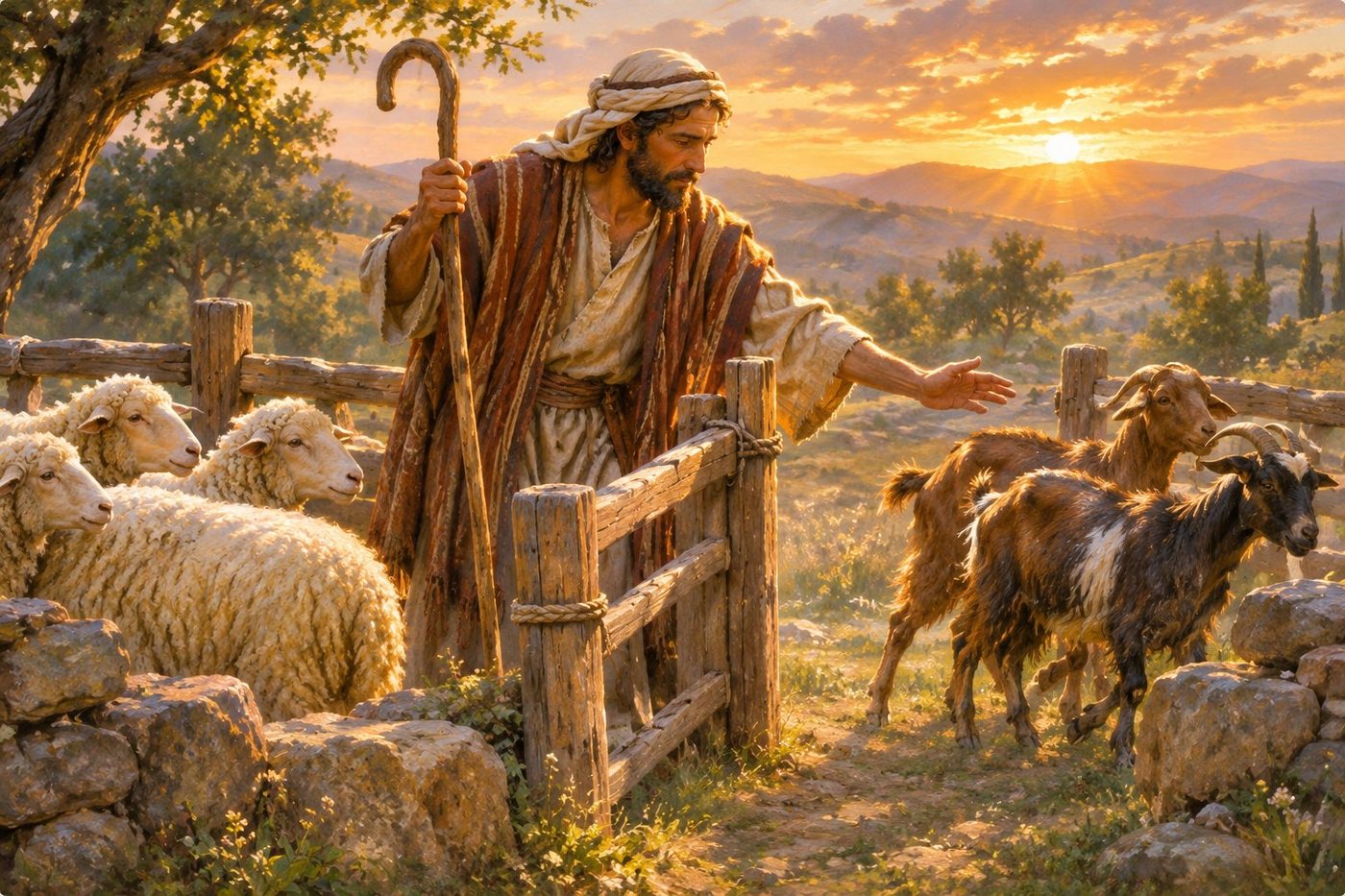
The right hand and the left hand are another important cultural reference. Our courtrooms have a jury box, a judge’s bench, and a witness stand, all very structured. In Jesus’ day, a judge deciding a case would move the person he ruled in favor of to his right hand and the person who lost to his left. It wasn’t that left-handed people were bad or second-class, though there were some odd superstitions about that. People just knew that the right hand meant a favorable judgment and the left hand meant an unfavorable one.
So Jesus comes again and immediately takes his seat as judge. The only thing he’s concerned with is the commitment you made, or didn’t make, to him. And he separates all people. A-L-L. Everyone. Right hand and left hand.
“Then the King will say to those on his right, ‘Come, you who are blessed by my Father; take your inheritance, the kingdom prepared for you since the creation of the world.’” (Matthew 25:34)
The kingdom prepared for you is the age to come. We’ll spend the final chapters on the really good stuff, where we’ll spend eternity. I’ve told you before that I don’t like the idea of sitting on a cloud as a fat naked baby with wings, singing songs. That’s not at all what it’s about.
But right now we’re talking about something so serious that you have to understand it. Only you can choose. The decision you made about Jesus in this life is the decision you’ll answer for when he comes again.
“Then he will say to those on his left, ‘Depart from me, you who are cursed, into the eternal fire prepared for the devil and his angels.’” (Matthew 25:41)
Where? Two Destinations
Jesus names only two destinations: “Then they will go away to eternal punishment, but the righteous to eternal life” (Matthew 25:46). (A word of comfort here: any child who dies before they’re old enough to decide for themselves to follow Jesus is with Jesus. I believe that one hundred percent, and Scripture backs it up.) Yet many people hold other views of what comes after death.
I’m not going to dwell on the Bible’s descriptions of hell, and I’m not going to say much about Satan here. But I want to name three popular views of the afterlife. Maybe you hold one of them. If so, I don’t want to dismiss you. I just want to suggest that these conclusions don’t come from the Bible. They come from somewhere else.
Nihilism. When you die, you just disappear. That’s it. A lot of people believe this. It’s a neat way to package life: nothing really matters, and there’s no afterlife. Nowhere in Scripture is that even hinted at. I’d call it anti-biblical.
Universalism. Everyone eventually ends up in heaven. There are many paths and many journeys, and it will all work out in the end. Jesus doesn’t really divide people right and left, or if he does, he says, Ha ha, just kidding. All of you on the left, come on over. I wish that were true. If I were writing the story, that’s how I’d write it. But it’s anti-biblical. It just isn’t in there.
Purgatory. A temporary safe zone where you can pray your way or work your way into heaven and figure it out later. It just isn’t in Scripture. You can’t find it.
What Scripture clearly teaches, and this is not Rick’s opinion, is that hell is a place. The people who go there will be conscious and aware. There will be punishment of both soul and body. It’s eternal. It’s irreversible. And it’s awful.
So why does Jesus talk about judgment? Why does he talk about hell? Because he is just and holy, so sin must be punished. But he is also loving and merciful, so he provided heaven. His love and mercy compelled him to warn us that judgment is coming. His love and mercy compelled him to invite us into a relationship with him. His love and mercy drove him to offer himself on the cross and die a death he didn’t deserve, to pay a price we couldn’t pay, for a life we could never earn.
We have to choose hell.
That’s the part I would rather not have had to tell you.
Why? The Evidence
Then Jesus describes the evidence of a person who is truly a believer:
“For I was hungry and you gave me something to eat, I was thirsty and you gave me something to drink, I was a stranger and you invited me in, I needed clothes and you clothed me, I was sick and you looked after me, I was in prison and you came to visit me… Truly I tell you, whatever you did for one of the least of these brothers and sisters of mine, you did for me.” (Matthew 25:35–36, 40)
Don’t misread this. Works reveal; works do not redeem. You can’t earn your place on the right hand by doing enough good deeds. Remember Chapter 1. But genuine faith produces a changed life. Their life looks different. They don’t live only for their three-foot world. It’s not all about them. They choose not to live as people did in the days of Noah, always chasing the next thing.
Let’s be honest with each other for a moment. How many of us have chased the next thing? While you’re chasing it, it seems like the only thing: the degree, the promotion, the purchase, the vacation, losing twenty pounds. Then you get it, and what do you have? Nothing. Because then it’s on to the next thing.
Jesus said a person who really understands him will refuse to live like the people of Noah’s day. They’ll take responsibility for the people closest to them, the people in his illustration, the father and son in the field, the mother and daughter at the mill. They’ll be a godly man or woman. A spouse of faith, if they’re married. A friend of faith. A parent of faith, if they’re parents, not so concerned with making their kids good at everything that won’t matter after they’re gone, but encouraging their families to invest in what matters for eternity. An employee, a student, or a boss of faith.
These two chapters have made the staff and me stop and think. As I’ve said, I’ve gone to bed several nights with the reality of hell on my mind. I’ll be perfectly honest with you, as I try to be every time: it horrifies me. And it compels me, and I think I speak for the rest of our pastoral staff, to do two things.
First, it makes me look inside. Not inside you. We’re all good at impression management. Inside me. Which side am I on? It makes me come face to face with the Lord and be honest with myself and with him about the answer, because that is the most important truth we’ll be judged on.
Second, it makes me pray for the people closest to me, the people I love, because I want nothing more than for them to be people of faith.
Come to me, all you who are weary and burdened, and I will give you rest. Come find the unforced rhythms of grace. Leave the pressure behind. Find the pace of the Holy Spirit as you discover your purpose in this life. Leave your three-foot world behind. When Jesus comes and separates the sheep from the goats, that’s what he’ll be looking for: evidence of a person who truly decided to follow him.
From here, the story turns. Next comes the millennial kingdom. It sounds like something from Star Wars, but it isn’t. The story gets much more upbeat and a lot more fun. We just couldn’t go on without first being clear about the different destinations, and the decision that determines eternity.
Key Truths
- Jesus’ invitation is wide open: “Come to me.”
- When he returns, he will separate all people one way or the other.
- Works reveal faith; they don’t redeem us.
For Reflection
- Read Matthew 11:28–30. What would the unforced rhythms of grace look like in your life this week?
- Jesus said his return will be like the days of Noah. What does your three-foot world tend to fill up with?
- Works reveal; works do not redeem. How does Matthew 25:35–40 fit with salvation by grace through faith?
- Why do you think universalism is so appealing? Why does Jesus’ warning about judgment flow from his love?
- Which words will you hear: Come or Depart? Who closest to you do you most want to hear Come?
For the kids in your life: the same truth in the Kids' Edition, Chapter 5 · Comic, Issue 5: One Way or the Other
Highway to Heaven: 1000 Mile Marker

The Sermon at a Glance
- Restraint: the deceiver is confined. · Revelation 20:1–3
- Reign: the faithful live and reign. · Revelation 20:4–6
- Rebellion: the enemy’s last attempt. · Revelation 20:7–9
- Removal: the devil is defeated forever. · Revelation 20:10
You are here the thousand years and the
final judgment
Paradise & Hades → Tribulation → Second Coming → Thousand
Years → Great White Throne → New Earth → Who
We’ll Be · Road Map ›
Read First · Revelation 20:1–10
Restraint
1 And I saw an angel coming down out of heaven, having the key to the Abyss and holding in his hand a great chain. 2 He seized the dragon, that ancient serpent, who is the devil, or Satan, and bound him for a thousand years. 3 He threw him into the Abyss, and locked and sealed it over him, to keep him from deceiving the nations anymore until the thousand years were ended. After that, he must be set free for a short time.
Reign
4 I saw thrones on which were seated those who had been given authority to judge. And I saw the souls of those who had been beheaded because of their testimony about Jesus and because of the word of God. They had not worshiped the beast or its image and had not received its mark on their foreheads or their hands. They came to life and reigned with Christ a thousand years. 5 (The rest of the dead did not come to life until the thousand years were ended.) This is the first resurrection. 6 Blessed and holy are those who share in the first resurrection. The second death has no power over them, but they will be priests of God and of Christ and will reign with him for a thousand years.
Rebellion
7 When the thousand years are over, Satan will be released from his prison 8 and will go out to deceive the nations in the four corners of the earth—Gog and Magog—and to gather them for battle. In number they are like the sand on the seashore. 9 They marched across the breadth of the earth and surrounded the camp of God’s people, the city he loves. But fire came down from heaven and devoured them.
Removal
10 And the devil, who deceived them, was thrown into the lake of burning sulfur, where the beast and the false prophet had been thrown. They will be tormented day and night for ever and ever.
We’ve been to hell and back.
The last two chapters were heavy, and they were true. It would be easier to rewrite the Bible with a different ending, but that isn’t my job. My job is to tell you what God said. And from here, the story turns toward the good news.
Five Minutes After
Remember the question this whole book is built on: five minutes after we die, certain things will be on our minds, and I want what will matter most to us then to matter most to us today. I want it to pull us out of our three-foot world, out of the days of Noah, so busy with the next job, the next purchase, and the next vacation that we forget the story we were born into.
From the rich man and Lazarus, we know at least two things will matter five minutes after you die: your own eternal state, and the people closest to you: whether you did what you could to nudge them toward Jesus.
This past week I was with a friend who is facing the possible end of her life. We reviewed the end-times timeline together, but that wasn’t the important part. What we really talked about was where her confidence was placed. When your trust is in Christ alone, not Christ plus good works or Christ plus some religion you’ve invented, you can be completely confident that the moment you leave this life you will hear, “Well done, good and faithful servant” (Matthew 25:21). Welcome home.
Her body is failing her. She looked down and said, “I leave this body behind?”
“Yep.”
“And I get to be with Jesus.”
“Yep. That’s the promise of Scripture.”
She paused. Then she said, “I am ready.”
And then: “I can’t wait.”
That’s why it matters to know your end story.
Taking the Penicillin
It’s a little like going to the doctor with a sore throat. The doctor says, “Here’s penicillin. Take it and you’ll feel better.” You can just do that. If you aren’t interested in the details, take the antibiotic and move on: trust Christ, and you’re safe.
Or you can go deeper. Why penicillin and not doxycycline? Pretty soon you’ve formed a whole worldview about antibiotics. That’s what I want this chapter to do for you: build a way of seeing the world that gives you the confidence my friend has.
What comes next can sound a little crazy. The apostle John, who gave us the up-close, personal Jesus of the fourth Gospel, was later exiled on an island and given a vision of the end of time. He had no science fiction, nothing to compare it to, and he did his best to describe the indescribable. Some of what follows involves my interpretation, and I’ll tell you where. But nobody really argues about what the Bible says here. The question is whether you’ll believe it.
The Thousand Years
The tribulation is over (Chapter 3), and the sheep and the goats have been separated (Chapter 5). Believers have received their glorified bodies. That’s where our story picks up: the thousand-year millennial kingdom, the reign of Christ.
I believe it’s a literal thousand years, because the specific thousand-year period is repeated several times in Revelation 20. Some people don’t take it literally, and I can’t prove them wrong. Time itself may be marked differently once these events happen. And whether you believe the church is gathered before or after the tribulation shapes how you read some of what follows, so you’ll run into questions that are hard to answer.
Go Deeper
Wondering how others read the thousand years? The Tribulation and the Millennial Kingdom, my two-chapter study guide, lays out the main views side by side, the Scripture behind each, and questions to help you reach a conclusion you can support. Open the guide ›
With Satan no longer active in the world and Jesus in charge, many believe the world will be restored to something like the Garden of Eden. Scripture hints at dangerous and gentle animals living together in harmony, and at streets so safe your kids can roam them. There will be prosperity and peace. For the most part, people will get along.
But the Bible also says some people will still choose evil. How do you choose evil if Satan is bound? Let’s walk through the text. Revelation 20 describes four things: restraint, reign, rebellion, and removal. A thousand years in four points: for a preacher, that’s hard. And remember who’s writing: John, an apostle, writing a real letter to seven real churches full of real people. Prepare. Don’t believe false teaching. Don’t fear persecution. Don’t get complacent. Trouble is coming. But Jesus is going to win.
1. Restraint: the deceiver is confined
And I saw an angel coming down out of heaven, having the key to the Abyss and holding in his hand a great chain. He seized the dragon, that ancient serpent, who is the devil, or Satan, and bound him for a thousand years. He threw him into the Abyss, and locked and sealed it over him, to keep him from deceiving the nations anymore until the thousand years were ended. After that, he must be set free for a short time. (Revelation 20:1–3)
Which angel? That was my first question. He isn’t named, but he has a pretty cool job. Gabriel? Michael? Maybe. Some say it’s Jesus. I think if it were Jesus, the Bible would call him Jesus, not an angel. But some make that argument.
He has a key and a great chain, symbols of God’s power over evil. And what is the Abyss? It’s a bit of a mystery. Some scholars think it’s a separate place altogether, a third place besides Hades and Gehenna (the lake of fire), something like a jail cell. Nobody knows. Many think it’s the basement of Hades, the bottom floor of a really, really bad place, where Satan will be locked up for a thousand years. The Antichrist and the false prophet, meanwhile, have already been thrown into the lake of fire before the millennium begins. They’re the only ones there for now, waiting.
Whatever you decide about the details, understand what’s happening: Satan is bound, chained, and locked up. His direct influence is removed from the earth, and the earth is under the control of Jesus.
All of this may feel theoretical right now.
I went to the bank this week. I don’t like going into the bank, but I had to. The girl behind the counter looked about fourteen; I’m sure she was twenty-five. It was taking forever, and the Bee Gees were playing over the speakers. (Do you know the Bee Gees? You have to be of a certain age.) I didn’t like the Bee Gees even when they were the bee’s knees. It was loud, and you know how much I love waiting, so I was tapping my foot.
“Man, your music is really bad,” I said.
“I know, right?”
That phrase bothers me. I know. I just said it.
“I don’t like this music,” I said, “and I’m old.”
She looked at me, waited a beat, and said, “I’ve seen older.”
I didn’t know how to take that. My goodness. What have I just been told?

You might think this is for old people, something to worry about when you’re the oldest person in the bank. But none of us knows when it will stop being theory and become reality. One day this will be either the decision you’d give anything to go back and make, or the one you’re so thankful you made. So work it out now.
2. Reign: the faithful live and reign with Christ
I saw thrones on which were seated those who had been given authority to judge. And I saw the souls of those who had been beheaded because of their testimony about Jesus and because of the word of God. They had not worshiped the beast or its image and had not received its mark on their foreheads or their hands. They came to life and reigned with Christ a thousand years. (Revelation 20:4)
We’ll reign in our glorified bodies, received when Jesus comes again and the dead in Christ rise (1 Thessalonians 4:16). That body is the one you’ll have through the millennial kingdom and into the new earth, forever. (Chapter 8 is all about what it will be like.) For now, this much: your identity and personality will remain, perfected and untainted by sin. The gifts God gave you and the things he made you good at, you’ll still use, but perfectly, for his glory and not your own. With the noise of this life gone, you’ll finally find your stride. You’ll know people. You won’t be married, but you’ll still know your spouse. And you’ll have a job to do.
The Bible calls these people priests who take part in Jesus’ rule on earth. There will also be mortals living on earth during the millennial kingdom. If you’re comparing the antibiotics, you’ll ask, Who are the mortals? The answer depends partly on where you land on the tribulation, and Scripture doesn’t spell it out. It isn’t critical to know every detail, but it’s good to have a solid working assumption.
(The rest of the dead did not come to life until the thousand years were ended.) This is the first resurrection. Blessed and holy are those who share in the first resurrection. The second death has no power over them, but they will be priests of God and of Christ and will reign with him for a thousand years. (Revelation 20:5–6)
This passage describes what the tribulation martyrs will do, and it shows how terrible those last three and a half years will be. But other passages extend the same promise to every believer: if we endure, we will also reign with him (2 Timothy 2:12; see also Revelation 5:10). We’ll have some role in making sure Jesus’ way is the way during the thousand years. We’ll get to work directly for Jesus, helping see that his will and his kingdom are carried out exactly as he wants. You’ll be uniquely you, using all your gifts, never wondering what your purpose is, hitting your stride. I can’t wait to see what that’s like.
Notice the parenthesis: the rest of the dead, the unsaved, those who didn’t follow Jesus, did not come to life until the thousand years were ended. Put that in your back pocket.
3. Rebellion: the enemy’s last attempt
When the thousand years are over, Satan will be released from his prison and will go out to deceive the nations in the four corners of the earth, Gog and Magog, to gather them for battle. In number they are like the sand on the seashore. They marched across the breadth of the earth and surrounded the camp of God’s people, the city he loves. But fire came down from heaven and devoured them. (Revelation 20:7–9)
Nobody knows for sure what Gog and Magog are. Some think Gog is a leader and Magog a nation (the names echo Ezekiel 38). If you research it, you’ll find guesses, not answers.
The Message says there are millions and millions of them. At the end of the thousand years, Satan is released, deceives some of the nations, gathers an army of millions, and marches on Jerusalem. As they surround the city, they are destroyed by the power of God. That marks the end of the millennial kingdom and the start of the final chapter of our existence.
4. Removal: the devil is defeated forever
And the devil, who deceived them, was thrown into the lake of burning sulfur, where the beast and the false prophet had been thrown. They will be tormented day and night for ever and ever. (Revelation 20:10)
Notice that Satan doesn’t rule the lake of fire. He is punished there, along with the beast and the false prophet, forever. The devil is dangerous, but he is never in charge.
The Great White Throne
At the end of the millennial kingdom and that last battle, when Satan has been thrown into the lake of fire to join the beast (the Antichrist) and the false prophet, the great white throne judgment takes place. Remember the two judgments from Chapter 2, the judgment seat of Christ and the great white throne? This is the great white throne.
When people are gathered before it, those who are not Christians are given their bodies and cast into the lake of fire. The picture is that Hades is turned upside down and shaken out, and they spend eternity with Satan, the beast, and the false prophet, in a future that is personal, painful, permanent, and preventable.
For Christians, their names must be written in the Lamb’s Book of Life.
When I studied this, it sounded like a test, and it made me uneasy. I know what it’s like to try out for a team. Back in the old days, before coaches texted you, you ran to the bulletin board to see whether your name was on the list. A few times it wasn’t, and I know how it feels not to be chosen. So in my mind I picture an angel with a big book, flipping through, getting to the M’s (my last name is Melick), and I’m nervous: Oh Jesus, help me. And he says, I already have helped you. Why don’t you listen to me? But I’m still nervous.
Here’s a funny story. Years ago, while I was starting a church in Arkansas that met on Sunday evenings for over a year, I served briefly as interim pastor of a tiny country church on Sunday mornings. Thirteen or fourteen people on a high-attendance day, all super-senior adults. I think the youngest in the youth group was eighty-three. They were the sweetest people. I’d come from a much larger church where we counted people by sections, and I’d lost touch with that kind of personal ministry.
Every Sunday I walked up to that little church and preached to them, and they were so gracious. I still carry a picture of that church on my phone to remember those people, because they were so special. The treasurer, an older lady, made me hug her before she’d give me my check. That’s probably an HR violation, but with forty years between us, I figured it was okay.

Once, a church member’s relative died, and I was asked to do the funeral. The first thing you want to know is, Was he a believer? A believer’s funeral is completely different. Hope or no hope. Celebration or despair.
The church treasurer said, “Well, I know he’s a Christian.”
“He said he wasn’t a Christian,” I told her. “In fact, he said he had no interest.”
“I know he’s a Christian.”
“Listen, only Jesus knows his heart. And when Jesus looks at the heart, he’s looking for one thing: whether a person has decided to follow him. It’s not a sliding scale where good people get the benefit of the doubt.”
“I know he’s a Christian.”
“How do you know?”
She disappeared into the church archive and came back with, “I’ve got the Lamb’s Book of Life.”
“Do you have the Holy Grail back there too? The Ark of the Covenant?” She was about 130 years old, so she probably had a lot of stuff. She came out with a dusty ledger as thick as a family Bible, holding every record since the church started in the 1800s. On the cover, it literally said Lamb’s Book of Life. That was the church I wanted my name written in. (I wrote it in later, just to cover my bases.)
She flipped through and found him. “He was baptized in this church when he was eight years old. His name is in the Lamb’s Book of Life.”
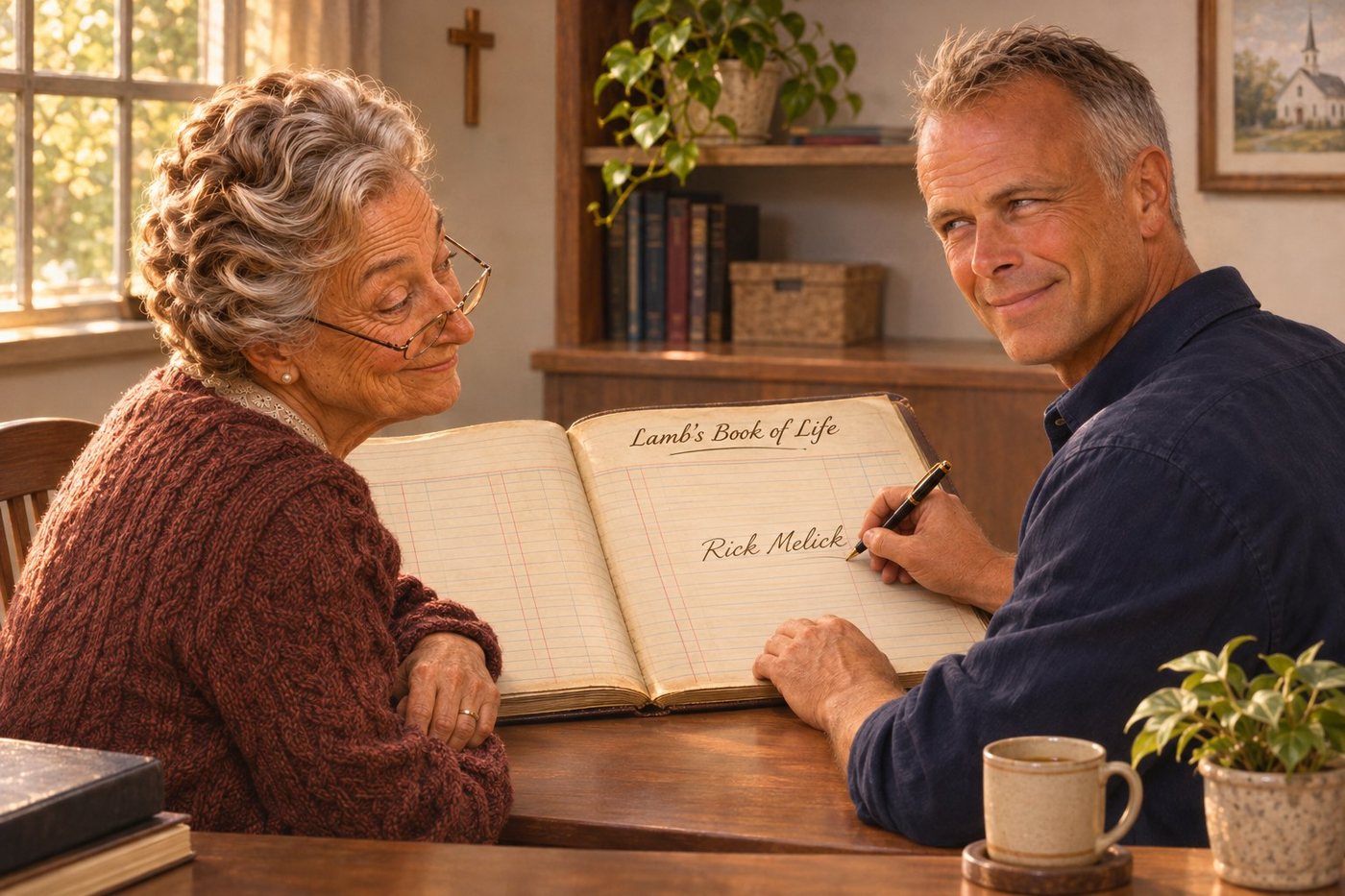
We talked a little more, but that moment stayed with me long after.
Your name is written in the Lamb’s Book of Life the moment you decide to follow Jesus.
Only God judges the heart. But the life, the fruit, is what’s examined: the desire to step outside the three-foot world, to live today with what will matter most five minutes after we die, to influence the world around us. Those things matter. But your name is written in the Lamb’s Book of Life the moment you decide to follow Jesus. Jesus says anyone who wants to follow him can. Only you can choose. Your name will be written there if you want it to be.
When your name is found in the book, you’re ushered onto the new earth, which is also heaven, which is also eternity. That’s where the next two chapters go, and I’ve been looking forward to them since the beginning of this book.
Don’t Let Your Hearts Be Troubled
As we close, I want to point you to the words of Jesus to his disciples in John 14.
“Do not let your hearts be troubled. You believe in God; believe also in me.” (John 14:1)
Maybe this subject troubles you. Maybe you don’t know for sure that you’ve decided to follow Jesus, and that’s troubling, as it should be. Maybe you sense the Holy Spirit nudging you and you’re fighting it. Maybe you’re thinking about someone you love, or you come from a belief system so different that you’re not sure any of this is true. Maybe it’s just the fear of death. I’ve been praying for you, that you’d make the right decision.
Jesus says, Don’t let your hearts be troubled.
Why were the disciples troubled? John 13 gives at least three reasons. Jesus had told them that one of them would betray him, and they didn’t know who. He told Peter he would deny him, and that rattled Peter. But what really shook them was this: “Where I am going, you cannot follow now.”
What do you mean we can’t follow you? We’ve been following you for two years and eleven months!
And he said:
“My Father’s house has many rooms; if that were not so, would I have told you that I am going there to prepare a place for you? And if I go and prepare a place for you, I will come back and take you to be with me that you also may be where I am.” (John 14:2–3)
Don’t let your hearts be troubled. But make absolutely sure your faith is in Christ, and Christ alone.
Key Truths
- Restraint: the deceiver is confined.
- Reign: the faithful live and reign with Christ.
- Rebellion and removal: evil gets one last attempt, then is defeated forever.
For Reflection
- What does it change for you to know that the devil is dangerous but never in charge? What fear do you need to bring to Jesus?
- Revelation 20:4–6 promises that God’s people will serve and reign with Christ. Which of your gifts can you imagine using perfectly, for his glory?
- Even after a thousand years of peace with Jesus reigning, some still rebel. What does that teach about our need for changed hearts, not just better circumstances?
- Your name is written in the Lamb’s Book of Life the moment you decide to follow Jesus. How does that change the way you think about the great white throne?
- If Jesus is the King of your future, where do you need to surrender to his rule today?
For the kids in your life: the same truth in the Kids' Edition, Chapter 6 · Comic, Issue 6: Highway to Heaven
Leaving the Light On

The Sermon at a Glance
- Why is it different? A new body, a new morality, a new creation. · Revelation 21:1–8
- How will it look? The New Jerusalem. · Revelation 21:9–21
- Who makes it great? A new relationship with Jesus. · Revelation 21:22–22:5; John 14:1–6
You are here the new earth, our forever
home
Paradise & Hades → Tribulation → Second Coming → Thousand Years →
Great White Throne → New Earth → Who We’ll Be · Road Map ›
Read First · Revelation 21:1–22:5
Revelation 21:1–8
1 Then I saw “a new heaven and a new earth,” for the first heaven and the first earth had passed away, and there was no longer any sea. 2 I saw the Holy City, the new Jerusalem, coming down out of heaven from God, prepared as a bride beautifully dressed for her husband. 3 And I heard a loud voice from the throne saying, “Look! God’s dwelling place is now among the people, and he will dwell with them. They will be his people, and God himself will be with them and be their God. 4 ‘He will wipe every tear from their eyes. There will be no more death’ or mourning or crying or pain, for the old order of things has passed away.”
5 He who was seated on the throne said, “I am making everything new!” Then he said, “Write this down, for these words are trustworthy and true.” 6 He said to me: “It is done. I am the Alpha and the Omega, the Beginning and the End. To the thirsty I will give water without cost from the spring of the water of life. 7 Those who are victorious will inherit all this, and I will be their God and they will be my children. 8 But the cowardly, the unbelieving, the vile, the murderers, the sexually immoral, those who practice magic arts, the idolaters and all liars—they will be consigned to the fiery lake of burning sulfur. This is the second death.”
Revelation 21:9–21
9 One of the seven angels who had the seven bowls full of the seven last plagues came and said to me, “Come, I will show you the bride, the wife of the Lamb.” 10 And he carried me away in the Spirit to a mountain great and high, and showed me the Holy City, Jerusalem, coming down out of heaven from God. 11 It shone with the glory of God, and its brilliance was like that of a very precious jewel, like a jasper, clear as crystal. 12 It had a great, high wall with twelve gates, and with twelve angels at the gates. On the gates were written the names of the twelve tribes of Israel. 13 There were three gates on the east, three on the north, three on the south and three on the west. 14 The wall of the city had twelve foundations, and on them were the names of the twelve apostles of the Lamb.
15 The angel who talked with me had a measuring rod of gold to measure the city, its gates and its walls. 16 The city was laid out like a square, as long as it was wide. He measured the city with the rod and found it to be 12,000 stadia in length, and as wide and high as it is long. 17 The angel measured the wall using human measurement, and it was 144 cubits thick. 18 The wall was made of jasper, and the city of pure gold, as pure as glass. 19 The foundations of the city walls were decorated with every kind of precious stone. The first foundation was jasper, the second sapphire, the third agate, the fourth emerald, 20 the fifth onyx, the sixth ruby, the seventh chrysolite, the eighth beryl, the ninth topaz, the tenth turquoise, the eleventh jacinth, and the twelfth amethyst. 21 The twelve gates were twelve pearls, each gate made of a single pearl. The great street of the city was of gold, as pure as transparent glass.
Revelation 21:22–27
22 I did not see a temple in the city, because the Lord God Almighty and the Lamb are its temple. 23 The city does not need the sun or the moon to shine on it, for the glory of God gives it light, and the Lamb is its lamp. 24 The nations will walk by its light, and the kings of the earth will bring their splendor into it. 25 On no day will its gates ever be shut, for there will be no night there. 26 The glory and honor of the nations will be brought into it. 27 Nothing impure will ever enter it, nor will anyone who does what is shameful or deceitful, but only those whose names are written in the Lamb’s book of life.
Revelation 22:1–5
1 Then the angel showed me the river of the water of life, as clear as crystal, flowing from the throne of God and of the Lamb 2 down the middle of the great street of the city. On each side of the river stood the tree of life, bearing twelve crops of fruit, yielding its fruit every month. And the leaves of the tree are for the healing of the nations. 3 No longer will there be any curse. The throne of God and of the Lamb will be in the city, and his servants will serve him. 4 They will see his face, and his name will be on their foreheads. 5 There will be no more night. They will not need the light of a lamp or the light of the sun, for the Lord God will give them light. And they will reign for ever and ever.
You’re out of time. Those are words you never want to hear.
Yesterday I led a memorial service for a friend I’ve mentioned in earlier chapters, the one who had been in hospice care. She is now at home with the Lord.
Planning a memorial with someone who knows they’ll be passing soon is a surreal, humbling experience. When she and I were planning hers, she said, “I want you to teach on 2 Kings 5. The story of Naaman. I want you to talk about Naaman the leper.”
I just looked at her. “Is this the medicine talking?” I had no idea how I’d connect that to a memorial.
“No, no,” she said. “Remember the series? When you taught on Elijah, and then Elisha, and then you went to 2 Kings 5 and talked about this man Naaman who had to be healed of leprosy?”
“I remember the story. I just have no idea how I’m going to teach it at your memorial.”
“Talk about humility,” she said. “Talk about what it takes to follow Jesus. Talk about the fact that sometimes it’s hard to believe what we’re supposed to do, and the things Jesus asks of us and the way he asks us to live seem difficult. That’s when we humble ourselves and take him at his word.”
Then I started tracking with her.
Out of Time
As I studied for her memorial, it struck me that the secret to the whole passage, really the secret to the urgency of life and the reason we take this book’s subject so seriously, is tucked into the end of the very first verse.
Naaman is introduced as a great man, commander of the army of Aram. He had money, military victories, a résumé, a massive retirement account. He woke up every morning thinking, What’s next?
And at the very end of that first verse, after describing this great man and everything he’d accomplished, there’s a little phrase that changes everything:
Naaman was a great man, a commander in the army of Aram… but he had leprosy.
One morning Naaman woke up and it was unlike any other morning. Maybe he saw a spot on his arm. Maybe he nudged his wife: “Hey, look at this. Is this what I think it is?” In those days leprosy was fatal. She probably looked afraid. Let’s get a second opinion. So Naaman reluctantly showed the doctor the spot, and the doctor confirmed it: Yes, it’s exactly what you think. You’re going to die.
She passed the final exam without having to answer a single question, because she had already answered the only question that mattered.
Time runs out.
All of us live with the illusion that we have time, so we squander it, until one day we’re out of time: at the end of a long illness, through the bumper of a runaway vehicle, in a sudden cardiac event.
But what we’ve been talking about in this book is the opposite of the fear we feel when we think about time running out. It’s what my friend knew as she lay in what some would call her deathbed. I didn’t see it that way. She knew time had run out for her in this life, and she said the words I told you about in the last chapter: I’m ready. I can’t wait. Then she closed her eyes and opened them to the reality of heaven.
She passed the final exam without having to answer a single question, because she had already answered the only question that mattered: What did you decide about Jesus?
At her memorial, her ashes sat on a table. That was the body where she used to live. She didn’t need it anymore. Paul talks about the body being like a tent, folded up and put away. She has moved out. Her soul is with the Lord in paradise. She now understands what we can only speculate about.
Who Cares How It Ends?
Theologians call the study of the end eschatology, and you may be surprised how many Christians aren’t interested in it. It’ll all work out in the end. For some it’s fear. For some it’s apathy. But here’s how I see it. Who do you trust? “I trust Jesus.” So you believe in Jesus? “Yes.” What about God’s Word? “Oh, yes. I believe God’s Word.” All of it? “Every single word is true.” Do you know what’s in it? “Uh, no.” Are you interested in how it ends? “Nope.” Do you want to know the story? “No. It’s going to work out.”
If I told you I was a Muslim who believed every word of the Quran, and you asked me, “Okay, Rick, what does it say?” and I said, “I don’t know,” you’d think I was brainwashed. You’d think I was simple. You’d make fun of my faith, and for good reason, because that isn’t faith at all. It’s conjecture. Somebody handed me something and I accepted it without ever making it my own.
So working through these things matters, not to settle every detail but to be informed. Revelation is the only book in the Bible that promises a blessing for reading it (Revelation 1:3) and warns against adding to it or taking away from it (Revelation 22:18–19). Knowing how the story ends is our responsibility as Christians. It’s also our privilege.
A Little Angst
I’ll admit something. I’ve looked forward to getting to heaven in this book for a long time, and now that we’re here, it gives me a little anxiety.
Last night my wife and I were watching a football game. I was half-watching, with my notes in my lap; that’s my obsessive Saturday-night routine. She asked what she always asks: “Are you looking forward to tomorrow?” She can tell from my answer where I am in my preparation. Too early, and I say, “Uh-uh, not at all,” and she leaves me alone for a while. Later: “Yep, I’m getting there.” Then: “Yeah, I think we’re ready.”
This time I looked over at her and said, “Listen, I want to ask you something. I’m teaching on heaven, and I’ve got a little angst about the new earth and the New Jerusalem. Does it stress you out at all?”
She said, “Yeah.”
I said, “Oh, good,” because it stresses me out too.
What’s stressful about it? For me, part of it is that I can’t wrap my mind around being in one place, doing one thing, for all of eternity. I like to move. I like change. What if I get bored? What if it’s not what I…? I go through all the what-ifs. And she said, “Well, yeah. You and I like being together, and we’re not going to be married.” We started going down the list.
Then we stopped and called a time-out. Wait a second. There’s a reason we can’t understand the reality and the promise of heaven: we can’t see it clearly.
Eternity in Our Hearts
Ecclesiastes is a book full of interesting questions and answers, and it gives us a handhold for thinking about heaven, eternity, and forever. In chapter 3 the author wrestles with an existential question: Why are we here? What is life about? What are we supposed to do?
C. S. Lewis summed up what you and I sense instinctively: that there’s more, that we were created for something else we long for but can’t quite grasp. I’ve held on to this quote all week:
If I find in myself a desire which no experience in this world can satisfy, the most probable explanation is that I was made for another world. (C. S. Lewis, Mere Christianity)
I resonate with that. You were made for another world. But what world is that? What will it look like? What will it be like?
This chapter looks at what the Bible tells us that world will be like. The final chapter asks, What will I be like when I’m there? Scripture tells us enough about the new earth, but not a lot. (Remember the reason from Chapter 2: if we knew everything, we’d be so eager to get there that we’d be no good here.)
He has made everything beautiful in its time. He has also set eternity in the human heart; yet no one can fathom what God has done from beginning to end. (Ecclesiastes 3:11)
You were created for it. If you believe in Jesus Christ, you’re destined for it. Yet we can’t quite understand it, because we’re human, flawed, and sinful, and we just can’t see.
The Last Stop
Look at the Road Map and you’ll see how far we’ve come: paradise, where my friend is right now; the reality of hell; the tribulation; the thousand years, where we still end some sentences with an ellipsis; and the great white throne. Now we reach the last stop. Believers, in glorified bodies, are ushered onto the new earth, forever, in a place we can’t really picture. John described what he saw as well as a first-century man could. I believe it’s true. But right now we can’t see clearly, because we’re still here, and that is still to come.
Then I saw “a new heaven and a new earth,” for the first heaven and the first earth had passed away, and there was no longer any sea. (Revelation 21:1)
A few verses later the one on the throne says, “I am making everything new!” The good news is that we’ll be given at least four things we don’t have now and desperately need.
Why Is It Different? A New Body
First, we’ll be given a glorified body with glorified senses, able to experience what God created for us in ways we simply can’t now.
My wife likes hot water. When she gets ready in the morning, no bathroom fan can keep up with the steam. I don’t know how anyone can stand it; I’m not a hot-water guy. But on Sunday mornings I sometimes have to run in and use the sink. I have to see the mirror, because this hair takes a while to get perfect. (It doesn’t actually take a while, and it never gets perfect. But I give it a shot.)
This morning I was at the sink, and there was so much steam. I wiped the mirror with my hand and could see for a second, and then the steam rolled right back in and I couldn’t see a thing. Wipe, wipe again. I got so frustrated. I just needed to see, and I couldn’t.

I think that on this side of heaven, in this present age, we get glimpses of what heaven may be like, glimpses of eternity, like the thin places we talked about in Chapter 2. But we need new eyes and new senses. We need to be able to see. Our glorified bodies will include new senses that let us see without the steam of sin fogging up the mirror of reality.
It’s almost too good to imagine, almost too powerful to think about. But it’s one of the promises that comes to us because of Jesus and his sacrifice. We receive a new body.
A New Morality
The second thing we receive is a new morality. I don’t know a better way to put it. And it doesn’t start only on the new earth; it begins in us earlier.
I think that if we understood how much sin handicaps every part of our lives, it would stagger us. We tend to see ourselves as mostly good with a little bit of bad. I think the reality is that we’re mostly broken, and that Jesus has begun working in us to unbreak what’s broken. But it takes so much time, with so many ups and downs, that we’re not even aware of how flawed and faulty our perception of the world really is.
I’m looking forward to the day when I don’t have to fight that nature anymore. When that new morality is fully given, we’ll experience Jesus for who he really is and ourselves for who we really are, and finally be present and at home in the bodies and lives God has given us.
A New Creation
The third thing we’ll receive is a new creation. This one is harder to wrap our minds around. We’ll get a new earth. The earth will still exist, but newly created.
I saw the Holy City, the new Jerusalem, coming down out of heaven from God, prepared as a bride beautifully dressed for her husband. And I heard a loud voice from the throne saying, “Look! God’s dwelling place is now among the people, and he will dwell with them. They will be his people, and God himself will be with them and be their God. He will wipe every tear from their eyes. There will be no more death or mourning or crying or pain, for the old order of things has passed away.” (Revelation 21:2–4)
The new earth
What will it look like when we get there? Does anybody care? I don’t like cities. I appreciate them; I like having shopping centers and hospitals. But if you gave me a choice between a cabin on a mountain and an apartment in a city, I’d take the cabin ten times out of ten. So when we talk about the New Jerusalem, a city, I get it, and I want to go there. But when you say the new earth might be a bit like the Garden of Eden, now I’m tracking with you.
The problem is that we can’t simply say the new earth will be like Eden, because what God has in mind for our future is far greater than what he gave humanity at the beginning. But Scripture gives us a few glimpses.
People ask me over and over, Will there be animals in heaven? I think that’s a great question, and I think the answer is probably yes. Will there be Eden-like landscapes on the new earth? I think so. I believe God will create that for us to enjoy. But the Bible also says there will be nations, people groups, and cities. There will be cultures on the new earth. How it all blends and works together, I don’t know. But we’ll be able to enjoy it and move from place to place without the limitations of the bodies we have now.
I want a little more. We don’t get a little more. This is what John tells us. Isaiah has some prophecies that point in this direction. Some theologians say they describe the millennial kingdom, and some say the new earth. Nobody really knows for sure.
How does time pass?
As you picture eternity, you get to decide in your own mind how you think time passes there, because the Bible doesn’t teach it conclusively. There are three main views.
One view is that time passes in eternity the way it does now. You have a watch, and hours, weeks, months, and years go by. And you won’t get bored, because you won’t have the short attention span, the easily bored, days of Noah existence where all we want is the next thing and immediate gratification. We’ll have a new body with new senses and a new morality.
A second view, held by many theologians, is that time still unfolds in sequence, but at a different rhythm than now. Maybe it moves faster. Maybe we perceive it differently. Maybe the thousand-year millennial kingdom won’t feel like a thousand years.
A third view, which Thomas Aquinas developed in the 1200s, is that since time is something God created, we’ll exist outside of time entirely and enjoy eternity without any of its limits. I like thinking about that, but we won’t go too far into it.
As you picture the new earth, you get to decide how you perceive it, because nobody knows for sure. What gives you comfort? What gives you a handhold?
How will it look? The New Jerusalem
When John describes the city coming down from heaven, he describes it as best he can. It will be the center of society and civilization, as we understand those things, on the new earth. It comes down out of heaven and touches the earth. It’s enormous, a cube, so big that you’d have to make about five 250-mile drives to get from one side to the other, going by the measurements in Scripture. Its walls are around two hundred feet thick.
It has twelve gates that are always open. Many believe that’s symbolic of safety, because sin has been banished forever. There are three gates on each side, north, south, east, and west, bearing the names of the tribes of Israel. Beneath them John describes twelve foundations bearing the names of Jesus’ twelve apostles.
And the gates: how many pearls is each gate made of? If you don’t remember from Chapter 1, the answer is one. Each gate is a single giant pearl. Not pearly gates with St. Peter sitting at a desk with a ledger, deciding whether you get in. John is trying to describe the beauty he saw. It’s as if each gate were carved from one enormous pearl.
At the center of the city is a throne: God’s presence and the Lamb, the name Revelation uses for Jesus. Their light is so complete that the city has no need of the sun or moon. Notice that John doesn’t say there is no sun or moon. He says there’s no need for them. The light of the Lamb never goes out.
That’s why I called this chapter Leaving the Light On.
John says the city is made of gold. Don’t get too excited; it’s gold you can’t spend. These are jewels you don’t need to lock in a safe. John is describing beauty, not a transactional economy where you can stash something away and get rich.
He describes the jewels in the foundations in as much detail as he can. He says a river flows from the throne down the main street of the New Jerusalem. The river is clear; you can see the bottom. And he describes the street as made of clear gold. There’s no such thing as clear gold. I wish I knew exactly what he saw.
He says the tree of life stands on either side of the river. Interestingly, if you want to dig deeper into how time passes, he says the tree bears fruit every month, in seasons. There’s every indication that we’ll eat in heaven. And I’m guessing that with perfect bodies we can eat and never gain weight. So if you need something to look forward to, there’s the heavenly buffet. I don’t know that it will be quite like that.
What John saw was so overwhelming and amazing that he couldn’t wrap his mind around it. But the angel told him to describe it as best he could.
No more tears
The passage we read earlier contains one of the biggest promises we have, and one of the things we say most often about heaven. Have you heard people say, In heaven there’s no pain, no sorrow, no sadness, no tears? They go through the whole list. It’s true, and this is where it comes from: Revelation 21.
He will wipe every tear from their eyes. There will be no more death or mourning or crying or pain, for the old order of things has passed away.
The old order of things: the way you experience this world, the way you feel loss, the unsettledness of your soul. The prayer requests that never seem to get answered. The inadequacy you live with and wish you didn’t have but can’t seem to make go away. The ache in your heart for the people you love who just can’t seem to get out of their own way. The things that aren’t right in this world, the things that unsettle your soul, frighten you, and give you no rest: they’re gone, and gone forever. That’s where the promise comes from.
So it’s a beautiful city on an amazing new earth that we don’t fully understand but will get to experience, the place we were uniquely created for. We’ll have a new body and a new morality, and with them a new creation.
Who Makes It Great? A New Relationship
And fourth, we’ll have a new relationship with Jesus, a new way to experience him.
This is what brought me back to a place of real peace in my spirit, where I started truly looking forward to eternity. The more complicated it gets, in a sense, the simpler it becomes.
If you’re looking forward to heaven only for its benefits, if all you’re thinking about is a great place with no fear where all your stuff is finally dealt with, but you’re not thinking about being with Jesus and living in a perfect relationship with him, then we don’t yet grasp what it’s all about.
Heaven draws us because we were created to be with God: finally with him, free of everything the sin we chose has brought into our lives.
That reminded me of the simple truth at the heart of this whole book. The most important decision we can make is the decision we make about Jesus.
I Drive, You Ride
So here’s a handhold to take with you.
My wife and I were driving to Hy-Vee. I go to Hy-Vee every day. I think Jesus intentionally placed a Hy-Vee on our way home from church. No matter which way we go, we drive right by it, so we have to stop every day, because there’s always something we need.
Last week we were coming home in the afternoon. I was driving up State Street, heading north, and I turned left, west. The sun sets in the west, right? I don’t know what it will do on the new earth, but on this earth it still sets in the west. As it was setting, the sun was pouring through the windshield of the truck.
My wife said, “Stop. You have to stop.” (I don’t know if you ladies do this, but whenever she wants me to stop, she puts her hand up like a cat and grabs the door handle.) “Stop!”
“What are you talking about? I’m fine.” I had my Maui Jim sunglasses on, and I also have a creation called a sun visor that you can pull down to block the sun coming through the windshield.
“Stop!”
“What is wrong?”
“I can’t see where we’re going! I can’t see where we’re going!”
What she meant was, I can’t see well enough to tell you everything you need to know to park this truck safely without my help. But I said to her as nicely as I possibly could, “You don’t need to see. I can see. I can park. I drive. You ride.”

She didn’t like it. I liked it a lot. I liked it so much that I put a note in my phone to remind me to tell you how it connects to John 14.
Jesus had just told his disciples he was going to prepare a place for them. He didn’t say a mansion. He didn’t say a loft above a big city. He said a place, a place for them to be together, a dwelling place for those who believe.
And Thomas said, in effect, Stop, Jesus. I can’t see.
Thomas said to him, “Lord, we don’t know where you are going, so how can we know the way?” Jesus answered, “I am the way and the truth and the life. No one comes to the Father except through me.” (John 14:5–6)
We’ve all been Thomas. We don’t know where you’re going. If we don’t know where you’re going, how are we going to get there?
And Jesus said, I’m the way. I’m the truth. I’m the life. I know where we’re going. You don’t have to see. You just have to ride. Trust me, and I’ll lead you through.
Know the Person
What that reminded me is how important it is for me to know more about Jesus. The more I know about him, the more I want to spend time with him, the more I look forward to spending eternity with him, and the more I look forward to the place he’s prepared for me.
We don’t know a lot about the place. But we know a lot about the person.
So what did it do? It drove me right back to Matthew, Mark, Luke, and John, the books of Scripture that tell us who Jesus is, what he cares about, and how much he loves us. They tell us what he thinks about sin, how he offers salvation to anyone who will choose him, and how he wants us to live as faithful followers until he leads us home.
We don’t know a lot about the place, except that it’s there and that it will be created specifically for us. But we know a lot about the person. And that leads us to the last question of this book: who will we be when we finally meet him?
May we live today with what will be most important to us five minutes after we die. May we keep orienting our thoughts, our hope, and our habits around what God has revealed about himself and about Jesus in the pages of his Word. And may we make our days, from here to eternity, count.
Key Truths
- God will make everything new, and he will live with his people.
- No more death, mourning, crying, or pain.
- The best part of heaven isn’t the place. It’s being with Jesus.
For Reflection
- When you picture heaven, what comes to mind? Where did that picture come from?
- God promises an end to death, tears, and pain. Which of those means the most to you right now?
- If a friend were grieving, how could you share this hope without making them feel they should stop being sad?
- What did you assume about heaven that you need to rethink?
- Jesus says, in effect, I drive, you ride. Where do you most need to stop trying to see the road and simply trust him?
For the kids in your life: the same truth in the Kids' Edition, Chapter 7 · Comic, Issue 7: Leaving the Light On
Now That I’m Here
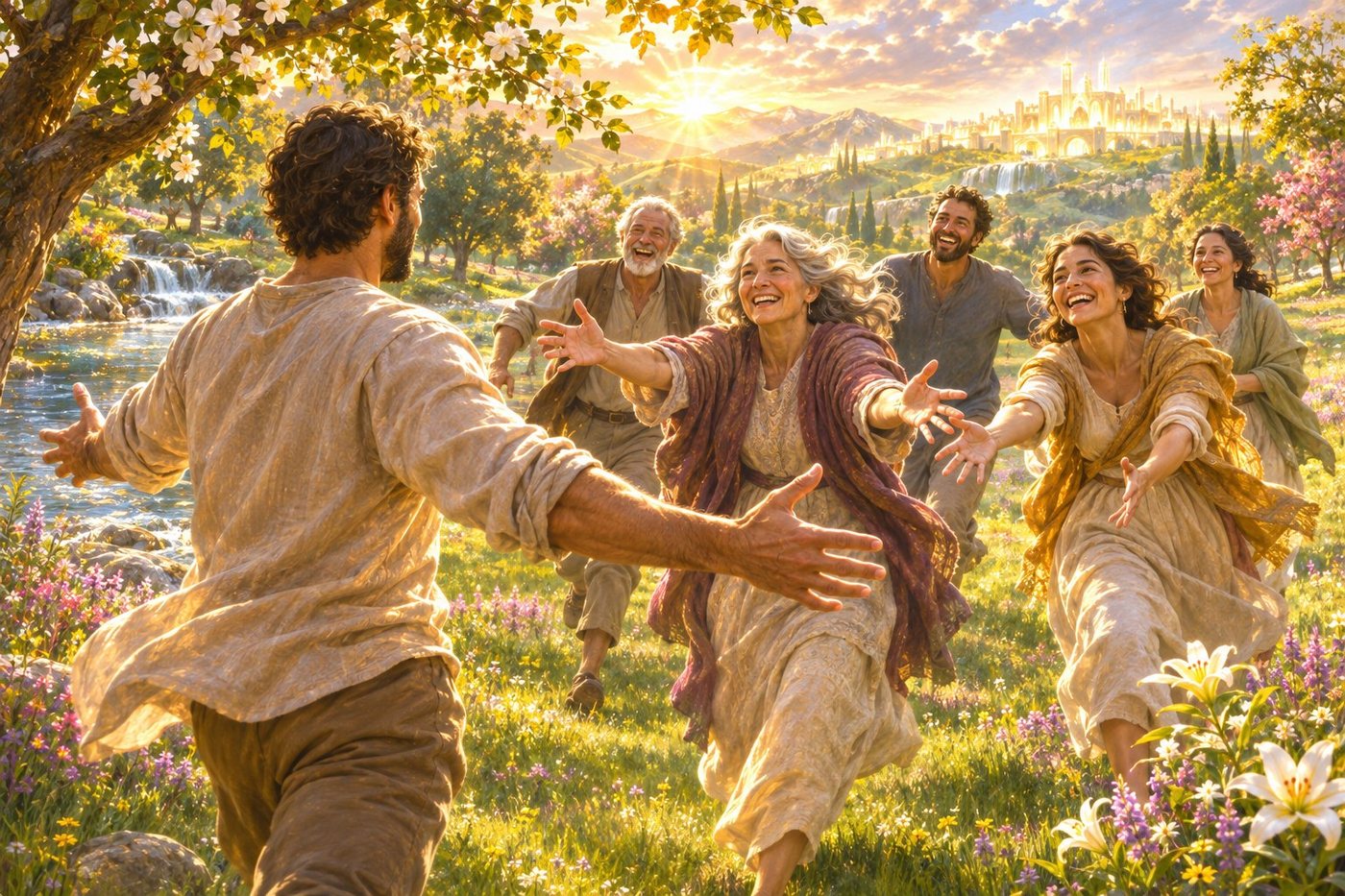
The Sermon at a Glance
- Who will I be? Still me, better than ever, like Jesus, forever changed. · 1 Corinthians 15:35–58
- What will I do? Worship him, serve him, reign with him. · Revelation 22:3–5
- What does it mean for today? Our labor is not in vain. · 1 Corinthians 15:58
You are here who we will be, forever
Paradise & Hades → Tribulation → Second Coming → Thousand Years →
Great White Throne → New Earth → Who We’ll Be · Road Map ›
Read First · 1 Corinthians 15:35–58; Revelation 22:3–5
Still me · 1 Corinthians 15:35–41
35 But someone will ask, “How are the dead raised? With what kind of body will they come?” 36 How foolish! What you sow does not come to life unless it dies. 37 When you sow, you do not plant the body that will be, but just a seed, perhaps of wheat or of something else. 38 But God gives it a body as he has determined, and to each kind of seed he gives its own body. 39 Not all flesh is the same: People have one kind of flesh, animals have another, birds another and fish another. 40 There are also heavenly bodies and there are earthly bodies; but the splendor of the heavenly bodies is one kind, and the splendor of the earthly bodies is another. 41 The sun has one kind of splendor, the moon another and the stars another; and star differs from star in splendor.
Better than ever · 1 Corinthians 15:42–44
42 So will it be with the resurrection of the dead. The body that is sown is perishable, it is raised imperishable; 43 it is sown in dishonor, it is raised in glory; it is sown in weakness, it is raised in power; 44 it is sown a natural body, it is raised a spiritual body.
Like Jesus · 1 Corinthians 15:44–49
If there is a natural body, there is also a spiritual body. 45 So it is written: “The first man Adam became a living being”; the last Adam, a life-giving spirit. 46 The spiritual did not come first, but the natural, and after that the spiritual. 47 The first man was of the dust of the earth; the second man is of heaven. 48 As was the earthly man, so are those who are of the earth; and as is the heavenly man, so also are those who are of heaven. 49 And just as we have borne the image of the earthly man, so shall we bear the image of the heavenly man.
Forever changed · 1 Corinthians 15:50–58
50 I declare to you, brothers and sisters, that flesh and blood cannot inherit the kingdom of God, nor does the perishable inherit the imperishable. 51 Listen, I tell you a mystery: We will not all sleep, but we will all be changed—52 in a flash, in the twinkling of an eye, at the last trumpet. For the trumpet will sound, the dead will be raised imperishable, and we will be changed. 53 For the perishable must clothe itself with the imperishable, and the mortal with immortality. 54 When the perishable has been clothed with the imperishable, and the mortal with immortality, then the saying that is written will come true: “Death has been swallowed up in victory.” 55 “Where, O death, is your victory? Where, O death, is your sting?”
56 The sting of death is sin, and the power of sin is the law. 57 But thanks be to God! He gives us the victory through our Lord Jesus Christ. 58 Therefore, my dear brothers and sisters, stand firm. Let nothing move you. Always give yourselves fully to the work of the Lord, because you know that your labor in the Lord is not in vain.
Worship and serve · Revelation 22:3–5
3 No longer will there be any curse. The throne of God and of the Lamb will be in the city, and his servants will serve him. 4 They will see his face, and his name will be on their foreheads. 5 There will be no more night. They will not need the light of a lamp or the light of the sun, for the Lord God will give them light. And they will reign for ever and ever.
I’ve been to too many memorials lately: two in the last couple of weeks. The first was for a woman who had a great relationship with the Lord. She’s at home in heaven with Jesus. She had time to think about it and time to prepare, and she was ready. The second was for a young man who died tragically and unexpectedly in a car accident in the middle of the night.
The only decision either of them made that really mattered was the decision they made about Jesus.
“Where, O death, is your victory? Where, O death, is your sting?” (1 Corinthians 15:55)
For those who have faith in Christ, there is no need to fear death. We don’t mourn like people with no hope. We mourn like people with real hope. When someone we love dies with a relationship with Jesus, we don’t say goodbye. We say, See you later. We say, See you on the other side.
Here’s what I’ve gotten out of this study: I don’t have to look forward to being a fat, naked baby with wings, playing a harp on a cloud for all eternity. I get to be me. You’re still going to be you, better than ever, a little more like Jesus, forever changed. And you’ll be worshiping, with Jesus, working with him. Which means what we do on this earth matters.
You Get Out What You Put In
My wife and I were at the gym this week. We work out together, but I think we go for slightly different reasons. She was on the bench doing a set of dumbbell presses, and the whole time she was talking to me. “Don’t forget we have to take the trash out tonight, and then we have to stop at Hy-Vee on the way home, and then we have to call the kids, and our granddaughter is going to dress up like a princess…” The entire set. I didn’t say anything, because whatever she’s doing is clearly working. She must have the secret, and I don’t.
When she finished, I asked, “How was it?”
She laughed. “Hee hee, it was fun.”
Now, if you’re describing a set at the gym, it shouldn’t be fun. Enjoyable, maybe, but it should be work. Then she looked at her hands and said, “Hee hee, I have two different weights in my hands.”
“One side’s going to be all pumped up and the other side all shriveled. You’re just not going to look right the rest of the day,” I said. “It’s really important to use two weights that are the same.”
“It’s not important to me.”
“But do you see the sweat on my forehead?”
“Why, are you hot in here?”
She just wasn’t having it. She was there to have a good time, and it’s clearly working for her.

This book is a little like that. If you’ve come along just for a good time, you’ll get something out of it. But if you’ve sweated a little and gone deeper, maybe you can now see the timeline: what lies ahead for you, for the loved ones who’ve gone before you, and for your kids who come after you. Maybe you can picture the other side.
I’ve never wanted to pretend this is simple. I’ve wanted you thinking it through and arriving at your own conclusions, or at least your own ellipsis, inside the biblical fence. Scripture gives us a few clear promises and drops some Easter eggs (Isaiah, Daniel, Hosea, the words of Jesus). Beyond those are hints that point toward hopes that are perfectly fair to hold.
The Whole Story
We started with the decision that matters most: receive Christ, and your ticket is punched; refuse him, and death determines destiny. Then we walked the whole Road Map, from paradise to the new earth. One question is left: who will I be?
In this final chapter I want to do three things. First, from the pen of the apostle Paul, I want to show you what we know for sure about what we will be like for eternity. Second, from Revelation 22, three things we know for sure we’ll be doing. And third, a few things the Bible hints at. They’re not proven beyond a doubt, but they’re fun to think about.
Who Will I Be?
Paul wrote 1 Corinthians to a church full of rascals, just like ours, just like any church: people who couldn’t get out of their own way, who kept tripping and falling, and who were forgiven and got up and started again. Some of their dysfunction we probably don’t share, thank the Lord. But a lot of it we can relate to.
These were new Christians in the first century. Their friends were dying, and they wanted to know what happened next. Maybe you’ve been in exactly that place, maybe recently. When you watch someone you love go into the ground, or watch their ashes laid to rest, it raises fair questions, existential questions. Scripture answers them, but only a careless person would answer them with trivial sayings that never touch the grief, the loss, the wonder, and the faith underneath.
In chapter 15, Paul reminds them that one day the believer who goes into the grave will be given a heavenly body, and that body will be them going into eternity. If they deny that, he says, they’ve denied the resurrection of Jesus himself, who went into the grave, came out the other side, and defeated sin, Satan, and death. We’ll still face death on this side, and our bodies will go into the ground. But our spirits go instantly to be with Jesus in paradise.
So what happens after that? They wondered. We don’t see anybody rising again. The graves are still here. The stones are still in place. And Paul says, in effect: It’s a promise. But I know promises are hard to picture.
Promises are hard to picture
That’s one of my struggles. In my little seasons of doubt I don’t go all the way back to if it’s true, but I get it. We’ve been promised heaven, and we haven’t seen it. Nobody has come back to tell us about it. And seeing is believing.
Tell me about the best vacation spot on the planet and I’ll want pictures, then what the people are like, what it costs, what to pack. Once I can picture it, the promise isn’t so hard to hold on to. Paul understood that. In effect he says, You haven’t seen bodies rise. You haven’t seen souls reunited. You haven’t seen the other side. You have to believe. But if you let go of the teaching that a glorified body will be joined to your spirit, you’ve let go of the resurrection itself.
Paul calls Jesus the firstfruits. In Leviticus, when a crop came in, farmers gave the first of it to the Lord as a pledge that the whole harvest belonged to him. Jesus was the firstfruits. When he rose again, it was God’s guarantee that we would rise too.
Paul’s language in this chapter is hard going in English, so let me point out four simple things he tells us. You’ll still be you. You’ll be better than you’ve ever been. You’ll be like Jesus. And you’ll be forever changed. Your glorified body and your glorified spirit will go into eternity together, and it will be you, the you that you know today.
Still me
But someone will ask, “How are the dead raised? With what kind of body will they come?” … When you sow, you do not plant the body that will be, but just a seed, perhaps of wheat or of something else. But God gives it a body as he has determined, and to each kind of seed he gives its own body. (1 Corinthians 15:35, 37–38)
I’m no gardener, but some of you are, and you know that what you plant doesn’t look like what comes up. A seed goes in looking like a seed. When a body goes into the ground, it doesn’t look like what will come out the other side.
When the dead in Christ are raised, whether before or after the tribulation depending on your conclusion, we’ll receive our glorified bodies, and they’ll carry us, body and spirit together, into the millennial kingdom and on into the new earth. The body that goes into the ground is a mortal body, made for this world and tainted by its sin. What comes up will be very different. But it will still be you.
Better than ever
So will it be with the resurrection of the dead. The body that is sown is perishable, it is raised imperishable; it is sown in dishonor, it is raised in glory; it is sown in weakness, it is raised in power; it is sown a natural body, it is raised a spiritual body. (1 Corinthians 15:42–44)
The body we have now is natural. It’s perishable. And it’s disappointing.
Has your body ever disappointed you? I don’t mean looking in the mirror and seeing a few extra pounds. I mean coming face to face with the reality that your body is failing you. It’s sobering. It happened to me more than six years ago. I woke up one morning thinking everything was fine. I tried to take care of myself, eat right, stay healthy. Then a phone call from the doctor: You have thyroid cancer. I hung up the phone, and suddenly I didn’t trust my body anymore. It may not have happened to you yet. It will.
On Friday, my wife and I spent a couple of hours with two sweet ladies who are part of our church family, even though they can’t attend in person anymore. They live in an assisted living facility in West Des Moines. We talked for two hours about heaven. They’ve been following along with this whole series. And at their age and in their condition, they know what it means that the body can’t be trusted. It fails you. It wears out. One day you look in the mirror and see yourself, the next day you see your parents, and then your grandparents. We can live in denial, and we can spend tens of thousands of dollars trying to reverse it.
Make no mistake: our bodies are a test and a trust. We’re expected to take care of them, to stay healthy and present for as long as God gives us life, so that they let us accomplish his purpose. But if we live long enough, they will fail. That began with Adam and Eve’s sin, and it’s reinforced by ours. These bodies will wear out and be left behind, and I hope they’ll be worthless to me then. Fold the tent up and throw it in the corner. I won’t want it.
But planted in the ground like a seed, the body comes up as something very different: imperishable, spiritual, prepared to experience eternity.
I’m not prepared to experience eternity right now. That’s why some parts of it make me a little anxious. Promises are hard to picture because I don’t have eternal eyes yet. I have faith that when I get there, I’ll want it and love it. But right now I have questions, and the questions aren’t caused by reality. They’re caused by my limited ability to perceive reality. I see spiritual truth through the eyes of a sinful person, and so do you. When we receive our spiritual bodies, they’ll be perfectly suited to the eternal home God has prepared for us, and we’ll see differently.
Like Jesus
The first man was of the dust of the earth; the second man is of heaven. As was the earthly man, so are those who are of the earth; and as is the heavenly man, so also are those who are of heaven. And just as we have borne the image of the earthly man, so shall we bear the image of the heavenly man. (1 Corinthians 15:47–49)
Again, this is Paul’s way of talking, and it’s hard in English. But what he’s saying is simple. We’re born in God’s image, but also in Adam’s. The curse passed down from Adam and Eve to every generation affects us profoundly and irreversibly, apart from the intervention of Jesus. The first man, Adam, came from the dust (Paul is quoting Genesis 2). The second man, Jesus, is from heaven. Our second birth comes through Jesus and his work. Because of him we’ll be given spiritual bodies, to live with him forever and enter the kingdom.
Adam and Eve made such a tangle of things that it’s hard to even untie the knot. My wife and I had dinner with some friends this week, and we got to talking about heaven. (That’s the danger of having dinner with your pastor while he’s preaching a series like this. The conversation always comes back around. Consider yourself warned.) Our friend said, “When I get to heaven, I want to talk to Eve.” She’s had four kids, and she has some grievances. “I want to ask her, What in the world were you thinking?”
Everything changed in that garden. We were created to experience God with our senses, to walk and talk with him, to know him conversationally and experientially in a perfect place without sin. They chose sin. And because God is holy and just, as well as loving and merciful, sin had to be punished. He placed a curse on humanity and sent Adam and Eve from the garden. Pain in childbirth, toil in work, strife between people, dysfunction, disease, and death all came as consequences of what happened through the first man.
But the second man reversed the curse for everyone who puts their faith and trust in him.
Forever changed
Listen, I tell you a mystery: We will not all sleep, but we will all be changed—in a flash, in the twinkling of an eye, at the last trumpet. For the trumpet will sound, the dead will be raised imperishable, and we will be changed. (1 Corinthians 15:51–52)
Some people will be alive when Jesus comes again. Maybe not our generation, but somebody will be. And all of us will be changed. If we’re still alive when the trumpet sounds, we’ll receive our glorified bodies in the blink of an eye. Those of us who die before then will receive ours when the dead in Christ are raised. Either way, Paul guarantees it: you’ll be like Jesus (not Jesus, but a lot like him), with a body perfectly suited for the eternity waiting for you.
That’s hard to understand, so it helps to know how theologians break it into three stages.
Justification · Sanctification · Glorification
- Justification: the moment you’re saved. We’re justified by faith alone, in Christ alone, because God gives grace, the free gift of eternal life through his Son. Confessing your sin, believing in Jesus, and deciding to follow him punches your ticket. But it isn’t a card you tuck in your wallet. It’s a commitment that shapes your life.
- Sanctification: the lifelong process. The Holy Spirit comes to live in you and spends the rest of your life making you a little more like Jesus. Each day a little less sin, a little more Jesus. Some days it feels like more sin and less Jesus. But over time, he’s taking out the old and putting in the new.
- Glorification: the other side. When we step onto the other side, we finally experience the reality of being with Jesus, the reality that’s been set in motion since the creation of the world.
Right now we’re in sanctification. One day, glorification.
What Will I Be Like?
We have lots of questions about our resurrection bodies, and we’ve toyed with them for a few chapters. Some things we know for sure. Others we can believe with a measure of confidence, because we see them in Jesus’ glorified body after he rose and appeared to his disciples and others for about six weeks before he ascended. I can’t tell you these are one hundred percent certain for us, because the Bible doesn’t say so specifically. But I think the evidence points that way.
The very best part of heaven isn’t what we’ll get, or even the place prepared for us. It’s that we’ll be with Jesus.
Jesus was recognizable. People knew who he was. He kept his identity. And there are other examples in Scripture of people being recognized on the other side. You’ll recognize people in heaven, and they’ll recognize you.
Jesus still had scars. That one makes me think, because I tend to imagine a perfect body as, well, perfect. But it has nothing to do with our standards of beauty. Even in his glorified body, Jesus let his disciples see and touch his scars. Will we carry any of our scars to the other side? We won’t carry any of the sadness, pain, or disappointment. But Jesus carried some scars. Some of you have a lot of them. I have a couple of little ones I never thought much about. I figured maybe I’d get a little heavenly plastic surgery before I got there.
Your personality will be much the same, only perfect. Those of us who are a little obnoxious and hard to deal with will keep the good sides of our personalities, and leave the rough edges behind. The traits and characteristics that make you you will probably come with you. Just not the ones that disappoint you.
What you love will be perfected. Many people believe that the things we enjoy and the way we appreciate beauty, whether nature, music, or art, will be perfected and become one of the ways we worship for eternity.
Jesus moved through a locked door. Will we be able to? Will we even care? He didn’t seem limited to moving through time and space the way we are. Is it possible for us? Sure. Is it promised? No. But it’s fun to think about. Pick your favorite Marvel hero. No, that’s going too far. We don’t want to get outside the bounds of Scripture.
To recognize and be recognized. To keep the best of our personalities and desires, the things we love, perfected by the absence of sin.
But let me add a caution before we go on. If all we think about is what we’ll get, who we’ll become, and how we’ll finally be rewarded, we’re missing the point of heaven. The very best part of heaven isn’t what we’ll get, or even the place prepared for us. It’s that in that place, we’ll be with Jesus.
What Will I Do?
For what we’ll be doing, we turn to Revelation 22. There’s a lot we don’t know. Someone asked me this week, “What are the angels going to be doing in eternity?” I started to answer and then thought, Huh. I’ve never thought about that. Why not? I don’t know. Maybe I didn’t care. But I cared then, so I went looking. We know there will be an angel at each of the gates of the New Jerusalem. Beyond that, we don’t know.
But in Revelation 22, we see three things we know for sure we’ll be doing.
No longer will there be any curse. The throne of God and of the Lamb will be in the city, and his servants will serve him. They will see his face, and his name will be on their foreheads. There will be no more night. They will not need the light of a lamp or the light of the sun, for the Lord God will give them light. And they will reign for ever and ever. (Revelation 22:3–5)
No longer will there be any curse. That isn’t a throwaway line. That’s the reason I can say, O death, where is your victory? It’s the reason you don’t have to mourn like people without hope. It’s the reason you can look forward to seeing people on the other side, and the reason you can face the worst times in life with confidence. The curse will be reversed. You’ll no longer live with everything that keeps you from being the person God created you to be. You’ll be free of yourself.
Do you know what I pray for you? That God would get into your head before you do. Does that make sense? We get into our own heads, and then we can’t hear. Our spirit gets crowded out, and the noise keeps us from embracing simple truths. So I prayed, God, get into their heads before they get into their own. Part of the curse is that we get into our own heads first thing every morning and crowd everything else out.
No longer will there be any curse.
1. We will worship him
The throne of God and of the Lamb will be in the city. The Lamb is Revelation’s name for Jesus, and the throne represents the very presence of God. We will be with God. We will be with Jesus.
Promises are hard to picture. But Jesus isn’t hard to picture.
When I have questions or doubts about eternity, I find myself going back to the person of Jesus. The more I study who he is, what he was about, what he cared about, and how much he loves me, the more at ease I feel and the more I look forward to heaven.
You’ll be with Jesus and with God, and you will see his face. In the Old Testament, seeing God’s face was a death sentence. In the New Testament, people saw Jesus, who is God, and who taught us everything we need to know about God. But on the other side, things will be completely different. They will see his face, and his name will be on their foreheads. (That last part is a long discussion for another day. Don’t get too caught up in it.)
Worship there won’t be an endless church service. It will be life in his presence: seeing him, knowing him, loving him.
2. We will serve him
His servants will serve him. We’ll be working for God, serving him in some way. I want to stop here for a minute, because I think some things are probably true about heaven even if I can’t say I’m one hundred percent sure.
I think we’ll work in heaven. And if you hate work now, it isn’t because you were created not to work. It’s because sin is in the world. If there were no sin, I think the line between work and play would disappear.
Imagine being created by God with abilities, interests, and gifts to contribute and build and accomplish something, and then having sin removed and being free to do that for all eternity, in a way that not only brings you joy and fulfillment but adds to everyone else’s joy and fulfillment. That’s an interesting thought.
Scripture points this way. Go back to Genesis 2: God worked, and he created Adam to work. Ephesians says we are God’s workmanship, created to do good works (Ephesians 2:10). The Psalms talk about the works of God. Jesus told a parable about servants who used their master’s money well or poorly (Matthew 25:14–30), and how that shaped what they were given afterward. Maybe there’s something we’ll do for eternity, the perfect job we’ll never want to quit.
I have a friend who’s an engineer. Engineering sounds boring to me. (I’ve never driven a train, and I don’t want to. That’s a joke. A bad one, I know.) He designs fuel-injection parts for jet engines. He spends years on tiny, microscopic parts that keep jets in the air. It’s important work. It’s just not for me. You don’t want me doing that; your plane would crash for sure. So I thought I had him. “Could you see yourself, under any circumstances, being an engineer for all eternity, working on little parts?”

“Wait a second,” he said. “There are things about what I do that I love. If I could contribute, if I could build something, if I could be part of it… yeah. I could get behind that.”
I said, “Oh my goodness.” To each his own.
God made us all different. But what if he’s given you something you’ll get to do, perfectly, for all eternity?
I also think the Bible at least hints that there will be learning in heaven. Have you ever thought about that? Some people assume that when they get to heaven they’ll know everything. Then you’d be God, because the only one who knows everything is God. When you get to heaven, you won’t suddenly be Jesus: Here I am, scoot over, I’m moving in. God is God. He’s all-knowing, all-powerful, everywhere present. We’re not. We may share in some of that in a far lesser way, but we won’t know everything.
So what if you get to learn in heaven, without any disability or difficulty or short attention span, and without any of the subjects you never wanted to study? What if every day something new is revealed to you about who God is and how things work, and you’re so excited and engaged that you can’t wait for the next day’s discovery? That’s very consistent with the nature God gave us when he created us in his image.
And what if there’s travel in heaven? There will be nations and kings. There could be all kinds of places to go and experience and explore. What if you don’t have to get on a plane, wait in line, and sit in the middle seat? What if you can travel in a way that suits your glorified body perfectly, with none of the aggravation?
What if? Can you get behind any of this? Do any of these possibilities start to wake your spirit up? We don’t know for sure. But we do know that if there’s work to do, the work God gives us will be unlike anything we’ve experienced so far.
3. We will reign with him
And they will reign for ever and ever. I don’t know exactly what that means or whom it includes. But I know it means we’ll be an active part of making sure God’s will is done and that he is honored, and that everything we think, everything we do, everything we plan, and everything we are will be one big signpost pointing to him.
Since It’s True
Both John in Revelation and Paul in 1 Corinthians bring it back to this: since all of this is true, what you do here really, really matters.
Therefore, my dear brothers and sisters, stand firm. Let nothing move you. Always give yourselves fully to the work of the Lord, because you know that your labor in the Lord is not in vain. (1 Corinthians 15:58)
But it’s hard, because the distance between if and since is a chasm of hard truths, difficult concepts to receive by faith, and seasons of doubt that come with the natural ebb and flow of life. I hope and trust that by now you’ve arrived at since this is true, even if we don’t understand everything.
As we close this book, I want to leave you with three things.
1. Hold on to the thin places
What are your best days here? What are the best times of your life, the moments that have given you the most joy? They’re few and far between, because this world is full of disappointments and bad days. But have you ever had a moment when heaven felt so close you could sense it?
I told you about standing in the yard at the house in Arkansas, looking through the window at my family. There’s another moment I keep thinking about, when God gave me a sense that there was something bigger and better, and I just worshiped.
My wife was pregnant with our first son. She was well along and getting uncomfortable. This was a long time ago. She had a pregnancy pillow, but she didn’t like it. She liked me better. We lived in Dallas then, in an old house, and it was hot most of the time. She used me as her pregnancy pillow instead, while I lay there sweating like crazy. But that’s okay. I had the easy part; she had to have the baby. (Remember Eve and all that.)

So there I was in the middle of the night, her belly propped on my arm, a bulldog on his back taking up the other side of the bed, snoring. My wife was sound asleep. Our son wasn’t born yet. We had no kids, and I was lying there wondering, How am I going to be a dad? How am I going to love somebody I don’t even know? I wasn’t especially kid-oriented, and I was having all the freak-out thoughts.
And in the middle of the night I felt a little thump on my arm. Just a little thump. It was my son, kicking me from the other side.
Even though that’s what babies do, something in me woke up. Something powerful moved me. It went far beyond I’m going to be a dad. It connected me to the fact that God is real, that he has so much planned, and that he does miracles and things we can’t even imagine.
If you have moments like that, hold on to them. Heaven isn’t about making our best days better. It’s about living in the best place, with Jesus, forever. But those moments help prime us for the other side.
2. Live with eternity in mind
Think about what will matter most to you five minutes after you die.
The story of the rich man and Lazarus tells us the first thing on your mind will be where you are for eternity. Get that settled. If you don’t know Jesus, please consider giving your life to him. You can do it today.
A prayer can be as simple as a thought. Just think it, or say it to Jesus, and he will receive you:
Forgive me for my sin. I’ve fallen short. I’ve done things that displeased you, in my thoughts, my actions, my attitudes. Forgive me. I believe who you are. I believe you paid the price for me through your death, burial, and resurrection. And I want to follow you with my life.
However you say it is fine. He understands what you mean. And when you mean it, you pass from death to life, from old to new, from lost to found, and your eternity is changed forever. That’s what will matter most to you when you die.
The second thing will be where the people closest to you are. What are you doing now with the people who depend on you to point them to Jesus? Are you so busy giving them good experiences that you crowd out the best experience? Are you praying? Are you focused? Are you intentional? Five minutes after we die, those are the people we’ll be most concerned about, the people God holds us most responsible for.
3. Keep learning about Jesus
The thing that truly prepares us for eternity and gives us confidence in the face of death is what we know to be true about Jesus. It’s what lets us sit through a memorial service, whether for an older woman who was ready or for a young man who died tragically and without warning, and still have hope.
So keep learning about Jesus. The more you learn about him, the more you’ll want to spend eternity with him, and the more ready for heaven you’ll be.
The Old Testament points to Jesus: He’s coming. Be on the lookout. Get ready. Matthew, Mark, Luke, and John tell his story. And the rest of the New Testament shows us how to live in light of him. The Bible tells us everything we need to know about this life, and God has revealed everything we need to know about himself through his Son, Jesus Christ.
So let’s keep doing that together, for as long as we’re together: learning about Jesus through Scripture, nudging each other toward heaven, looking forward to getting there, and making a difference with every day we have left.
I want to see you on the other side.
A Closing Prayer
Father, thank you for my friends. As we close this book and move on to other things, may we never move past the main thing.
I pray for anyone reading this who hasn’t yet decided to follow you. Eternity hangs in the balance. It’s so easy to be deluded into thinking we have time, but we never know when our time runs out. So if nothing else, help us come face to face with that reality today: if we died now, would we spend eternity with you in heaven?
And help us look at how we influence the people closest to us. If we’re married, our spouse. If we’re parents, our kids, at home or grown and gone. If we’re grandparents, our grandkids. How are we investing our time, our resources, our thoughts, and our prayers? Are we doing everything we reasonably can, through relationship, compassion, concern, and love, to nudge those closest to us toward eternity with you?
Help us live with purpose. Eternity reveals what life conceals. Give us a purpose that carries us through every trial of life, with the expectation and hope of heaven to come, so we can face whatever you allow into our lives and enjoy the blessings you bring. Help us do it together, growing a little more each week.
In Jesus’ name. Amen.
Key Truths
- You’ll still be you: better than ever, like Jesus, and forever changed (1 Corinthians 15).
- In eternity we will worship him, serve him, and reign with him (Revelation 22:3–5).
- Since it’s true, what we do here matters. Our labor in the Lord is never wasted.
For Reflection
- What makes heaven heaven for you? Of everything in this book, what are you most looking forward to?
- Paul says we’ll still be ourselves, but transformed. What part of you are you most glad to keep, and what are you most glad to leave behind?
- If the line between work and play disappears without sin, what work do you hope God has for you?
- Who are the people closest to you, the ones you most want to see on the other side? What is one step you can take this week to point them to Jesus?
- Has this book changed the way you understand eternity? How?
For the kids in your life: the same truth in the Kids' Edition, Chapter 8 · Comic, Issue 8: Now That I'm Here
Study Guide
Rick’s original outlines, background notes from the series guides, and a glossary.
Punching My Ticket
Chapter One · Romans 3:20, 23–24 · September 13, 2026
The original outline
Good people go to heaven. Romans
3:23–24
Why we believe it: (1) it feels fair; (2) I make the cut; (3) God is
good, right?; (4) fear motivates us to be good.
So what’s the deal? Romans 3:20
- There is no mutually agreed-upon, generationally survivable definition of good. Good is a moving target.
- We don’t know what percentage of our actions have to be good.
- We don’t know whether our thoughts and motives count against us.
- We might already be out of time, and then we’re being good for nothing.
- We could miss heaven by one good deed.
You don’t make the cut. Neither do I.
What do I do? Romans 6:23
“The gift of God is eternal life in Christ Jesus our Lord.”
Background
Who is speaking, and to whom? Paul writes to the church in Rome, which included Jewish and non-Jewish believers. He explains the good news of Jesus and why every person needs it. Religious background and moral achievement do not remove anyone’s need for God’s mercy.
Where the passage fits. Romans 1:18–32: humanity turns away from God. Romans 2:1–3:20: judging others or possessing God’s law doesn’t excuse our own sin. Romans 3:21–31: God makes people right with him through faith in Jesus, and boasting is excluded. Romans 4: Abraham shows what it means to receive God’s promise by faith. Romans 5:1–2: being made right with God brings peace and hope.
Why the law matters. “The law” means God’s revealed commands, especially those given through Moses. A command can show us what is right and reveal where we’ve failed. It cannot erase the failure. Paul isn’t saying God’s commands are bad or that obedience is pointless.
Why this starts the series. Before asking what happens after death, we have to ask how we become right with God. Everything later about accountability and judgment rests on this foundation: forgiveness and eternal life are received through Jesus, not earned by piling up good deeds.
A closer look. A wage is earned; a gift is received. Grace challenges both pride (“I deserve it”) and despair (“I could never be forgiven”).
Prepare for Landing
Chapter Two · 2 Corinthians 5:1–10 · September 20, 2026
The original outline
Prepare to land on the other side. Phase 1: Paradise.
1. We are going to die (once). Hebrews
9:27–28
“People are destined to die once, and after that to face judgment.”
2. We leave our body “here” (for now). John
11:25–26
“The one who believes in me will live, even though they die.”
3. We will be judged by Jesus (but it is okay).
2 Corinthians 5:10
We are saved by grace but rewarded for works. We will give an account
for:
- how we treat people
- the words we speak
- how we endured suffering
- how we gave and asked for forgiveness
- our generosity toward the kingdom of God
- making an effort to share our faith
- being generous with our time
Landing in paradise. The Garden of Eden was paradise
only because of the presence of God.
Heaven’s handholds: thinking about the thin places.
Romans 8:28
Background
A real hope for tired people. Paul is writing to the church in Corinth. The surrounding chapters describe weakness, suffering, and the demands of ministry. This isn’t detached speculation about heaven. Paul is explaining why believers can stay courageous while their bodies wear down. 2 Corinthians 4:7–12: God works through fragile people. 4:16–18: the outer person is wasting away, but inward renewal and eternal hope give courage. 5:1–5: God promises a lasting future beyond our present weakness. 5:6–10: confidence about being with the Lord leads to the goal of pleasing him.
Why a tent? A tent is a vivid picture of a vulnerable, temporary home. The contrast with “a building from God” emphasizes permanence and God’s provision. Paul longs for death to be overcome by life, not for the body to be thrown away as worthless.
What is paradise? Jesus promised the criminal beside him, “Today you will be with me in paradise” (Luke 23:43). Paul connects paradise with heaven in 2 Corinthians 12:2–4. In this series, paradise describes being with Jesus after death while awaiting the resurrection.
A closer look. The central comfort is a person: we will be with Jesus. We don’t need every geographical detail to trust that promise. And giving an account to Jesus doesn’t turn eternal life into something we purchase.
Meeting in the Middle
Chapter Three · Matthew 24–25 · September 27, 2026
The original outline
Because Jesus is coming again…
- Perception (don’t be deceived). Matthew 24:4–5, 23–26. Don’t believe every prediction, teacher, or claim about Christ’s return.
- Peace (don’t panic). Matthew 24:6. The world may become chaotic, but Jesus has already told us what to expect.
- Perseverance (don’t quit). Matthew 24:12–13. When following Jesus gets difficult, don’t quit.
- Productivity (don’t waste the wait). Matthew 24:45–46; 25:14–30. Jesus expects to find his people faithfully doing what he entrusted to them. Don’t waste the wait by watching the sky. Wait for Jesus by doing the work.
- Preparation (be ready, stay ready). Matthew 24:42, 44; 25:13. We don’t know when he’s coming, so readiness isn’t something we can schedule for later.
Background
Jesus speaks on the Mount of Olives. Matthew 24 begins with Jesus leaving the temple and predicting its destruction. His disciples ask when this will happen and what will signal his coming and the end of the age. He answers while seated on the Mount of Olives, across from Jerusalem. This teaching is called the Olivet Discourse.
Why the questions are connected. For the disciples, the temple was the center of their world. Its destruction raised huge questions about God’s purposes and the future. Jesus’ answer includes warnings about deception and suffering, his coming, and the need to live ready. Christians differ on how much of Matthew 24 concerns Jerusalem’s destruction in AD 70 and how much describes Jesus’ final return.
The flow of the conversation. 24:1–3: the temple prediction and the disciples’ questions. 24:4–14: deception, trouble, endurance, and the spread of the gospel. 24:15–31: severe distress, false messiahs, and the coming of the Son of Man. 24:32–51: watchfulness and faithful service without knowing the day. 25:1–13: the bridesmaids (be ready). 25:14–30: the entrusted money (be faithful). 25:31–46: the sheep and goats (Jesus returns as King and Judge).
Before or after? Christians disagree about whether believers will be gathered before the tribulation or when Jesus returns after it. For the passages behind each view, compare 1 Thessalonians 4:16–17 with Matthew 24:29–31. For the seven years, see Daniel 9:27.
A closer look. Read the whole conversation and you’ll see Jesus move from “What will happen?” to “How will you live?” The warnings and the call to faithfulness belong together.
Go Deeper
For a full study: The Tribulation and the Millennial Kingdom, my two-chapter study guide, lays out the main views side by side, the Scripture behind each, and questions to help you reach a conclusion you can support. Open the guide ›
Eternity Reveals What Life Conceals
Chapter Four · Luke 16:19–31 · October 4, 2026
The original outline
Eternity reveals what life conceals.
The contrast: what we see now. Luke
16:19–21
The rich man: purple (wealth and status), fine linen
(luxury), feasting (daily extravagance), the gate (a
substantial home).
Lazarus: he was a beggar; he was “laid” at the gate; he was covered with
sores; he was hungry; even the dogs licked his sores.
The need (the opportunity) was at his gate. Who is at your
gate?
The crossing: death reveals reality. Luke 16:22–26
- Personal: conscious existence continues after death.
- Painful: Hades involves real suffering.
- Permanent: his destination cannot now be reversed.
- Preliminary: Hades is not the end of the story.
The choice: respond while there’s still time.
Luke 16:27–31
The gate he would not cross became the chasm he could not cross. Who is
at your gate? What will you do with Jesus?
Background
The setting. In Luke 16:14–15, Jesus addresses people who loved money and justified themselves before others. God knows their hearts. That frames the contrast between appearances and reality.
Parable or historical account? Luke doesn’t explicitly identify the genre. The central warning doesn’t depend on settling the question, so avoid turning every narrative detail into a map of the afterlife.
Hades is not the final lake of fire. Revelation 20:13–14 distinguishes them. The fixed chasm in Luke 16 concerns destination. It doesn’t mean Hades itself lasts forever.
Moses and the Prophets. For the rich man’s brothers, “Moses and the Prophets” was the only Bible they had. Abraham points them to God’s Word, and they still have something the rich man no longer has: time.
A closer look. Outward circumstances don’t reveal a person’s standing before God. Wealth doesn’t prove God’s approval, and suffering doesn’t prove his rejection. The need may be in your home, neighborhood, workplace, church, or family.
One Way or the Other
Chapter Five · Matthew 25:31–46 · October 11, 2026
The original outline
The question: what will matter five minutes after we
die?
The big idea: eternity reveals what life conceals.
- When? The return. Matthew 25:31. Jesus returns in glory with his angels and takes his seat as King. The future gives urgency to the present.
- Who? The gathering. Matthew 25:32–33. All nations are gathered; no one is outside the scope of this scene. The Shepherd separates the sheep on his right from the goats on his left.
- Why? The evidence. Matthew 25:34–45. The King names concrete acts of mercy: food, water, hospitality, clothing, care, and visits. The righteous are surprised; they didn’t realize that serving the least of these was serving him. Compassion doesn’t purchase salvation; it shows what has taken root in the heart. Neglecting people in need exposes a life unmoved by the King.
- Where? The destinations. Matthew 25:46. Two final outcomes: eternal punishment and eternal life. The invitation is today. We respond to Christ in this life, not after death.
Background
Where the passage fits. This is the climax of the Olivet Discourse (Matthew 24–25), where Jesus teaches about his return, the end of the age, and how to live in light of it. The parables of the ten virgins and the talents come just before it and emphasize watchfulness and faithful living. Jesus speaks to his disciples, but his words also challenge every later reader.
Works reveal. Works do not redeem. Salvation is by grace through faith, and genuine faith produces a changed life (Ephesians 2:8–10). The question isn’t whether we’ve been religious, but whether we truly belong to Jesus.
Key words. Glory: his visible majesty and royal authority. Nations: all peoples gathered before the King. Separate: a decisive distinction made by the Judge. Come: the King’s welcome into his kingdom. Depart: the King’s sentence of exclusion. Inheritance: the kingdom prepared by the Father. Least of these: the exact meaning is debated, but at minimum the passage demands serious attention to how we treat those Jesus identifies with.
A closer look. Two words, come and depart. Which will you hear?
Highway to Heaven: 1000 Mile Marker
Chapter Six · Revelation 20:1–10 · October 18, 2026
The original outline
Jesus will reign. His people will share his victory. Evil will meet its final end.
- Restraint: the deceiver is confined. 20:1–3. Authority from heaven (“having the key to the Abyss”); arrest of the enemy (“he seized the dragon”); absence of deception (“to keep him from deceiving the nations anymore”). The devil is dangerous, but he is never in charge.
- Reign: the faithful live and reign. 20:4–6. Faithfulness honored; from death to life; favored by God; set apart for God alone; free from the second death; faithful service to God; future rule with Christ. Faithfulness to Jesus is never wasted.
- Rebellion: the enemy’s last attempt. 20:7–9. Released to deceive; rebellion reveals the heart; rebels defeated. Being near God’s blessings is not the same as surrendering to his King.
- Removal: the devil is defeated forever. 20:10. Permanent punishment; a perfect future to follow (21:1–5). God’s future brings more than a limit on evil. Evil will finally be defeated.
My response. If Jesus is the King of my future, his rule should shape my life today: trust him when I’m afraid, stay faithful when obedience is costly, ask him to change my heart, and serve today with hope for the future.
Background
A message for real churches. John writes to seven churches in the Roman province of Asia (now western Turkey): Ephesus, Smyrna, Pergamum, Thyatira, Sardis, Philadelphia, and Laodicea (Revelation 1:4, 11). Some faced poverty, threats, and death. Others struggled with false teaching, fading love, or comfortable religion.
John on Patmos. John says he was on the island of Patmos “because of the word of God and the testimony of Jesus” (Revelation 1:9), usually understood as exile. Many scholars date the book around AD 95–96, near the end of Emperor Domitian’s reign; others argue for an earlier date.
Where chapter 20 fits. Chapters 1–3: Jesus and his churches. 4–5: heaven’s throne and the Lamb. 6–11: judgment and witness. 12–14: the conflict exposed. 15–18: Babylon falls. 19: the victorious King defeats the beast and false prophet. 20: Satan is restrained, Christ’s people reign, the final rebellion ends, and judgment follows. 21–22: God makes everything new.
Roots in earlier Scripture. The ancient serpent is the snake who deceived Eve in Genesis 3 (identified as Satan in Revelation 12:9). The thrones recall Daniel 7, where God judges evil and gives his people a share in his kingdom. Gog and Magog come from Ezekiel 38–39, enemies who gather against God’s people and are defeated.
A closer look. This book reads Revelation 20 as a future thousand-year reign that follows Jesus’ return. Other Christians read the chapter as revisiting the present age from another angle. All agree on the bigger message: Jesus keeps his promises, faithfulness matters, and evil won’t have the last word.
Go Deeper
For a full study: The Tribulation and the Millennial Kingdom, my two-chapter study guide, lays out the main views side by side, the Scripture behind each, and questions to help you reach a conclusion you can support. Open the guide ›
Leaving the Light On
Chapter Seven · Revelation 21:1–22:5 · October 25, 2026
The original outline
Start here: trust Jesus. John 14:1–6. Jesus promises a place
with him, and he is the way to the Father.
Filled with the light of God’s glory. Nothing broken. Everything
made new.
- Why is it different? Revelation 21:1–8. A new world. God makes his home with his people. No more death, tears, or pain. Everything made new, and life offered as a gift.
- How will it look? Revelation 21:9–21. A city shining with God’s glory. Gates and foundations that tell God’s story. A city whose size stretches our imagination. Gold, precious stones, and gates of pearl.
- Who makes it great? Revelation 21:22–22:5. God himself will be there with his people. Light that never fails; evil cannot enter. The river of life, and no more curse. We will see his face.
Closing question: what does this passage teach us that can help us face death without fear?
Background
The measurements. John records the city as 12,000 stadia on each side (about 1,400 miles) and the wall as 144 cubits thick (about 200 feet). We can trust God’s promise without explaining every physical detail.
The names on the gates. Israel’s twelve tribes and Jesus’ twelve apostles are named on the gates and foundations, recalling God’s faithfulness to his people across the whole story. The Lamb is Jesus, who gave his life for our sins and rose again.
“Many rooms.” In John 14:2, the word translated rooms (Greek monai) points to a permanent dwelling and a lasting relationship with Jesus, not a mansion on a street of gold.
The tree of life. After Adam and Eve’s disobedience, God sent them from Eden and guarded the way to the tree of life (Genesis 3:22–24). In Revelation 22, the tree of life stands open again, and “no longer will there be any curse.”
A closer look: will there be animals? There are good biblical reasons to expect animals on the new earth: creation’s liberation from decay (Romans 8:19–23) and Isaiah’s pictures of peaceful animals (Isaiah 11; 65:25). The return of a particular pet is a hopeful possibility, not a biblical promise. Revelation 21–22 doesn’t settle specific species, so hold these hopes loosely.
Now That I’m Here
Chapter Eight · 1 Corinthians 15:35–58 · Revelation 22:3–5 · November 1, 2026
The original outline
Who will I be? What will I do?
1. Who will I be? 1 Corinthians 15:35–58
- Still me. Verses 35–41. The seed illustration shows continuity and transformation.
- Better than ever. Verses 42–44. Raised imperishable, glorious, and powerful.
- Like Jesus. Verses 45–49. We will bear the likeness of the heavenly man.
- Forever changed. Verses 50–57. Death is defeated.
2. What will I do? Revelation 22:3–5
- I will worship him. Verses 3–4. I will be with Jesus; his servants will see his face. The Jesus we meet in the Gospels is the Jesus we’ll spend eternity with. Worship is more than singing. It’s enjoying his presence, loving him, and living in relationship with him.
- I will work for him. Verses 3, 5. God’s people will serve him and reign with him. With the curse removed, our work will no longer be burdened by the frustrations of this world.
What does this mean for today? 1 Corinthians 15:58. Our labor in the Lord is not in vain. What we do for Jesus today matters.
Background
Different, yet connected (vv. 35–41). The seed points to both continuity and transformation. God gives a body as he chooses. It doesn’t answer our questions about apparent age, facial features, or exactly how we’ll recognize each other.
Better than we have known (vv. 42–44). Four contrasts: perishable and imperishable, dishonor and glory, weakness and power, natural and spiritual. Paul is describing a real bodily resurrection, not an escape from having a body.
Like Jesus (vv. 45–49). Adam represents our present, mortal humanity; Christ is the heavenly man whose likeness believers will bear. Philippians 3:20–21 adds that Christ will transform our lowly bodies to be like his glorious body.
Changed forever (vv. 50–57). Believers who have died are raised, and believers still living are changed. Mortality gives way to immortality, and death loses its victory.
Work before the curse. Work existed before the fall (Genesis 2:15); painful toil came with the curse (Genesis 3:17–19). Purposeful work without that frustration is a reasonable expectation, though Scripture doesn’t give us a job description.
What will I look like? Scripture clearly promises a real, imperishable body (1 Corinthians 15:42–44) and an end to death and pain (Revelation 21:4). It strongly suggests we’ll remain recognizably ourselves. It doesn’t tell us what age we’ll appear, and it doesn’t settle whether we’ll keep particular scars. Jesus kept his (John 20:24–29), but that doesn’t prove every believer will.
A closer look: getting to know Jesus. The reason to look forward to eternity isn’t simply what we’ll do, but who we’ll be with. In the Gospels, Jesus welcomes children (Mark 10:13–16), grieves with his friends (John 11:32–36), eats with people others dismissed (Luke 5:27–32), and restores Peter after failure (John 21:15–19). He is warm without being shallow, honest without being cruel, powerful without intimidating the vulnerable, and holy without being unapproachable. He isn’t simply nice. He’s good.
Glossary
Abomination of desolation. The event at the tribulation’s midpoint, connected with the temple and worship, when the Antichrist shows who he really is. Chapter Three
Abraham’s side. Jesus’ Old Testament description of paradise in Luke 16. Chapter Four
Abyss. The prison where Satan is bound for the thousand years (Revelation 20:1–3). Some see it as a separate place; many see it as the lowest level of Hades. Chapter Six
Age to come. Eternity, the age that follows the present one. The tribulation is the transition between the two. Chapter Three
Antichrist (the beast). The charismatic world leader who rises during the tribulation, then reveals his evil at its midpoint. Chapter Three
Armageddon. The final battle of the tribulation, when Jesus returns and defeats the nations gathered against Jerusalem. Chapter Three
Bema (judgment seat of Christ). The “podium” where believers, already saved by grace, give an account and are rewarded for how they lived (2 Corinthians 5:10). Not a judgment of salvation. Chapter Two
Eschatology. The study of last things: death, judgment, the return of Christ, and eternity. Chapter Seven
False prophet. The Antichrist’s right-hand man during the tribulation. Chapter Six
First resurrection. Believers raised bodily to live and reign with Christ (Revelation 20:4–6). Chapter Six
Firstfruits. The first of the harvest, given to God as a pledge that the whole crop belonged to him (Leviticus 23). Paul calls the risen Jesus the firstfruits: the guarantee that we will rise too. Chapter Eight
Gehenna (the lake of fire). The final, eternal place of punishment after the great white throne judgment. The name comes from the burning valley outside Jerusalem. Chapter Four
Glorification. God’s final work of making us complete, including our resurrected bodies, when we step onto the other side. Chapter Eight
Glorified body. The resurrected body believers receive when Jesus returns: real, recognizable, imperishable, and free from sin. Chapter Six · Chapter Eight
Gog and Magog. Names from Ezekiel 38–39 for the nations Satan gathers for one last rebellion after the thousand years. Chapter Six
Great white throne. The final judgment at the end of the millennial kingdom. All whose names are not written in the Lamb’s Book of Life are cast into the lake of fire. Chapter Six
Hades. The intermediate place of punishment for those who die without Christ: personal, painful, permanent, and preliminary. Chapter Four
Imperishable. No longer subject to decay, sickness, or death. Chapter Eight
Justification. God declaring us right with him because of Jesus, not our own goodness, received by faith alone in Christ alone. Chapter Eight
Lamb’s Book of Life. God’s record of those who belong to Jesus. Your name is written there the moment you decide to follow him. Chapter Six
Millennial kingdom. The thousand-year reign of Christ on earth after his return, while Satan is bound. Chapter Six
New heaven and new earth. God’s renewed creation, where he lives with his people forever (Revelation 21–22). Chapter Seven
New Jerusalem. The city that comes down out of heaven to the new earth: God’s dwelling with his people, with twelve gates of pearl that never close. Chapter Seven
Olivet Discourse. Jesus’ teaching on the Mount of Olives about his return and the end of the age (Matthew 24–25). Chapter Three
Paradise. Where believers go immediately at death: with Jesus, awaiting the resurrection (Luke 23:43). Chapter Two
Present age. The age we live in now, from Jesus’ ascension until his return. Scripture also calls it “the last days.” Chapter Three
Purgatory. A teaching that souls are purified after death before entering heaven. This book holds that Scripture doesn’t teach it. Chapter One
Rapture. Jesus gathering living believers to himself as the dead in Christ rise (1 Thessalonians 4:16–17). Christians differ on whether it happens before or after the tribulation. Chapter Three
Sanctification. The Holy Spirit’s lifelong work of making us more like Jesus: a little less sin, a little more Jesus. Chapter Eight
Second death. Final judgment in the lake of fire (Revelation 20:14). It has no power over those who belong to Christ. Chapter Six
Sheol. The Old Testament word for the realm of the dead. Chapter One
Son of Man. Jesus’ favorite title for himself, drawn from Daniel 7. Chapter Five
Spiritual body. A real, resurrected body transformed and empowered by God’s Spirit (1 Corinthians 15:44). Chapter Eight
Thin places. A Celtic Christian idea: moments when heaven feels close and God points us toward home. Chapter Two
Tribulation. The seven-year period that ends the present age: three and a half years of false peace, then three and a half years of persecution. Chapter Three
About the Author

Rick Melick has served as senior pastor of Capitol City Church in Des Moines, Iowa, since November 2016. A pastor and church planter for more than three decades, he planted congregations in San Anselmo, California, and Cotter, Arkansas, and has served churches in Texas, Tennessee, and Washington.
In 2017 he founded City Serve DSM, a nonprofit that partners with Capitol City Church to bring businesses, schools, and community organizations together to serve the teachers, first responders, and military personnel of Greater Des Moines. He also serves as a chaplain with the Iowa State Patrol.
Rick studied at The Criswell College and Golden Gate Baptist Theological Seminary, and did doctoral work at San Francisco Theological Seminary and Midwestern Baptist Theological Seminary.
He and his wife have been married thirty-six years. They have two grown sons, two daughters-in-law, and grandchildren who call him Bapo.
Rick wants what will be most important to him five minutes after he dies to be most important to him every day.