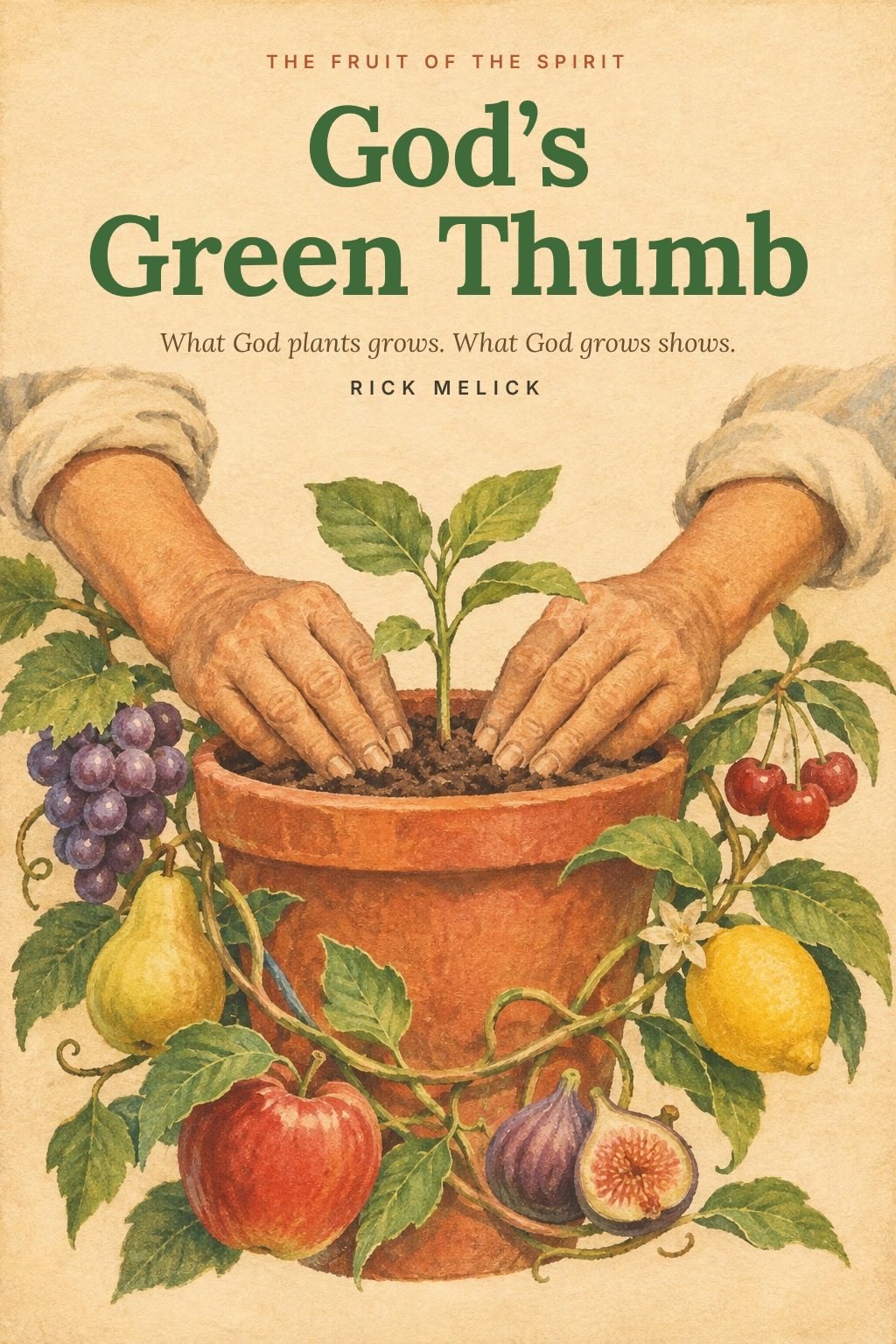
Read the entire book right here. Tap Contents to jump to any chapter.
Before You Start
Galatians 5:22–23 · "But the fruit of the Spirit is love, joy, peace, forbearance, kindness, goodness, faithfulness, gentleness and self-control. Against such things there is no law."
Nobody has ever grown an apple by trying really hard.
You can stand in front of a tree and grunt all you want. You can lecture it. You can read it a book about apples. Nothing happens. A tree grows fruit because it's alive, it's planted in good soil, and it's getting what it needs. The fruit just shows up.
That's the picture Paul gives us in Galatians 5. He doesn't call these nine things the works of a Christian. He calls them the fruit of the Spirit. They're what grows when God's Spirit is at home in you. You can't manufacture them. But you can put yourself where God grows them.
This book grew out of a spring series at Capitol City Church on that one short list. Each chapter covers one message. You'll find the stories I told (some of them at my own expense), the Scripture written out in full, and the plain truth that sits underneath all of it:
What God plants grows. What God grows shows.
How to use this book
- Read First. Every chapter opens with the passage. Read it before you read me. A paper Bible is best: circle, underline, write in the margins.
- The Message at a Glance. Three lines that tell you where the chapter is going.
- Myth and Truth. One thing most of us believe about this fruit that isn't quite right.
- Try It This Week. One or two things to do before the next chapter. Not ten, just a couple.
- Key Truths and For Reflection. Questions to work through on your own, with your spouse or with your small group. No right answers, and no Bible background needed.
- Let's Pray. A prayer to end with, or to start your own.
You'll notice love doesn't get its own chapter. It's the first fruit on the list, and it got an entire book of its own: Love Intentionally, on 1 Corinthians 13. Kindness and goodness share a chapter, and so do gentleness and self-control. They grow on the same branch.
Take one chapter a week. Don't rush it. Fruit never does.
Rick Melick
Capitol City Church · Des Moines, Iowa
Chapter 1What God Plants Grows
Matthew 5:43–48 · Matthew 23:27–28 · Galatians 5:16–25
The Message at a Glance
- The goal isn't to be more spiritual. It's to grow up. Jesus never once told anyone to be more spiritual. He called people to be mature. · Matthew 5:48
- You can look great on the outside and be a mess on the inside. Jesus had his harshest words for people who did. · Matthew 23:27–28
- You can't make yourself grow, but you can put yourself where God grows you. Live in the realm of the Spirit, and keep in step with him. · Galatians 5:16, 25
Read First · Matthew 5:43–48
43 "You have heard that it was said, 'Love your neighbor and hate your enemy.' 44 But I tell you, love your enemies and pray for those who persecute you, 45 that you may be children of your Father in heaven. He causes his sun to rise on the evil and the good, and sends rain on the righteous and the unrighteous. 46 If you love those who love you, what reward will you get? Are not even the tax collectors doing that? 47 And if you greet only your own people, what are you doing more than others? Do not even pagans do that? 48 Be perfect, therefore, as your heavenly Father is perfect."
The cabinet over the toilet
Joy and I love spring. What we don't love is the stretch of winter when it gets dark at four in the afternoon. We like to walk after work, and when the sun goes down that early, we go a little stir-crazy. So on the evenings we're not at church, I look for projects around the house, projects within my ability, which is a fairly small list.
One thing that drives me crazy is our master bathroom. I know, having a master bathroom is a blessing. Ours is a small one, though, and that is not a blessing when two grown adults are trying to get ready at the same time. We bump into each other, there's no storage, and when you're in a hurry (and we're usually in a hurry), it's just frustrating.
Above the toilet there was a towel rack, and I thought, I bet a cabinet would fit there. The bathroom cabinets I found online were little eight-inch-deep medicine cabinets that wouldn't hold anything, so I bought a kitchen cabinet instead. A full-size, swing-door kitchen cabinet. I measured it, I hung it myself, and it was level. Now, I know a kitchen cabinet over the toilet sounds terrible, but it doesn't look that bad, and I was proud of it.
Then we had a new problem. Joy has a lot more stuff than I do, and her side of the counter was covered with bottles and jars, all the things that make you ladies look so nice and smell so good. So we went to Target, because Target has a solution for everything. (I hate going in there. You always walk out with more than you came for.) We filled an entire cart with little plastic bins, big ones that stack and little ones a quarter of the size.
When we got home, I lined the cabinet with bins on all three shelves, took everything off the counter and dropped it into whatever bin was closest. No system. Didn't care. Slammed the cabinet door. The counter was spotless and the cabinet looked great, but if you opened the door, it was a mess.
Joy wanted to sort every bin before it went in. I said, "No, that's going to take time, and you don't know yet which shelf you want things on. So every day, when you open the cabinet, move a few things around and put them where you want them. A little at a time, it'll get more useful and more beautiful."
And I realized, probably because I was working on this message, that I'd just described what the Holy Spirit does in us.
When you become a follower of Jesus, the Holy Spirit moves in. He's the organizer, the power that makes it all work. You hand him the mess, all of it, including the junk you didn't know where to put. You put it in his hands and shut the door. Then, as you do your part, he does his. Every time you open the doors of your heart, it's a little more useful and a little more beautiful, until eventually you're unrecognizable. Not because you organized yourself, but because God did a work in you.
What God plants grows
This book walks through the nine qualities Paul lists in Galatians 5. If you've been around church, you know them as the fruit of the Spirit: love, joy, peace, patience (the NIV calls it forbearance), kindness, goodness, faithfulness, gentleness and self-control.
The title says it simply: What God plants grows. What God grows shows. If the Holy Spirit lives in you, something is growing, and sooner or later it shows on the outside.
Let me say one quick word about who the Holy Spirit is, because it matters for everything that follows. The Holy Spirit is God, not a force or a feeling. God expresses himself in three persons. The Father has the master plan. Jesus the Son carried out that plan on earth, and he still carries it out, seated at the Father's right hand. The Holy Spirit is the power that makes it happen. When Jesus did a miracle, the Father willed it, Jesus did it, and the Spirit powered it. Each of them is God, and none of them is each other. That's deeper water than one chapter can swim in, but here's what you need to know: if you follow Jesus, the Holy Spirit lives in you, and he's doing something even when you can't see it.
Love comes first in Paul's list, and it's the root of all the rest. I wrote an entire book on it, Love Intentionally, so in these pages we'll start with joy and keep love in the background. It's never far away.
Jesus never said, "Be more spiritual"
Here's something that surprises people: Jesus never once told anyone to be more spiritual, and Paul never wrote about it either. What they both talk about is maturity.
There's a big difference. Spirituality can be shallow. It can be all about me. It can turn into a buffet where I keep what I like, skip what I don't, and end up with a religion that looks a lot like me and not much like Jesus. Maturity is different, and Jesus taught about it in the Sermon on the Mount.
Jesus probably preached that sermon many times. He was a master teacher, and I'm sure you could hear him give the exact same message over and over and still hang on every word. I'm starting to repeat myself too. I'll be halfway into a story and think, Oh man, if you've been around a while, you've heard this one. The difference is, when Jesus repeated himself, nobody minded.
In the Sermon on the Mount, Jesus held up a mirror. His crowd included devout religious people, people who didn't believe at all and people who wanted him dead. The world they lived in was full of walls between families, religions, nationalities and political parties, and the religious folks had narrowed down "my kind of people" so far that they had permission to ignore just about everyone else.
Jesus said, "You have heard that it was said, 'Love your neighbor and hate your enemy.' But I tell you, love your enemies and pray for those who persecute you" (Matthew 5:43–44).
Notice what he didn't say. He didn't say pray against them, or pray that God gives them what they've got coming. He said pray for them.
Here's how I try to do that. I don't always do it well, but it's my goal. When somebody is angry, attacking me or attacking what I hold dear, I assume something is probably broken between them and God. So I pray, "Lord, restore that relationship, or give them one. And do it as gently as possible." (I pray the same thing for me, by the way: "If I'm the one out of line, fix me. Start here.")
That last part, as gently as possible, is where it gets real. Think about the person who's hurt you the most. Even if you can bring yourself to pray that God would bring them back to him, don't you kind of want them to jump through a few hoops first? Pay a little? Come back the hard way? But we don't want what we deserve, and if they deserve it, we deserve it.
Then Jesus said the line that's confused a lot of us: "Be perfect, therefore, as your heavenly Father is perfect" (Matthew 5:48).
Growing up, I had that verse held over my head. It usually came out whenever my behavior didn't match somebody's religious standards, and "Be perfect like God" really meant "Be perfect like us, because we know exactly what God wants." If that's the standard, who could ever say, "I've arrived. I'm spiritually perfect"? You'd have to be on drugs or deluded. So most of us throw up our hands and say, "Well, I'm out."
But that's not what the word means. The word Jesus used here (teleios) means mature, complete, grown up. Jesus is saying, "If you want to grow up in your faith, start by checking your heart toward people: the ones in your life, the ones around your life and the ones who aren't in your life at all but still affect it."
When I was in fifth grade, if you'd asked me, "Rick, why do you always think about yourself?" I'd have said, "Who else is there?" That's normal for a fifth grader. Growing up is figuring out that life isn't all about you.
This part makes me uncomfortable. I like to think Jesus hates the same people I do. But the minute I start thinking that way, I've created him in my image instead of letting him create me in his.
Maturity is the goal, not spirituality.
Bright on the outside
One of the big mistakes Christians make is measuring maturity by how much we know. "I'm a deep Christian. I know my Bible." Jesus never measured maturity by what you know. He measured it by how you apply what you know.
The religious leaders of his day had the best education available. They knew the Scriptures backward and forward, and their hearts were a long way from God and a long way from people.
During the last week of his life, Jesus spoke some of the hardest words he ever said. In Matthew 23, he pronounced seven "woes" on those religious leaders. A woe isn't a curse word. The word even sounds like grief. It's a cry from the gut, a heartbroken verdict on the condition of someone's heart. The sixth one goes like this:
Matthew 23:27–28 · "Woe to you, teachers of the law and Pharisees, you hypocrites! You are like whitewashed tombs, which look beautiful on the outside but on the inside are full of the bones of the dead and everything unclean. In the same way, on the outside you appear to people as righteous but on the inside you are full of hypocrisy and wickedness."
Everybody listening knew exactly what he meant. Tombs in Israel were caves and rock markers, and you couldn't always tell they were tombs. Under Jewish law, if you touched one, you became ceremonially unclean and had to go through purification. So every spring, about a month before the crowds came to Jerusalem for Passover, there was a day set aside to mark the tombs with whitewash, so travelers would know where not to sit and what not to touch.
This wasn't paint like we have. You couldn't run down to Sherwin-Williams and buy the good stuff that covers in one coat. It was crushed limestone mixed with water, the really cheap stuff, and it lasted less than a year. When the winter rains came, they washed it right off, and everybody had to do it all over again. Bright and clean on the outside, death on the inside, and everybody knew it was just for show.
That's the cabinet over the toilet, isn't it? Spotless counter, door shut, just don't open it. And for those leaders, it wasn't getting better. It was getting worse, because they were organizing their own bins.
So what are we supposed to look like? Paul answers that in Ephesians 4. As we serve each other, love each other and grow in our faith together, the goal is that we "become mature, attaining to the whole measure of the fullness of Christ" (Ephesians 4:13). The goal is Jesus: how he acts and reacts, when he responds and when he chooses not to. If the Holy Spirit is in you, he's rearranging the cabinet, so that over time, when you open those doors, you stop seeing the mess you made and start seeing the beauty he's making. And it looks like Jesus.
Myth: Mature Christians know the most
Truth: Maturity isn't measured by what you know. It's measured by how you live what you know, starting with how you treat the people closest to you. The most mature person you know may not be the one with the most information. It's the one with the most transformation.
Better than a stack of paperwork
My wife loves sticky notes. Loves them. I bought her an iPad, and she uses it as a place to stick her sticky notes. It's her personality, and it's very cute, unless I need the note.
Not long ago we were out shopping for something that needed measurements.
"Joy, where are the measurements?"
"They're with my paperwork."
"Where's your paperwork?"
"In my stack."
"Where's your stack?"
"At home."
The information existed. It was just useless, because it was in a stack at the house and we weren't.
I'm on a mission to ruthlessly eliminate paper from my life. If you hand me a piece of paper, I'll take a picture of it (maybe not in front of you, because that would be rude), save it and shred the paper. If it's in the cloud, I have it anywhere, on any device: my phone, my watch, my iPad, your computer. It's always with me. My wife takes a picture of something so she can go home, print it and put the printout in her stack. Then she deletes the picture. It's a personality difference. It's fine. Really.
But think about the Holy Spirit before and after Jesus went back to heaven. Before, it was like paperwork. You had to be where Jesus was. If you needed to hear from him, you had to go find him, because he was one body in one place at one time.
Then Jesus told his disciples something that must have sounded impossible: "It is for your good that I am going away. Unless I go away, the Advocate will not come to you; but if I go, I will send him to you" (John 16:7). The Spirit wouldn't be better than Jesus in quality. He'd be better in proximity, living inside every follower, everywhere, all the time. You don't have to go find your stack. The one you've been learning from now lives in you, and all you have to do is put yourself in a place to connect.
Two words that change how you grow
Right before Paul lists the fruit of the Spirit, he tells us how it grows:
Galatians 5:16–17, 25 · "So I say, walk by the Spirit, and you will not gratify the desires of the flesh. For the flesh desires what is contrary to the Spirit, and the Spirit what is contrary to the flesh. They are in conflict with each other, so that you are not to do whatever you want… Since we live by the Spirit, let us keep in step with the Spirit."
There's a war going on inside every one of us. That's okay. God is going to win, if we let him, and Paul gives us two words that show us how.
The first is walk (peripateō). It literally means to walk around, to live in the realm of someone. You don't need to know the Greek, unless you want to impress your friends. (It might. It might just make you obnoxious.)
Here's what it looks like. Let's say you really wanted to know what I was going to preach next Sunday, so you asked, "Rick, can I follow you around this week? Every time you think of something for the sermon, just tell me, and I'll write it down." (I know, I'm not that exciting. You'd only do this once.) So you follow me to the gym and to Hy-Vee. Wherever I go, however boring it is, there you are, right behind me, and every once in a while I toss something back over my shoulder, a little truth bomb, lovingly lobbed, and you write it down.
That's living in the realm of someone, and that's how it worked in the first century. Students followed their teacher everywhere, not just to class. They watched what he did when somebody bumped into him at the market. Did he get angry, or did he respond with gentleness? They watched how he talked to his wife and raised his kids, and they learned as much from that as from anything he taught. Walking by the Spirit means making yourself available to him all day long, in the ordinary moments.
The second word is keep in step (stoicheō). It's a marching word. It means doing the things you know will keep you in line, the habits that put you in a place where you can grow.
You can't grow yourself. But you can put yourself where God grows you.
A bonsai on my dresser
A couple of weeks before this series started, I bought a bonsai tree. I learned there are several kinds, and I bought the easiest one to keep alive, which also happens to make it the ugliest one. It needs a haircut, and I haven't figured out how to trim it yet. I'm learning.
I'm not a plant guy. I appreciate trees and nature, but I don't care about plants. And by the way, plants don't have a soul. God gave them to us, and they serve a purpose, but please don't hug a tree. My goodness, people get weird. Anyway, I bought this one on purpose, because I wanted to start every day with a reminder: I can't do the changing, but I can do the placing.
I looked up how to keep it alive. A little light, not too much. A little water, not too much, or it gets root rot. A little food once in a while. If the leaves turn yellow, you're doing it wrong.
Our bedroom has blackout shades, because headlights from the street used to shine on our ceiling all night. So every morning I pick up the bonsai off my dresser, take three steps to the window, raise the blinds, lift the shade and set it in the sun, where it stays all day. At night I put it back on the dresser, on its little doily (I had to ask Joy what those are called) so it doesn't leave water rings, and close everything up. The next morning I do it again. I haven't missed a day yet. (Watch, I'll miss tomorrow.)
I don't know the first thing about photosynthesis, and I can't make it grow. I just know that if you put it in the right place, the right things happen. And if you don't get the simple things right, nothing else matters.
Here are the simple things I do to put myself where God can grow me. Take what helps.
Get God's Word in you every day. God says his Word teaches us, corrects us and restores us (2 Timothy 3:16–17). It's alive (Hebrews 4:12), and it's one of the main tools the Holy Spirit uses to change us. If you're not opening it, you're not raising the blinds.
Redeem the time. I like to walk, on the treadmill or outside, and most of the time, instead of music, I listen to something that grows my relationship with Jesus: a chapter of a book, a sermon or a podcast on what I'm studying. My music tastes run toward AC/DC, old Eminem and Tupac. Nothing wrong with that. But I'm trying to grow spiritually while I grow physically.
Guard your waking and waning moments. The first thought when I wake up sets the tone for the entire day. Who am I living for? What do I want today? I don't know anything more important than starting the day by giving myself to the Lord. Not so he knows. So I know. The last thoughts before I fall asleep matter too, and I want them to remind me that I trust him, not myself. During the day, I set reminders on my phone to check in.
Find people who are farther down the road. You need people in your life who, if your faith turned out like theirs, you'd be the person you want to be. Don't look for the person with the most information. Look for the person with the most transformation.
Do those things, and the Holy Spirit will start changing your actions, your reactions, your desires and your thoughts. You'll find it easier to forgive. You'll think less about yourself and more about other people. And one day you'll open the cabinet doors of your heart and realize something has changed. You're becoming useful and you're becoming beautiful, and it's for his glory, not yours.
If your leaves are a little yellow right now, that's good news. It means you can start today.
Try It This Week
- Raise the blinds every morning. Before you look at your phone, give the day to the Lord in one sentence: "Today, I'm yours."
- Pray for one person who's hard to love. Not against them. For them. "Lord, draw them to you, as gently as possible."
- Read Galatians 5:16–26 each day this week. Underline every word about the Spirit.
- Name one person whose faith you'd like yours to look like. Ask them to coffee.
Key Truths
- What God plants grows. What God grows shows.
- Maturity is the goal, not spirituality.
- The quality of your faith shows up in the quality of your relationships.
- You can't grow yourself, but you can put yourself where God grows you.
For Reflection
- When you hear "be more spiritual," what comes to mind? How is that different from becoming mature?
- Jesus said to pray for people who oppose you. Who's hardest for you to pray for that way? Why?
- Where might your life be "whitewashed": clean on the outside, but cluttered inside?
- What's one way you can "raise the blinds" every day?
- Who in your life has more transformation than information? What could you learn from them?
Let's Pray
Father, we don't just want to be more spiritual. We want to grow up. Examine our hearts. Point out any thought, action or attitude that doesn't please you, any sense of entitlement, any demand we're making on the world around us. Thank you that your Holy Spirit lives in us and is reorganizing the cabinet of our hearts. Help us put ourselves where you can grow us, so that what you plant in us grows, and what you grow shows. In Jesus' name, amen.
Watch the message: vimeo.com/1163054970
Chapter 2Joy

John 15:5–11 · Galatians 5:22–26 · Nehemiah 8:10
The Message at a Glance
- Joy grows from the inside out. The world chases joy from the outside in. The joy Jesus gives starts deep inside and works its way out. · John 15:11
- Joy grows in people who stay. Jesus said remain. Don't quit. Stick around, and let him do what only he can do. · John 15:5
- You can't create joy, but you can stop it. Put yourself where God can grow it. · Romans 12:2
Read First · John 15:5–11
5 "I am the vine; you are the branches. If you remain in me and I in you, you will bear much fruit; apart from me you can do nothing. 6 If you do not remain in me, you are like a branch that is thrown away and withers; such branches are picked up, thrown into the fire and burned. 7 If you remain in me and my words remain in you, ask whatever you wish, and it will be done for you. 8 This is to my Father's glory, that you bear much fruit, showing yourselves to be my disciples. 9 As the Father has loved me, so have I loved you. Now remain in my love. 10 If you keep my commands, you will remain in my love, just as I have kept my Father's commands and remain in his love. 11 I have told you this so that my joy may be in you and that your joy may be complete."
"An older gentleman"
Our staff eats lunch together every Tuesday before our weekly meeting. One week, our early childhood director was describing a man in our church, and she looked right at me and said, "He's an older gentleman, just like you."
She's thirty-nothing. She's a child.
I said, "What do you mean, older gentleman?"
She looked at me blankly. "Well, you're older than me, and I guess you're a gentleman. So you're an older gentleman."
To me, an older gentleman is the guy shuffling across the parking lot who needs help getting up on the curb. That's not what I see in the mirror. (Some mornings it's what I feel in the mirror.) So I looked across the table for a little backup from one of our other staff members, who is also thirty-nothing, and he said, "Hurts when somebody holds up a mirror, doesn't it?"
So both of them are fired. We're hiring. I even looked at the staff member who keeps our records and said, "Put this in their HR file." She was laughing too hard to write anything down.
Okay, not really. They survived, and so did I. But I'll tell you what: I was motivated at the gym all week. Every rep. Older gentleman. I'll show you older gentleman. I had a chip on my shoulder, and it got me moving.
So here's my question for you: what's your motivation for following Jesus?
For some people, it's a get-out-of-hell-free card. You signed a card, walked an aisle and made a decision, so when you die you'll go to heaven, and you never have to think about it again. If that's you, you're missing the point of following Christ, and you may be missing the relationship with Jesus altogether.
Following Jesus is more than a position, a social club, a worldview or an ideology. It's your identity. When you follow Christ, you become a new creation. The old is gone, the new has come, and the Holy Spirit starts growing something new in you. One of the first things that shows is joy.
Joy is second in Paul's list of the fruit of the Spirit, and I believe it's one of the clearest marks of a follower of Jesus. Our world is so short on joy that when a believer has it, it's unmistakable.
The world does not need more explanations about who Jesus is. It needs more examples of the difference Jesus makes in a life.
When people look at your life, what do they see? Do you have a joy that doesn't make sense, one that doesn't depend on your circumstances? Does it show up at the most unlikely, inconvenient times, so that people who don't know who you follow want to know what's different about you?
You can't manufacture that kind of joy. But you can stop it. Jesus talked about it in John 15.
An old man remembers a Thursday night
The Bible is one book made up of lots of books, and each one was written for its own purpose. The Gospel of John was written by an older gentleman. I don't think John would mind me calling him that. He was probably in his eighties when he wrote it.
John had been part of Jesus' inner circle. He called himself "the disciple whom Jesus loved," and he saw everything we read about in the Gospels. Then he lived for decades after Jesus rose and went back to heaven. He saw amazing things and tragic things, things that would have made most people walk away, and he didn't. When the Holy Spirit inspired him to write down what he remembered, one of the things he wanted us to know was how to have joy.
John 15 takes place on the Thursday night before Jesus died. Jesus and his disciples were in the upper room, celebrating Passover. Jesus knew he would soon be arrested, tried, tortured and killed, so he was giving them his last instructions, the things they couldn't afford to forget. And he used a picture: a vine, a gardener and branches.
To us, that doesn't mean much. To them, it meant a lot. Israel had been called God's vine for centuries (Psalm 80:8; Isaiah 5:7), and a huge golden vine decorated the entrance to the temple in Jerusalem. Every Jewish person knew that picture.
Here's what else you need to know. For almost three years, there had been twelve disciples. Now there were eleven. Just a few minutes earlier, Judas had gotten up from the table and walked out into the night to betray Jesus (John 13:27–30). The friend they'd trusted with the money was gone. So when Jesus talked about two kinds of branches, the ones that stay and the ones that don't, everyone at that table knew exactly who he meant. One had left. Eleven had stayed.
Remain
The big word in this passage is remain. Older translations say abide. In everyday Greek, it was a word for home, the place you'd rather be than anywhere else.
You know those friends who would always rather stay home? You invite them out, and they say no. It's not because they don't like you. They like being asked. They just love being home. That's the feel of this word. Jesus was saying, "Don't forget your home. Stay close. Stay connected."
This word means a lot to me personally. Before Joy and I moved from Tennessee to Marin County, just north of San Francisco, to start a church, we had prayed for six months that God would send us somewhere so hard that nobody could give me credit for anything good that happened, somewhere I'd have to ask God every single day what to do.
He answered that prayer. Marin County was one of the least-churched, best-educated and wealthiest places in the country, full of brilliant people who knew far more than I did about almost everything except Jesus. We started from scratch: just Joy, me and our two little boys.
I needed a name for the church that would make sense to people who had zero experience with church. After a lot of prayer and some trial and error, we chose the word from John 15 and called it Abiding Way. The staying way. The don't-walk-away way. The keep-coming-back way.
Somebody once said that eighty percent of success is just showing up, and that's a big part of what Jesus is saying. You keep coming even when you don't understand it, even when you don't feel it and even when you don't want to, because that's who you are. You put yourself where God can do the rest.
Look at what Jesus promises in John 15 to the people who remain.
You'll have a personal relationship with God. "Remain in me, as I also remain in you" (John 15:4). That should blow your mind.
You'll ask, and you'll receive. "Ask whatever you wish, and it will be done for you" (John 15:7). Hang on to that one. We'll come back to it.
Your life will bear fruit. There are two kinds of fruit in the Bible. There's action fruit, the things we do that look like Jesus. And there's attitude fruit: who we are on the inside, how we respond and what comes out of us when life squeezes. Galatians 5 is about attitude fruit.
And then Jesus sums it all up: "I have told you this so that my joy may be in you and that your joy may be complete" (John 15:11). Complete means full, grown up. If you don't quit, joy is going to happen, not just to you but through you.
Inside out, not outside in
The Greek word for joy is chara. It's closely related to charis, the word for grace, a gift, and that tells you a lot. Joy is our natural response to grace. We have joy because God has been gracious to us.
Joy is an emotion, something you feel, but it's more than that. It becomes part of your attitude and part of how you see the world. When your circumstances don't look joyful, something inside you responds differently than it normally would.
The world looks for joy from the outside in. What can I buy? Where can I go? What can I accomplish? And when we finally grab it, we find out it was nothing, so we chase the next thing. Ecclesiastes calls it chasing after the wind. The joy Jesus gives works the other way. It's planted on the inside by the Holy Spirit, and it grows its way out.
Here's a simple way to remember it: J.O.Y. Jesus, Others, You. In that order.
And here's why so many of us miss it. We're looking for the extraordinary, scanning the horizon with binoculars and waiting for the big explosion, something that will move us and impress us. Meanwhile joy is all around us in ordinary places, and we walk right past it.
We often miss joy because we overlook the ordinary and expect the extraordinary.
When believers live with an outside-in kind of joy, just like everybody else, we're telling the world something. We're telling them Jesus isn't as good as the songs we sing on Sunday.
Myth: Joy depends on what happens to you
Truth: Happiness depends on what happens. Joy depends on who lives in you. It's planted by the Holy Spirit, it grows from the inside out, and it can show up on your hardest days. As Nehemiah told God's people, "Do not grieve, for the joy of the LORD is your strength" (Nehemiah 8:10).
Peter stuck around
If you had to pick the one disciple most likely to quit, who would it be?
Most of us would pick Peter. He meant so well, and he failed so hard. One time Jesus looked him in the eye and said, "Get behind me, Satan!" (Matthew 16:23). Jesus wasn't calling him the devil. He was saying, "Right now, you're standing in the way of what my Father wants." That would be hard to hear.
In John 6, Jesus was teaching some hard things. Following him meant denying yourself and dying to self, and a lot of people didn't want that. They'd liked the show and loved the teaching. He was funny, kids loved him, and sometimes there was free lunch. But now, a few at a time, they were slipping away, and it broke Jesus' heart.
So he turned to the twelve and asked, "You do not want to leave too, do you?"
And guess who spoke up. Peter. Unpredictable, inconsistent, volatile Peter. "Lord, to whom shall we go? You have the words of eternal life" (John 6:67–68).
What did Peter have going for him? He stuck around. Judas walked away.
I'm a lot like Peter. People sometimes try to correct me when I say this, but I'm really bad at this Christian thing. Maybe I'm better at it than you. (I'm kidding. Mostly.) But I don't compare myself to you. I compare myself to Jesus, and I'm nowhere near Jesus.
But I'm not going to quit. Where else would I go? I've stopped searching. Even when I fail, even when I'm inconsistent, even when I embarrass him, I'm still here.
More than marketing
I love hand sanitizer. Hand sanitizer and breath mints are the two things that keep me going. If you're a medical professional, I don't want to argue with you about whether it works. Let me have my placebo. Just let me believe it kills everything.
Joy and I needed more, and the store was out of Purell. They only had Germ-X. Germ-X is nasty. It leaves a film on your hands and smells suspiciously like chemicals from somewhere you don't want to visit. If you need to start a campfire, use the Germ-X. Just don't put it on your hands.
So I went to Amazon to order Purell, and I found a bottle labeled Prime Defense. Maximum strength. For high-risk environments. I said, "Joy, I found it! The holy grail of hand sanitizer!" and I paid two bucks more a bottle.
When it came, I read the label. It's exactly the same as the regular stuff, with no difference at all. But I liked the marketing. It was worth two bucks to feel better.
Our faith can be like that. If you only buy the marketing, if you just go through the motions and look the part, you'll never experience the real thing God had in mind.
When Jesus says "remain," he doesn't mean "just come to church and everything will be okay." Getting yourself to church matters. I really do think it's a big part of the battle, because when your body shows up, your heart eventually follows. But I can drive to college and sit in the parking lot all semester, or drive to the gym and never get out of the car. Being in the right place doesn't make the right things happen.
Paul put it this way: "Do not conform to the pattern of this world, but be transformed by the renewing of your mind" (Romans 12:2). Notice how that works. You can't transform yourself, but you can refuse to be squeezed into the world's mold, so God can do the transforming.
Baby leaves
Remember my bonsai? Twenty-one days out of twenty-one, I opened the window, and I'm really proud of that. Three steps from the dresser to the window, raise the blinds, lift the shade and set it on the sill. (Full disclosure: the price tag is still on it. When this is over, I may take it back to Lowe's. I'm a little undecided about its future.)
One morning I noticed little baby leaves sprouting, and I was so excited. I don't know how they got there. I didn't make them. All I did was open the window every morning and put that little tree where it could grow. While the shade is up and the pot is on the sill, God is doing something in that plant I have nothing to do with. I can't make it grow. But I could stop it.
Your life works the same way. There are things you have to do to cooperate with God so he can grow joy in you. If you won't do them, you won't grow. And if you won't do them for a lifetime, it's worth asking whether you have a relationship with Jesus at all.
Now, don't attack my system. People love to do that when they get defensive. If you tell me you don't like my system, I'll ask, "What's yours?" And if you say, "Well, I don't have one," I'll smile, pat you on the shoulder and say, "Then why not try mine until you find something that works?" Because doing nothing, my friend, is how you stay the same year after year and die filled with regret.
Start somewhere, and adjust as you go. Here's what works for me.
Waking and waning moments. Every morning, I give my day to the Lord. I'm really telling myself: Self, today you're going to live for Jesus. You won't want to, because you're selfish. But today belongs to him. Raising the shade for the bonsai became my picture of that. At night, I make sure my last thoughts remind me that I belong to him.
Reminders on my phone. My phone runs my life. When it dings, I look. Some of you have mastered ignoring your phone. You frustrate me, but I respect you. I haven't gotten there, so I use it. I set reminders that go off all day to put God's Word in front of me. Here are a few.
- 8:00 a.m.: "This is the day the Lord has made; we will rejoice and be glad in it." (That's the wording of Psalm 118:24 I grew up with.) This is the day the Lord has made. I'm the me the Lord has made. These are the circumstances the Lord has made, and these are the people the Lord has put around me. Wherever I am and whoever I'm with, I will rejoice and be glad in it.
- 8:30 a.m.: "Attention is the rarest and purest form of generosity." It's not Scripture, but it's biblical. It reminds me to really pay attention to the person in front of me, to the opportunity I have and to what God might want from me.
- Proverbs 3:5–6: "Trust in the LORD with all your heart and lean not on your own understanding; in all your ways submit to him, and he will make your paths straight."
- Psalm 5:12: "Surely, LORD, you bless the righteous; you surround them with your favor as with a shield." That one might sound like I think I'm righteous. I don't. It reminds me to live in a way God would call righteous, so I'm not the one getting in the way of his protection.
Something good going in. I've told you about listening to sermons and books when I walk. Do it your way: read, listen, whatever works. Just make sure God's Word gets in. If nothing goes in, nothing grows, and that's buying the marketing without the product.
Someone holding up the mirror. Remember my thirty-nothing coworker? "Hurts when somebody holds up a mirror, doesn't it?" It does, and you need it. You need at least one person whose faith you'd love yours to look like, someone who will hold up the mirror for you while you hold it up for them. Without that, you'll fool yourself into thinking you're fine. And pretty soon God will agree with everything you think, and he won't like anybody you don't like.
Asking in Jesus' name
Now, back to that promise: "Ask whatever you wish, and it will be done for you."
Does that mean God is a vending machine? No. Jesus is talking about asking in his name, as someone who remains in him, and here's what I think that means.
- It means not being angry when you don't get what you want. That's a deal-breaker for a lot of people. "If God loved me, he'd give me what I asked for." No, he wouldn't. Not if it would hurt you.
- It means accepting the roles. He's the Father. You're the child.
- It means trusting that God is in control and has your very best interest at heart.
- It means knowing you'd get everything you asked for if you prayed knowing everything God knows. We don't know what he knows. Sometimes we're asking for the wrong thing, or at the wrong time. But when our wants line up with his, we get exactly what we pray for.
That's one more thing that happens as you stay close. I check in with God all through the day. Sometimes something comes up, and I'll ask, "Lord, do we need to talk about this now, or later?" If it's now, I stop what I'm doing and listen. Usually it's later, so I put a note in my phone, because otherwise I'll forget. If you ask me to follow up on something and I care about you, I'll put it in my phone. What conversation could be more important than the one I'm having with God?
Reasons for joy
Joy is a strange thing. It comes from what we know, but it isn't limited by what we know. Sometimes we feel it first and then go back and ask why. The Bible gives us some bearing points, so we know it's real.
The joy of salvation. Jesus said "there will be more rejoicing in heaven over one sinner who repents than over ninety-nine righteous persons who do not need to repent" (Luke 15:7). Heaven throws a party.
The joy of being set free. When an angel broke Peter out of prison, he knocked on the door of the house where the church was praying for him. The servant girl, Rhoda, was so overjoyed that she ran back to tell everyone and forgot to let him in (Acts 12:14). Whether it's a prison or sin, a habit, an addiction or an attitude, being set free is a reason for joy.
The joy of a growing faith. Paul was filled with joy when he saw the Holy Spirit changing the people in the churches he loved (2 Corinthians 7:4). Sometimes you can see God's hand in someone else's life more clearly than in your own.
The joy of God's presence. "You will fill me with joy in your presence, with eternal pleasures at your right hand" (Psalm 16:11).
There are plenty of reasons to feel it. But only God can grow it.
Abiding Way had a tagline: The Church Becoming. People used to ask me, "How long are you going to be the church becoming? When will you be the church that became?"
Never. And it's true of you too. You're the person becoming, and you'll never be the person who became until Jesus comes back or you go to be with him. So between now and then, let's remain. Don't put down the window shade, and don't walk out of the room. Stay close to the Vine, and let him grow a joy in you that the world can't explain.
Try It This Week
- Set one reminder on your phone with a verse from this chapter. Psalm 118:24 is a great place to start.
- Look for ordinary joy. Each night this week, write down one small thing you would have missed if you'd been looking for something big.
- Pray in Jesus' name about one thing you really want. Then add, "But you know better than I do."
- Read John 15:1–17 twice this week. Circle every time Jesus says remain.
Key Truths
- The world doesn't need more explanations about Jesus. It needs more examples of the difference he makes.
- Joy grows from the inside out, not the outside in.
- You can't create joy, but you can stop it.
- We often miss joy because we overlook the ordinary and expect the extraordinary.
- Remain. Don't quit. Stick around, and let God do what only he can do.
For Reflection
- What's your real motivation for following Jesus right now?
- Where do you tend to look for joy from the outside in?
- Peter failed often but stayed. What makes you want to walk away when following Jesus gets hard?
- Which of the "asking in Jesus' name" statements is hardest for you to accept? Why?
- Who in your life could hold up the mirror for you?
- What's one ordinary thing this week that brought you joy?
Let's Pray
Father, some of us have let circumstances, people or our own choices steal our joy. Sometimes we're cynical. Sometimes we worry like everything depends on us. Sometimes we fail like Peter. But we don't want to quit. Help us get up every morning, whatever happened the day before, and open the shades. Help us remain in you and let your words remain in us. Grow in us a joy from the inside out, a joy the world can't explain, so that people look at us and see you. In Jesus' name, amen.
Watch the message: vimeo.com/1165179708
Chapter 3Peace

John 16:25–33 · Philippians 4:4–9
The Message at a Glance
- Peace isn't just the absence of trouble. It's the presence of Someone. God is in control, and I'm not. That's where peace starts. · John 16:33
- In this world you will have trouble, but in Jesus you can have peace, because he has overcome the world. · John 16:33
- You can feel anxious without living anxious. Prayer, thanksgiving and a mind set on what's true let the peace of God stand guard over your heart. · Philippians 4:6–7
Read First · John 16:31–33
31 "Do you now believe?" Jesus replied. 32 "A time is coming and in fact has come when you will be scattered, each to your own home. You will leave me all alone. Yet I am not alone, for my Father is with me. 33 I have told you these things, so that in me you may have peace. In this world you will have trouble. But take heart! I have overcome the world."
All is well between God and me
If there's one thing our world is missing right now, I think it's peace.
The Hebrew word for peace is shalom. Jewish people still use it today to say hello and goodbye, and here's what it means: All is well between God and me, so all is well.
If you're like me, your first reaction is, "That can't be true. Have you seen the news? Things are not okay." It's tempting to think that if God were really paying attention, the world wouldn't look like this. But shalom doesn't mean nothing's going wrong. Look at how the Old Testament uses it.
When King David wanted a report from the front lines, he asked about the soldiers' shalom (2 Samuel 11:7). They were in the middle of a war, so peace didn't mean the fighting had stopped. It meant they were whole, with nothing missing.
When God told Moses how to build an altar, he said to use whole stones, stones with no cracks or chisel marks (Deuteronomy 27:6). The Hebrew word for those stones comes from the same root as shalom: complete, no gaps. When Solomon built the temple, the stones were finished at the quarry so they'd fit perfectly (1 Kings 6:7). Same idea. Nothing shoddy, nothing missing.
That's peace. It's not the absence of conflict but the presence of Someone. It's knowing that I don't control my circumstances, but God does, and because I've let him take his rightful place in my life, everything is okay between him and me. Life is still a roller coaster. But God is in control, and I can rest.
In the New Testament, the Greek word for peace is eirēnē. It carries the same two ideas, peace inside your own heart and peace in your relationships with other people, and under both of them is peace with God. When Paul lists peace as a fruit of the Spirit in Galatians 5, he doesn't say which one he means. I think he means all three.
Three things everyone needs
I love it when psychology lines up with Scripture. Not because it proves the Bible is true. I already believe that. It's just nice when the science catches up.
Psychologists say every person needs three things:
- Someone to love, and someone who loves us back.
- Someone to trust, and someone who trusts us.
- Something to hope in, something to put our future in.
Paul said it centuries earlier: "And now these three remain: faith, hope and love. But the greatest of these is love" (1 Corinthians 13:13). All three show up in Jesus' last words to his disciples in John 16. You just have to peel back a layer to see them.
It was the Thursday night before Jesus died. The Passover meal was over, and Judas was gone. It was probably after midnight by now, just hours before Jesus would be arrested in the garden. These are the last words John records Jesus speaking to his disciples before the end, and he ends with a promise: peace.
First, Jesus told them things were about to get clearer. "Though I have been speaking figuratively, a time is coming when I will no longer use this kind of language but will tell you plainly about my Father" (John 16:25). Jesus often taught in parables, stories that revealed the truth to some people and hid it from others. But the Holy Spirit was coming to guide them into all truth. And here's something interesting: after the Gospels, nobody in the New Testament teaches in parables. The rest of the New Testament says it plainly.
Second, they could go straight to the Father themselves. "In that day you will ask in my name. I am not saying that I will ask the Father on your behalf" (John 16:26). That was a bombshell for Jewish believers. No priest, no go-between. Direct access.
And then Jesus said something that blew my mind when I was studying this. I don't know how I missed it before: "No, the Father himself loves you because you have loved me and have believed that I came from God" (John 16:27).
God likes you
The Greeks had several words for love. Here are three.
Agape is the love of commitment. It's the fruit-of-the-Spirit word for love, the one Paul uses in 1 Corinthians 13: choosing to love because it's right, no matter what, for as long as it takes. It's the kind of love I promised my wife when we got married, for better or worse, in sickness and in health, till death do us part.
Eros is romantic love, physical love. (It never shows up in the New Testament, but it's the kind you hope comes along with the commitment. Thankfully, in our marriage, it did.)
And philia is the love of family and friendship. It's a bond, an affection.
Jesus had already told his disciples that God agape-loves them. But here in John 16:27, the word for love is phileō, friendship love. Here's what that means: God doesn't just love you. God likes you.
When your name pops up on his caller ID, he smiles. He doesn't groan and send you to voicemail. When he sees you coming down the aisle at Target, he doesn't turn his cart around. You make his heart happy.
When I sat with that, it overwhelmed me a little, because I don't always feel that way. Part of me thinks, Okay, God, you love me because you have to. But that's not what Jesus said. God chooses you, and he enjoys you. There's the first thing everybody needs: someone to love, who loves you back.
The disciples said, "Now you are speaking clearly… This makes us believe that you came from God" (John 16:29–30).
And Jesus said, "Do you now believe? A time is coming and in fact has come when you will be scattered, each to your own home. You will leave me all alone" (John 16:31–32).
Within about twelve hours, that's exactly what happened. When the soldiers came, the disciples ran. But Jesus kept going: "Yet I am not alone, for my Father is with me."
That's good news for you too. Even if everyone in your life has walked away, you are not alone. God is with you. You can understand him, and you can go to him directly. You're loved completely, and you're never alone. There's the second thing: someone to trust.
Three things to remember
Then Jesus summed it all up in one verse: "I have told you these things, so that in me you may have peace. In this world you will have trouble. But take heart! I have overcome the world" (John 16:33).
1. In this world, you will have trouble. Expect it. The rain falls on good people and bad people, because we live in a broken world. Sometimes we bring trouble on ourselves, and sometimes it just happens. Life happens.
The Greek word for trouble is thlipsis. It means pressure, crushing pressure, like grapes in a winepress.
When Jesus says "the world," he doesn't just mean the planet. He means the system, the way things work in a world that's turned its back on God. John later wrote that "the whole world is under the control of the evil one" (1 John 5:19). God is still in control, but for now he's given the enemy a long leash.
Jesus was straight with his disciples. The world was going to hate them for three reasons: because it hated Jesus first, because they didn't belong to the world's system anymore and because the world doesn't know God (John 15:18–21; 16:3). They'd have a different love, a different faith and a different hope, so why would they expect to fit in?
Here's a hard question. If you never feel any friction in this world because you follow Jesus, if you're just going along to get along, are you really following him?
2. But in me, you will have peace. Not instead of trouble, but in the middle of trouble. Here's why:
- You are loved by God.
- You are in God's everlasting care.
- God has a promise for your future.
There's the third thing everybody needs: something to hope in.
3. Because I have overcome the world. "Take heart!" In Greek, it's one word, tharseite. It's a command, and in the New Testament it's almost always Jesus who says it. You could translate it, "Cheer up!"
Now, when your friend tells you to cheer up while you're hurting, it's annoying. It feels like they're brushing off your pain. But when Jesus says it, it's not a pep talk. It's a promise. He loves you, he knows what's going on, and he's paying attention. He's in control, and he has already won.
Wired for bad news
Part of our problem with peace is how we're wired. Our brains pay more attention to bad news than good news. That's not all bad, because noticing danger keeps us alive. But it also means we collect bad news and believe the worst.
A while back, I heard a talk by a Swedish doctor who wrote a book about how wrong most of us are about the state of the world. He's not writing as a Christian. He just studied the numbers. He showed that over the last two hundred years, extreme poverty has gone from the way most of the world lived to fewer than one in ten people, and that deaths from natural disasters are a small fraction of what they were a century ago. I didn't believe him, so I bought the book. It was chapter after chapter of research.
We don't necessarily have more disasters. We just see more of them. And a lot of Christians love to whisper about how terrible everything is, because it fits the story we like to tell.
But that's not the point Jesus was making. He wasn't saying, "Cheer up, the numbers are better than you think." He was saying, "You will have trouble. And you can still have peace, because I have overcome the world." Peace is what Jesus offers. But we have to choose what we believe.
Gnats in the soil
Yes, I still have my bonsai, and I'm still raising the shade every morning. I can't make it grow, but I can put it where it can grow. Then I ran into a problem.
The bonsai sits on my dresser, close to my pillow. One night I was lying in bed, and something flew in front of my face. It was winter, and there weren't any bugs, so I smacked it and figured it was a fluke. Then there was another one. Gnats, coming out of the soil of my bonsai tree.
My first instinct, I promise you, was to throw the entire thing away. I'm not sleeping next to gnats. It didn't cost that much, nobody at church would ever know, and I'd just go buy another one.
Joy called her mom, who is a plant genius, and her mom said, "Oh, you can fix that. Don't throw the tree away."
So we ordered a pack of thirty-five sticky traps. (Those of you who grow plants are thinking, "Of course you do that.") You peel off the backing, stick them in the soil, and in the morning you count how many gnats you caught and give your wife a high five. We got to seventeen, and we were going to get every last one, because I had thirty-five traps and I was not giving up.
Sometimes there are gnats in the system. Don't throw the tree away.
Pulled in two directions
When I studied this passage, I wanted to spend a month on it. The more I studied, the more I found. Joy finally told me, "You have got to stop studying. They're going to be there for three hours." The night before I taught it, I had my Bible out again, and she said, "Just don't write anything else down." I think she wanted to go to lunch at some point.
Paul warned about one of the biggest gnats that will make you want to give up on peace: anxiety.
Philippians 4:4–7 · "Rejoice in the Lord always. I will say it again: Rejoice! Let your gentleness be evident to all. The Lord is near. Do not be anxious about anything, but in every situation, by prayer and petition, with thanksgiving, present your requests to God. And the peace of God, which transcends all understanding, will guard your hearts and your minds in Christ Jesus."
Let me be really clear. Anxiety can be medical. It can be biological and chemical, and a lot of people, especially young adults, struggle with it. You might need counseling. You might need medicine. That's not a lack of faith. I'm not making light of it, and I don't think that's what Paul had in mind here.
The word Paul uses for anxious has the idea of being pulled apart, and many teachers connect it with a word that means divided. Picture two very big people, each holding one of your arms and pulling in opposite directions, until your heart, your mind and your peace are about to tear. It's the opposite of shalom. Shalom is whole. Anxiety is divided.
I know this one personally. About five years ago, I was diagnosed with thyroid cancer. Part of the treatment was to keep my thyroid levels high, so my body runs in a hyperthyroid state, which keeps the cancer cells down. The first time my family doctor saw my blood work, he said, "We have to fix this or you're going to die." Then he wrote a note in my chart: Medically supervised insanity.
My cancer doctor explained it. "You're going to feel like you're on the edge of panic. You'll run at the red line most of the time, and you'll have to learn to manage it."
He was right. There are times I've had to ask my wife, "I know what I'm feeling. Tell me what I should be thinking. What would a normal person think right now?" I've asked our church staff to do the same thing, because what I'm feeling isn't always what's real.
That's what Paul is telling us. Don't live with a divided heart. Wrap your mind around what's true, and let the truth tell your feelings what to do.
You can feel anxious without being anxious.
That's not a word trick. It's straight from Scripture. Don't be anxious about anything. Instead, pray. Go straight to the Father. You don't need anyone in between. Bring him your requests with thanksgiving, and the peace of God, a peace that blows the human mind, will guard your heart and mind in Christ Jesus.
Guard is a military word. Picture Jesus standing guard at the door of your heart, telling you what's true no matter how you feel.
This is the most powerful prayer I know how to pray. I've prayed it silently at a funeral visitation and out loud in a hospital room. It's the prayer I pray for my wife, for myself and for you. If you put Scripture reminders in your phone, put this one in, and I'd go all the way to verse 9:
Philippians 4:8–9 · "Finally, brothers and sisters, whatever is true, whatever is noble, whatever is right, whatever is pure, whatever is lovely, whatever is admirable—if anything is excellent or praiseworthy—think about such things. Whatever you have learned or received or heard from me, or seen in me—put it into practice. And the God of peace will be with you."
Myth: If I had enough faith, I'd never feel anxious
Truth: Feeling anxious isn't a sin, and sometimes it's medical. Paul isn't shaming us for our feelings. He's showing us what to do with them: pray, give thanks and fix our minds on what's true. Then the peace of God stands guard over our hearts, even while the feelings are still there.
The ministry of presence
One Sunday our church family was hurting. In one week, we'd had deaths, a serious accident and sickness. Grief seems to come in clusters sometimes.
So before we sang, I asked everyone to stand. Then I asked anyone carrying a heavy burden, for themselves or for someone else, to sit down. No one had to say a word or explain why. Then I asked the people standing, if they were comfortable, to walk over to someone who was seated and stand beside them, or put a hand on their shoulder, even if they didn't know them. And we prayed silently for each other.
It's called the ministry of presence. Not presents. Presence. Being there, and letting someone know they're not alone.
That's a picture of what God does for us: "The Lord is near" (Philippians 4:5). And it's a picture of what we get to do for each other.
Peace grows from the right small things, done on repeat. Here are three ways to practice it.
1. Look back before you plan forward. Too many of us bite off too big a chunk. We see the person we ought to be and the person we are, and we decide we have to get from here to there by Tuesday. It doesn't work that way.
The disciples kept wanting to jump ahead. Let's take over Jerusalem. Let's run the government. Let's get ours. And Jesus kept saying, "Right now, serve. Right now, grow. Remember what I taught you. I'll lead you to what I consider great, and when you get there, it probably won't look like what the world calls great."
So look back. Let the regrets of the past motivate you, not paralyze you. Learn from your mistakes so you don't repeat them, then give them to the Lord. Let your past successes give you confidence, and plan around what's worked. But don't get stuck in the past.
2. Schedule small to win big. Look at what's right in front of you: the people around you and the opportunities you have. God put you where you are, with the people you're with, in the circumstances you're in, on purpose and for a purpose. Be faithful with what you can do, and don't get frustrated with what you can't change. Little things become big things over time.
3. Make good choices easier. This makes so much sense to us at the gym. If you want to work out in the morning, you lay out your clothes the night before so you trip over them. If you want to eat better, you get the junk out of the cupboard and meal-prep ahead of time, so when you're hungry, the good choice is right there. (I don't keep food in my closet. Except what I'm hiding from Joy.)
But when it comes to spiritual growth, we just assume it'll happen. It won't. Plan your life for transformation. Get rid of the gnats, put yourself where you can grow and establish a rhythm. Think small. Do the ordinary things on repeat, and you'll find yourself filled with a peace you can't explain.
In this world you will have trouble. But take heart. Jesus has overcome the world.
Try It This Week
- Put Philippians 4:6–7 in your phone as a daily reminder.
- When you feel anxious, ask yourself, "I know what I feel. What do I know is true?" Then pray it with thanksgiving.
- Practice the ministry of presence. Sit with someone who's hurting this week. You don't have to fix anything. Just be there.
- Make one good choice easier. Lay out your Bible the night before. Set the reminder. Trip over it.
Key Truths
- Peace isn't just the absence of conflict. It's the presence of Someone.
- God doesn't just love you. He likes you.
- In this world you will have trouble, but in Jesus you can have peace.
- You can feel anxious without being anxious.
- Peace grows from the right small things, done on repeat.
For Reflection
- Where do you most need shalom, wholeness, right now?
- How does it change things to know God likes you, not just loves you?
- Which of the three things everyone needs (someone to love, someone to trust, something to hope in) feels most missing in your life?
- What "gnats" make you want to give up and throw the entire tree away?
- When your feelings and the truth don't match, who helps you sort it out?
- Which of the three practices could you start this week?
Let's Pray
Father, thank you that we don't need anyone to go to you for us. We can come straight to you. Thank you that you don't just love us because you have to, but that you like us and delight in us. For those of us carrying heavy burdens, meet us right where we are. When we feel pulled apart, give us the peace that blows the human mind, and let it stand guard over our hearts and minds in Christ Jesus. Help us remember that in this world we will have trouble, but you have overcome the world. In Jesus' name, amen.
Watch the message: vimeo.com/1167166606
Chapter 4Patience
Galatians 5:22–23 · 1 Thessalonians 5:14–15 · 1 Timothy 1:12–17
The Message at a Glance
- There are two kinds of patience. Don't give up (patience with circumstances). Don't blow up (patience with people). The fruit of the Spirit is the second one. · Galatians 5:22
- Patience with people looks like three things: warn the idle, encourage the disheartened, help the weak. And never pay back wrong for wrong. · 1 Thessalonians 5:14–15
- You don't lose your patience. You give it away. And the reason to keep it is the patience God has shown you. · 1 Timothy 1:16
Read First · 1 Thessalonians 5:14–15
14 And we urge you, brothers and sisters, warn those who are idle and disruptive, encourage the disheartened, help the weak, be patient with everyone. 15 Make sure that nobody pays back wrong for wrong, but always strive to do what is good for each other and for everyone else.
A D on the way to church
The NIV translates this fruit of the Spirit as forbearance. It has nothing to do with your student loans, and I think it's better translated patience.
I've never heard a pastor preach on patience without a little chuckle. "Ha ha, I'm not a very patient person." Like it's the one sin we're allowed to laugh about.
When I studied this passage, I wasn't laughing. I held God's Word up like a mirror, and I didn't like what I saw: myself, the way I really am in my worst moments. Then I got to see it again on the way to church that Sunday.
My commute is short. If I hit the lights right, it's about five and a half minutes, so I'm never rushing in at the last minute. I'm headed down Second Avenue in the left lane, because that's where I drive, and in front of me is a delightful older lady in a Ford Escape, going forty-seven in a fifty-five, right next to a dump truck, going the exact same speed as the dump truck.
Now, I understand why a dump truck full of gravel goes forty-seven. Good. Do that, in the right lane. But if you're in a Ford Escape and you're perfectly able to go the speed limit, go the speed limit.
You can see where this is going. I look in my mirror, and there are no fewer than five cars behind me, all of them thinking I'm the problem. So I'm on her bumper, then I back off, then I'm on her bumper again.
And my wife says, "You have got to stop. She's probably going to our church. You're going to follow her into the parking lot, and you'll have to confess, and she'll tell everybody."
So then I start swerving a little. Not to be obnoxious, just so the people behind me can see it's not me holding up traffic. It's her.
The irony is not lost on me. I was on my way to teach about patience, and I lost it. When my wife told me to calm down, I almost lost it on her too.
There are two words for patience in the New Testament. That morning, I got a D on both.
Patience with circumstances: don't give up
The first word is hupomonē. It means patience with circumstances, or endurance. Put simply: don't give up.
That's not the word Paul uses in Galatians 5, but it's important, so let me take a minute with it in case you're going through something hard right now.
James wrote: "Consider it pure joy, my brothers and sisters, whenever you face trials of many kinds, because you know that the testing of your faith produces perseverance. Let perseverance finish its work so that you may be mature and complete, not lacking anything" (James 1:2–4). Perseverance is hupomonē. Trials, handled the right way, grow endurance, and endurance grows you up.
New believers often have a crisis of faith every time something bad happens. Growing believers learn they're going to get through it. The harder the circumstances, the harder that is, but if you're underwater right now, here are three things to remember.
1. Instead of "Why me?" ask "Why not me?" The rain falls on the righteous and the unrighteous (Matthew 5:45). Bad things happen to good people, and sometimes stuff just happens. "I wish it weren't me. But it is. So what do I do now?"
2. Instead of "Where is God?" as in he's not paying attention, ask "Where is God?" as in where can I find him in this? God is always there. When you seek him with all your heart, you'll find him (Jeremiah 29:13).
3. Ask, "Which of God's promises apply to me?" Christians can get weird here. We grab promises God made to a specific person or to Israel at a specific time and try to claim them all for ourselves. Not every promise in the Bible is addressed to you, but some are. If you don't know where to start, start here: "And we know that in all things God works for the good of those who love him, who have been called according to his purpose" (Romans 8:28). The good things, the bad things, the things you'd never choose: God works them all together for good.
Patience with people: don't blow up
Now for the word Paul does use in Galatians 5: makrothumia. This is patience not with circumstances but with people. If this chapter had a soundtrack, this is where the music would change. Dun dun dun. Because this is where it gets real.
If hupomonē means don't give up, makrothumia means don't blow up. It literally means long-tempered: a long fuse, a slow burn. You could get even. You have every ability to avenge yourself, and you choose not to, because other people matter more than your comfort.
We like to giggle patience away. But here's the truth: if I'm not a patient person, I'm not a Christlike person. If my patience isn't growing, my faith isn't growing. And if I'm done with people, I'm done with Christianity.
In hockey, you can go to the penalty box, take a timeout, and then get back on the ice. You can do that as a Christian too. But you can't be done with people without being done with God, because God put us here for people. As frustrating as they can be, people are the point.
(I wrote an entire book on love, and the first thing Paul says about love in 1 Corinthians 13 is "love is patient." So if you've read that one, you know where I land. This chapter is about what patience looks like with the people who test it most.)
A letter to a small-town church
Thessalonica was a small church Paul started. Think of a town about the size of Ames or Newton, important to the people who lived there but not to many others. Paul was only there a few weeks (Acts 17:2) before he had to leave in a hurry. It's a great story, and you can read it for yourself in Acts 17.
Paul was worried, because there were false teachers there trying to undo everything he taught. "Following Jesus isn't that hard. You can live for yourself and for Jesus." So Paul sent his friend Timothy back to check on them.
Timothy came back with good news. "They're doing great! They're holding on to the faith. They want to grow. They're new, but they're starting to look like Jesus. You'd be so proud of them" (1 Thessalonians 3:6).
So Paul wrote them a letter of encouragement, a pat on the back: "Way to go. Keep going." Near the end, he told them how to live at peace with each other, and he described what patience with people looks like.
He starts at the end, so let's start there too: "Always strive to do what is good for each other and for everyone else" (1 Thessalonians 5:15).
For each other means your people: your family (if you like them), the folks you choose to have dinner with, your tribe.
And for everyone else. In case you thought patience was just for your people, Paul says no. It's for all people. Then he gives us three ways to practice patience with the people who test it most. ## 1. Warn those who are idle and disruptive
These are people who know better but don't do better. They've been around long enough to say they're Christians, but they don't seem to be getting any traction. They're not pulling their weight. Put bluntly, they're spiritual deadbeats, and they're easy to get frustrated with.
Warn is a dangerous word, because some Christians love the idea of warning people. They think their spiritual gift is confronting, controlling and telling everybody else how they don't measure up.
If that's you, you may need to go back to square one. You're not looking for Christ in your life. You're looking for yourself and calling it Christlike.
The person who warns well is humble. They remember what it was like to struggle, to be new, to be stuck. They understand how hard things can be, emotionally, financially, with a crazy schedule or a hard relationship, and they're full of compassion.
To warn doesn't mean standing back and saying, "Stop it! You're having fun and I'm not." It means coming alongside, putting an arm around someone and sharing from your own life the joy of really following Jesus, of serving him with your time, your money, your heart and your thoughts. It's coming from someone who once needed a warning too.
And if you don't have any joy to share about serving the Lord, if you're serving out of fear or obligation or to get something back, don't warn anybody. You're missing the point yourself.
This one scared me, because when Jesus had to do this, he did it with a broken heart.
2. Encourage the disheartened
These are people ready to give up, people struggling in their faith.
If someone struggles once, it's easy. "Come on. You're all right. Let's do this together."
But Paul has more in mind. He's talking about the people who always seem to be struggling, the ones who can never get out of their own way, who've built their identity around being broken and hurting. You know who I mean. They can suck the life right out of you. And it's so easy to say, "You have got to get past this," and just be done.
Paul says no. Come alongside and encourage them, again. That one's tough for me. It might be tough for you too.
3. Help the weak
Weak here doesn't mean someone who can't bench 135. It means someone who's new, who hasn't been walking with Jesus as long as you have.
Notice the difference. Warn and encourage are for people who've had time to grow but are stuck. Help is for people who just haven't been on the road very long. Expect new believers to act like new believers. You don't expect a toddler learning to walk to run a race, and you can't expect a brand-new Christian to look just like Jesus. It takes time.
Here's what helping looks like. Let's say our early childhood director was right and I really am an older gentleman. (I'm not.) And let's say I'm walking down some stairs, and you think I might fall, so you offer me your arm.
You go at my pace, right?
If you're trying to show off how strong you are, how many Greek words you know, how long you've been saved, how many verses you can quote, you're going to be so busy impressing me that you leave me way behind. And I'll be standing on the stairs scratching my head, going, "What just happened?"
Paul says go at their pace. Offer what they can receive, walk with them and never leave them behind.
Sometimes preachers do this. We stuff our sermons full of things that sound impressive from a distance but don't help anybody live. Jesus could have put the cookies on the top shelf. He kept them on the bottom shelf, where you and I could reach them, every time.
You didn't lose it
Then Paul says, "Be patient with everyone." Makrothumia: long-suffering, slow burning.
"Well, I just lost my patience!"
No, you didn't lose it. You gave it away. You decided someone had gone past the limits of your patience, so you took it back and blew up, because you decided that's what they deserved.
And Paul adds one more thing: "Make sure that nobody pays back wrong for wrong" (1 Thessalonians 5:15). Even if you think they have it coming, it's not your call. Don't be aggressive, and don't be passive-aggressive. When you pay back wrong for wrong, you're putting yourself in God's place, and you're not God.
Paying back wrong for wrong usually starts with telling yourself one of three things about the other person:
- It's unbearable. I can't take one more minute of this.
- It's unchangeable. They'll never be any different.
- It's unforgivable. What they did is too much.
Patience pushes back on all three.
When patience runs out
Now, Paul says be patient with everyone. He doesn't say be patient forever.
There are times in Scripture when it's right for a mature Christian to stop being patient. Jesus did it without sinning, and Paul did it too. When someone's behavior becomes dangerous to the church, when it hurts other people or wrecks the peace of a church family, a person who's further down the road no longer has the option to just keep waiting. With a broken heart, they have to protect the peace.
Paul never made room for Christians who want to stay stuck, loudly, around people who are trying to grow, until it hurts everyone else. Scripture gives specific instructions for that. But that's the exception. For most of us, most of the time, the instruction is the same: don't give up, and don't blow up.
And if that sounds impossible, remember: patience is a fruit of the Spirit. He grows it in you. All you have to do is put yourself where he can.
Five weeks in a row, I opened the window by my bed and set the bonsai on the sill. And every morning, I tell the Lord, "I can't do this. But today I want to put myself where you can." Because what I'm looking for, what Christlike looks like, is something I can't produce. The good news is, God promises to produce it if I let him.
Twelve items or less
Here's how I usually work. Sunday after I preach, I'm exhausted. (Don't tell me you didn't like my sermon on a Sunday afternoon.) Then about three o'clock, my mind starts turning toward next week's passage, and all week I start seeing my life through it. I used to think God arranged my life around my sermons, but that sounded a little self-important. Now I think he just lets me see my life through whatever I'm studying. The week I was studying patience, it was Hy-Vee.
We go to Hy-Vee way too often. I'm convinced we live too close to it, because we use it like our refrigerator. It's just Joy and me now, and somehow we're there four days out of seven.
Joy always has a list, and the length of the list decides whether I sit in the car or go in. Sometimes I go in for self-defense, to keep things out of the cart. Sometimes I go in to keep things moving. (Here's a tip: never get the big cart. You'll fill it. Get the little one.)
That day we had fourteen small items, like an onion and a bell pepper. You could almost argue they were all "vegetables," one item. But it was fourteen. We didn't count, and we got in the twelve-items-or-less lane.
The cashier said, "You guys have more than twelve items."
I could not care less. My wife, however, likes rules and likes to keep them. She was horrified. "I'm so sorry! We didn't count!"
The cashier was really gracious about it. She said, "Some people really get upset about this. I had a coworker who checked out a customer with fifteen items last week, and she got so upset she had to leave her shift early."
I said, "That's terrible. I hope she's okay."
"Oh, she's fine," the cashier said. "I told her, you don't need to get upset at the customers. We just make fun of them after they leave."
I promise this happened. Some of my stories, my wife doesn't one hundred percent verify, but this one we remember exactly the same.
So I learned two things that day. You need to have twelve items or less. And if you don't, they make fun of you after you leave. How many times have I walked out to my car while people were making fun of me? Life is hard enough.
The next day, guess where we were. Hy-Vee. And guess which lane we got in. But this time my wife was counting, because she was not getting caught twice.
"Joy, it's about twelve. It's fine."
"No. Not again. There are people behind us." She counted. We were over. "We can't go through this line."
I'd already invested seven minutes in that line, and I did not want to abort. But she was not having it. We were not getting made fun of. So I U-turned the cart into another line, behind an older couple who I promise were shopping for the next three months. The conveyor belt was packed. The cashier was scanning one item at a time. Beep. Beep. Beep.
And it hit me: Rick, you're preaching on patience in three days. My heart rate was through the roof, and I was about ready to check myself into urgent care. I tried thinking heavenly thoughts. I looked at the gum. Is that sugar-free? Anything to keep my mind busy.
Finally, they got to the end. I'd made it. I endured. Hupomonē. Good for me.
Then the cashier asked the lady, "Do you have the Hy-Vee app?"
"App? No."
"Well, if you have the app, you get a discount. You can download it right now."
So she downloaded the app, right there. Then she didn't know how to set up an account. So the cashier helped her set up an account. The cashier was choosing a password for her. And I'm standing there going, God, what else have you got for me?
You see how frustrating that is, right? Right?
And I realized that even over the pettiest, most unimportant things, I give my patience away. I didn't lose it. I conceded it, over seven minutes I'd already lost.
Up close
I like to write my sermon points on poster board with markers. I've got this old-school trick: I go over the letters twice, in two colors, so you can read them from the back. From a distance, they look great. Up close, they look terrible. You can see every shaky line. (My wife complimented me once. She said, "Your penmanship is better this week than last week." I didn't know I had a problem last week.)
Lives are like that. From a distance, we look fine, but the closer people get, the more they see the flaws, and one of the first places they show up is impatience.
Here's a hard one. If you're reading this thinking of all the impatient people who really need to read this chapter, there's a good chance you've already written them off, and that means you're the one who needs to pray for patience.
The worst of sinners
Paul closes this case with his own story.
1 Timothy 1:12–16 · "I thank Christ Jesus our Lord, who has given me strength, that he considered me trustworthy, appointing me to his service. Even though I was once a blasphemer and a persecutor and a violent man, I was shown mercy because I acted in ignorance and unbelief. The grace of our Lord was poured out on me abundantly, along with the faith and love that are in Christ Jesus. Here is a trustworthy saying that deserves full acceptance: Christ Jesus came into the world to save sinners—of whom I am the worst. But for that very reason I was shown mercy so that in me, the worst of sinners, Christ Jesus might display his immense patience as an example for those who would believe in him and receive eternal life."
Here's my translation of verse 12: Jesus saved me, even though if I were him, I wouldn't have saved me. And then he gave me a job.
Paul knew exactly who he'd been. In Acts 7, a young deacon named Stephen was preaching about Jesus, and the religious leaders got so angry they stoned him to death. The witnesses laid their coats at the feet of a young man named Saul (Acts 7:58). "And Saul approved of their killing him" (Acts 8:1). That Saul is the man we know as Paul.
He never forgot who he was, and that kept him thankful for who he became.
You can't forget who you were. It keeps you thankful for who you are.
Then Paul says, "Here is a trustworthy saying that deserves full acceptance." When you see that phrase in Scripture, it means you can bet your life on this. And here it is: "Christ Jesus came into the world to save sinners."
Let's talk about sinners for a second. Sinners aren't a category of people or a subset of the population. They aren't the people who look different from you, or seem to be having too much fun, or vote differently than you do, or who you think are the problem with the world today.
Sinners are all people. "All have sinned and fall short of the glory of God" (Romans 3:23). Some of us have been saved by God's grace, but then we get the big head and forget. And when we forget, we judge other people by a standard God never used on us, and we lose our patience.
Look at why Paul says he was shown mercy: so that Christ could display his immense patience. That's makrothumia again. Jesus put his patience on display in Paul's life as an example, a prototype, for everyone who would ever believe, including you and me.
No wonder Paul ends with a burst of praise: "Now to the King eternal, immortal, invisible, the only God, be honor and glory for ever and ever. Amen" (1 Timothy 1:17).
Myth: Some people are just naturally patient
Truth: Patience with people isn't natural to anyone. It's supernatural. It's a fruit of the Spirit, grown by God, not something you work up on your own. Some personalities may come across calmer, but the patience Paul is talking about only comes from remembering how patient God has been with you.
A pause and a choice
Here's how patience usually comes into my world. Very rarely do I feel patient, almost never. But I can choose it.
The Spirit gives me a pause, just long enough to shut my mouth so he can work, and in that pause I've got a left and a right. My flesh says, They deserve this. I'm sick of it. It's the same thing every time. I can always find people who'll agree with me. Can't you? When you want to do the wrong thing, there's always somebody to cheer you on. (You can tell the direction of your faith by the people you pull closest to you.)
But the Spirit puts another choice in front of me. I can choose to burn slow, power under control. Nothing gives me more heartburn than swallowing my pride and choosing patience. It is not natural.
Cultivating patience that is unnatural to us starts with an awareness of the supernatural patience God extended to us.
Why should you be patient with people? Because God has been patient with you.
And when we choose impatience with his people, God takes it personally. It's one of the few things he asks of us: Love my sheep. Be patient with my people. Warn, encourage and help. Don't repay wrong for wrong. Do good to all people, not just your people.
Don't give up. Don't blow up. That's what Christlike looks like.
Try It This Week
- Read 1 Thessalonians 5:12–24 and hold it up like a mirror. What do you see?
- Find the pause. The next time you feel your fuse burning, stop long enough to ask, "Which way am I going to choose?"
- Pick one person who tests your patience. Decide which one they need: a gentle warning, encouragement or a hand. Then do it at their pace.
- Remember who you were. Write down one way God has been patient with you. Read it before you talk to that person.
Key Truths
- Hupomonē is patience with circumstances: don't give up.
- Makrothumia is patience with people: don't blow up.
- People are the point. You can't be done with people without being done with God.
- You don't lose your patience. You give it away.
- Sinners aren't a category of people. Sinners are all people.
- Cultivating patience that is unnatural to us starts with an awareness of the supernatural patience God extended to us.
For Reflection
- Which is harder for you right now: patience with circumstances or patience with people?
- If you're going through something hard, which of the three questions (Why not me? Where is God? Which promises apply to me?) helps most?
- Who in your life needs a gentle warning, encouragement or a helping hand? Which one is hardest for you to give?
- Which of the three lies (unbearable, unchangeable, unforgivable) do you tend to believe about difficult people?
- Where have you "given away" your patience over something small this week?
- How does remembering who you were change how you treat people who aren't there yet?
Let's Pray
Father, we confess that we've been petty with patience and treated it like it doesn't matter. Some of us have written people off. Some of us have paid back wrong for wrong. Crush us with the weight of our impatience, and then free us with your grace. Thank you for the immense patience you've shown us through Jesus, and keep showing us, even when we don't deserve it. Grow in us what we can't grow ourselves. Help us not to give up and not to blow up, so that people see what Christlike looks like. In Jesus' name, amen.
Watch the message: vimeo.com/1169358314
Chapter 5Kindness and Goodness

John 7:45–8:11 · John 1:14–17 · Colossians 3:12 · Galatians 6:9–10
The Message at a Glance
- Kindness isn't the same as nice. Kindness is a supernaturally generous orientation of the heart toward other people, even, or especially, when they don't deserve it and don't return it. · Colossians 3:12
- Grace + truth = kindness. All grace with no truth is cruel. All truth with no grace is every bit as cruel. Jesus was full of both. · John 1:14
- Kindness sees the soul, not just the sin, and it's willing to play the long game. · John 8:1–11
Read First · John 8:2–11
2 At dawn he appeared again in the temple courts, where all the people gathered around him, and he sat down to teach them. 3 The teachers of the law and the Pharisees brought in a woman caught in adultery. They made her stand before the group 4 and said to Jesus, "Teacher, this woman was caught in the act of adultery. 5 In the Law Moses commanded us to stone such women. Now what do you say?" 6 They were using this question as a trap, in order to have a basis for accusing him. But Jesus bent down and started to write on the ground with his finger. 7 When they kept on questioning him, he straightened up and said to them, "Let any one of you who is without sin be the first to throw a stone at her." 8 Again he stooped down and wrote on the ground. 9 At this, those who heard began to go away one at a time, the older ones first, until only Jesus was left, with the woman still standing there. 10 Jesus straightened up and asked her, "Woman, where are they? Has no one condemned you?" 11 "No one, sir," she said. "Then neither do I condemn you," Jesus declared. "Go now and leave your life of sin."
Speak that truth over me
The Sunday I preached on kindness was the morning after the time change, and Baxter did not get the message. He has a schedule, and he demands it. I don't know what it says about me, but I do whatever the dog wants.
I hadn't slept well, either. As a pastor, you live with a quiet fear of oversleeping on a Sunday. I know the phone changes the time by itself, and I know my alarms will go off. I have four of them, five minutes apart, every Sunday, and Joy sets her own on her side of the bed. But I still spent the night half-awake, sure I was looking at the clock.
The alarms went off. I said, "Hit snooze, babe," which is a terrible way to start a day.
When we finally got up, Joy asked, "How'd you sleep?"
"Not well at all."
"Uh-oh," she said. "You're going to be in a really bad mood today."
I said, "Well, just speak that truth over me, babe. How about some encouragement? I'm getting ready to preach."
She said, "See? It's starting already."
So I reminded her that I was preaching on kindness that morning, and that I'd already put my bonsai in the window. "Stop bashing my bonsai, babe. I'm trying to put myself in a place where I can grow."
Kind isn't the same as nice
Our world is short on kindness. But before we go any further, you need to know something:
Kindness is not necessarily nice. And nice is not necessarily kind.
Some of the fruit of the Spirit you can define on their own. Kindness is best understood by watching it in a life. So I'll give you a definition, and then I'll show you what it looks like in one of the most familiar stories in the Gospels.
Here's the definition:
Kindness is a supernaturally generous orientation of the heart toward other people, even, or especially, when they don't deserve it and don't return it.
It's supernatural, because it comes from God, not from you. It's generous. And it's an orientation of the heart, the direction your heart faces. It has nothing to do with whether someone deserves it or how they treat you back.
Paul says to wear it like clothes: "Therefore, as God's chosen people, holy and dearly loved, clothe yourselves with compassion, kindness, humility, gentleness and patience" (Colossians 3:12). The Greek word is chrēstotēs. Kindness isn't a mood you wait for. It's something you put on every morning.
Setting the trap
This story happened during the Festival of Tabernacles, one of the feasts that set the rhythm of Jewish life. Jesus was in Jerusalem, teaching, and the crowds were hanging on every word. He was the best storyteller they'd ever heard, and what he said didn't just sound good. It tugged at their hearts.
Jesus was getting close to saying it plainly, I'm the Messiah, and that freaked out the religious leaders.
By Jesus' time there were around six thousand Pharisees in Israel. Some of the most powerful sat on the Sanhedrin, the ruling council of about seventy, like a Supreme Court for Jewish life. These were seasoned men who had worked their entire lives to get there. If you had a question about God or the law, they gave you the thumbs up or thumbs down. Jesus was a threat to all of it. If the Messiah had really come, they weren't in charge anymore.
So they sent the temple guards to arrest him, and the guards came back empty-handed.
"Why didn't you bring him in?"
"No one ever spoke the way this man does" (John 7:45–46).
Then an unlikely defender spoke up: Nicodemus, the Pharisee who had come to Jesus at night and heard about being born again (John 3). "Does our law condemn a man without first hearing him to find out what he has been doing?" (John 7:51).
The others shut him down. But they couldn't just grab Jesus, so they decided to trap him instead.
A quick word about your Bible
Your Bible may have a note here saying the earliest manuscripts don't include John 7:53–8:11. People have asked me about that, so here's my take, briefly. If you're not a Bible nerd, skip ahead.
My view of Scripture is simple. I believe it's true, God-inspired, written by human authors moved by the Holy Spirit. It's everything we need to know how to live, how to relate to each other and how to connect with God. When I hit something hard in Scripture, the problem ends up being with me, not with it.
Some of the earliest copies of John don't have this story, or have it in a different spot. Some say the vocabulary doesn't sound like John's. For example, John never mentions "the teachers of the law" or the Mount of Olives anywhere else. And some early church leaders suggested that a few copyists may have left it out because it seemed to make Jesus look soft on sin.
Careful, Bible-loving scholars land in different places on this. But even many who question where it belongs in John believe it's a true story about Jesus, because it sounds exactly like him. For me, it's one of my favorites. I come back to it every year around Easter.
Never let familiarity with a Bible story make you think there's nothing left to learn. God's Word is alive, and every time I go through this one, I see something new.
The woman in the middle
At dawn, Jesus was back in the temple courts and sat down to teach. The religious leaders marched in with a woman caught in adultery and made her stand in front of everyone.
"Teacher, this woman was caught in the act of adultery. In the Law Moses commanded us to stone such women. Now what do you say?"
She was probably guilty. But it takes two, so where was the man? Maybe he was standing in that crowd of accusers. We don't know.
The law was real. "You shall not commit adultery" was one of the Ten Commandments that God wrote with his own finger. And the law of Moses said that both people caught in adultery were to be put to death (Leviticus 20:10).
Stoning was brutal. Later Jewish writings describe a pit, a drop, and witnesses who had to throw the first stone. If that didn't kill the person, everyone else joined in until it did.
My heart goes out to this woman. They weren't treating her like a person; she was a prop. But the point of this story goes beyond her, straight to the heart of Jesus. And then it comes right back to her.
They didn't care about her. They wanted to trap Jesus. If he said, "Let her go," he was breaking the law of Moses. If he said, "Stone her," he'd lose the crowd, and he'd be calling for an execution that only Rome was allowed to carry out.
Jesus bent down and started writing in the dirt with his finger.
They kept pushing, so he stood up and said, "Let any one of you who is without sin be the first to throw a stone at her."
Then he bent down again and kept writing.
Watch Jesus in this story. He stoops down, then stands up, then stoops down and stands up again. When he stoops, he's getting low, next to the woman, in the dirt. When he stands, he's speaking with authority. Humility and authority, back and forth.
What did he write? Nobody knows, and it's nobody's business. It's between Jesus and the woman.
One at a time, they left, the older ones first. I like to think it's because they had the wisdom to know they weren't going to get Jesus that day. Then the younger ones left, until only Jesus was left, with the woman still standing there.
"Woman, where are they? Has no one condemned you?"
Woman wasn't harsh. It's what Jesus called his own mother (John 2:4; 19:26), a word of respect and care.
"No one, sir."
"Then neither do I condemn you. Go now and leave your life of sin."
Jesus saw her soul
Those religious leaders walked away thinking two things: Jesus is okay with sin, and Jesus doesn't care about the law. They were wrong on both counts.
Jesus didn't care what the religious crowd thought of him, and he wasn't managing his image with the church. He cared more about what this woman thought of his Father than what the church thought of him. So he put his reputation on the line, right between that woman and those stones.
Then, once he'd earned the right, he told her the truth: "Go now and leave your life of sin."
Jesus saw her soul, not just her sin.
Then and now, the church tends to get worked up about sins of the flesh: adultery, murder, the scandalous stuff. Meanwhile, sins of the spirit like pride, judgment and gossip get a pass. Jesus seemed far more bothered by sins of the spirit, but he never approved of either one.
Here's why. Jesus isn't against sin because he's against fun. He's against sin because he's for freedom. To be free from ourselves, free from our past, free to live for his glory and spend eternity with him, we have to walk away from sin. His rules are for us, not against us.
But some Christians act like non-Christians are having all the fun, and since we can't, they shouldn't either. So we yell about it and post about it, and we end up separate, useless and weird.
Jesus filled the gap between grace and truth with kindness.
What do you believe about the Bible?
Before we go further, you have to settle something. What do you believe about God's Word?
If you believe Scripture is true, that it's God's communication to us and the source of truth, then we're on the same page, and we can have real conversations and build our lives on the same foundation.
But if you believe some of it is true, and you get to decide which parts based on how you feel or what the culture says this week, then you've made yourself the source of truth. We can still be friends, but we're not building on the same foundation.
When I come to something hard in Scripture, I don't deconstruct it. I live in the tension, figure out what it means and why it's there, and let the Holy Spirit apply it. If I adjust the Word to fit me, I've made myself God.
And here's one of the biggest problems in the church today. A lot of churches and Christians have decided for themselves what's kind and what isn't, and they refuse to live in the tension between grace and truth.
Grace + truth = kindness
John 1:14, 17 · "The Word became flesh and made his dwelling among us. We have seen his glory, the glory of the one and only Son, who came from the Father, full of grace and truth… For the law was given through Moses; grace and truth came through Jesus Christ."
The Word became flesh. It wasn't enough for Jesus to stand in heaven, separate from us, pointing out our sin. The invisible became visible, the infinite became finite, and the Creator stepped into his creation. Jesus stayed fully God and became fully man.
Made his dwelling literally means pitched his tent. He moved into the neighborhood and lived alongside us.
Some people say Jesus kept his distance from people he disagreed with. That is so wrong. Look at the woman in John 8, the woman at the well, Matthew the tax collector, and Zacchaeus, where Jesus invited himself over (Luke 19:5). Story after story, Jesus wasn't worried about being judged for who he spent time with. He had people in his life who liked him and weren't like him at all.
And John says he was full of grace and truth. Both, all the way.
Grace (charis) is God's undeserved favor. You may have learned it as an acronym: God's Riches At Christ's Expense. Here's a simple way to tell grace from mercy:
- Grace is getting what we don't deserve.
- Mercy is not getting what we do deserve.
Grace is God choosing a relationship with you that you didn't earn. It's him seeing your soul and not just your behavior. It's patience you don't deserve, standing you back up and giving you another chance. Paul writes about grace more than anyone in the New Testament, and people call him the apostle of grace.
Truth (alētheia) literally means something like not hidden: fully revealed, nothing concealed. And truth isn't just a set of facts. It's part of who God is.
Now watch what happens when you split them up.
All grace with no truth is cruel. Half the church looks at the world and wants to be all grace. So we take timeless truths and throw them away, because we're more worried about making someone uncomfortable than about letting God's Word do its work. God gave us his truth to bring us to depend on him, to restore us through repentance, to rebuild us according to his plan and to release us into a future with him. If I really believe that, the moment I hide it from you, I could not be more cruel, no matter how nice it feels.
All truth with no grace is every bit as cruel. The other half wants to weaponize the Word. Just keep lobbing Bible verses over the church walls, and eventually they'll hit somebody, and then those people can come in and agree with us. When we do that, the truth becomes a wall between us and the people Jesus came to save, and we congratulate ourselves while our own sins of the spirit run wild.
But put them together, and you get something beautiful.
Grace + truth = kindness.
Kindness is the supernatural orientation of the heart that moves us toward people. It sees the soul, not just the sin. It never compromises the truth, and it never speaks the truth without a foundation of grace.
Two hula hoops
When I taught this, I wanted bigger hula hoops. (I was going to hoop for everyone.) All I could find were the little ones from our kids' ministry, so there was no hooping. But hold up two hoops and overlap them. One is grace, and one is truth. Where they overlap, that's where you find Jesus. That's where you find kindness.
If you're only about truth with no grace, or only about grace and acceptance with no truth, you're being a coward. Either way, you're being cruel, and nothing could be less kind.
Kindness means living in the overlap, in the tension: sometimes uncomfortable, not always sure what's next, looking to the Lord, not caring what religious people think, living for an audience of One.
Myth: Being kind means never making anyone uncomfortable
Truth: Nice avoids discomfort. Kind moves toward people with both grace and truth. Jesus never shamed the woman, and he never pretended her sin didn't matter. Real kindness may make someone uncomfortable for a moment, but it never leaves them alone, and it never stops pointing them toward freedom.
Play the long game
Living in that tension takes a couple of things. First, you have to live for an audience of One, like Jesus did. Second, you have to be willing to play the long game, the way Jesus has with you. That means giving your time to people you don't agree with and people who don't live like you, even people you know are living in a way that's hurting them and pulling them away from God. There's no part of kindness that wants to kick someone out of your life because of the choices they've made. Even when you want them to know the truth, grace sticks around. Grace lives alongside, grace is patient and grace is rooted in love.
Now, I need to be clear. Sometimes it's unwise or unsafe to stay in a relationship with someone, and that's not what I'm talking about. What I'm talking about is the idea that because you disagree with how someone lives, you have to cut them off. It happens on both sides, among the tolerant and the intolerant. Friendships divide, churches split, and our country is in turmoil, because everybody is withdrawing from everybody they disagree with.
If Jesus had done that with us, my friend, we'd be lost forever.
God's kindness doesn't run out until a person's life does, and then the only choice that matters is the choice they made about Jesus. Eternity hangs in the balance. So stay in the tension, stay in the relationship and keep pointing toward the cross. The ground is level at the foot of the cross.
What about goodness?
You may have noticed we skipped one. Right after kindness in Paul's list comes goodness (agathōsynē). It doesn't get its own chapter, and here's why: kindness and goodness grow on the same branch.
The two words are close cousins. If kindness is the orientation of your heart toward people, goodness is what that heart does with its hands. Kindness sees the soul. Goodness gets up and does something about it.
Paul puts it this way: "Let us not become weary in doing good, for at the proper time we will reap a harvest if we do not give up. Therefore, as we have opportunity, let us do good to all people, especially to those who belong to the family of believers" (Galatians 6:9–10).
Remember what he told the Thessalonians? "Always strive to do what is good for each other and for everyone else" (1 Thessalonians 5:15). Not just your people, everybody.
And remember the bonsai. You can't make goodness grow, but you can put yourself where God grows it. Then, when the opportunity comes, you can do the good thing in front of you.
That's what Jesus did that morning in the temple courts. He didn't just feel kindly toward that woman. He stepped between her and the stones, and that's kindness and goodness growing together.
Try It This Week
- Get dressed in kindness. Each morning, read Colossians 3:12 and ask God to help you put it on before you put on anything else.
- Think of someone you've written off. Ask, "Am I seeing their soul, or just their sin?" Then take one step toward them.
- Check your hoops. Do you lean toward all grace or all truth? Ask a trusted friend what they think.
- Do one good thing this week for someone who can't pay you back, and don't tell anyone.
Key Truths
- Kindness is not necessarily nice, and nice is not necessarily kind.
- Kindness is a supernaturally generous orientation of the heart toward other people, even, or especially, when they don't deserve it and don't return it.
- All grace with no truth is cruel. All truth with no grace is every bit as cruel.
- Grace + truth = kindness.
- Jesus saw her soul, not just her sin.
- Kindness sees the soul. Goodness does something about it.
For Reflection
- Where have you confused being nice with being kind?
- Do you naturally lean toward grace without truth, or truth without grace? How does that show up?
- Put yourself in the crowd in John 8. Which stone would you have been holding?
- Who in your life is hard to see as a soul, and not just a sin?
- Is there a relationship you've walked away from because you disagreed? What would playing the long game look like?
- What's one good thing God has put in front of you to do this week?
Let's Pray
Father, our world fights about this all the time, and too often the church makes it worse: with our keyboards, our posts, our texts. Sometimes we hide the truth behind a fake kindness. Sometimes we use the truth like a weapon. Forgive us. Help us live in the overlap of grace and truth, like Jesus. Help us see souls, not just sins. Give us a heart turned toward people, even when they don't deserve it and don't return it, and give us hands that do good. Lead us, and the people you've trusted us to be around, to the foot of the cross, where the ground is level for all of us. In Jesus' name, amen.
Watch the message: vimeo.com/1171542507
Chapter 6Faithfulness

Romans 7:15–25 · John 18:1–18 · Hebrews 3:1–3
The Message at a Glance
- The fruit of the Spirit grows through cooperation. It's what the Spirit produces through us as we cooperate with him. Our failures don't stop him, but our quitting can. · Romans 7:24–25
- Follow + through = faithful. Faithfulness is when our choices match our commitments and our performance matches our promises. · Hebrews 3:1–2
- Your failure can be a painful memory without becoming a debilitating identity. Peter said, "I am not." Jesus said, "I am." And Jesus had the last word. · John 18:5–6, 17
Read First · Romans 7:15, 18–19, 24–25
15 I do not understand what I do. For what I want to do I do not do, but what I hate I do… 18 For I have the desire to do what is good, but I cannot carry it out. 19 For I do not do the good I want to do, but the evil I do not want to do—this I keep on doing… 24 What a wretched man I am! Who will rescue me from this body that is subject to death? 25 Thanks be to God, who delivers me through Jesus Christ our Lord!
The one we didn't record
In five years of recording every Sunday, there's exactly one message we don't have. Technical difficulties: no audio, no video, nothing. It was the one on faithfulness.
I'm choosing not to read too much into that. Honestly, it might be fitting. Faithfulness isn't about one big moment somebody captured on camera. It's about what you keep doing when nobody's recording.
Paul's honest moment
Have you ever made a promise to God and broken it before lunch? Me too. So did Paul.
Romans 7 is one of the most honest passages in the Bible. Paul, the man who wrote a big chunk of the New Testament, says, "I don't understand myself. The thing I want to do, I don't do. And the thing I hate, I keep doing."
Bible teachers debate whether Paul is describing his life before Jesus or after. Either way, every follower of Jesus recognizes the war he's describing. We talked about it back in chapter 1: "The flesh desires what is contrary to the Spirit, and the Spirit what is contrary to the flesh" (Galatians 5:17). Every one of us knows that tug-of-war.
Paul gets to the end of himself, "What a wretched man I am! Who will rescue me?" and then he answers his own question: "Thanks be to God, who delivers me through Jesus Christ our Lord!"
And the very next thing he says is one of the best sentences in the Bible: "Therefore, there is now no condemnation for those who are in Christ Jesus" (Romans 8:1).
Here's why that matters for faithfulness. If you think faithfulness means never failing, you'll quit the first time you fail. And you will fail. Paul did, Peter did, and I do.
Cooperation, not perfection
Here's a definition I want you to hang on to for this entire book:
The fruit of the Spirit is the reactions produced through us as a result of our cooperation with God's Spirit within us.
Produced through us. We don't produce it. God does. Our cooperation. We don't grow it, but we can work with him, or we can get in his way. That's the bonsai. I can't make it grow, but I can raise the shade every morning.
I'll confess something. I was very proud of my streak with that little tree: fourteen days for fourteen, then twenty-one for twenty-one. I told our church they could clap for that. And the entire point was faithfulness. Not a big moment, just three steps to the window every single morning, putting it where it could grow. Faithfulness isn't flawless. It's showing up again tomorrow.
Follow + through
Here's the simplest definition of faithfulness I know: the quality of being loyal and steadfast, loyal to someone and steady over time. And here's how I like to say it:
Follow + through = faithful.
Faithfulness is when:
- my choices match my commitments, and
- my performance matches my promises.
When I think about what I lack, what a lot of us lack, what maybe our churches and our country lack, I think it's this: faithfulness to finish what we start.
We start strong. We make the commitment and say the words. Then it gets hard, or boring, or inconvenient, and we drift.
Sometimes we treat Jesus a little like a drug dealer. We show up every six or seven weeks: "Okay, Jesus, I need a fix. What have you got?" Then we take off and do whatever we want, and we wonder why life isn't going very well.
Jesus didn't call us to a fix. He called us to follow him. "Follow me" isn't a one-time decision. It's a daily one.
Jesus said it this way: "Whoever can be trusted with very little can also be trusted with much" (Luke 16:10). Faithfulness starts in the smallest things: opening your Bible when you said you would, showing up when you said you'd be there, calling back, keeping your word to your spouse, your kids, your boss and your friends, and finishing what you started.
The night shift
When our first son was born, I made my wife a heroic offer. She had carried him for nine months and gone through the entire business of giving birth. The least I could do, I said, was be the one who gets up with him in the middle of the night.
I meant it. I just had no idea what I'd signed up for. It started right away. When he was hungry at two in the morning, I got up and carried him to his mom. Then our second son came along, and I got up for him too. As the boys grew, the deal grew with them. Bad dream? Call Dad. Sick? Call Dad. Need a drink of water? Call Dad, and let Mom sleep.
That one sentence I said in a hospital room turned into eighteen years of night shifts.
That's what faithfulness usually looks like. Not one big heroic moment, just keeping your word one small, sleepy night at a time, long after the feeling that made the promise has worn off.
Jesus is the faithful one
Before we look at how we fail at this, look at who gets it right.
Hebrews 3:1–3 · "Therefore, holy brothers and sisters, who share in the heavenly calling, fix your thoughts on Jesus, whom we acknowledge as our apostle and high priest. He was faithful to the one who appointed him, just as Moses was faithful in all God's house. Jesus has been found worthy of greater honor than Moses, just as the builder of a house has greater honor than the house itself."
Fix your thoughts on Jesus. He's the one who was faithful all the way to the end. His choices matched his commitment, and his performance matched his promise, every time.
That's good news, because our faithfulness doesn't hold us. His does. "If we are faithless, he remains faithful, for he cannot disown himself" (2 Timothy 2:13).
Nowhere is that clearer than on the night he was arrested.
"I am he"
It was Thursday night. Jesus had finished the Passover meal and the long talk with his disciples we've been reading about in this book. He'd prayed for them (John 17), and then he led them across the Kidron Valley to a garden where they often went.
Judas knew the place, and he showed up with a detachment of soldiers and officials from the religious leaders, carrying torches, lanterns and weapons (John 18:1–3).
Look at what Jesus did. He didn't hide, and he didn't run. "Jesus, knowing all that was going to happen to him, went out and asked them, 'Who is it you want?'" (John 18:4).
"Jesus of Nazareth."
"I am he."
And when Jesus said, "I am he," they drew back and fell to the ground (John 18:5–6).
In Greek, what Jesus said is just two words: I am. It's the name God gave Moses at the burning bush. "I AM WHO I AM" (Exodus 3:14). All through John's Gospel, Jesus has been saying "I am": the bread of life, the light of the world, the gate, the good shepherd, the way, the truth and the life, the vine. And here, with soldiers in front of him, he says it one more time, and an entire crowd of armed men falls down.
Then he asked again, "Who is it you want?"
"Jesus of Nazareth."
"I told you that I am he. If you are looking for me, then let these men go" (John 18:8).
Even while he was being arrested, Jesus was protecting his friends, faithful to the Father and faithful to them, all the way.
Peter's sword
Then Peter, who had a sword, swung it and cut off the right ear of the high priest's servant, a man named Malchus (John 18:10).
Jesus said, "Put your sword away! Shall I not drink the cup the Father has given me?" (John 18:11). Luke tells us Jesus reached out and healed the man's ear (Luke 22:51).
Now, you'd think Peter was being faithful here, brave even. He was the one guy willing to fight.
But I've been noodling on this. I'm not one hundred percent sure Peter was protecting Jesus. I think he may have been protecting the picture of Jesus he'd built in his own mind: a Messiah who would take over, kick out the Romans and give Peter what he wanted. So he was willing to fight for that picture rather than let it die, because Jesus going to a cross was not part of Peter's plan.
That's the difference between an emotional reaction and real faithfulness. Peter's sword was a big, loud, in-the-moment reaction. Jesus' faithfulness was quiet, steady obedience to what the Father had asked, even when it cost him everything.
Sometimes we're like Peter, fiercely loyal to the version of Jesus that gives us what we want. But when following him means letting go of our plans, we don't know what to do with him.
"I am not"
They arrested Jesus, tied him up and took him to Annas, the father-in-law of the high priest. Peter and another disciple followed. The other disciple knew the high priest, so he got in and then talked the servant girl at the door into letting Peter in too (John 18:12–16).
The girl at the door asked Peter, "You aren't one of this man's disciples too, are you?"
He replied, "I am not" (John 18:17).
Did you catch that? A few minutes earlier, Jesus said, "I am," and soldiers fell to the ground. Now a servant girl asks Peter a question, and Peter says, "I am not."
"It was cold, and the servants and officials stood around a fire they had made to keep warm. Peter also was standing with them, warming himself" (John 18:18).
Before the night was over, Peter would deny Jesus three times. This is the same Peter who, just hours earlier, had promised, "Even if all fall away on account of you, I never will" (Matthew 26:33).
His performance didn't match his promise, and his choices didn't match his commitment. Follow, but no through. Peter would have to live with that memory for the rest of his life.
A painful memory, not a debilitating identity
But that's not where Peter's story ends.
After Jesus rose from the dead, he met Peter on a beach in Galilee, and John tells us there was a charcoal fire burning there (John 21:9). The word John uses shows up only one other place in the New Testament: the fire in the courtyard where Peter denied Jesus.
Three times Peter had said, "I am not." So three times Jesus asked, "Do you love me?" And three times Peter answered, "Yes, Lord, you know that I love you." And three times Jesus gave him a job: "Feed my sheep" (John 21:15–17).
Then Jesus said the same words he'd said when he first called Peter by the Sea of Galilee: "Follow me!" (John 21:19; Matthew 4:19).
Jesus didn't pretend the denial never happened. That fire must have brought it all back. But Jesus didn't let it define Peter, either.
A painful memory, but not a debilitating identity.
Some of you have a night like Peter's: a promise you broke, a season you walked away, a moment you said, "I am not." And you've let it become who you are. I'm the one who quit. I'm the one who failed. I'm the one who can't be trusted.
That's a painful memory. It doesn't have to be a debilitating identity.
The same Peter who said "I am not" by one fire stood up a few weeks later in Jerusalem and preached so boldly that about three thousand people came to Jesus in one day (Acts 2:41). That's what happens when a failure becomes a painful memory instead of an identity. God can still use you, and faithfulness can still grow.
Staying when it's hard
When Joy and I planted Abiding Way in Marin County, the entire idea was in the name: abide, remain, the staying way.
And we did stay. It was hard, and some days it was really hard. There were people who let us down and circumstances that made no sense. That church made it for a while, but eventually Marin swallowed it up.
But here's what I learned there: the safest place to be is in the center of God's will. Not the easiest. The safest.
Our two sons grew up in all of that. They saw the best side of the church and the worst side of the church, and they turned out to be great young men who still love God and still go to church. They saw beyond the people and the circumstances.
People will let you down. God never does. That's faithfulness, not because we were so faithful, but because he was.
Myth: Faithful people don't fail
Truth: Faithful people fail. Paul did, and Peter did. Faithfulness isn't a perfect record. It's coming back and letting God turn a painful memory into part of your story instead of your identity. And underneath all of it is a God who stays faithful even when we don't (2 Timothy 2:13).
Making it personal
Faithfulness to finish what we start takes a couple of courageous decisions.
Make peace with where you are. Some of us have a grudge against God. Things happened, and some of it wasn't our fault, some of it was, and some of it was a mix. We don't feel like we got what we were entitled to, so we hold back from him until he makes it right. Call a truce. The circumstances you're in right now and the people around you right now are where God grows you. Not after you get out of it, but in it and under it. There's a little pressure there, but that's where the fruit grows.
Be faithful to the people God put in your life. Maybe they're not the people you'd have chosen. Be faithful anyway, to encourage, to forgive, to love and to nudge them toward Jesus.
Start small and keep going. Faithfulness isn't built in the big moments. It's built in the three steps to the window, every single morning.
Great is his faithfulness. "Because of the LORD's great love we are not consumed, for his compassions never fail. They are new every morning; great is your faithfulness" (Lamentations 3:22–23). New every morning. So tomorrow, raise the shade again.
Try It This Week
- Finish one thing you started and quit. A Bible reading plan, a phone call, a promise. Just one.
- Check your follow-through. Write down one commitment you've made. Does your performance match your promise?
- Name your painful memory. Then say out loud, "That's part of my story, but it's not who I am." Read John 21:15–19.
- Read Lamentations 3:22–23 every morning this week before your feet hit the floor.
Key Truths
- The fruit of the Spirit is the reactions produced through us as a result of our cooperation with God's Spirit within us.
- Faithfulness is the quality of being loyal and steadfast.
- Follow + through = faithful: choices match commitments, and performance matches promises.
- What many of us lack is faithfulness to finish what we start.
- Your failure can be a painful memory without becoming a debilitating identity.
- If we are faithless, he remains faithful.
For Reflection
- Where do you relate to Paul in Romans 7: wanting to do good but not following through?
- Where do your choices and your commitments not match right now?
- Have you ever been fiercely loyal to the version of Jesus you wanted, instead of the real one?
- What's your "I am not" moment? Has it become a painful memory or a debilitating identity?
- Who has God put in your life that you need to be faithful to, even if you wouldn't have chosen them?
- What's one small thing you can do faithfully, every day, starting tomorrow?
Let's Pray
Father, we confess that our performance hasn't always matched our promises. Like Paul, we do the things we don't want to do. Like Peter, we've said, "I am not." Thank you that there is no condemnation for those who are in Christ Jesus. Thank you that you stay faithful even when we don't. Take our painful memories and keep them from becoming our identity. Help us cooperate with your Spirit, finish what we start, and follow you all the way through. Your mercies are new every morning. Great is your faithfulness. In Jesus' name, amen.
Chapter 7Gentleness and Self-Control
Galatians 5:22–23 · James 1:19–20 · Galatians 6:1 · Psalm 141:3
The Message at a Glance
- Self-control is mostly about what comes out of your mouth. Quick to listen, slow to speak, slow to become angry. · James 1:19–20
- Gentleness isn't weak. It's how strong people treat people. When someone stumbles, people who live by the Spirit restore them gently. · Galatians 6:1
- You can't tame it yourself, but you can ask God to set a guard. This is fruit the Spirit grows, not a muscle you build. · Psalm 141:3
Read First · Galatians 5:22–23; James 1:19–20
22 But the fruit of the Spirit is love, joy, peace, forbearance, kindness, goodness, faithfulness, 23 gentleness and self-control. Against such things there is no law.
19 My dear brothers and sisters, take note of this: Everyone should be quick to listen, slow to speak and slow to become angry, 20 because human anger does not produce the righteousness that God desires.
The snow shovel
We've made it to the last two on Paul's list. I'm putting them together because I've never once had a problem with one without the other one showing up too. Let me tell you how I know.
One winter morning, my wife looked out the window at a little snow on the ground and asked, "Are we going to have to shovel snow this afternoon?"
We?
My wife has never shoveled snow at our house. Not once. That's my job, and I don't like it. In that moment, I really, really wanted to set the record straight. I wanted to be right.
I'm not going to tell you whether I did. It's none of your business. But I'll tell you this: I was about to go stand in front of a church and teach on self-control.
Most of the things I regret saying, I didn't plan to say. They just came out. Somebody pushes a button, and before I've thought about it for one second, the words are already out of my mouth, and as soon as they're out, I know.
That's where these two fruit grow: right in the space between what happens to you and what comes out of you.
Quick, slow, slow
James was the half-brother of Jesus. During Jesus' ministry, he didn't believe (John 7:5), but after the resurrection he became a leader of the church in Jerusalem. When he wrote his short, practical letter, he kept coming back to our words, because the tongue is the gauge on the dashboard of the heart.
Quick to listen. Slow to speak. Slow to become angry.
I once watched a pastor teach that with hand motions, like a kindergarten Sunday school class. I've been practicing them. (My wife thought I'd lost my marbles during the snow shovel incident, because I hadn't told her about the hand motions.)
It's easy to say, easy to remember and hard to do. If you actually lived that one verse, it would be worth the price of this book.
And look at why James says to be slow to anger: "Human anger does not produce the righteousness that God desires." Righteousness is a churchy word that just means being right with God and right with each other. God is far less interested in us proving we're right than in us being right with each other.
Believing the truth matters, and living it matters. But just because something is true doesn't mean you have to say it right now. That takes timing, relationship and a sensitivity to the Holy Spirit.
Self-control isn't never feeling it. It's not letting what you feel decide what comes out of your mouth.
People are irritating
"But Rick, people are wrong. And irritating." Yes, they are.
Not long ago, my wife and I were turning left at a four-way stop. I was minding my own business, driving in the Spirit as far as I was concerned. A guy ran the stop sign, laid on his horn, and then, with his hand still on the horn, gave me a one-fingered salute that lasted about fifteen seconds.
I went from zero to a hundred. My wife said, "We're not going to the mall. We're going home. You're out of control."
There was no limit to what I wanted to say in that moment.
People will provoke us. But we're still responsible for every word we say, every gesture and facial expression, and everything we type or post. And was I any better? Earlier that same week I'd wanted to blow up my wife's morning over a snow shovel.
Here's something else I've learned about myself: the people who get the worst of my mouth usually aren't strangers. You'd have to be a maniac to yell at random people at the mall. It's the people I love, the people who have to live with me, who get hurt. Some of the people at your Thanksgiving table installed your buttons, so of course they know how to push them.
Proverbs 16:32 · "Better a patient person than a warrior, one with self-control than one who takes a city."
It takes more strength to keep your mouth shut than to win the argument.
Spirit-grown, not self-made
Now here's the important part. You and I can work hard at self-control. We can grit our teeth and white-knuckle it. Some people are disciplined by nature, and they get up early, eat right and never miss a workout. That's good. But that's not what Paul is talking about. Self-control in Galatians 5 is a fruit of the Spirit.
Back in chapter 3, I told you about my thyroid treatment and how my body runs at the red line most of the time. I know what it's like to feel things I can't just will away, and white-knuckling it doesn't work for me. I couldn't make it through one morning on willpower, and you probably couldn't make it through one afternoon.
James says it straight: "No human being can tame the tongue" (James 3:8). Notice that he says no human, and that's why we don't rely on ourselves. We rely on God's strength through the Holy Spirit, working in broken, mouthy people like you and me.
That's the bonsai again. I can't grow self-control, but I can put myself where the Spirit grows it.
Gentle isn't weak
Gentleness gets a bad rap. When we hear gentle, we think soft, a pushover. "Ha. I'm not a gentle person."
But the most powerful person who ever lived described his own heart with that word:
Matthew 11:29 · "Take my yoke upon you and learn from me, for I am gentle and humble in heart, and you will find rest for your souls."
Jesus wasn't gentle because he was weak. He was gentle because he was strong enough not to have to prove it. That's what gentleness is: how strong people treat people.
Paul tells us where it matters most.
Galatians 6:1 · "Brothers and sisters, if someone is caught in a sin, you who live by the Spirit should restore that person gently. But watch yourselves, or you also may be tempted."
Notice the order. Paul doesn't say, "Ignore it," and he doesn't say, "Blast them." He says restore, and he says gently. Then he says, Watch yourself, because the person holding the bucket of truth isn't immune either.
Your breath really stinks
Years ago, a seminary student visited a church I was pastoring. After the service, he shook my hand and said, "I have to tell you something. Your breath really stinks."
I'd never met him, and I was stunned. He said, "It's just my gift. I tell people what they need to hear."
I thought about recommending a good church up the street.
Here's the thing: I probably did need to be told, just not by him. He didn't know me, he didn't love me, and he'd invested nothing in me. He had strength (the truth) and no gentleness at all.
He could have done what a friend would do: check his own breath first (and the spinach in his teeth), put an arm around me and say, "Hey, we're friends. Everybody has a bad breath day. Today's yours."
That's gentleness. It doesn't mean you never say the hard thing. It means you've loved someone enough, long enough, that the hard thing can land. Aim for building people up most of the time, so that when correction is needed, it sounds like love.
Truth without gentleness is just a weapon. Gentleness without truth is just being nice.
The porcupine
Before he met Jesus, Paul was the prickliest porcupine you ever saw. He was self-righteous, everything was a fight, and his opinion was all that mattered. He arrested Christians and approved when they were killed. Then Jesus got hold of him, and years later, the same man who used to breathe out murderous threats wrote this:
Philippians 4:5 · "Let your gentleness be evident to all. The Lord is near."
If the Spirit can grow gentleness in Paul, he can grow it in you, and in me.
I'm loud, and I get animated when I talk. To me, I'm having a conversation. To my wife, I'm yelling. I used to think that was her problem. It isn't. It's my job to talk in a way that builds her up, not just in a way that feels good to me.
So here's the question for all of us. As we get older, our opinions tend to get stronger, our fuses get shorter and our filters wear thin. We either become softer and kinder, or more bitter, cynical and prickly. Which way are you growing?
Myth: Gentle people let everything slide
Gentleness isn't the absence of conviction. Jesus turned over tables. Paul confronted Peter to his face. Gentle people still tell the truth. They just tell it in a way that restores instead of wins. The goal isn't to be right. It's to be right with each other.
Set a guard
So what do we do? Here's what I've been doing, and it's simple enough to try tomorrow morning. I start the day with a prayer from the Psalms:
Psalm 141:3 · "Set a guard over my mouth, LORD; keep watch over the door of my lips."
And then I add a little:
God, set a guard over my mouth, and over my face, my phone and my keyboard. Keep me from being critical or judgmental, or saying something I'll regret today. Help me be quick to listen, slow to speak and slow to become angry. I accept that my words are a reflection on Jesus. And I need your help.
Can you imagine getting to the end of one day without saying one thing you regret? I'd pat myself on the back and blow it three minutes later. But I believe God can do it, one day at a time.
Against such things there is no law
Paul ends his list with a funny little line: "Against such things there is no law."
In other words, you'll never get in trouble for too much of these. Nobody's ever been arrested for too much love, joy, peace, patience, kindness, goodness, faithfulness, gentleness or self-control. There's no speed limit on the fruit of the Spirit.
And remember, these aren't nine separate things you have to work up on your own. It's one fruit, grown by one Spirit, showing up in nine ways. It's what Jesus looks like, growing in you.
Try It This Week
- Pray Psalm 141:3 every morning before you pick up your phone. Write it on a sticky note and put it on your bathroom mirror.
- Practice quick, slow, slow in one relationship where you tend to react fast. Listen all the way to the end before you answer.
- Prepare one gentle word for someone who irritates you. Something true and kind. Say it when the moment is right.
- Check your own breath first. Before you correct anyone this week, ask God what needs correcting in you.
Key Truths
- Self-control isn't never feeling it. It's not letting what you feel decide what comes out of your mouth.
- Quick to listen, slow to speak, slow to become angry.
- No human can tame the tongue, which is exactly why the Spirit has to grow this fruit.
- Gentleness isn't weak. It's how strong people treat people.
- Restore gently, and watch yourself.
- Truth without gentleness is just a weapon. Gentleness without truth is just being nice.
For Reflection
- Think of something you said that you wish you could take back. What was happening right before you said it?
- Who in your life knows exactly where your buttons are? Why?
- Which is hardest for you: quick to listen, slow to speak or slow to become angry?
- What's the difference between self-made and Spirit-grown self-control in your own experience?
- When has someone corrected you gently? When has someone done it without love? What was the difference?
- As you get older, are you becoming softer and kinder, or more prickly? What would change that?
Let's Pray
Lord Jesus, you are gentle and humble in heart, and you invite us to find rest in you. We confess that our mouths often run ahead of our hearts, and the people closest to us get hurt. Set a guard over our mouths. Grow your self-control in us, not the kind we make ourselves, but the kind your Spirit grows. Make us quick to listen, slow to speak and slow to become angry. And when someone stumbles, help us restore them gently, the way you have restored us. In your name, amen.
Chapter 8What Grows Shows
John 10:10 · John 15:5 · Galatians 5:22–25
The Message at a Glance
- Jesus came to give you life to the full, not just a ticket to heaven, but a life that grows here and now. · John 10:10
- The fruit of the Spirit is what life to the full looks like. It's the evidence that the Holy Spirit is at home in you. · Galatians 5:22–23
- It all comes down to what you want most. Follow me means don't follow yourself. · John 15:5
Read First · John 10:10; John 15:5
"I have come that they may have life, and have it to the full."
"I am the vine; you are the branches. If you remain in me and I in you, you will bear much fruit; apart from me you can do nothing."
Open the cabinet
We started this book in my master bathroom, with a kitchen cabinet over the toilet, a cart full of plastic bins from Target and a counter that looked spotless as long as nobody opened the door.
Remember what I told Joy? Don't sort it all today. Every time you open the cabinet, move a few things around. A little at a time, it'll get more useful and more beautiful.
That's what the Holy Spirit does in us. We hand him the mess, and every time we open the doors of our hearts, it's a little more organized, a little more like Jesus. So let's open the cabinet. What's growing in you?
Life to the full
Jesus said it in John 10: "I have come that they may have life, and have it to the full" (John 10:10). Life to the full means two things.
It means eternal life. When you confess your sin, believe who Jesus is and give him your life as your Savior and your Lord, you become a child of God. Heaven is your home.
But there's more. It also means a full life right now: a faith that's alive, a life that couldn't get any more meaningful, because it's connected to the Vine.
So let me ask you: what's the state of your faith right now? Is it alive? Do you feel like you're growing? Do you wake up wondering what God might do in you and through you today? Do you have a sense that something is growing in you that the people around you can see?
If not, something's wrong. The good news is, it doesn't have to stay that way.
A gate in the woods
My kids live in Mountain Home, Arkansas. On one trip, my younger son asked me to go look at some property with him, way out in the Ozarks, on gravel roads with no road names. "Turn at the white house with the truck in front."
Down at the bottom, near the creek, a gate crossed the road. The sign on it said, Nothing inside is worth dying for.
The realtor laughed and told us it was a dummy lock, so we went in. It wasn't a neighborhood. It was a compound. Shacks arranged like a fort, a school bus parked to block the road, a truck in front of every house and not a single person in sight. We knew they knew we were there.
On the way out, we asked a man in a pickup about the place. "Don't go down there," he said. "If Granny's on the porch, she'll fire a round over your truck."
We never told him we'd already been.
Sometimes information comes too late. Sometimes it comes in plenty of time, and we ignore it. The crowd that cheered Jesus into Jerusalem had all the information they needed, but they wanted a king who would fix their money and their politics. When they figured out that wasn't the life he came to give, the cheering turned. By Friday they were shouting, "Crucify him!"
What life to the full looks like
What does life to the full actually look like? We've spent this entire book answering that question: it looks like the fruit of the Spirit.
"But the fruit of the Spirit is love, joy, peace, forbearance, kindness, goodness, faithfulness, gentleness and self-control. Against such things there is no law" (Galatians 5:22–23).
Notice that Paul says fruit, not fruits. It's one fruit, grown by one Spirit, showing up in nine ways. Here's a quick look back. Read it slowly, like a mirror.
- Love is the root of all the rest. Patient. Kind. Committed, for as long as it takes, no matter what it takes.
- Joy grows from the inside out, not the outside in. You can't create it, but you can stop it. Remain.
- Peace isn't the absence of trouble. It's the presence of Someone. In this world you will have trouble. Take heart. He has overcome the world.
- Patience means don't give up, and don't blow up. You don't lose your patience. You give it away.
- Kindness is grace plus truth. It sees the soul, not just the sin.
- Goodness gets up and does something about it.
- Faithfulness is follow plus through. Your failure can be a painful memory without becoming a debilitating identity.
- Gentleness is how strong people treat people.
- Self-control creates the space, and gentleness fills it.
And remember the definition from the faithfulness chapter: the fruit of the Spirit is the reactions produced through us as a result of our cooperation with God's Spirit within us. We don't make it. We cooperate with the One who does.
What I saw in the mirror
When I went back through all nine of these, I tried to be truthful about my own life. Does my life look like Jesus?
I thought about patience: warn, encourage, help. And I was reminded that those things almost never come to me as a desire. They come as an option. The Holy Spirit suggests another way to handle a moment or a relationship, and I get to choose.
As I prayed about it, here's what I decided I lack, and what I think a lot of us lack, maybe our church and our country too: faithfulness to finish what we start. We start strong, we say we'll do it, and then we drift.
Jesus called his first disciples with two words: "Follow me." They looked at what they had and decided it wasn't worth living for. "I'm not one hundred percent sure where we're headed, Jesus, but I'm in." Then they spent the rest of their lives finishing what they started. That's what I want for you, and for me. Not a great start. A faithful finish.
What do you want most?
Here's where it all comes down. Life to the full starts with a question: What do you want most? And what are you willing to let go of to get it?
Following Jesus means coming to him with nothing hidden behind your back. Everything I am belongs to you, Jesus. You tell me who I am. You tell me what to love. You tell me what I'm working for now.
That's a brand-new identity. Remember chapter 2? Following Jesus isn't a get-out-of-hell-free card. It's who you are.
And here's the thing about the fruit of the Spirit. I think it's one of the clearest signs of whether the Holy Spirit is at home in our lives, or whether we're still in charge. When the fruit isn't growing, a lot of times it's because we have a problem with our wanter. We want what we want more than we want what Jesus wants.
Jesus said, "Apart from me you can do nothing" (John 15:5). Apart from him, you can still reach your goals, make money and fill your calendar. But the things that really matter, you can't get without him. And with him, you can become the person he had in mind when he made you.
Right where you are
One more thing, and it might be the most important. A lot of us are waiting. Once God gets me out of this situation, then I'll grow. Once this relationship gets better. Once this season is over.
But where you are right now is where God grows you. Not after you get out of it or through it, but in it and under it. There's a little pressure there, and that's where the fruit starts to grow and bloom.
The people around you right now are the ones God has given you to encourage, to forgive, to love and to nudge toward Jesus, even if they're not the people you'd have chosen. The circumstances you're in right now are the soil.
So don't wait. Open the shade.
The bonsai
Remember my bonsai? I bought it as a reminder that I can't do the changing, but I can do the placing. Every morning, it was three steps from the dresser to the window, raise the blinds, lift the shade and set it in the sun.
I fought off gnats and celebrated baby leaves. Somewhere along the way I said I might take it back to Lowe's when this was over. I still had the price tag on it. I didn't take it back.
Here's what I learned from a little tree that started out pretty ugly: growth is slow. You can't see it day to day, and some days it looks like nothing is happening at all. Then one morning you notice something new that you didn't put there.
That's how the fruit of the Spirit grows. You won't see it every day, but if you keep putting yourself where God can grow you, in his Word, in prayer, around people who are farther down the road, one day you'll open the cabinet doors of your heart and realize something has changed. You're more patient than you used to be, and kinder, and there's a joy in you that doesn't make sense.
You didn't make it. He did. You just kept raising the shade.
What God plants grows. What God grows shows.
Myth: I'll grow once my life settles down
Truth: God doesn't wait for your circumstances to change before he grows you. He grows you in them and under them, and the pressure you're under right now may be the very place the fruit is starting to show.
Try It This Week
- Hold up the mirror. Read Galatians 5:22–23 slowly. Which of the nine do you see growing? Which one is hardest right now?
- Answer the question. Write down, honestly: What do I want most? Then: What am I willing to let go of?
- Finish one thing. Pick one commitment you've drifted on and follow through this week.
- Keep raising the shade. Choose one daily habit from this book (Scripture in the morning, a phone reminder, a walk with a sermon, a friend who holds up the mirror) and keep it for thirty days.
Key Truths
- Jesus came to give you life to the full, eternal life and a full life now.
- The fruit of the Spirit is what life to the full looks like.
- It's one fruit, grown by one Spirit, showing up in nine ways.
- What many of us lack is faithfulness to finish what we start.
- Where you are right now is where God grows you.
- What God plants grows. What God grows shows.
For Reflection
- When you look back over the nine fruit, where have you seen the most growth in your life?
- Which one is the hardest for you right now? Why do you think that is?
- What do you want most? Be honest.
- Is there a grudge, a fear or a "once things settle down" that's keeping you from growing?
- Who has God put in your life right now for you to love, encourage and nudge toward Jesus?
- What's one thing you'll keep doing to put yourself where God can grow you?
Let's Pray
Father, you tell us that if we remain in you, we'll bear much fruit, and that apart from you we can do nothing. Each day we have to choose who we're going to live for and what we want most. For those of us with restless, unsettled souls, give us freedom: freedom from self, freedom from sin and freedom to live a different way. Grow your fruit in us, right where we are. Help us finish what we start. And as we keep putting ourselves where you can grow us, let what you've planted grow, and let what you grow show, for your glory alone. In Jesus' name, amen.
Watch the message: vimeo.com/1178241445