Read the whole book free, right here. Tap Contents to jump to any chapter.
Introduction: Dig In

The Big Idea · If you want to know God, get to know his Son.
This little book started as four Sunday mornings in the summer. You know summer Sundays: half of us are thinking about the lake, and the other half are thinking about lunch. But week after week, we leaned in anyway and spent a whole month on just three verses, Hebrews 1:1–3.
Why so long on so little? Because those three verses answer one of the biggest questions you’ll ever ask: Who is God, really, and how can I possibly know him? And God’s answer is beautifully simple. “If you want to know me, let me introduce you to my Son.”
Each chapter covers one Sunday. You’ll find the stories (yes, several are about my granddaughter), every main Scripture written out in full, and questions at the end of each chapter to talk through on your own, with your spouse, or with your small group.
There are no throwaway weeks. God’s word never goes out and comes back empty.
Looks Right, but Is It?
I wear a bracelet with my two grandkids’ names on it, Emery and Roecker. It’s not really my style, but every time I see it, I’m reminded to pray for them. Little reminders help.
Well, I broke the bracelet, and Etsy is cheap, so I ordered a new one. When it arrived, I honestly couldn’t tell whose names were on it. I wear multifocal contacts, which are a compromise at best: I see pretty well, but not fine detail, and the engraving was tiny. I handed it to my wife, Joy, and asked, “Is this Emery and Roecker?” She said, “I don’t know.”

So for a couple of days I wore it just assuming it was right. Finally I held it in just the right light, and sure enough, the names were correct. But I had to look closely to know for sure.
That’s what we have to do with God’s word. You have to intentionally dig in.
A lot of us talk about the Bible without ever really engaging with it. Things get mixed together: what Grandma taught us, what our childhood pastor said, what we saw on TikTok or a Facebook reel. Myths start blending in with Scripture. Reading the word isn’t enough. Even memorizing it isn’t enough.
Five Questions to Ask Any Passage
When I was in eighth grade, my pastor gave me a handful of questions to ask whenever I read the Bible. I still use them. Try them on every chapter of this book:
- Is there a lesson to learn? Some passages teach us how to live differently. Some teach us how to think differently.
- Is there a sin to avoid? Something I’m prone to, something that’s trapped me before, or something lurking that God wants to reveal.
- Is there a blessing to enjoy? Many blessings in Scripture were for other people in other situations, so be careful. But when Jesus gives a blessing, you can’t go wrong.
- Is there a promise to claim? One that can change the way you think or the way you live.
- Is there a new thought to carry with me? This one is hard for those of us who’ve been around church forever. Have the facts made their way to my heart? Are they showing up in my hands and feet?
When we spent nine weeks in Daniel 1 through 6, most of us walked in thinking, “Daniel and the lions’ den, I know that story.” Then we found something new almost every week. If we’re not careful, we can be too proud to think there’s anything left to learn. So come to these pages with an open heart. Be willing to listen, to engage, and maybe even to change.
The Passage
Here it is. Read it slowly, out loud if you can. We’ll spend four chapters unpacking these three verses.
“In the past God spoke to our ancestors through the prophets at many times and in various ways, but in these last days he has spoken to us by his Son, whom he appointed heir of all things, and through whom also he made the universe. The Son is the radiance of God’s glory and the exact representation of his being, sustaining all things by his powerful word. After he had provided purification for sins, he sat down at the right hand of the Majesty in heaven.” (Hebrews 1:1–3)
A Little Background
Nobody knows for sure who wrote Hebrews. Some think it was Paul, some don’t, and it doesn’t really matter. We know it’s Scripture. It was written mostly to Jewish people scattered around the Roman world, some already Christians and some not yet. The whole book has one big theme: Jesus is number one. You don’t need a priest, a sacrificial system, or a pile of rules. You need a relationship with Jesus.
The Map for Our Journey
Hidden in these verses is a list of things God wants you to know about Jesus, and through Jesus, about himself. Here’s where each one shows up:
- God speaks, and now he speaks through his Son · Chapter 1
- Heir of all things · Chapter 2
- Through him God made the universe · Chapter 2
- The radiance of God’s glory · Chapter 3
- The exact representation of his being · Chapter 3
- Sustains all things by his powerful word · Chapter 3
- Provided purification for sins · Chapter 4
- Sat down at the right hand of the Majesty · Chapter 4
Every one of them points to Jesus.
Scripture quotations are from the New International Version (NIV) unless otherwise noted.
Loud and Clear
The Chapter at a Glance
- Stop at the doorway don’t rush in
- Does God still speak? two camps and a balance
- “In the past, God spoke” Hebrews 1:1
- “Let me tell you about my Son” Hebrews 1:2
- How the Trinity works one God, three persons
- Jesus searches until he finds Luke 15:4–10
The Big Idea · God is a God who speaks, and he chose to speak through his Son.
Read First · Hebrews 1:1–2
1 In the past God spoke to our ancestors through the prophets at many times and in various ways, 2 but in these last days he has spoken to us by his Son, whom he appointed heir of all things, and through whom also he made the universe.
New International Version
Stop at the Doorway
Joy and I have been married 36 years, and we’ve got our rhythm down. Even in a bathroom that’s too small for two, I can sense where she’s going and get out of the way. I might be old, but I’m spry.
But one week I ran into her three times. At first I thought I was getting clumsy. Then I paid attention. On Sunday morning I was following on her heels into the bedroom and plowed into her just inside the door. That’s when I figured it out: when Joy walks into a room, she stops right at the threshold. Every time. (A couple of my friends said their wives do the exact same thing.)

Maybe she’s just wise enough to look around first. That’s a good word for us, too. Don’t rush in. Step over the threshold, take a beat, breathe, and let the Scripture sink in. We’re not in a hurry. We’re on a journey together.
Does God Still Speak?
Since our Daniel series, I’ve kept four prayer alarms on my phone. At 9:00 a.m. I pray for my kids, daughters-in-law, and grandkids. At noon I pray for my church family. At 6:00 I pray for Joy. And at 3:00 p.m. I pray for God’s will for my own life: What do you want from me, Lord? Is there anything I’m missing?
During one of those 3:00 prayers, it hit me: what am I actually expecting? A hand writing on the wall, like in Daniel? A burning bush, like Moses? A whisper after the wind, the earthquake, and the fire, like Elijah? And how would I know it’s really God?
That question matters. In the Old Testament, if you said “God told me” and you were wrong, you could be stoned to death. It was that serious. You didn’t dare say “God said” unless you knew for sure.
Today, preachers and teachers tend to land in one of two camps.
Camp one: God stopped speaking when the last word of Scripture was written. Everything you need is in the Bible. Period.
Camp two: God has a specific word for you every moment of every day. Which parking spot, which lunch, which route home. Miss it, and you’ve missed his will.
I once had a friend who prayed for the best parking spot at the mall. If she got a close one, she figured she was right in the center of God’s will. If she had to park way out with everybody else, something must be off. Even as a young man, I thought, that doesn’t sound like Jesus. If anything, Jesus might say to park far away and leave the close spot for someone who needs it.
Both extremes can be dangerous. Truth, as it often does, lives in the balance.
The risk with camp two is that you make yourself the main character and turn God into a supporting actor. So how do we find the balance? God himself tells us how he speaks, right here in Hebrews 1.
“In the Past, God Spoke”
Two phrases jump out at me. First, “in the past.” That’s a period with a beginning and an end, running from Genesis 1 until Jesus ascended into heaven and sat down at God’s right hand.
Second, “God spoke.” Isn’t that good news? Try being in a relationship with someone who won’t communicate. (When I said that on Sunday, I saw a few elbows land in a few ribs.) I don’t wake up trying to make my wife miserable. Just tell me what you want, and because I love you, I’ll do my best! Other so-called gods stay silent. You’re left guessing, trying to appease them and tip the scales. But our God, all-powerful, all-knowing, and everywhere at once, wants you to know him. So he speaks.
He spoke “at many times and in various ways,” mostly through prophets. God spoke to them, they spoke for God, and they often wrote it down. That’s where much of the Old Testament comes from. All of it is true and inspired, but most of it was written to specific people in specific situations. Daniel was Daniel, and Babylon was Babylon. So we look for the timeless principles. In Daniel, the big one is that God is in control. He raises up leaders and takes them down, and his plan keeps moving.
“Let Me Tell You About My Son”
Now, about “these last days.” Some folks love to whisper “we’re in the last days” like they’ve got secret knowledge. Here’s the reality: yes, we’re closer to Jesus’ return today than we were yesterday. But that’s like me waking Joy up to announce, “I have a word for you! Today I’m one day closer to dying than I was yesterday.” Well, of course! The “last days” are simply the time between Jesus’ ascension and his return. We’re living in a giant ellipsis (dot, dot, dot), and nobody knows how long it lasts.
And in these days, God speaks to us by his Son.
Think of it this way. If we’d just met and you said, “Tell me about yourself, Rick,” it would be weird if I said, “Well, let me tell you about my oldest son, Richard.” You’d say, “That’s great, but tell me about you.” “Okay, let me tell you about my other son, Nathan.” Yet that’s exactly how God introduces himself! If you want to know me, get to know my Son. Learn how Jesus thought, how he worked, what mattered to him, how he treated people. When you know Jesus, you know God.
If you want to know me, let me tell you about my Son.
Here’s a simple way to picture the whole Bible:
- The Old Testament is a big, flashing red arrow pointing forward to Jesus. Along the way we learn God’s character, but the arrow keeps pointing.
- The Gospels (Matthew, Mark, Luke, and John) tell the story of Jesus himself, from birth to ascension.
- Acts through Revelation point back to Jesus. They’re letters inspired by God, written to real churches and people, applying the life and teaching of Jesus to real situations.
So when we pray, “God, give me a word! Tell me what to do!” we can end up saying, in effect, “I already know everything there is to know about Jesus, and it isn’t enough.” I believe God sometimes reveals himself to us in specific, personal ways. But most of the time, we learn how to live by learning Jesus.
How the Trinity Works
Okay, lean in for a second. If you’ve been in church a long time, this is a reminder. If you haven’t, don’t worry. Nobody has explained it to you yet, and that’s all.
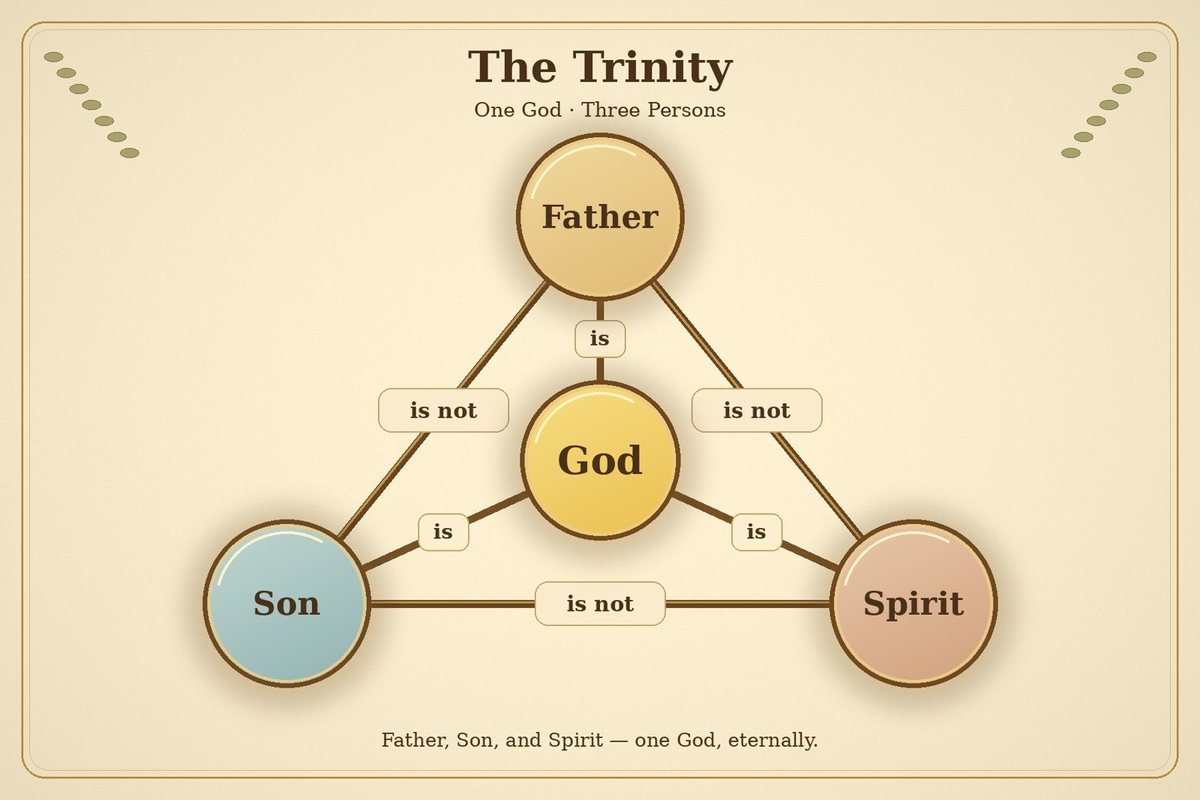
The Bible talks about the Father, the Son, and the Spirit. A smart reader could easily conclude there are three separate gods. But there is one God in three persons: not three gods, and not one God wearing three masks, but three persons who are each fully God, with different roles.
God is Jesus and Jesus is God. God is the Holy Spirit and the Spirit is God. The Father is God and God is the Father. But the Spirit is not Jesus, Jesus is not the Father, and the Father is not the Spirit. Different roles, one God. (I saw a few heads tilt like a puppy hearing a funny noise. That’s okay!)
Each one is God. But they aren’t each other.
Jesus didn’t just exist for 33 years. He was there at creation. He walked with Adam and Eve in the garden. When he did miracles, the Father willed it, the Spirit powered it, and Jesus did it. They’re never separate, because they’re one.
And when you become a believer, the Holy Spirit comes to live inside you, and he never leaves. He points you toward truth, almost always the truth of Scripture, and never against it. He also makes you restless when you’re wrong or when you’re running.
Jesus Searches Until He Finds
So if knowing God means knowing Jesus, let’s look at Jesus. I could have picked dozens of stories. This is the one that stuck with me that week.
Religious leaders were criticizing Jesus for hanging out with “sinners.” (You and I would call them “us.”) They thought he should keep his distance and preach at them. Jesus said no. This is the heart of God: not above, not aloof, but among. Then he told three stories. Here are the first two:
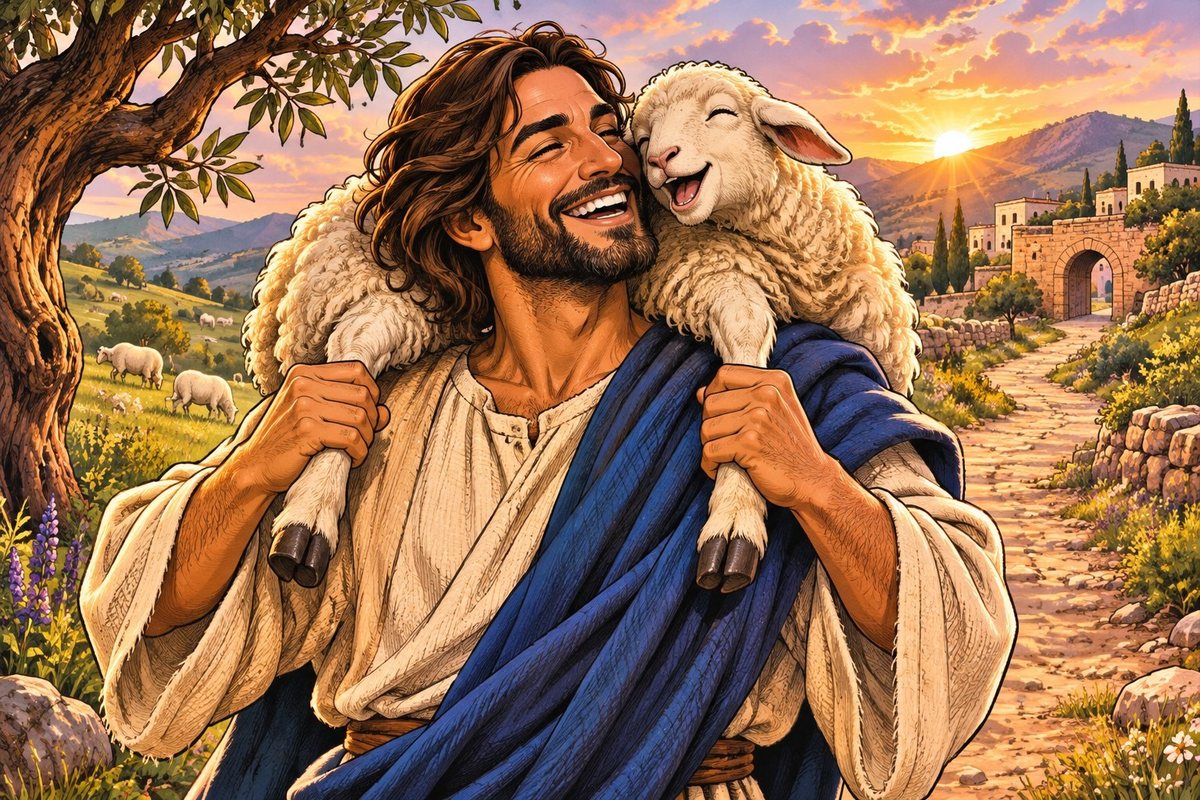
“Suppose one of you has a hundred sheep and loses one of them. Doesn’t he leave the ninety-nine in the open country and go after the lost sheep until he finds it? And when he finds it, he joyfully puts it on his shoulders and goes home. Then he calls his friends and neighbors together and says, ‘Rejoice with me; I have found my lost sheep.’ I tell you that in the same way there will be more rejoicing in heaven over one sinner who repents than over ninety-nine righteous persons who do not need to repent. Or suppose a woman has ten silver coins and loses one. Doesn’t she light a lamp, sweep the house and search carefully until she finds it? And when she finds it, she calls her friends and neighbors together and says, ‘Rejoice with me; I have found my lost coin.’ In the same way, I tell you, there is rejoicing in the presence of the angels of God over one sinner who repents.” (Luke 15:4–10)
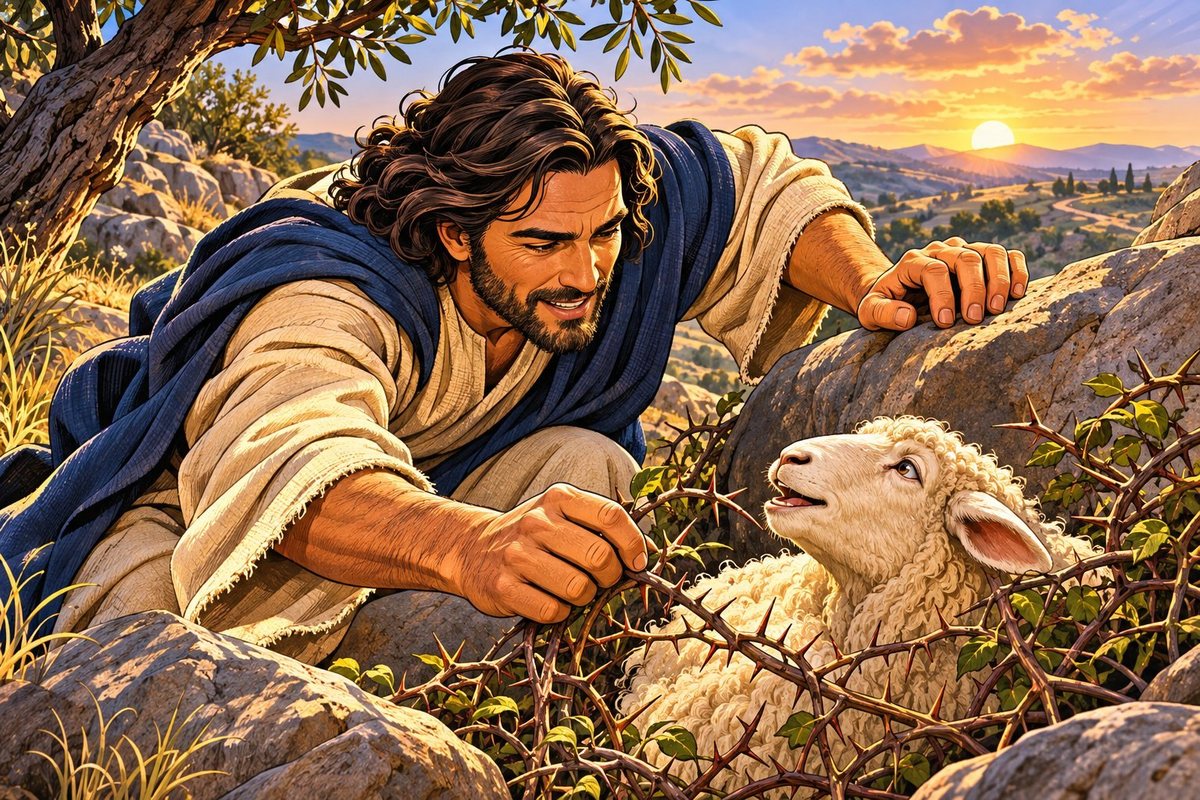
If you’ve got a paper Bible, circle “until he finds it” and “until she finds it.” When something is repeated, it’s important. (The coin was likely part of a bride’s wedding jewelry, something with real sentimental value. Jesus told one story the men would connect with and one the women would. He made sure everybody could understand.)
He doesn’t quit, and when he finds you, he carries you home rejoicing.
The third story, the prodigal son, shows this isn’t only for people who’ve never met him. It’s also for those who’ve wandered off. Some slip. Some drift. Some run.
Two things have been on my heart. First, maybe you’re praying for someone who seems far from God, and you’re losing hope. Jesus describes himself as a Savior who keeps searching. Second, maybe you’re the one who’s wandered. If so, I hope you’re restless. I hope there’s no peace in your soul until you stop and let him catch up with you.
When Moses killed an Egyptian, he ran and ran and ran. Then he sat down because he was tired of running, and that’s where God’s will found him. Maybe today’s the day you sit down.
Key Truths
- God is a God who speaks. He wants to be known (Hebrews 1:1).
- In these last days, God speaks most clearly through his Son. When you know Jesus, you know God (Hebrews 1:2).
- God may speak in personal ways, but never against his word. Most of the time, we learn how to live by learning Jesus.
- There is one God in three persons: Father, Son and Holy Spirit.
- Jesus is a Savior who seeks, finds and saves, and he celebrates when he does (Luke 15:4–10).
For Reflection
- Which “camp” do you naturally lean toward: God speaks only through Scripture, or God directs every little detail? What’s the danger in your direction?
- When you pray for direction, what are you secretly hoping for: a burning bush, a whisper, a sign?
- How would studying the life of Jesus change the way you look for God’s will?
- Who in your life feels “lost” right now? How does “until he finds it” encourage you to keep praying?
Let’s Pray
Father, thank you that you are a God who speaks, and that you’ve spoken most clearly through your Son. Slow us down at the doorway so we can really listen. When we want a sign, point us back to Jesus. And for the ones we love who have wandered, thank you that you search until you find. In Jesus’ name, amen.
Louder and Clearer
The Chapter at a Glance
- Did you plug it in? looking connected isn’t being connected
- The whisper on the mountain 1 Kings 19:11–13
- Heir of all things Hebrews 1:2
- The Creator keeps his promises John 1:1–5
- The day Jesus braided a whip John 2:13–17
The Big Idea · Jesus owns it all and made it all, so every promise he makes, he can keep.
Read First · Hebrews 1:2
2 But in these last days he has spoken to us by his Son, whom he appointed heir of all things, and through whom also he made the universe.
New International Version
Did You Plug It In?
I have a confession. I don’t embarrass easily, but this one got me.
Both of our sons have little camping trailers. If your kids are grown, you know how it goes: whatever they love to do, you want to do with them. So Joy and I bought one too. Not from a fancy dealership, but from Facebook Marketplace: a 2019 model from a sweet older couple in Kansas City. The first thing I did was order a box of assorted wood screws, because I knew I’d be putting things back together.
The second time I plugged the trailer into my truck, the lights stopped working right and the dash started flashing warnings about the trailer brake circuit. I called my younger son, Nathan. He didn’t know. Next I turned to AI. I pay for the extra-thinking version, because I’m tired of calling my kids every time something breaks.
I unscrewed and re-screwed every ground wire on that camper. I removed the backup camera I’d just installed. Nothing. Then Nathan asked, “You put a tester in the truck’s plug to see if it’s the truck or the camper, right?” No! Why didn’t you tell me? “I didn’t think I’d have to. That’s pretty basic.” (That’s how gracious he was.)
So I bought a tester. The problem was the truck. I pulled every single fuse, one at a time. Finally, sitting in a Harbor Freight parking lot, I begged the AI for help. It said there was a 60 percent chance the problem was the connection between the wiring harness and the plug. “Have you checked to see if it’s plugged in?”
“Yes, of course!” Then I thought: how well did I check? I’d stuck my head under there and thought, “Yep, looks plugged in.” And it pushed back: “Did you actually, physically check it?”

I got home, scooted under the truck on the garage floor, and grabbed it. It looked plugged in. It was not plugged in at all. One twist, and everything worked perfectly. And of course, Joy walked into the garage right as I did it. For the rest of my life, whenever anything goes wrong, she’s going to ask, “Did you plug it in?”
It’s easy to look plugged in without actually being plugged in.
So I won’t assume you know how to get connected. In the last chapter we said that God the Father speaks, because of what Jesus did, through the power of the Holy Spirit. The Holy Spirit comes to live in you when you give your life to Jesus. Until then, you’re not plugged in. Not because you aren’t wanted, but because you haven’t chosen it yet.
Getting plugged in involves three things:
- Believe who Jesus is, as much as you know about him.
- Confess that you’ve sinned and fallen short, and ask his forgiveness.
- Follow. Tell him, “I want to spend the rest of my life following you, even if I’m not sure where it goes.”
Say it in your own words. A thought and a prayer are the same thing to God. When you do, the Spirit moves in for good. He gives you the power to live for God and the ability to talk with him, and he makes Scripture come alive. Everything else in this book works best once you’re plugged in. (There’s more on this in How to Follow Jesus, at the back of the book.)
The Whisper on the Mountain
God spoke in the Old Testament in all kinds of ways. He walked with Adam and Eve. He spoke to Abraham, sent angels, spoke from a burning bush, and thundered around Mount Sinai. But here’s one of my favorite stories.
Elijah never wrote a book; his story is told in 1 and 2 Kings. At this point in his life, he was exhausted and depressed. I think he may even have wanted to die. He’d just seen God do a huge miracle in a showdown with some truly wicked people, and now he was running for his life. God told him to go stand on the mountain, because the Lord was about to pass by.
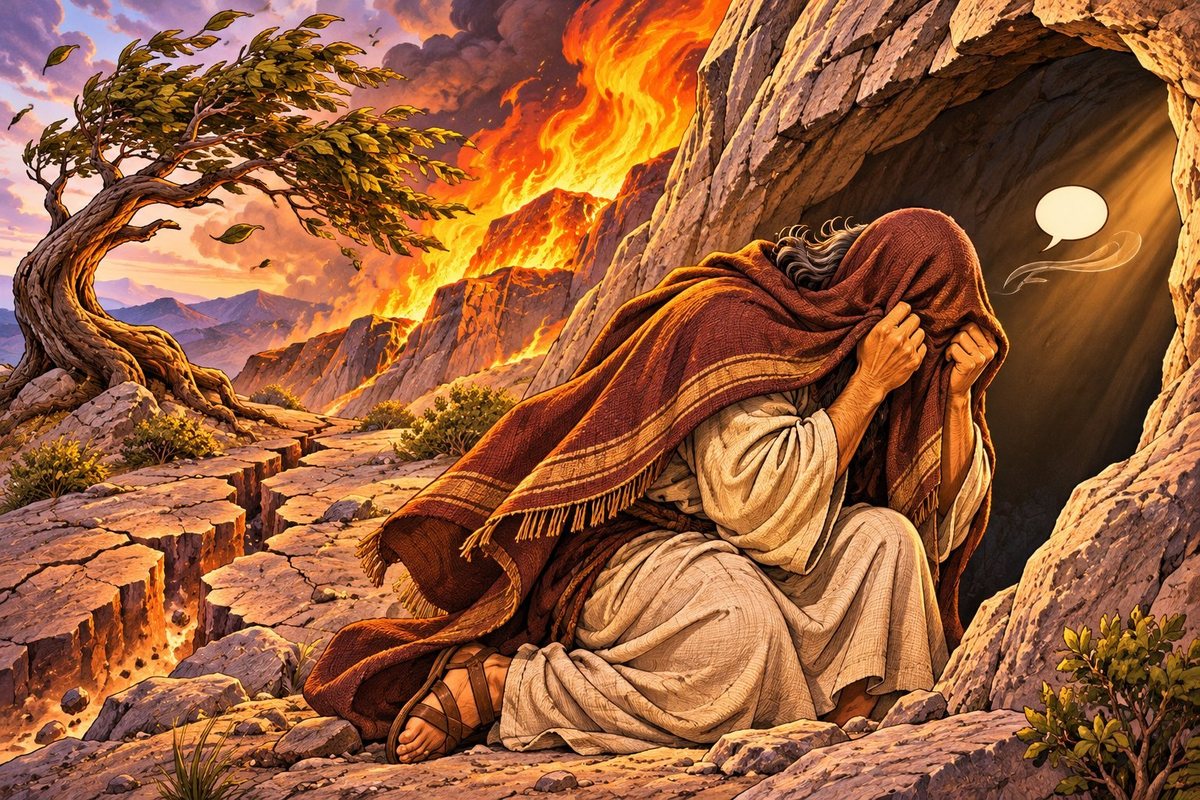
“The Lord said, ‘Go out and stand on the mountain in the presence of the Lord, for the Lord is about to pass by.’ Then a great and powerful wind tore the mountains apart and shattered the rocks before the Lord, but the Lord was not in the wind. After the wind there was an earthquake, but the Lord was not in the earthquake. After the earthquake came a fire, but the Lord was not in the fire. And after the fire came a gentle whisper. When Elijah heard it, he pulled his cloak over his face and went out and stood at the mouth of the cave.” (1 Kings 19:11–13)
Wind, earthquake, fire. That’s how God talks, right? But God wasn’t in any of it. He came in a whisper that drew Elijah to the edge of the cave to listen.
Not in the wind, the earthquake or the fire, but in a whisper.
Does God always whisper? No. He doesn’t speak the same way to everyone every time. Has he whispered before? Yes. Could he whisper again? Absolutely. You don’t need to go find a cave on a mountain, but you can clear out the noise. Showing up is 80 percent of the battle. The rest happens inside you, when you choose to lean in and listen.
Heir of All Things
God can seem so big and so abstract. I need something to hold on to, the low-hanging fruit. And God says, “Here it is: a person. My Son.”
Jesus was 100 percent human and 100 percent God. He voluntarily set aside some of his “superpowers,” like being everywhere at once, and I believe he looked to the Father for what to do next. Why? So we could see what God looks like with skin on.
The first thing Hebrews tells us about Jesus is that God “appointed him heir of all things.” It’s listed first, which suggests it may be the most significant. Everything is coming back to Jesus. He has authority over everyone and everything ever created. It all belongs to him.
That’s hard to square with the world we see, where plenty happens that Jesus would never approve of. When sin entered the world, God, in his mercy and love, let people choose whether they want a relationship with Jesus. And for reasons we don’t fully understand, evil has a wider fence than you and I would like. But it’s never outside his control. Paul teaches that God works even the bad things for good for those who love him (Romans 8:28). In the end, it all works out.
The Creator Keeps His Promises
The second thing Hebrews tells us: Jesus is the one “through whom also he made the universe.” Here’s a sentence worth writing down:
God the Father, through the Son, by the Holy Spirit, created all that was not God, out of nothing, by his spoken word.
“In the beginning was the Word, and the Word was with God, and the Word was God. He was with God in the beginning. Through him all things were made; without him nothing was made that has been made. In him was life, and that life was the light of all mankind. The light shines in the darkness, and the darkness has not overcome it.” (John 1:1–5)

Why does that matter? Because a promise is only as good as the power to keep it. My intentions might be good, but I can still write a check I can’t cash. Jesus never does. He made it all, he owns it all, and he controls it all, even what looks like chaos in your life.
So when Jesus says, “Blessed are the meek, for they will inherit the earth” (Matthew 5:5), that’s not just some guy talking. That’s the Owner of the earth promising you a share in it. And when he says, “I am going there to prepare a place for you… I will come back and take you to be with me” (John 14:2–3), it isn’t wishful thinking from a nice teacher. It’s a promise from God, and he can keep it.
The Day Jesus Braided a Whip
In the last chapter we saw the Jesus who searches, finds, and rejoices. This story shows a side of him that surprises people. Jesus never sinned, but he did get angry.
Passover was a required, week-long festival in Jerusalem, and the city swelled to ten times its normal size. No hotels, old friends everywhere, merchants rolling in dough. Think Christmas at Walmart. Worshipers brought an animal to sacrifice, or bought one there, as a temporary covering for sin.
But it had become a racket. You had to pay the temple tax in temple money, and the money changers gave you maybe 30 cents on the dollar. If you brought your own animal, an inspector might say, “Sorry, there’s a blemish. Buy one of ours.” He’d pay you too little for yours, charge you too much for his, then walk your animal around back and sell it to the next person. They had made worship all about themselves.
“When it was almost time for the Jewish Passover, Jesus went up to Jerusalem. In the temple courts he found people selling cattle, sheep and doves, and others sitting at tables exchanging money. So he made a whip out of cords, and drove all from the temple courts, both sheep and cattle; he scattered the coins of the money changers and overturned their tables. To those who sold doves he said, ‘Get these out of here! Stop turning my Father’s house into a market!’ His disciples remembered that it is written: ‘Zeal for your house will consume me.’” (John 2:13–17)
Notice: he made a whip. The word means braided, or plaited. I’ve tried to braid Emery’s hair. It’s harder than it looks! That took time, maybe ten minutes, maybe an hour. This was no impulse. Picture the brand-new disciples watching him sit off to the side, pulling vines and braiding, slowly realizing what he’s about to do. Whoa, whoa, Jesus! They were badly outnumbered, and Roman soldiers in the Fortress of Antonia looked right down into the temple courts, ready to crush any sign of trouble.
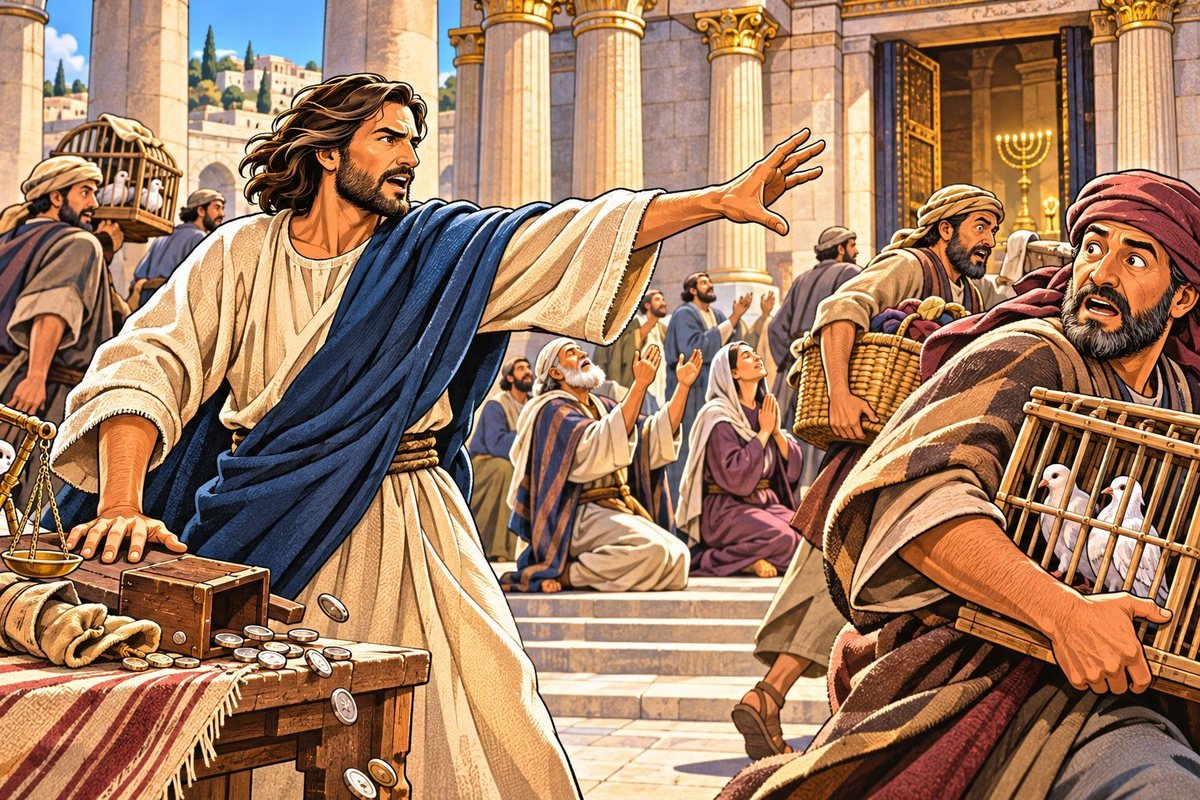
(I love that he couldn’t drive out the doves. Doves just do what they want. So he told the sellers to carry them out.)
Stop making worship about you. Point it back to God.
Key Truths
- It’s possible to look plugged in without being plugged in. The Holy Spirit moves in when you give your life to Jesus.
- God doesn’t always speak in the wind, the earthquake or the fire. Sometimes it’s a whisper, and we have to clear out the noise (1 Kings 19:11–13).
- Jesus is heir of all things. Everything belongs to him and is coming back to him (Hebrews 1:2).
- Jesus made everything, so every promise he makes, he can keep (John 1:1–5).
- Jesus cares so much that worship stays about God that it moved him to holy passion (John 2:13–17).
For Reflection
- Is there an area of your faith that looks plugged in but isn’t really connected?
- What “noise” in your life might be drowning out God’s whisper right now?
- Which promise of Jesus means more to you knowing he owns and created everything?
- Where might you be tempted to make church or worship “about you”?
Let’s Pray
Jesus, you made everything and you own everything, so we trust you to keep every promise. Show us where we only look plugged in. Quiet the noise so we can hear your whisper. And keep our worship about you, not about us. In Jesus’ name, amen.
Loudest and Clearest
The Chapter at a Glance
- The red sparkly dress already chosen
- The blood of the lamb Exodus 12
- The God who washes feet John 13
- Radiance and exact representation Hebrews 1:3
- He sustains every heartbeat Hebrews 1:3
- Coming to the table 1 Corinthians 11:23–28
The Big Idea · Jesus is God himself, he holds your every breath, and he has chosen you.
Read First · Hebrews 1:3
3 The Son is the radiance of God’s glory and the exact representation of his being, sustaining all things by his powerful word. After he had provided purification for sins, he sat down at the right hand of the Majesty in heaven.
New International Version
The Red Sparkly Dress
Surprise: another story about my granddaughter, Emery. She’s four and a half and goes to a Montessori preschool. Her iPad has just a few icons for calling her grandparents and Uncle Nate, and she FaceTimes us most mornings over breakfast.
One Thursday she called, still in her pajamas, holding up a bright red sequined dress. Then she held up silver, sparkly heels. On a Thursday. At preschool. (I thought, “She’s going to look like a fishing lure,” but I didn’t say it.)

“Emery, why are you dressing up like a princess?”
“Because today’s the day he’s going to choose.”
Now, that got Bapo’s attention. (That’s me.) It turns out there’s a boy in her class with a little fan club of four or five girls. One of the teachers is getting married, so everyone’s talking about weddings, and today this boy was going to choose who he’d marry. On the outside I was calm, cool Bapo. On the inside, the vein in my forehead was bulging. We’re not doing The Bachelorette in preschool!
That evening Joy asked her, “What was the best part of your day?” “I get to go camping tonight!” Anything else? “Oh yeah. Walter chose me.” I said, “Well, of course he did, he’s not dumb.” And she said, “Bapo, that doesn’t even make sense. He loved my dress.” End of conversation. I had to leave the room and text my son.
But remember the stress of wanting to be chosen? Teams, jobs, dating profiles that don’t quite match the person who shows up. The constant pressure to compete, to impress, to measure up.
Jesus has already chosen you. No red dress. No sparkly shoes. Pressure relieved.
There’s nothing you have to do, and nothing you can do, to make yourself look better to God. You can’t earn heaven. It’s God’s grace, received by faith, a free gift. End of story. If you want a relationship with Jesus, you’re already chosen. There was never a competition. Relax and accept his grace.
The Blood of the Lamb
Every week we’ve said the Old Testament is a big sign pointing to Jesus. One of its clearest arrows is the very first Passover, in Exodus 12.
Pharaoh refused to let God’s people go, plague after plague. The final judgment was that on one night the angel of death would pass through Egypt, and the firstborn of every family would die. It seems brutal to us, and God dealt with nations differently then than he does now, in light of Jesus. But every household would be affected unless it followed God’s instructions.
Each family had to sacrifice a lamb and eat it, burning any leftovers. A small family could share a lamb with neighbors. Most important, they had to brush the lamb’s blood on the sides and top of their doorframe. That night, every house in the country was touched by death, except the ones that trusted in the blood of the lamb.
Under the blood, the household was safe.
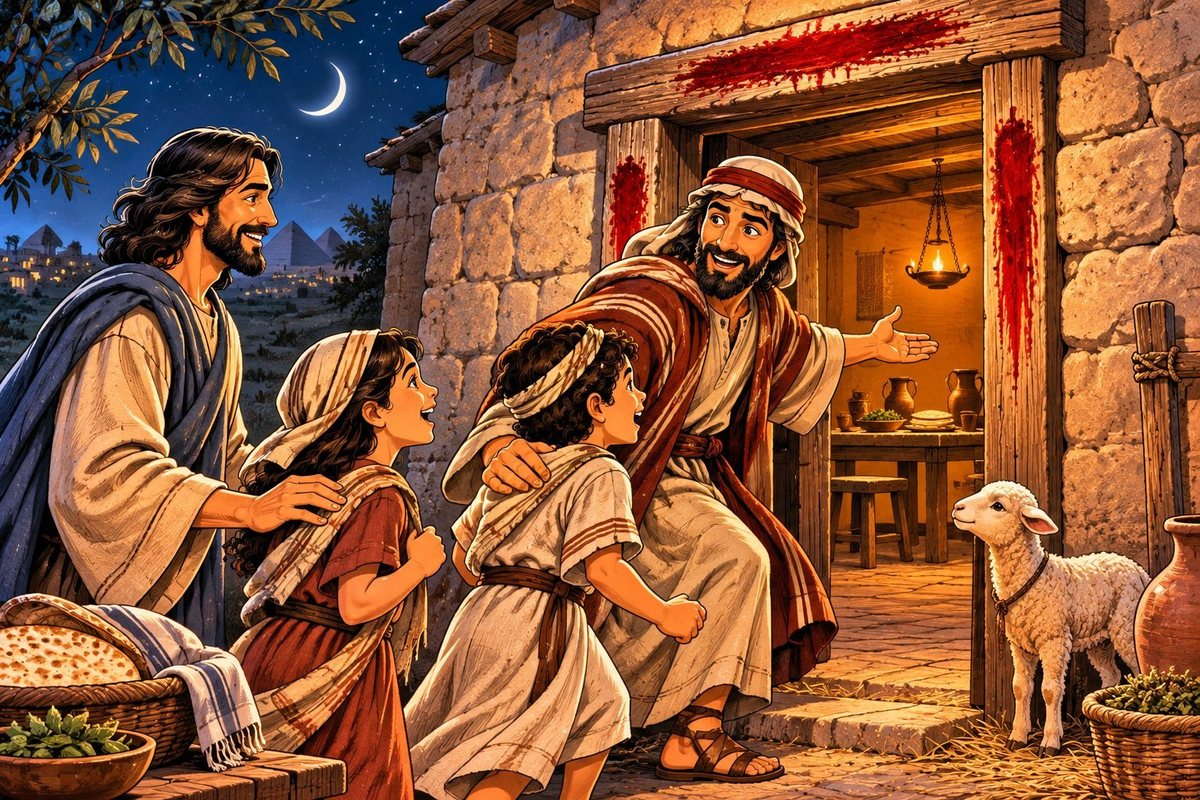
It was a real miracle for them, and a preview for us: we don’t have to live under judgment if we put our faith in the blood of the Lamb.
That’s one way God spoke in the past. Does he still speak in other ways today? I believe he does, sometimes through the Holy Spirit’s nudges and convictions, through other people, and through prayer. But everything has to line up with the word of God. He will never tell you something that contradicts it. Scripture is our only authority for faith and practice. And if everything we need to know about God comes through Jesus, then the more we study Jesus, the firmer our foundation.
Christianity can get sidetracked. We can turn it into an academic subject and end up worshiping the material instead of the Person it’s about. That’s why it makes me so happy when someone tells me they’re studying the life of Jesus in the Gospels. You can’t go wrong there. Fair warning, though: many people avoid studying Jesus because what he teaches makes them uncomfortable.
The God Who Washes Feet
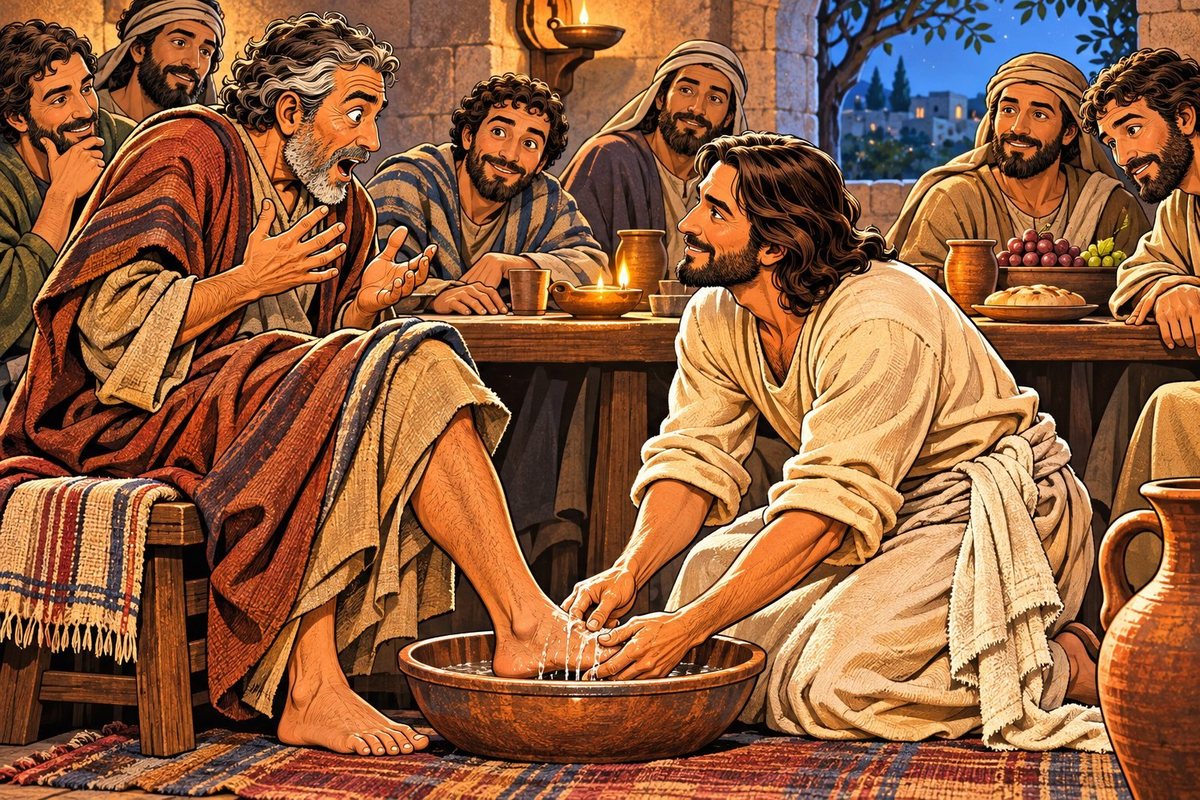
In John 13, Jesus and his disciples gathered in the upper room for the last Passover. Nobody had washed anyone’s feet. Remember who Jesus is: God, heir of all things, Creator of all things. Yet instead of demanding to be served, he took the role of a servant, knelt down, and washed his disciples’ feet.
The Creator of the universe, kneeling with a towel.
The God who made the universe showed us, by doing it himself, how much it matters to set aside what we think we deserve and serve the people around us, so they can see Jesus.
Radiance and Exact Representation
One of my favorite moments all year comes at the end of our Christmas Eve service. One of our singers begins “Silent Night” a cappella, and a single candle is lit in a dark room full of people. That’s how Jesus came into the world: one little baby who grew up, showed us who God is, lived a perfect life, and died a death he didn’t deserve so we could have peace with God. Then the flame passes from person to person until the light that came through one Person is shared by all of us, reflecting the glory of God we’ve seen in the face of Jesus.

“Exact representation” means just what it sounds like. The word originally described a stamp pressing an image into a coin, making an exact copy. By the time Hebrews was written, it meant “the very same essence.” Jesus is God. Not just a good man, not just a nice guy, not a spinner of fables or a moral teacher trying to make the world better. When Jesus spoke, God was speaking.
When Jesus’ teachings make us uncomfortable, the problem is us, not Jesus.
So we wrestle with the tension, but we resist the urge to tear out the pages that make us squirm. We sit under the authority of his words, because they’re God’s words.
He Sustains Every Heartbeat
Next comes one of my favorite phrases in all of Scripture: “sustaining all things by his powerful word.”
Jesus spoke everything into existence, and he’s heir of it all, seen and unseen, understood and not. But this promise is even bigger: he sustains it all. The world isn’t a clock God wound up and walked away from while it slowly runs down. If you take Scripture literally, and I do, Jesus wills the sun to rise and set, the earth to turn, and the laws of nature to hold.
Bring that down to your own life. You didn’t wake up this morning because God wound you up at birth and you’re ticking down your days. Every breath and every heartbeat is a gift he’s giving you right now.
So take a breath. He’s sustaining it. Feel your heartbeat. Jesus is with you this very moment, holding your life together. And the God who holds the universe together, and holds you together, has chosen you. You’re loved. Your salvation is secure. It’s all because of Jesus.
Coming to the Table
This Sunday ended with the Lord’s Supper, which ties everything together. For centuries, the Jewish people had celebrated Passover every year. Then Jesus gathered his disciples and essentially said, “Fellas, this is the last time Passover will be the way you’ve known it. The blood isn’t an animal’s anymore; it’s mine. The bread is my body, given for you.” He also promised them the Holy Spirit: fully God, but without the limits of a human body, so he could be with every follower everywhere at once.
Years later, the church in Corinth turned it into a mess. They had made church all about themselves, with cliques by income, education, and family name. People you talk to, and people you talk about. Today, the “in crowd” would text each other: “Communion’s at 7, but let’s get there at 6.” They’d eat the good food and drink the good wine, and by the time the 7 o’clock crowd arrived, the food was gone and some folks were tipsy.
“For I received from the Lord what I also passed on to you: The Lord Jesus, on the night he was betrayed, took bread, and when he had given thanks, he broke it and said, ‘This is my body, which is for you; do this in remembrance of me.’ In the same way, after supper he took the cup, saying, ‘This cup is the new covenant in my blood; do this, whenever you drink it, in remembrance of me.’ For whenever you eat this bread and drink this cup, you proclaim the Lord’s death until he comes. So then, whoever eats the bread or drinks the cup of the Lord in an unworthy manner will be guilty of sinning against the body and blood of the Lord. Everyone ought to examine themselves before they eat of the bread and drink from the cup.” (1 Corinthians 11:23–28)
“Unworthy” doesn’t mean you have to earn your place. Nobody puts on a red dress and gets chosen. Coming in a worthy manner means we’ve examined ourselves and brought our hearts back to where they were when we first said yes to Jesus.
It’s like marriage. On our wedding day 36 years ago, I held nothing back, and I figured it would be all gentle breezes and warm sunshine. I wouldn’t change a thing, but I know a lot more now. Sometimes I’ve had to apologize. (Sometimes Joy has too, though not very often.) Twice, we had to look at each other and decide to give each other a do-over. Every so often, you have to come back to the commitment you first made.
Some sins are obvious. Sins of the spirit are sneakier, and just as dangerous. What plagued Corinth was gossip, broken relationships, bitterness, unforgiveness, judgmentalism, legalism, and bad attitudes.
When I’m looking for something, I use a flashlight; it helps me focus. So I ask the Lord to shine the flashlight of his Holy Spirit into the nooks and crannies of my heart. And I’ll be honest: I have a whole cabinet in there labeled “Justified.” It’s where I stash the feelings I’ve decided I have a right to. That’s the one I argue with myself about opening. Maybe yours has a different label. Ask God to shine his light in there.
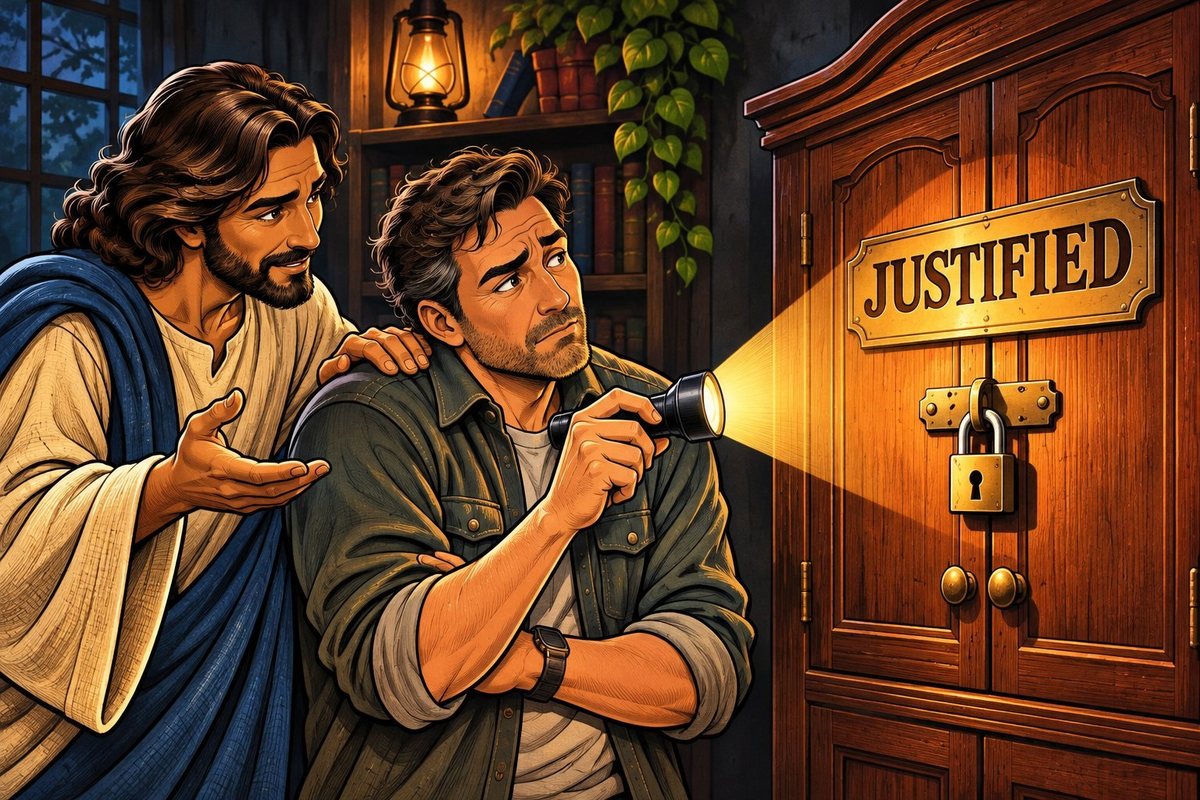
The Lord’s Supper is for followers of Jesus, including kids who understand who Jesus is and have decided to follow him. And there have been times, even as a pastor, when I’ve sat it out because I needed more time to get my heart right with God. There’s no shame in that. The goal is to get to the place where you can come.
Key Truths
- You can’t earn God’s approval. If you want a relationship with Jesus, you’re already chosen. It’s grace, received by faith.
- The Passover lamb pointed to Jesus. Under his blood, we don’t have to live under judgment (Exodus 12).
- Jesus is the radiance of God’s glory and the exact representation of his being. When Jesus speaks, God speaks (Hebrews 1:3).
- Jesus sustains all things, including every breath and every heartbeat you have right now.
- The God who made the universe knelt down and washed feet, and he calls us to serve the same way (John 13).
For Reflection
- Where are you still trying to “put on the red dress” to earn God’s approval?
- Which teaching of Jesus makes you most uncomfortable? What would it look like to sit under it instead of around it?
- Take a breath and notice your heartbeat. How does “he sustains all things” change how you face today?
- What’s in your “Justified” cabinet? What would it take to open it?
Let’s Pray
Jesus, thank you that we don’t have to compete to be chosen. You are exactly God, and you hold every heartbeat. Shine the flashlight of your Spirit into every cabinet we’d rather keep closed. Make us people who kneel down and serve, the way you did. In Jesus’ name, amen.
Once and For All
The Chapter at a Glance
- The seat that could never be satisfied Exodus 25, Leviticus 16
- Let’s talk about sin Romans 3:23; 6:23
- “Do” became “done” once and for all
- He sat down Hebrews 1:3
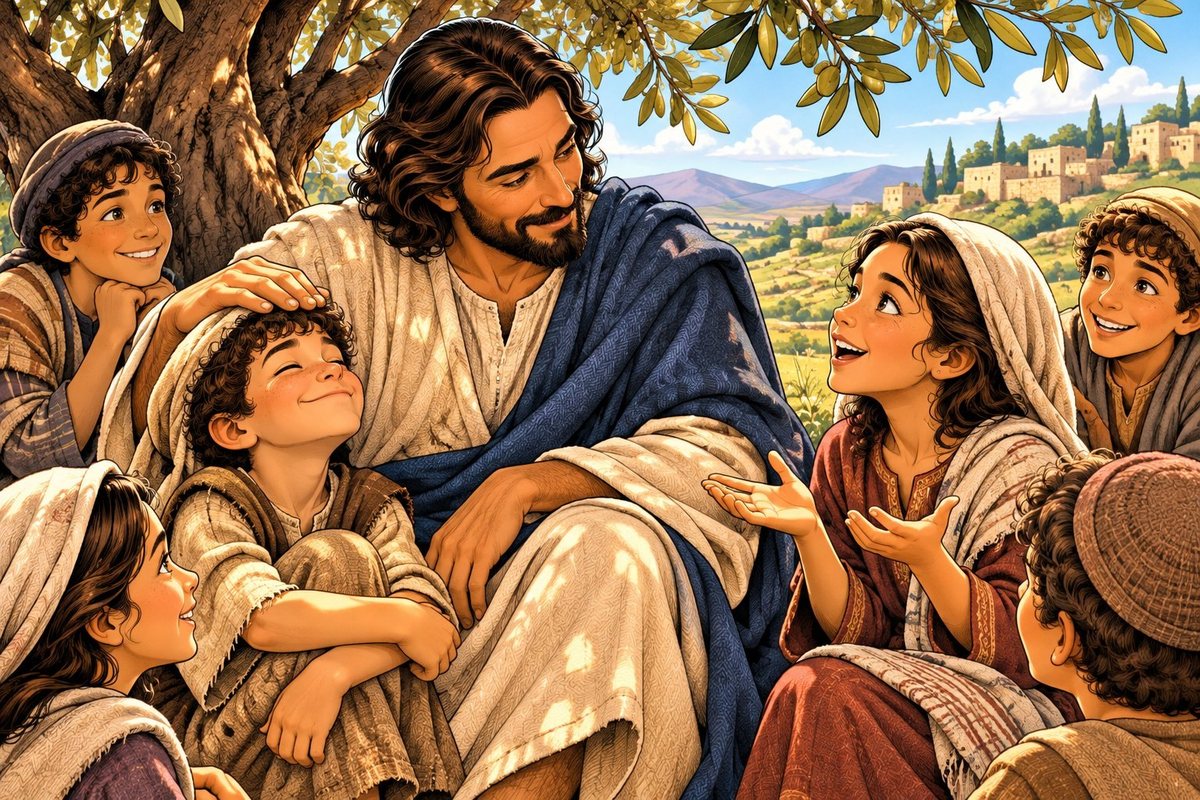
- Let the little children come Mark 10:13–14
The Big Idea · The work is finished. “Do” became “done.” Then he sat down.
Read First · Hebrews 1:3
3 The Son is the radiance of God’s glory and the exact representation of his being, sustaining all things by his powerful word. After he had provided purification for sins, he sat down at the right hand of the Majesty in heaven.
New International Version
The Seat That Could Never Be Satisfied
Stay with me here. This is the part where some of you will think, “Okay, now it’s the Discovery Channel.” But we’ll need this background in a minute.
One way God spoke in the Old Testament was through the sacrificial system, and it had two purposes. The first was to overwhelm people on purpose. There were too many rules, and nobody could keep them all. The best you could hope for was deferred judgment, kicking the can down the road. The second purpose was to make people long for the Messiah.
God gave instructions for the tabernacle, a traveling temple. In its innermost room sat the Ark of the Covenant (yes, the one from the old Indiana Jones movie). It was a chest holding the stone tablets of the Ten Commandments, Aaron’s staff, and a golden jar of the manna God used to feed Israel in the wilderness. On top was a solid gold lid, about 45 by 27 inches, with two carved cherubim facing each other. It was called the mercy seat.
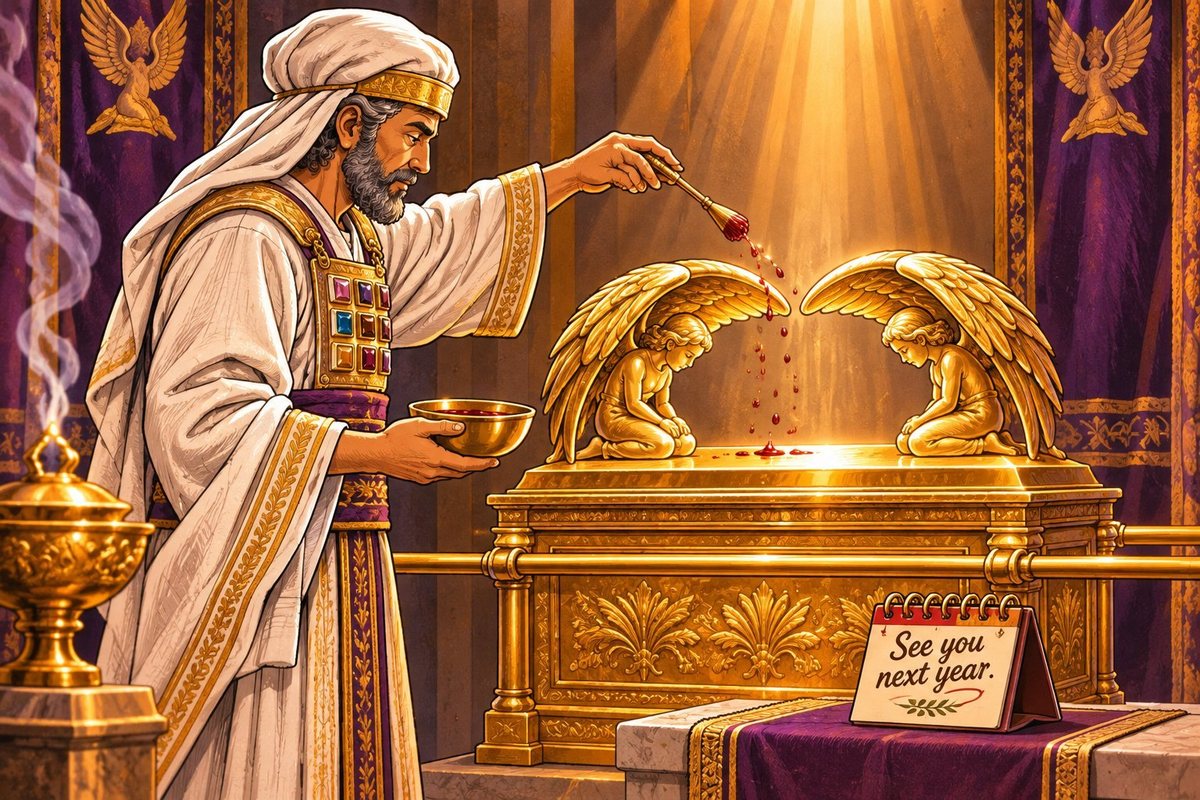
But really, it was the deferred judgment seat. Think of a traffic ticket where the judge tells you, “I won’t prosecute, but you’re on probation for six months. Mess up, and it all comes down on you.” Once a year, on the Day of Atonement, the high priest went behind the thick curtain into the Holy of Holies and sprinkled the blood of a sacrificed animal on that seat. God’s presence came, judgment was postponed one more year, and then everyone waited to do it all again.
Without Jesus, the best you could do was stay one step ahead of the snowball.
Let’s Talk About Sin
Who wants to talk about sin? Here’s a Bible trivia question: where did sin begin? Before the earth was created, Lucifer, an angel who led worship and pointed everyone to God, decided he wanted to be God. God cast him out of heaven. Other angels went with him and became what we call demons, and Lucifer became known as Satan.
Sin is any thought, action, or attitude that goes against what God wants. The Bible uses three main words for it:
- Sin: missing the mark. Doing what we shouldn’t, or not doing what we should. We just blow it sometimes.
- Transgression: willful defiance. You know what’s right, and you do what you want anyway because you think you deserve it or you just don’t care.
- Iniquity: who you become. Sin left unchecked and unconfessed hardens into a character, a way of life lived in opposition to God.
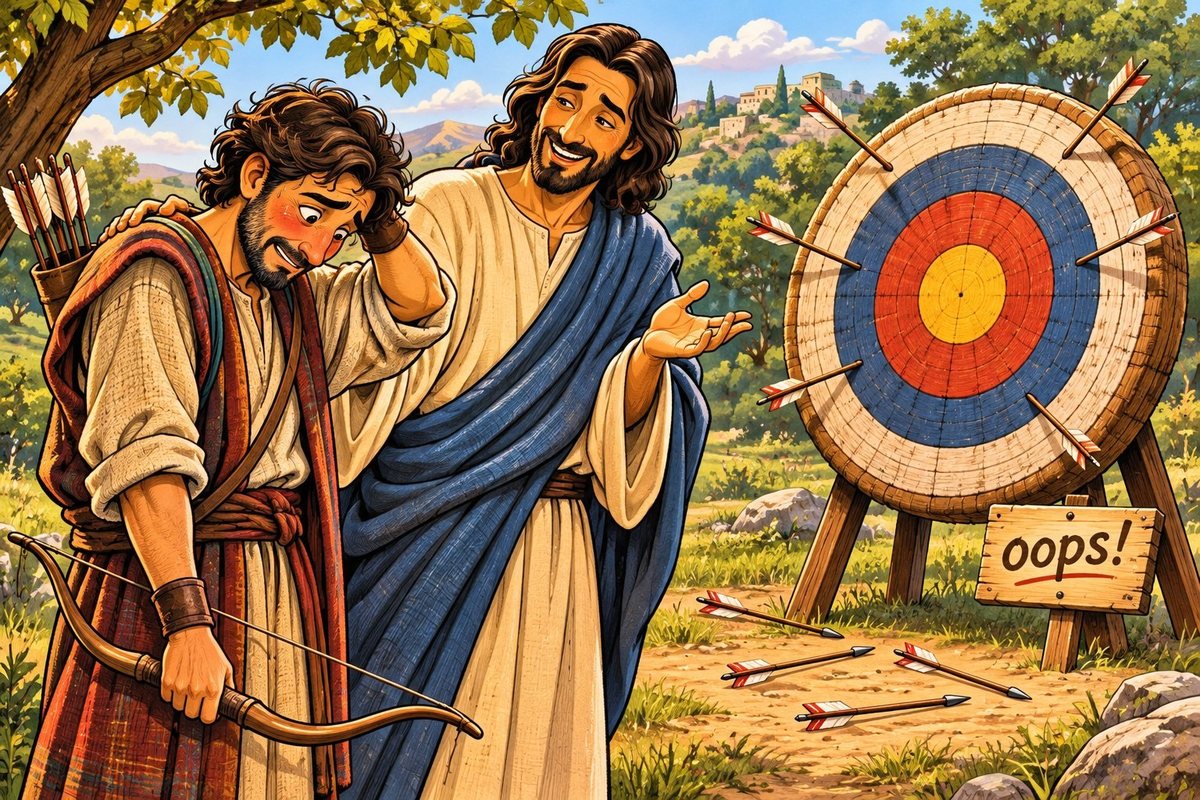
Sin entered the human race in the Garden of Eden, when Satan came as a serpent and tempted Eve with the same thing he fell for: God’s keeping you in the dark. Don’t you want to be like God? She ate and gave some to Adam (who probably didn’t need much convincing), and sin entered humanity. Now it’s passed down from generation to generation (Romans 5). It shapes how we think and react, it shows up in the choices we make, and without intervention, it shapes who we become.
“For all have sinned and fall short of the glory of God.” (Romans 3:23)
“For the wages of sin is death, but the gift of God is eternal life in Christ Jesus our Lord.” (Romans 6:23)
“Do” Became “Done”
Sin had to be paid for. The old system was exhausting and frustrating by design, so the whole world would long for the One who could pay the price once and for all.
And then he came. One hundred percent God and one hundred percent man. Emmanuel: God with us. He lived a perfect life, never sinning, yet he experienced everything we experience. He willingly took on the sins of the world, past and future, and died to pay the price. Three days later he rose again and defeated sin, Satan, and death once and for all.
What religion spelled D-O was finally spelled D-O-N-E.
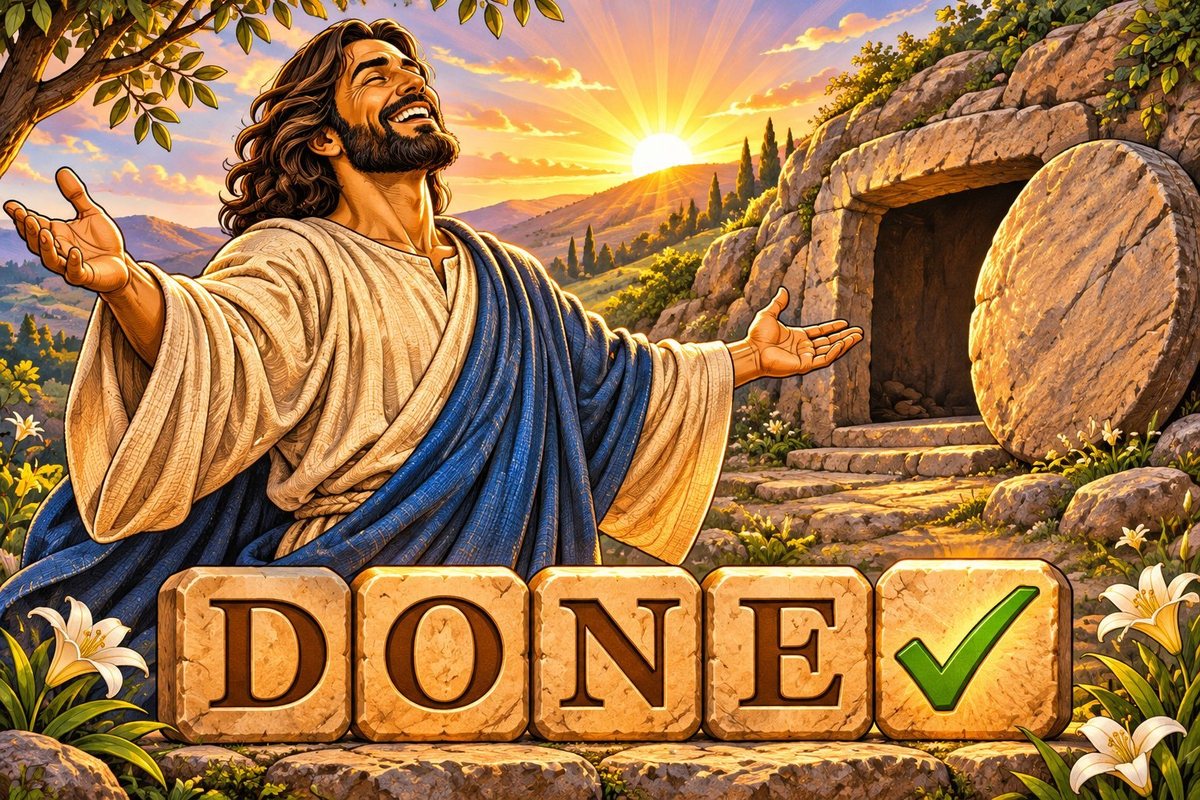
All that’s required now is faith in Jesus and a decision to give him your life. You couldn’t help the condition you were born in, but you’re still responsible for it. So we confess: “Guilty. Guilty because I was born with it, and guilty because I’m pretty good at it.” We believe, and we hand him our lives. (There’s a simple guide in How to Follow Jesus, at the back of the book.) Your faith plus his finished work equals salvation.
He Sat Down
Some of you are grammar people. (Thank you for your text messages. I appreciate most of them.) Remember diagramming sentences? You find the subject and the verb, and everything else supports those two. Verses 1–3 are one complete thought. The subject is “he.” The main verb is “sat down.”
That’s the main point of the whole passage! Everything else explains why. He created everything and inherits everything, so of course he’s seated at God’s right hand. He’s the exact representation of God, so of course. He sustains all things, so of course.
Why the right hand? When a ruler seated someone at his right hand, it meant equality and full authority. When that person acted, the king acted. And being seated means the work is finished. Picture Jesus walking up to that mercy seat that could never be satisfied and, because of his own blood, taking his seat. Payment complete. No more pulling your hair out trying to keep a system designed to show you that you can’t.
The right hand is also where Jesus intercedes for us. Here’s how I picture it (theologically it breaks down, so don’t press me!). The Father is watching me and says, “Rick did it again. I can’t believe he did it again.” Jesus says, “Hey, Dad, he’s with me.” The Father says, “Oh, okay. He’s with you.” A little later: “There he goes again…” And Jesus says, “No, wait, he’s mine.” “Yes, of course.” God knows everything, so the picture isn’t perfect. But the point is true: God sees me through his Son. Jesus is the reason our salvation is secure and the reason we have any connection to the Father at all.
“He’s with me.”
And there’s one more thing he’s doing at the Father’s right hand: waiting for the day he comes to bring you and me home to be with him forever.
Let the Little Children Come
All this theology matters. It shapes how we see the world. But I still need something I can hold on to. So here’s one more picture of Jesus.
“People were bringing little children to Jesus for him to place his hands on them, but the disciples rebuked them. When Jesus saw this, he was indignant. He said to them, ‘Let the little children come to me, and do not hinder them, for the kingdom of God belongs to such as these.’” (Mark 10:13–14)
These weren’t third graders. The word means little ones, even babies. Parents often brought babies to a rabbi for a blessing, and people loved Jesus. But in that culture, little ones were considered insignificant, so the disciples basically yelled at the parents. It’s the same word used when the crowd told blind Bartimaeus to be quiet on the road out of Jericho. And Jesus was indignant, an even stronger word than their rebuke.
Why did Jesus love children and talk about childlike faith? I think it’s their innocence and their trust. A baby doesn’t worry about tomorrow, the next meal, or whether there’s a clean diaper in the box. All a baby needs is to be close to the people who love them.
My phone’s text alert is a recording of Emery laughing for the very first time, at about a year old. When it goes off in a store or a coffee shop, people around me can’t help smiling. There’s an innocence in it. Little ones don’t understand everything, and they don’t know what’s coming next. All they know is they need their dad, and when they have their dad, they have everything they need.

All we need is our heavenly Father. That I can wrap my arms around.
That isn’t an uninformed faith. We keep learning and growing from wherever we start. But it is the faith of a child, and in a lot of ways, I think that’s a great summary of Hebrews 1:1–3.
Key Truths
- The old sacrificial system could only postpone judgment. It was built to make us long for the Messiah.
- All have sinned: missing the mark, willful defiance, and patterns that become who we are (Romans 3:23).
- Jesus paid for sin once and for all. What religion spelled D-O, he spelled D-O-N-E.
- “He sat down” is the main point of Hebrews 1:1–3. The work is finished, he rules, and he speaks up for us.
- Jesus welcomes the little ones. All we need is our heavenly Father (Mark 10:13–14).
For Reflection
- Where are you still living like it’s “deferred judgment,” trying to stay one step ahead?
- Which word describes your struggle right now: missing the mark, willful defiance, or a pattern that’s become part of you?
- How does picturing Jesus saying “He’s with me” or “She’s with me” change how you feel when you fail?
- What would childlike faith look like in your life this week?
Let’s Pray
Father, thank you for speaking to us, and for speaking loudest and clearest through Jesus. Thank you for choosing us, the unworthy and often unlovable. Give us hearts that keep getting softer. Give us childlike faith, not uninformed faith, but the faith of a child who knows all we need is our heavenly Father. Shine the flashlight of your Spirit into every locked cabinet of our hearts, and set us free. Keep Jesus at the center, always. In Jesus’ name, amen.
Closing: The Portrait of Jesus
Over four chapters, we painted a picture of Jesus from two directions: what Hebrews tells us about him and what the Gospels show us. He’s complex, isn’t he? And every side of him shows us the heart of God.
What Hebrews 1:1–3 Tells Us
- Heir of all things. Everything belongs to him and is coming back to him.
- Creator. He made everything, so every promise he makes, he can keep.
- Radiance and exact representation. He is God. When he speaks, God speaks.
- Sustainer. Every breath and every heartbeat is held by him.
- Purifier. He paid for sin once and for all. “Do” became “done.”
- Seated at God’s right hand. The work is finished, he rules, and he intercedes for you.
What the Gospels Show Us
- He seeks the lost. He searches until he finds, then throws a party. (Chapter 1)
- He’s passionate about worship. He braided a whip to keep God’s house about God. (Chapter 2)
- He serves. The Creator knelt down and washed feet. (Chapter 3)
- He welcomes the little ones. All we need is our Father. (Chapter 4)
Spoiler alert: he loves you just the way you are, and if you let him, he’ll lead you home.
Scripture in This Book
Every chapter follows one message in the series, and every message stays close to three verses: Hebrews 1:1–3. Here are the main passages, chapter by chapter.
Introduction · Hebrews 1:1–3
Chapter 1 · Hebrews 1:1–2; Luke 15:4–10
Chapter 2 · Hebrews 1:2; 1 Kings 19:11–13; Romans 8:28; John 1:1–5; Matthew 5:5; John 14:2–3; John 2:13–17
Chapter 3 · Hebrews 1:3; Exodus 12; John 13; 1 Corinthians 11:23–28
Chapter 4 · Hebrews 1:3; Exodus 25; Leviticus 16; Romans 3:23; Romans 5; Romans 6:23; Mark 10:13–14
How to Follow Jesus · Luke 15:4–7; Romans 3:23; Romans 6:23
All Scripture quotations are from the New International Version (NIV).
How to Follow Jesus
Remember my truck? It looked plugged in. It wasn’t. If you’ve read this far and aren’t sure you’re really connected to Jesus, there’s no better moment than right now. Nobody’s keeping you out. You’re already chosen. All it takes is your yes.
- Believe. Trust who Jesus is: God with us, who lived a perfect life, died for your sin, and rose again. Start with as much as you know and understand.
- Confess. Agree with God about your sin. “I was born with it, and I’m pretty good at it. Forgive me. I don’t want to live that way anymore.”
- Follow. Give him your life. “I want to follow you from now on, even if I don’t know where it leads. Live your life through me.”
Pray it out loud, think it, or write it on a napkin. How you say it doesn’t matter. It’s your heart talking to God, resting on Jesus’ finished work. That’s it. Done.
Your faith plus his finished work equals salvation, once and for all.
If you made that decision while reading, tell someone! A friend, a family member, a pastor, or a church near you. We’d love to celebrate with you, because when one lost sheep is found, heaven throws a party.
About the Author

Rick Melick has served as senior pastor of Capitol City Church in Des Moines, Iowa, since November 2016. A pastor for more than three decades, he has planted churches in San Anselmo, California, and Cotter, Arkansas, and has served churches in Texas, Tennessee and Washington. In 2017 he founded City Serve DSM, a nonprofit that brings businesses, schools and community organizations together to serve the teachers, first responders and military personnel of Greater Des Moines. He also serves as a chaplain with the Iowa State Patrol.
Rick studied at The Criswell College and Golden Gate Baptist Theological Seminary, and did doctoral work at San Francisco Theological Seminary and Midwestern Baptist Theological Seminary. He and his wife have been married since 1989. They have two grown sons, two daughters-in-law, and grandchildren who call him Bapo.
Rick believes the ground is level at the foot of the cross, and that anyone who wants to come can come.