Come and See
The big ideaJesus doesn’t hand us a sales pitch. He invites us to come and see, and he asks us to live a faith others can come and see too.
Read first John 1:35–51
The First Disciples
35The next day John was there again with two of his disciples. 36When he saw Jesus passing by, he said, “Look, the Lamb of God!”
37When the two disciples heard him say this, they followed Jesus. 38Turning around, Jesus saw them following and asked, “What do you want?”
They said, “Rabbi” (which means “Teacher”), “where are you staying?”
39“Come,” he replied, “and you will see.”
So they went and saw where he was staying, and they spent that day with him. It was about four in the afternoon.
40Andrew, Simon Peter’s brother, was one of the two who heard what John had said and who had followed Jesus. 41The first thing Andrew did was to find his brother Simon and tell him, “We have found the Messiah” (that is, the Christ). 42And he brought him to Jesus.
Jesus looked at him and said, “You are Simon son of John. You will be called Cephas” (which, when translated, is Peter).
Jesus Calls Philip and Nathanael
43The next day Jesus decided to leave for Galilee. Finding Philip, he said to him, “Follow me.”
44Philip, like Andrew and Peter, was from the town of Bethsaida. 45Philip found Nathanael and told him, “We have found the one Moses wrote about in the Law, and about whom the prophets also wrote—Jesus of Nazareth, the son of Joseph.”
46“Nazareth! Can anything good come from there?” Nathanael asked.
“Come and see,” said Philip.
47When Jesus saw Nathanael approaching, he said of him, “Here truly is an Israelite in whom there is no deceit.”
48“How do you know me?” Nathanael asked.
Jesus answered, “I saw you while you were still under the fig tree before Philip called you.”
49Then Nathanael declared, “Rabbi, you are the Son of God; you are the king of Israel.”
50Jesus said, “You believe because I told you I saw you under the fig tree. You will see greater things than that.” 51He then added, “Very truly I tell you, you will see ‘heaven open, and the angels of God ascending and descending on’ the Son of Man.”
The day after John the Baptist points to Jesus as “the Lamb of God,” two of John’s disciples start following Jesus down the road. Watch for:
- The question Jesus asks them, and the answer he gives (v. 38–39).
- What Andrew does first (v. 41–42).
- The new name Jesus gives Simon (v. 42).
- Nathanael’s doubt, and the words Philip uses to answer it (v. 46).
Everybody wants to hear from God. Some of us are a little afraid to, I suppose, depending on what he might say. But I want you looking forward to it, looking for it, structuring your life around the ways he speaks.
We spent several weeks in Hebrews 1:1–3 before we ever got to John, and here is what we found: we serve a God who likes to talk. He has spoken to us through his Son. Jesus is where heaven and earth intersect. If you want to know God, you look at Jesus, and to understand Jesus, you go to Scripture.
Other ways God speaks
But Scripture isn’t the only way God speaks. I got a lot of questions about this, so here are three more.
Sometimes God speaks through people. You probably have someone in your life whose walk of faith you’d be happy to end up with. Every once in a while they say something, maybe even in casual conversation, that has a ring to it. You sense it might be the Holy Spirit.
Sometimes God speaks through circumstances. My pastor in high school used to say that if you let your circumstances define your faith, your faith will always be in crisis. I didn’t like that when I was young. I understand it better the older I get. But God can still arrange people and opportunities to point you toward his will.
Sometimes God speaks through that still, small voice. In prayer, the Holy Spirit gives you a nudge: don’t do that, do this, look again at that verse.
Whichever way it comes, the first thing you do is take it to the Word. Does the Bible support it? Is it wise? Does it sound like something Jesus would say? Because “follow your heart” is one of the worst pieces of advice anybody can give you. Jeremiah 17:9 says the heart is deceitful above all things. Your heart will take you for a long walk into the middle of nowhere and leave you for dead. The Holy Spirit won’t.

One choice at a time
I grew up idolizing my dad’s little brother, Ray. He was about fifteen years younger than my dad, more like an older brother to me. He started out as a sportswriter, covering college football, and he was good at it. When the internet started swallowing up newspapers, he landed in public relations, handling the press for a major company in the middle of a national crisis. And from there? Politics. The sportswriter ended up working for an elected official. It wasn’t a straight line, but God kept placing him.
Years later we were sitting together at a family wedding. It was late in the night, and everybody was enjoying the party except, for some reason, Ray and me. We were sitting back watching like a couple of old Baptists. I’m not sure why. So I asked him, “How did your life end up the way it did? How did God lead you?”
He answered right away. “I prayed that God would only give me one choice at a time. If I had one choice, I knew I’d make the right one. If he gave me a bunch of choices, chances are I’d make the wrong one.”
That’s probably an oversimplification of his walk of faith. But that day I started praying the same thing: God, give me one choice at a time. Lead me through circumstances. Bring the people and opportunities into my life that show me what you want. God can make a crooked path straight.
Pour it into your hand
This summer I drove seven and a half hours with my daughter-in-law, Lia. Joy makes sure nobody ever goes hungry, so she always sends me off with a gallon Ziploc bag full of snacks. My snacks are rather boring: protein bars, turkey jerky, little bags of mixed nuts, some probiotic mega-immune trail mix from Costco that comes in two colors. We look at the calories, the fat, and the protein. If it fits, it fits.
When I eat them, I tear off the top, pour the whole thing in my mouth, and eat it as fast as I can. There’s a trash can Velcroed to the back of the passenger seat in my truck. The wrapper goes in, and I never think about it again. It’s not for enjoyment. It’s for substance. If I wanted to enjoy it, I’d be eating a Reese’s.
Joy eats them differently. She tears the bag open carefully and pours the nuts into her hand like they’re little treasures, little nuggets of gold. (She doesn’t spill them in my truck. We’ve had that talk.)
Then she picks through them and looks at each one before she eats it. It drives me crazy. Everything in me wants to lean over and say, “Just eat it!” But I don’t, because I’ve been married thirty-six years, and you learn things over time. You don’t do that on a long trip. Especially at the beginning. I just watched and thought, This is the weirdest behavior I have ever seen.

So I told Lia to help herself to any of the snacks she wanted. She opened the glove box, looked a little disappointed at what she found, and pulled out (guess what?) the mixed nuts. I watched out of the corner of my eye. She tore the bag open very carefully, poured them into her hand, and started eating them one by one, looking at each one.
My first thought was, Just eat it. My second thought was, Wait a second. If my wife eats them this way and Lia eats them this way, maybe I’ve been eating snacks wrong my whole life. Did you know that if you slow down, you can actually taste the difference between the things in there? Barely, but you can.
That’s how we need to come to Scripture. On Sunday you get thirty or thirty-five minutes in one blast. Then too many of us throw the wrapper away. This week, pour it into your hand. Pick out the pieces. See which ones fit your life and what God may be saying.
Jesus takes away sin
John the Baptist spent his whole ministry pointing at someone else. After about four hundred years of silence since Malachi, he showed up announcing that the Messiah was coming. A crowd gathered. Then one day he pointed: There he is. “Look, the Lamb of God, who takes away the sin of the world!” (John 1:29).
So here’s the first observation, the first thing to pick out of the bag: Jesus removes sin. When these disciples follow Jesus, they aren’t doing him a favor. When you give Jesus your life, you aren’t handing him all your talent and education and background. It isn’t heroic. We desperately need a Savior because we are desperately sinful. The old system made atonement for sin over and over. Jesus forgives once and for all.
“What do you want?”
The next day, two of John’s disciples heard him say it again, and they started following Jesus. Literally following, down the road. Jesus turned around and asked them, “What do you want?” It wasn’t aggressive. It was a real question.
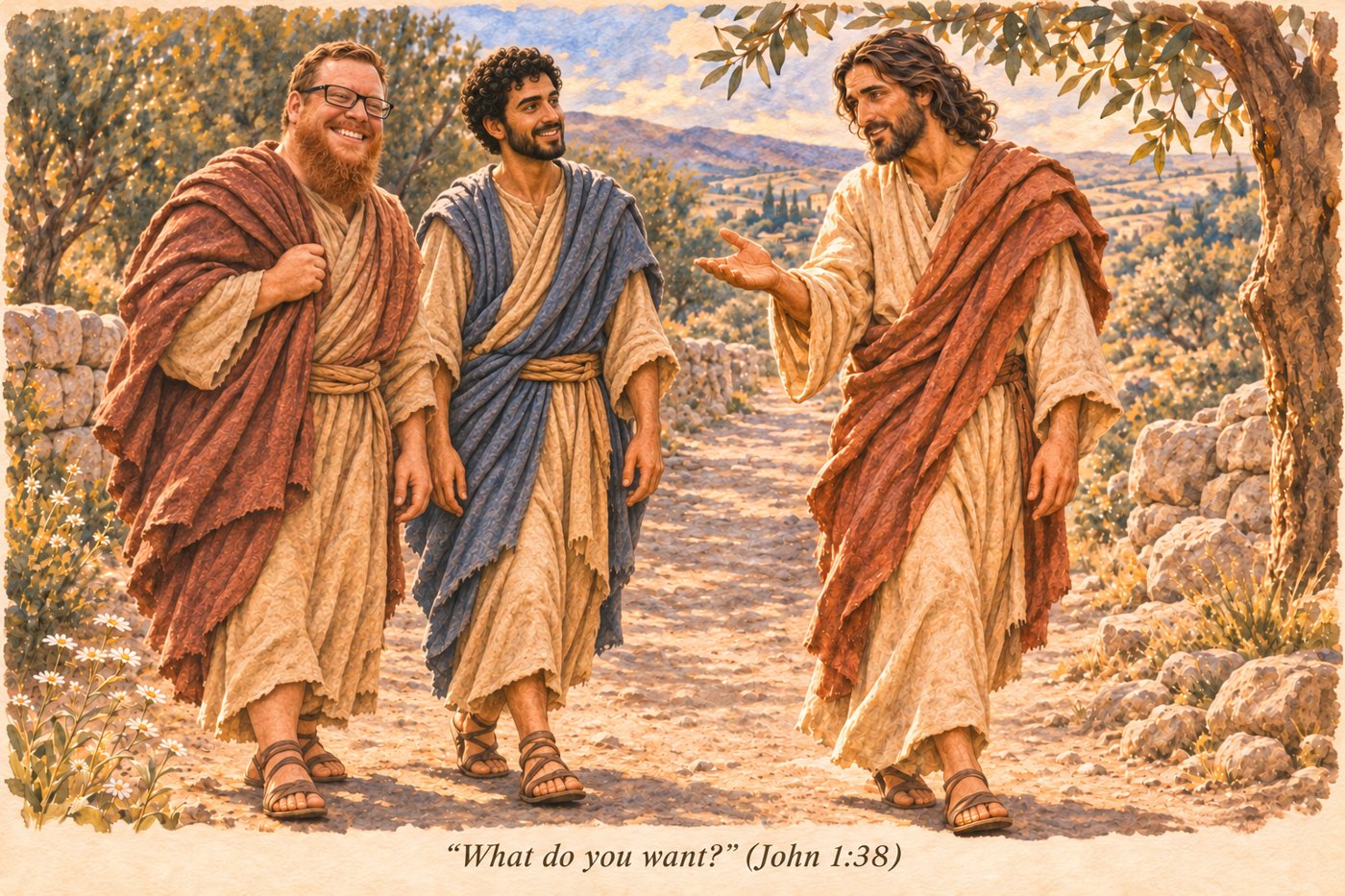
It’s a question you have to answer, and one you have to be ready to answer when people ask why you follow Jesus. What do you want out of life? What do you want to be known for? What do you want people to say at your funeral? Where do you find meaning, freedom, and peace?
The disciples kicked the can down the road. “Where are you staying?” And Jesus said three words that I believe shape the whole book of John:
“Come,” he replied, “and you will see.”John 1:39
That’s the second observation: Jesus gives spiritual sight. John writes in the simplest words, about a fourth-grade level, but full of double meaning. Over and over he tells about someone who can’t see physically, and then about people who can’t see spiritually. They don’t understand who God is, who they are, or the condition of their hearts. Then their eyes are opened. These two spent the evening with Jesus, from about four in the afternoon, and probably all night. Wouldn’t you love to have been at that campfire? By morning their lives had changed.
A new name
The first thing Andrew did was find his brother Simon. “We have found the Messiah.” And he brought him to Jesus. Jesus looked at him and said, essentially, Nice to meet you, Simon. I’m not going to call you Simon anymore. You’ll be called Cephas, Peter.
Imagine if I met our pastor Brandon for the first time and said, “Hey, Brandon, nice to meet you. By the way, I’m going to call you Rob from now on.” Brandon would say, “What’s your deal, man?” But Jesus saw something Simon couldn’t see. He named the person he had created him to be. Not a perfect person. A messy person who would fail, get back up, succeed, and fail again, and still hear, “Well done.”
So here’s the third observation: Jesus has the authority to change your identity, when you meet him and over and over as you walk with him.
When I ask who you are, most of us start with what we do for a living. I’ve worked in churches since my freshman year of college. I don’t have any other appreciable skills, if this one even counts. But “preacher” isn’t who I am. I’m a Christ follower, a husband, a father, a grandfather. Being a pastor is very important to me, but it’s not who I am.
So every morning we begin again: Lord, my life belongs to you. Who am I today? When you retire. When you’re fired. When a decision is in front of you. He knew you in your mother’s womb (Psalm 139:13–16), and his plans for you are specific to you. You find them only through Jesus.
Follow me
The next day Jesus found Philip and said, “Follow me.” That’s the fourth observation: Jesus has the authority to invite you to follow him. One of the most dangerous things any pastor or leader can do is get you following a person. People will always let you down. The longer you live in relationship with people, the more you find that they disappoint. You might follow someone who is following Jesus. But only Jesus never disappoints.
Can anything good come from Nazareth?
Philip, from Bethsaida like Andrew and Peter, found Nathanael. “We have found the one Moses wrote about in the Law… Jesus of Nazareth, the son of Joseph.” They’re all trying to describe him, and they don’t quite have it yet. I love that these guys didn’t know John was writing everything down. They aren’t using church words. They’re a little rough and raw. They’re just like us.
Nathanael said, “Nazareth! Can anything good come from there?” And Philip didn’t argue. He said, “Come and see.”
A come-and-see faith
That’s the challenge for you and me: to live a come-and-see kind of faith. It takes humility, transparency, vulnerability, and truth. If you want to look better than you are, or holier than you are, please don’t get involved in come-and-see.
The facts of the gospel matter. Jesus is God. He was born, lived a perfect life, died for our sins, rose again, and ascended. Our faith is built on those facts. In Bible college and seminary they taught us to present them almost like a sales pitch, and how to win the argument. But I’ve shared my faith with a lot of people over the years, and I’ve never debated one person into the kingdom. Following Jesus is shared life to life. It has to be seen, sensed, and felt, not just heard and learned.
And if you aren’t real great at being a Christian, join the club. Don’t compare yourself to the people around you. Compare yourself to Jesus. When I do that, I’m not very good at this. But I’m following. Just like Peter, I’m going to fail, and I’m going to get back up.
No secrets
When Jesus met Nathanael, he told him things about himself that no one could have known (John 1:47–49). And that’s the last observation: with Jesus, there are no secrets.
The last time I dated anybody besides my wife was 1988, before dating apps. (I still date my wife.) Now you swipe right and build profiles. If I had to make one, I’d put my best foot forward. I’d get the lighting right, make sure the glare isn’t coming off my head, and hide every red flag I have. Then if I finally met somebody, I’d hope there was enough good to outweigh everything else that comes along with Rick.
Or maybe we should put all the bad stuff right up front: a red-flag page. Click here to see all my quirks, peculiarities, and weirdness. If somebody makes it through that, you know it’s going to be a good first date. I don’t know. But here’s my point.
Jesus already knows your red flags. He knows the good, the bad, the dirty, the disappointing. You don’t have to wait for the other shoe to drop. He knows, he sees, and he loves you and accepts you anyway.
What’s a pepita?
One more thing happened on that drive. It was the first time Lia and I had spent that much time together one on one, and I was trying to make a good impression. My son Nathan had given me the rules before we left: “Dad, don’t grill her. Don’t ask her any Bible questions.” I told him, “I’m not going to do that, Nate. I’m a normal person.” Somewhat.
So I was on my best behavior when she looked up from the snack bag, studying the package very carefully, and asked, “What’s a pepita?”
“I don’t know, Lia. I just eat them.”
“Well, do you like them?”
I had no idea. I said, “Lia, I may have been eating something I don’t even like this whole time. I didn’t even know it was in there. You better Google it.” So she Googled it. “Oh, it’s a pumpkin seed.” Awesome. It’s just a pumpkin seed. I guess “pumpkin seed” was too many letters to fit on the front of the package.
(When I asked our church who knew what a pepita was, a bunch of hands went up. You all are so much smarter than me.)
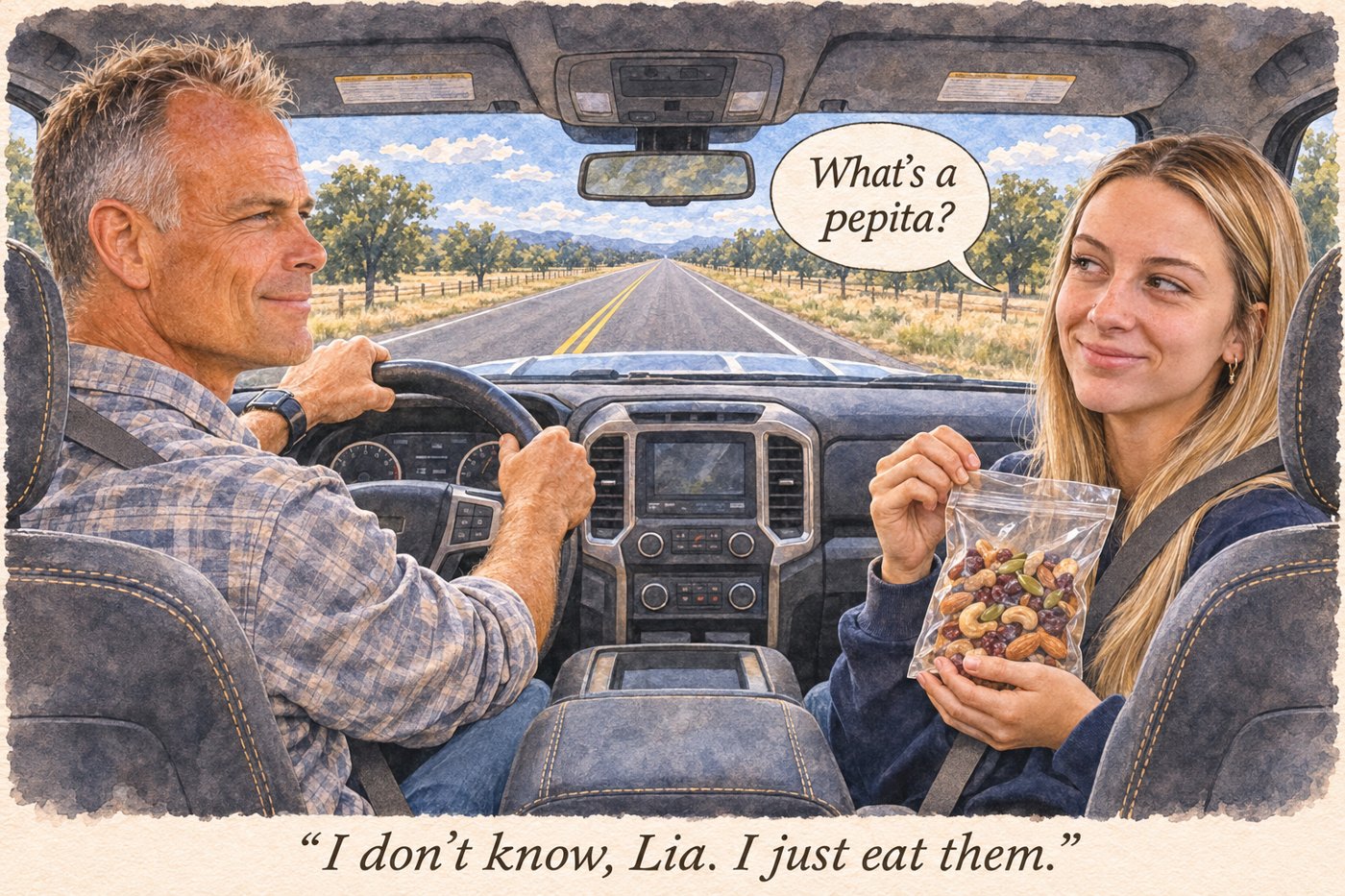
My point: when you read John, you’re going to find things like that. Things you didn’t know were in there, and things you’ll want to look up. Some of you have been taking it in on Sunday and throwing the wrapper away the rest of the week. Not this week.
Talk It Over
- Rick gulps his snacks; Joy and Lia pour them into their hands and look at each piece. Which are you? Psalm 119:105 calls God’s Word “a lamp for my feet.” What would change if you read the Bible, or anything that matters, the slow way?
- Two strangers were tailing Jesus down a road. He turned around and asked, “What do you want?” (John 1:38). If someone you respect asked you that tonight and really waited, what would you say? What would you be tempted to say instead?
- Uncle Ray prayed for one choice at a time. Proverbs 3:5–6 promises that if we trust God instead of our own understanding, he will “make your paths straight.” Does one-choice-at-a-time sound like relief to you, or like a cage? Why?
- The first time Jesus met Simon, he gave him a new name, Peter, meaning “rock” (John 1:42), long before Simon acted like one. What label have you carried around for years? What do you hope Jesus would call you instead?
- Nathanael was shocked when Jesus described him before they’d ever met (John 1:47–49). Imagine a dating profile with a “red flags” page up front. What would be on yours? How does it feel that Jesus has read it and is still interested?
Find Yourself · Find Someone Close
Which person in John 1:35–51 is most like you right now? The two following at a distance? Andrew, running to get his brother? Peter, getting a new name? Philip, simply told “Follow me”? Or Nathanael, arms crossed, asking, “Can anything good come from there?”
Who in your life is a Nathanael, skeptical and honest, wondering whether anything good could come out of church? Don’t argue with them this week. What would it look like to just say, “Come and see”?
This Week
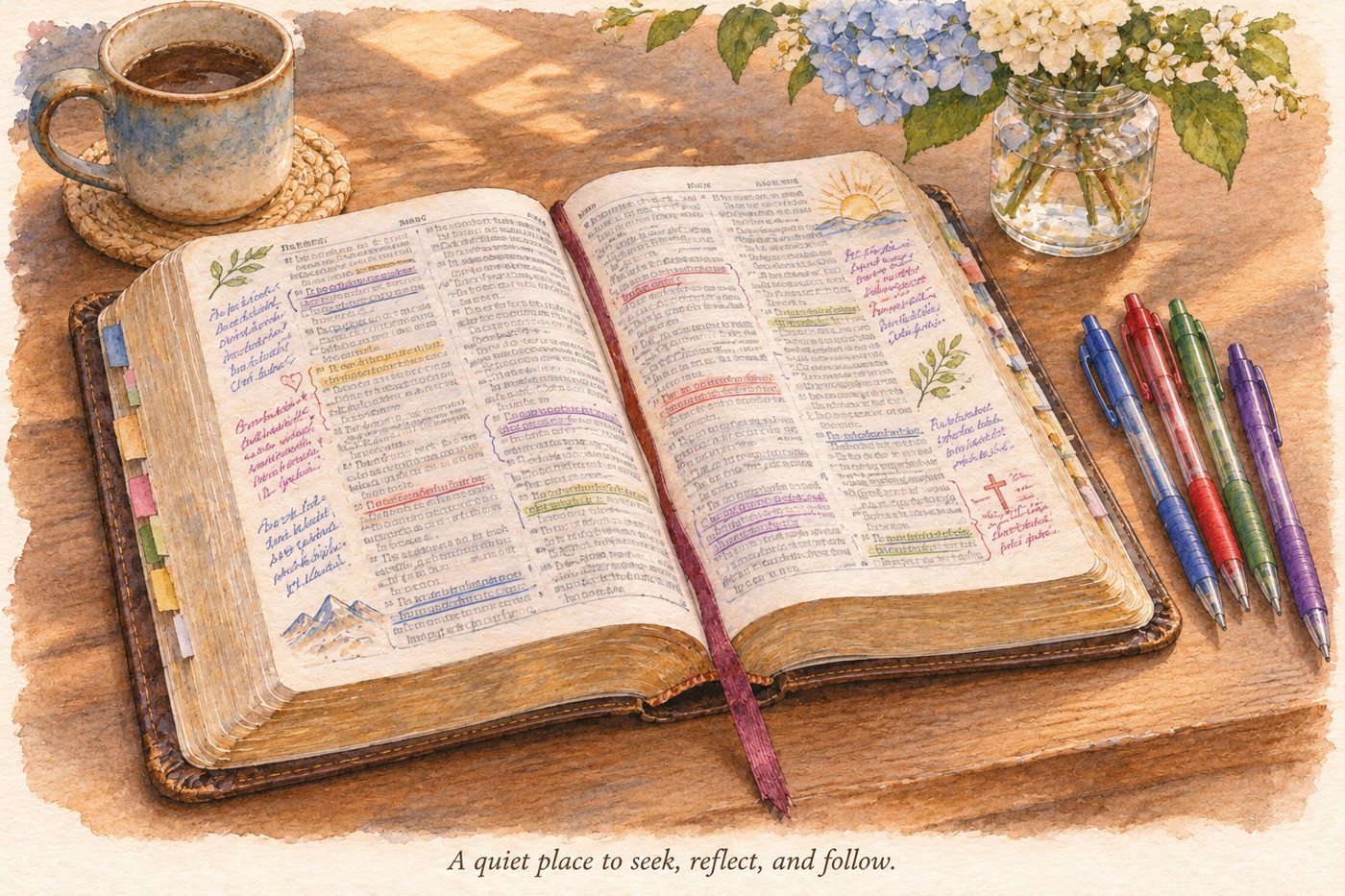
Read the whole Gospel of John, at least once. Pick your favorite story or miracle, the one the Holy Spirit connects to your life right now, and write down why. Then pick the story that best fits someone in your inner circle. Look for a chance to share it with them and tell them why.